Court Quashes Tax Reference, Mandates Speaking Order for Transfer Pricing Cases


Full News

Court Quashes Tax Reference, Mandates Speaking Order for Transfer Pricing Cases
Court Quashes Tax Reference, Mandates Speaking Order for Transfer Pricing Cases
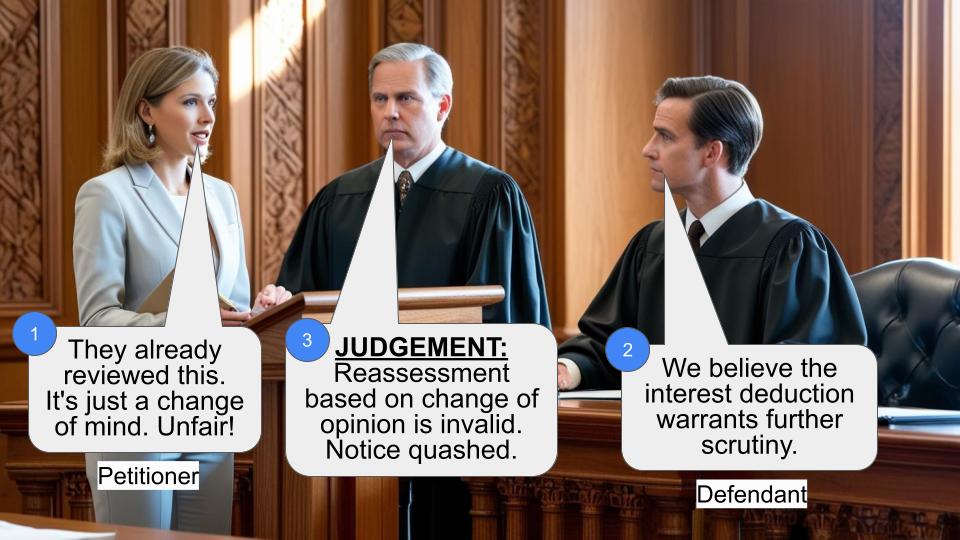
This case involves Alpha Nipon Innovatives Ltd. challenging a reference made by the Assessing Officer to the Transfer Pricing Officer (TPO) without providing a proper opportunity to the assessee to object. The High Court ruled in favor of the assessee, quashing the reference and directing the Assessing Officer to pass a speaking order after considering the assessee's objections.
Get the full picture - access the original judgement of the court order here
Case Name:
Alpha Nipon Innovatives Ltd. vs Deputy Commissioner of Income Tax & Anr. (High Court of Gujarat)
Special Civil Application No. 7720 of 2016
Date: 16th November 2016
Key Takeaways:
1. Assessing Officers must give assessees a chance to object before referring to TPO.
2. A speaking order is mandatory when making a TPO reference.
3. CBDT Instruction No.3/2016 dated 10th March, 2016, is crucial in such cases.
4. Courts prioritize procedural fairness in tax assessment processes.
Issue:
Was the Assessing Officer required to provide an opportunity to the assessee to object and pass a speaking order before making a reference to the Transfer Pricing Officer?
Facts:
1. The Assessing Officer made a reference to the Transfer Pricing Officer regarding the assessee's case.
2. The assessee claimed this was done without giving them a chance to object or passing a speaking order.
3. The assessee had reportedly entered into specified domestic transactions but didn't file the accountant's report under Section 92E (of Income Tax Act, 1961).
4. There was a dispute about a transaction amounting to Rs.3,59,80,168/- with a relative.
5. The assessee later claimed this was a mistake by their Chartered Accountant.
Arguments:
Assessee's Arguments:
- The Assessing Officer violated CBDT Instruction No.3/2016 by not allowing objections or passing a speaking order.
- The transaction in question was mistakenly reported and doesn't qualify as a transaction with a relative.
Revenue's Arguments:
- The assessee admitted to specified domestic transactions without filing the required report under Section 92E (of Income Tax Act, 1961).
- The assessee is trying to backtrack from their initial admission about the transaction with a relative.
Key Legal Precedents:
1. CBDT Instruction No.3/2016 dated 10th March, 2016: This instruction requires Assessing Officers to allow objections and pass speaking orders before TPO references.
2. Indorama Synthetics (India) Ltd. v. Additional Commissioner of Income Tax, [(2016) 71 Taxmann.com 349 (Delhi)]: This case was cited by the assessee's advocate, likely supporting the need for procedural fairness in such matters.
Judgement:
1. The court quashed and set aside the reference made by the Assessing Officer to the TPO.
2. The matter was remitted back to the Assessing Officer with instructions to:
a) Consider the assessee's objections (treating the communication dated 22.1.2016 as objections).
b) Pass a speaking order while making a reference to the TPO.
3. This process should be completed within four weeks.
4. The assessee agreed not to raise the issue of limitation if a new reference is made after following proper procedure.
FAQs:
1. Q: What is a "speaking order"?
A: A speaking order is a detailed, reasoned decision that explains the rationale behind an administrative action. It ensures transparency and allows for proper review if challenged.
2. Q: What is the significance of CBDT Instruction No.3/2016?
A: This instruction mandates that Assessing Officers must allow assessees to object and must pass speaking orders before referring cases to Transfer Pricing Officers.
3. Q: Does this judgment apply to all tax cases?
A: While it specifically addresses transfer pricing cases, the principle of procedural fairness could be applied more broadly in tax matters.
4. Q: What happens if the Assessing Officer still decides to refer the case to the TPO after following the proper procedure?
A: The assessee agreed not to challenge on grounds of limitation if a new reference is made after following the correct procedure.
5. Q: How does this judgment impact taxpayers?
A: It reinforces taxpayers' rights to be heard and receive reasoned decisions in transfer pricing cases, potentially leading to fairer assessments.

1. Rule. Mrs. Mauna N. Bhatt, learned advocate waives service of notice of rule on behalf of the respondents. In the facts and circumstances of the case and with the consent of the learned advocates appearing for the respective parties, the present petition is taken up for final hearing today.
2. By way of this petition under Article 226 of the Constitution of India, the petitioner has prayed for an appropriate writ, order or direction to quash and set aside/cancel the reference made by the Assessing Officer to the Transfer Pricing Officer (for short “TPO”).
3. The main grievance which is voiced in the present petition is that despite the specific instructions issued by the CBDT issued vide Instruction No.3/2016 dated 10th March, 2016, by which, before making a reference to the TPO, the Assessing Officer is required to deal with the objection raised by the petitioner assessee and is required to pass a speaking order. In the present case, the Assessing Officer has made a reference to the TPO without passing any speaking order on the objection raised by the petitioner – assessee.
4. Mr. R. K. Patel, learned advocate appearing on behalf of the petitioner – assessee has heavily relied upon para 3.4 and para 7 of the instructions issued by the CBDT vide Instruction No.3/2016 dated 10th March, 2016. Learned advocate for the petitioner – assessee has also heavily relied upon the decision of the Delhi High Court in the case of Indorama Synthetics (India) Ltd. v. Additional Commissioner of IncomeTax, [(2016) 71 Taxmann.com 349 (Delhi)].
5. Mr. M. R. Bhatt, learned advocate appearing on behalf of the revenue relying upon para 3.3 of the Instruction No.3/2016 dated 10th March, 2016, has tried to oppose the objection by submitting that, in the present case, admittedly, the assessee though entered into specified domestic transactions but did not file the accountant's report under Section 92E (of Income Tax Act, 1961), the Assessing Officer has rightly made a reference to the TPO. It is also submitted that, even in the reply to the notice dated 12.1.2016, the assessee specifically admitted that it entered into the transaction amounting to Rs.3,59,80,168/ as the transaction have been entered into with the relative. However, subsequently the assessee wants to back out from the same.
6. On the other hand, it is the case on behalf of the assessee that the aforesaid was a mistake on the part of the Chartered Accountant, and, according to the assessee, the aforesaid transaction does not amount to any transaction with the relative and, therefore, Section 92E (of Income Tax Act, 1961) shall not be attracted.
7. Having heard the learned advocates for the respective parties and considering the material on record, it is an undisputed fact that no speaking order has been passed by the Assessing Officer while making a reference to the TPO, which is a requirement as per the Instruction No.3/2016 dated 10th March, 2016, issued by the CBDT. Before making a reference to the TPO, the assessee is required to be given an opportunity to showcause why the reference may not be made to the TPO and thereafter a speaking order is required to be passed by the Assessing Officer while making a reference to the TPO.
8. Under the circumstances, on the aforesaid ground alone, the impugned reference made by the Assessing Officer to the TPO deserves to be quashed and set aside and the matter is required to be remanded to the Assessing Officer to pass a speaking order while making a reference to the TPO. For that purpose, as agreed between the learned advocates for the respective parties, the communication of the reply dated 22.1.2016 be treated as objection raised by petitioner – assessee against making a reference to the TPO. At this stage, Mr. M. R. Bhatt, learned advocate appearing on behalf of the revenue has apprehended that if the matter is remanded and the Assessing Officer is required to pass a fresh speaking order by making a reference to the TPO (after considering the objection submitted by the petitioner – assessee) that a question with respect to limitation may arise.
9. To the aforesaid, Mr. R. K. Patel, learned advocate appearing on behalf of the petitioner – assessee has stated at the Bar that, if the matter is remanded to the Assessing Officer for passing a fresh order while making a reference to the TPO (after considering the objection raised by the petitioner – assessee) and thereafter the reference is made to the TPO, the petitioner – assessee shall not raise issue/question with respect to limitation.
10. In view of the above and for the reasons stated above, on the aforesaid ground alone, the impugned reference made by the Assessing Officer to the TPO is hereby quashed and set aside and the matter is remitted to the Assessing Officer to pass a speaking order while making a reference to the TPO (after considering the objection raised by the petitioner – assessee). Such exercise shall be completed within a period of four weeks from today. As agreed by learned advocate Mr. R. K. Patel appearing on behalf of the petitioner – assessee, if, on remand, after considering the objection raised by the petitioner – assessee, a speaking order is passed and the Assessing Officer forms an opinion that reference is to be made to the TPO, the petitioner – assessee shall not take a plea of limitation. Rule is made absolute to the aforesaid extent. No costs.
(M.R. SHAH, J.)
(B.N. KARIA, J.)
×