


Court Quashes Income Tax Reassessment Notices for SEZ Firm with 100% Tax Exempt…


Full News

Court Quashes Income Tax Reassessment Notices for SEZ Firm with 100% Tax Exemption
Court Quashes Income Tax Reassessment Notices for SEZ Firm with 100% Tax Exemption
This is interesting case about a jewelry company called Sajani Jewels. They're based in a Special Economic Zone (SEZ) and enjoy 100% tax exemption. The Income Tax Department tried to reopen their assessment, claiming they made some bogus purchases. But the High Court said, "Not so fast!" and quashed the reassessment notices. Let's dive into the details, shall we.
Get the full picture - access the original judgement of the court order here
Case Name:
Sajani Jewels Vs Deputy Commissioner of Income Tax (High Court of Gujarat)
Special Civil Application No. 17935, 17936 and 17937 of 2015
Date: 9th June 2016
Key Takeaways:
1. The court emphasized that reopening an assessment requires independent decision-making by the Assessing Officer.
2. Even if bogus purchases are proven, it wouldn't result in additional tax liability for a company with 100% tax exemption under Section 10AA (of Income Tax Act, 1961).
3. The court clarified that Section 69C (of Income Tax Act, 1961) doesn't apply in cases where the source of expenditure is known.
Issue:
Can the Income Tax Department reopen an assessment for a company enjoying 100% tax exemption under Section 10AA (of Income Tax Act, 1961), based on allegations of bogus purchases?
Facts:
- Sajani Jewels is a partnership firm making and exporting diamond-studded jewelry.
- Their manufacturing unit is in a Special Economic Zone (SEZ).
- For the 2008-09 assessment year, they claimed a tax exemption of about ₹3.87 crores under Section 10AA (of Income Tax Act, 1961).
- Initially, the tax officer denied this exemption, but Sajani Jewels won their appeal at the Tribunal level.
- Later, based on a search operation involving one Bhanwarlal Jain, the tax department alleged that Sajani Jewels made bogus purchases of ₹90.17 lakhs from a company called Meridian Gems.
- The tax department issued a notice to reopen the assessment on March 27, 2015.
Arguments:
Sajani Jewels said:
1. The tax officer didn't apply her mind independently and just copied the investigation wing's findings.
2. They didn't hide any information during the original assessment.
3. Even if the purchases were bogus, it wouldn't change their tax liability because they're 100% tax-exempt anyway.
The tax department argued:
1. The officer did examine the evidence independently before reopening the case.
2. Sajani Jewels didn't disclose these alleged bogus transactions earlier.
3. The additional income from these transactions wouldn't qualify for tax exemption.
Key Legal Precedents:
The court referred to several cases, including:
- Pr. Commissioner of Income Tax-4 v. G & G Pharma India Ltd. (Delhi High Court)
- Joint Commissioner of Income-Tax v. George Williamson (Assam) Ltd. (258 ITR 126 Gauhati)
- Baijnath Saboo and others v. Income-Tax Officer, 'J' Ward, and others (113 ITR 303)
- Essex Farms P. Ltd. v. Commissioner of Income-Tax, Delhi (157 ITR 241)
- Fakir Mohmed Haji Hasan v Commissioner Of Income-Tax (247 ITR 290)
- Yogendrakumar Gupta v. Income-Tax Officer (366 ITR 186)
Judgement:
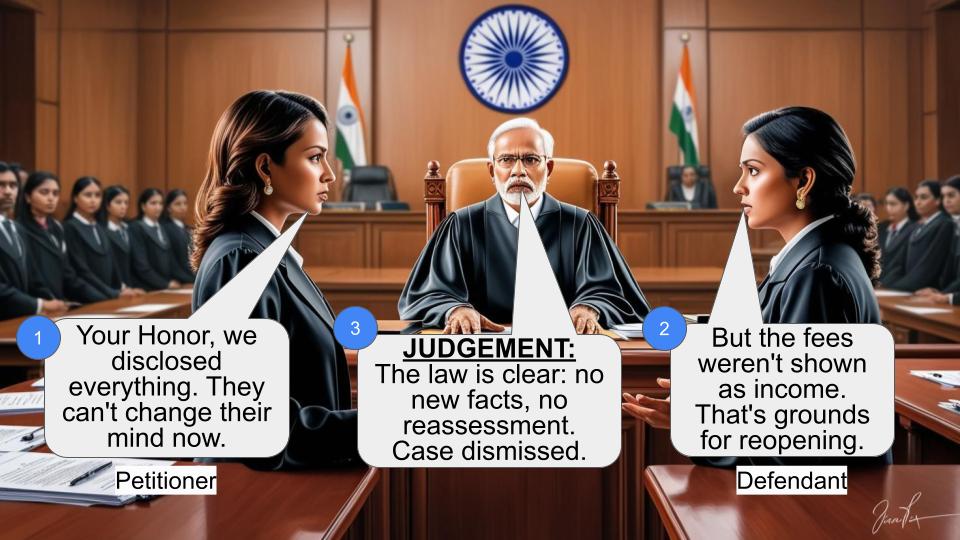
The court sided with Sajani Jewels and quashed the reassessment notices. Here's why:
1. They found that the tax officer did apply her mind independently when issuing the notice.
2. However, even if the bogus purchases were proven, it would only increase Sajani Jewels' profit, which is already 100% tax-exempt under Section 10AA (of Income Tax Act, 1961).
3. The court rejected the tax department's argument that this additional income should be treated as "income from other sources" under Section 69C (of Income Tax Act, 1961).
FAQs:
1. Q: What's the main takeaway from this case?
A: Even if a company with 100% tax exemption is found to have made bogus purchases, it may not result in additional tax liability.
2. Q: Does this mean companies in SEZs can make bogus purchases without consequences?
A: Not at all! This case only deals with tax reassessment. Other legal consequences could still apply.
3. Q: What's Section 10AA (of Income Tax Act, 1961)?
A: It's a provision that allows 100% tax exemption for businesses in Special Economic Zones under certain conditions.
4. Q: Why didn't Section 69C (of Income Tax Act, 1961) apply here?
A: Section 69C (of Income Tax Act, 1961) deals with unexplained expenditure. In this case, the source of the expenditure (cheque payments) was known, so it didn't apply.
5. Q: Could the tax department appeal this decision?
A: Potentially, yes. They could try to appeal to a higher court if they believe there are grounds to do so.

1. These petitions arose in similar background. They have been heard together and would be disposed of by this common judgment. For convenience, facts may be noted from Special Civil Application No.17935 of 2015. Petitioner is a partnership firm and is engaged in the business of manufacturing and export of diamond studded jewelery. Petitioner's manufacturing unit is situated in the Special Economic Zone and the entire export income is exempt from tax under section 10AA (of Income Tax Act, 1961) ('the Act' for short).
2. For the assessment year 200809, the petitioner filed its return of income on 10.08.2008, declaring nil income after claiming exemption of Rs.3.87 Crores (rounded off) under Section 10AA (of Income Tax Act, 1961). The return of the assessee was taken in scrutiny. The Assessing Officer framed the assessment on 28.12.2010 denying the exemption under section 10AA (of Income Tax Act, 1961) as claimed by the petitioner. The petitioner challenged the order of assessment before the Commissioner (Appeals), who dismissed the appeal by order dated 14.09.2011. The petitioner's further appeal to Tribunal was however, allowed by an order dated 20.07.2012. The entire exemption under section 10AA (of Income Tax Act, 1961) was granted. We are informed that the Revenue challenged such order of the Tribunal in Tax Appeal No.898 of 2012, which was dismissed on 06.03.2013.
3. To reopen the scrutiny assessment previously framed, the Assessing Officer issued impugned notice dated 27.03.2015. She supplied to the assessee the reasons recorded by her for issuing the notice. Such reasons read as under:
“In this case, a search and seizure action was initiated in the premises of Bhanwarlal Jain and Family on 11.10.2013 wherein the statement of shri Bhanwarlal Jain was recorded on oath. In the said statement, shri Jain had elaborated the modus operandi of providing accommodation entries to the entities / individuals through a number of bogus concerns controlled either by him or his close associates who were only namesake proprietors/partners/directors. The said concerns were providing bogus sale entries (Purchase entry to the beneficiary entitles) for which they used to receive cheque. After that, cash was paid to the beneficiary entities after deducting commission etc. He had also provided a list of the said bogus concerns wherein the name Maridian Gems has been appeared. Such dummy partners' statement on oath was also recorded who have admitted that they were only namesake partners/ directors/ proprietors. The said information has been received from the DIT (Inv)II, Mumbai vide letter No.DIT (Inv)II/Information/BLJ/SAL/201415/305 dated 16.7.2014. It has come to notice that the assessee has accepted bogus accommodation entries for purchase of Rs.90.17 Lacs from Maridian Gems in A.Y. 20082009 to inflate purchases. This information was not available at the time of passing the original assessment order. Further the statements of Bhanwarlal Jain and other associated persons were also not available with the Department which is crucial documentary proof of such bogus entry. Hence, entire bogus accommodation entries of the said purchases have escaped assessment.
Thus, the assessee has accommodated bogus entires of above said purchases, which cannot be allowed. Thus, in the case of the assessee, income to that extent has escaped assessment on account of bogus accommodation entries of purchases.
In view of the above facts, I have reason to believe that income of Rs.90,17,059/ chargeable to tax has escaped assessment within the meaning of section 147 (of Income Tax Act, 1961), on account of failure on the part of the assessee to disclose fully and truly all material facts and necessary for his assessment for A.Y.200809.”
4. The petitioner objected to process of reopening of assessment under communication dated 31.07.2015. Such objections were however, rejected by the Assessing Officer by an order dated 10.09.2015.
5. On the basis of such facts, learned counsel for the petitioner raised following contentions.
I. The reasons recorded by the Assessing Officer do not demonstrate any independent application of mind by her. Such reasons mechanically adopt the exercise undertaken by the investigating wing of Income tax department. In support of this contention, counsel relied upon following decisions.
• In case of Pr. Commissioner of Income Tax4 v. G & G Pharma India Ltd., passed by Hon'ble Delhi High Court in ITA No.545 of 2015.
• In case of Joint Commissioner of IncomeTax v. George Williamson (Assam) Ltd., reported in 258 ITR 126 (Gauhati).
II. There was no failure on the part of the assessee to disclose truly and fully all material facts and that therefore, reopening of assessment beyond a period of four years from the end of relevant assessment year was not permissible.
III.In any case, there is no escapement of income. The assessee enjoyed 100% exemption under section 10AA (of Income Tax Act, 1961). Therefore, even if the Revenue's theory of bogus purchases by the assessee is established, the same can only result into disallowance of business expenditure, thereby increasing the assessee's profit. This in any case would have no tax implication since even such additional income would be exempt under section 10AA (of Income Tax Act, 1961). In support of this contention, counsel relied upon following decisions.
• In case of Baijnath Saboo and others v. Income- Tax Officer, 'J' Ward, and others, reported in 113 ITR 303
• In case of Essex Farms P. Ltd. v. Commissioner of IncomeTax, Delhi reported in 157 ITR 241
6. On the other hand, learned counsel Shri Sudhir Mehta opposed the petition contending that;
I. The Assessing Officer had examined the entire report of the investigation wing and the statements of relevant witnesses and had independently come to the conclusion that there was sufficient material on record before forming a belief that income chargeable to tax had escaped assessment.
II. There was total non disclosure on part of the assessee of the illicit transactions of bogus purchases. Reopening of assessment even beyond period of four years from the end of relevant assessment year would therefore, be permissible.
III. Counsel contended that additional income arising out of such bogus transactions would not qualify as business income and therefore, would not be exempt under section 10AA (of Income Tax Act, 1961). He submitted that as held by this court in this case of Fakir Mohmed Haji Hasan v Commissioner Of IncomeTax, reported in
247 ITR 290, such income would be income from other sources. Counsel relied on section 69C (of Income Tax Act, 1961) in this context. Counsel contended that it is the satisfaction of the Assessing Officer whether income chargeable has escaped assessment. At the stage of notice for reopening what is required is material, primafacie suggesting escapement of income. In this context, the Counsel also relied on the decision of Division Bench of this Court in case of Yogendrakumar Gupta v. Income- Tax Officer, reported in 366 ITR 186.
7. Regarding the first contention of the counsel for the petitioner, we have perused the reasons recorded by the Assessing Officer for issuing notice for reopening. We have also perused the original file produced by the department. Relevant documents from the file were also shown to the counsel of the petitioner. In the reasons recorded itself, the Assessing Officer has noted that search and seizure action was initiated in the premises of one Bhanwarlal Jain and other family members on 11.10.2013, during which, statement on oath of Bhanwarlal Jain was recorded. In such statement, he had disclosed elaborative method of providing recognition entries to various individuals and entities through number of bogus concerns. Such concerns would provide bogus sale entries to the socalled purchasers. The sale consideration would be received in cheque. The seller would return the cash amount to the purchaser after retaining commission. Bhanwarlal Jain had also provided list of such bogus entities, one of them being Meridian Gems. The reasons further record that the assessee had also accepted bogus accommodation entries for purchase of goods worth Rs.90.17 lacs from said Meridian Gems in order to inflate the purchases.
8. We notice that under letter dated 16.07.2014, the investigation wing of the income tax department had placed the entire report of said investigation alongwith important documents such as the statement of Bhanwarlal Jain and other witnesses whose statements were recorded. If after perusal of such documents, the Assessing Officer recorded the reasons, gist of which is noted above, in our opinion, it cannot be stated that these reasons were not those of the Assessing Officer and merely amounted to mechanical reproduction of the exercise undertaken by the investigation wing of the Income tax department. It is undoubtedly true that the reasons to be recorded before issuance of notice of reopening have to be those of the Assessing Officer alone. This however, does not mean that the Assessing Officer cannot rely on the exercise undertaken by other wings of the Government departments, if the material so collected through inquiry or investigation provides primafacie information, a tangible material; which enables the Assessing Officer to form a belief that income chargeable to tax has escaped assessment. There is nothing to prevent the Assessing Officer from recording such satisfaction and to proceed to issue notice for reopening. An independent decision by the Assessing Officer to enable her to come to the conclusion that income chargeable to tax has escaped assessment is sinequanon for reopening an assessment. This would undoubtedly require application of mind on her part when certain materials collected by some other wing of the department is placed before her. There can however be no straightjacket formula of the manner in which, mind can be applied or shown to have been applied. The same may be gathered from the reasons recorded and other contemporaneous material on record. In this context, we are satisfied that it was the decision of the Assessing Officer, based on the materials collected by the investigation wing that she recorded the reasons to form a belief that income chargeable to tax had escaped assessment, which led her to issue notice of reopening.
9. The second contention of the counsel for the petitioner that there was no failure on the part of the assessee to disclose truly and fully all material facts, must meet with summary rejection. There is sufficient primafacie material on record that the assessee had made bogus purchases through the web of entities created by Bhanwarlal Jain. Obviously such facts were not on record during the original assessment proceedings.
10. This brings us to the last contention of the petitioner. We may recall, the argument is that in any case, the entire income of the assessee being tax exempt, even if the stand of the department as reflected in the reasons recorded is correct and ultimately established, there would be no additional tax burden on the petitioner. To put it simply, the question being posed is where is the escapement of income chargeable to tax ?
11. In this context, we may revisit the modus operandi adopted by the petitioner as alleged by the department. According to the department, the petitioner had shown purchases of goods worth Rs.90.17 lakhs from one of the bogus entities created by Bhanwarlal Jain. There was no genuine purchase. All that was done was that the assessee had paid such amount in cheque without making any purchases. The seller after receiving such amount, would return substantial portion thereof in cash retaining his commission. This circuitous route would ensure that cost of purchases made by the assessee would be artificially inflated, thereby deflating the profit. In that view of the matter, even if the department is correct, all that would be done even if the assessment is permitted, is to disallow the expenditure of Rs.90.17 lacs. Correspondingly, the income of the assessee would increase by the said sum of Rs.90.17 lacs. However, if the entire income is exempt under section 10AA (of Income Tax Act, 1961), there would be still no tax implication. With this background in mind, we had noted the history of petitioner's claim for exemption under section 10AA (of Income Tax Act, 1961) while recording facts. The assessee having succeeded upto High Court level in establishing such claim, we must proceed on such basis.
12. The result of this exercise would be that even if the expenditure of the so called bogus purchases is disallowed, the only effect it could have is to increase the profit of the assessee which in any case is exempt under section 10AA (of Income Tax Act, 1961). Section 147 (of Income Tax Act, 1961) would be applicable where the Assessing Officer has reason to believe that income chargeable to tax has escaped assessment. When this fundamental requirement fails, power of reopening cannot be exercised. We are unable to appreciate the argument of the counsel for the Revenue that such income would not qualify as business income and that it should be treated as income from other sources by applying section 69C (of Income Tax Act, 1961). This section pertains to unexplained expenditure and provides that where, in any financial year, an assessee has incurred any expenditure and he offers no explanation about the sources of such explanation or part thereof or the explanation offered is not satisfactory, the amount covered by such expenditure or the part, as the case may be, would be deemed to be the income of the assessee for such financial year. The present is not a case where the assessee has incurred expenditure, but failed to offer explanation about the source of such expenditure. The source of expenditure in question was very much available since in the reasons recorded itself, the Assessing Officer points out that the purchases were made by making cheque payments. Section 69C (of Income Tax Act, 1961) therefore has no applicability.
13. In the result, all petitions are allowed. Respective impugned notices for reopening of assessment are quashed. Petitions disposed of.
(AKIL KURESHI, J.)
(A.J. SHASTRI, J.)
×
Similar Ripples
Questions
Court Quashes Income Tax Reassessment Notices for SEZ Firm with 100% Tax Exemption
Write your CommentSimilar Posts


Generic
- Reportdata/2783.pdf
