


Tax Appeal Dismissed: Court Upholds Application of Section 14A (of Income Tax A…


Full News
Tax Appeal Dismissed: Court Upholds Application of Section 14A (of Income Tax Act, 1961) and Rule 8D (of Income Tax Rules, 1962) in Dividend Income Case
Tax Appeal Dismissed: Court Upholds Application of Section 14A (of Income Tax Act, 1961) and Rule 8D (of Inco…
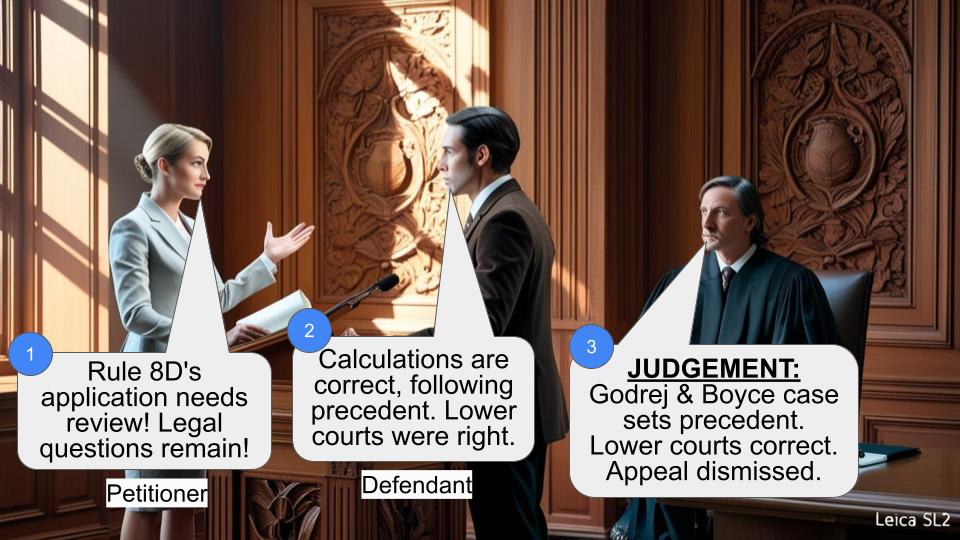
The Commissioner of Income Tax (that's the tax department) went up against India Advantage Securities Ltd. The main issue was about how to calculate expenses related to earning dividend income. Long story short, the court sided with the company and dismissed the tax department's appeal. They basically said, "Nope, the lower authorities got it right.
Get the full picture - access the original judgement of the court order here
Case Name:
Commissioner of Income Tax Vs India Advantage Securities Ltd. (High Court of Bombay)
Income Tax Appeal No. 1131 of 2013
Date: 13th April 2015
Key Takeaways:
1. The court confirmed that Section 14A (of Income Tax Act, 1961) and Rule 8D (of Income Tax Rules, 1962) were correctly applied in this case.
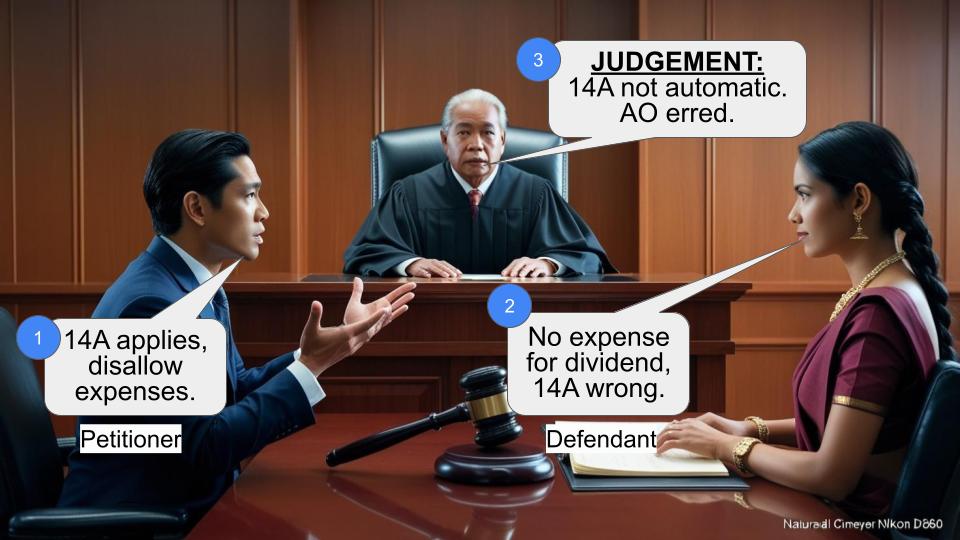
2. They emphasized that you can't just disallow any old expenses - only those actually incurred for earning dividend income should be considered.
3. The court showed that they're not keen on entertaining appeals on factual issues or questions already settled by previous judgments.
Issue:
The main question here was: Did the lower authorities (the Commissioner of Income Tax (Appeals) and the Tribunal) correctly apply Rule 8D(ii) (of Income Tax Rules, 1962) when calculating the expenses to be disallowed for earning dividend income?
Facts:
1. The Assessing Officer initially made some calculations about expenses related to dividend income.
2. The company wasn't happy with this and appealed to the Commissioner of Income Tax (Appeals).
3. The Commissioner looked at the rules and decided the Assessing Officer's figures weren't quite right.
4. Instead, the Commissioner said only about 10% of the income earned could be counted as expenses for getting that dividend income.
5. This revised calculation was then approved by the Tribunal (that's like a special tax court).
6. The tax department wasn't thrilled with this decision, so they appealed to the High Court.
Arguments:
The tax department's side:
- They argued that there were two important legal questions that the court needed to look at.
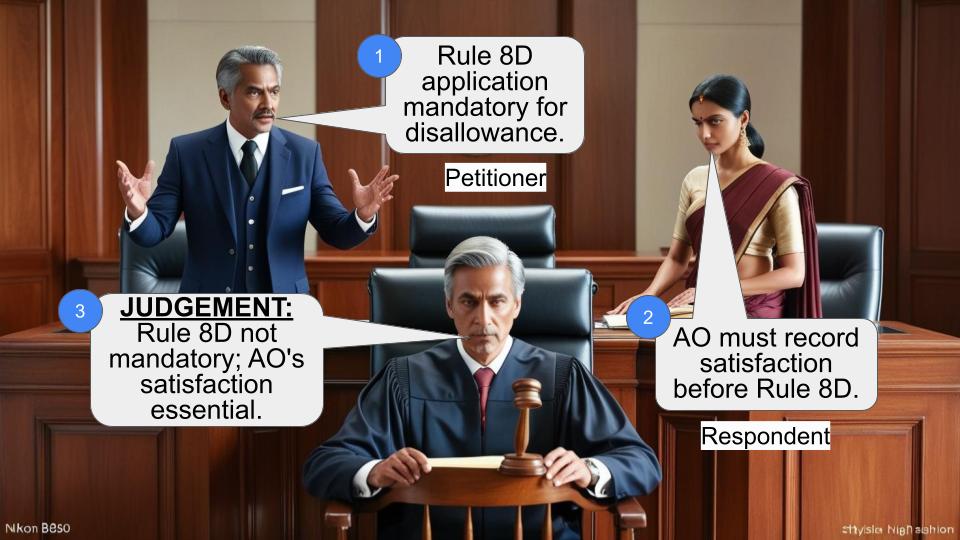
- They felt that the way Rule 8D (of Income Tax Rules, 1962) was applied needed to be reviewed.
The company's side:
- They basically stood by the decisions of the Commissioner and the Tribunal.
- They argued that the calculation method used was correct and in line with the law.
Key Legal Precedents:
The big one here is the case of Godrej & Boyce Mfg. Co. Ltd. vs. Dy.CIT, Income Tax Appeal No.626 of 2010 and Writ Petition No.758 of 2010. This case had already dealt with how to apply Section 14A (of Income Tax Act, 1961) and Rule 8D (of Income Tax Rules, 1962). The lower authorities in our current case followed this judgment.
Judgement:
So, here's what the court decided:
1. They said, "Nah, we don't see any big legal questions here that need answering."
2. On the first question raised by the tax department, they said it's already been answered in the Godrej & Boyce case.
3. For the second question, about how Rule 8D (of Income Tax Rules, 1962) was applied, they said it's just a factual issue, not a legal one.
4. They found that both the Commissioner and the Tribunal had applied the law correctly.
5. In the end, they dismissed the appeal, saying there were no substantial questions of law to be addressed.
FAQs:
1. Q: What's this Section 14A (of Income Tax Act, 1961) and Rule 8D (of Income Tax Rules, 1962) all about?
A: These are parts of tax law that deal with how to calculate expenses related to income that's exempt from tax, like dividends.
2. Q: Why didn't the court want to look into the case more deeply?
A: They felt the lower authorities had already applied the law correctly, and the questions raised were either factual or already settled by previous cases.
3. Q: What does this mean for other companies dealing with dividend income?
A: It reinforces that only expenses actually incurred for earning dividend income can be disallowed, and the calculation should be reasonable.
4. Q: Did the tax department have to pay any penalties for losing the case?
A: Nope, the court dismissed the appeal without imposing any costs on either party.
5. Q: Why couldn't the tax department's lawyer get more information from the Assessing Officer?
A: There was apparently some restructuring going on in the department, which made it hard to get the information in time.

1. Heard both sides. At the earlier occasion we had granted time to Mr. Suresh Kumar to seek instructions from the Assessing Officer and on some specific point, namely, whether Rule 8D(ii) (of Income Tax Rules, 1962) was correctly applied or not?
2. Despite granting an adjournment of nearly four weeks, Mr. Suresh Kumar is not able to obtain instructions. He states that there is a restructuring of the Department and that is why he is unable to obtain any instruction.
3. We do not wish to grant any further time to Mr. Suresh Kumar to verify a factual issue. The Revenue submits that the two questions at page 3 of the paper book are substantial questions of law, as they arise out of the Tribunal's order dated 1492012.
4. We find that the Tribunal has confirmed the order of the Commissioner of Income Tax (Appeals). At page 19 of the paper-book (para 4 of the Commissioner's order), the Commissioner took into account the words of the Rule and found that the figures as derived by the Assessing Officer cannot be taken into consideration. One can at best disallow the expenses which are incurred for earning dividend income. For that purpose, the figures under the head “Investment” could be taken and some charges apportioned for the purpose of computing the expenses. The Commissioner found from such figures, that only 10% of the income earned could be apportioned towards expenses for earning the dividend income. He, therefore, made a revised disallowance.
5. It is this revised disallowance which has been accepted by the Tribunal. We do not find that both the questions of law can be termed as substantial simply because the first one is covered against the Revenue by a Judgment of this Court in the case of Godrej & Boyce Mfg. Co. Ltd. vs. Dy.CIT, Income Tax Appeal No.626 of 2010 and Writ Petition No.758 of 2010. The Questions have been decided by this Court. Both the authorities in this case have followed this Judgment and applied Section 14A (of Income Tax Act, 1961) and Rule 8D (of Income Tax Rules, 1962). They have been applied correctly. The first question is, therefore, not a substantial question of law at all.
6. The second question pertains to the application of the Rule and which raises a pure factual issue. We find that the Commissioner, as also the Tribunal's order is neither perverse nor vitiated by any error of law apparent on the face of the record, and as noted above. Therefore, this Appeal does not raise any substantial question of law. It is devoid of merits and is dismissed. No costs.
(A.K. MENON, J.) (S.C. DHARMADHIKARI, J.)
×
Questions
Tax Appeal Dismissed: Court Upholds Application of Section 14A (of Income Tax Act, 1961) and Rule 8D (of Income Tax Rules, 1962) in Dividend Income Case
Write your CommentSimilar Posts
Generic
- Reportdata/3858.pdf
