


Court upholds higher interest rates paid to related parties as reasonable marke…



Full News
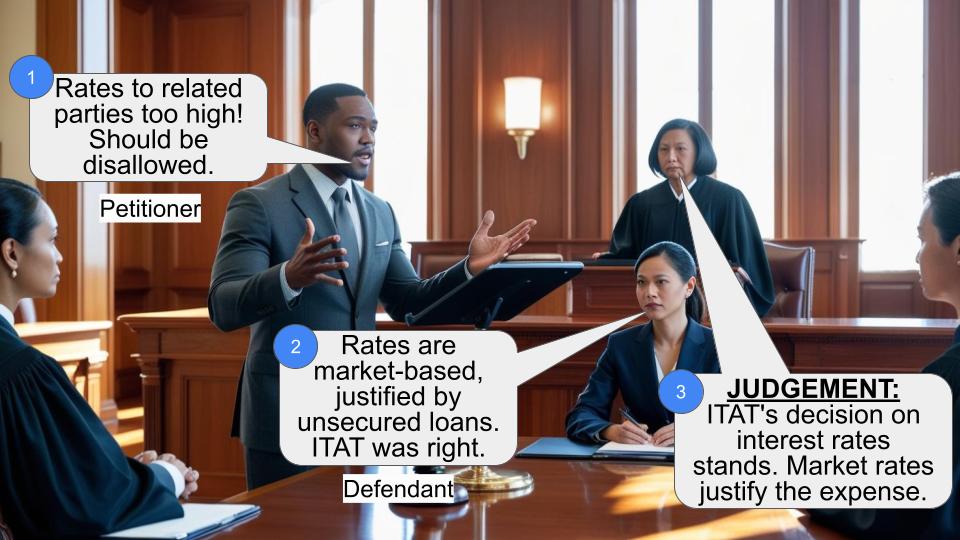
Court upholds higher interest rates paid to related parties as reasonable market rates
Court upholds higher interest rates paid to related parties as reasonable market rates
This case is about a company called Cama Hotels Ltd. that paid higher interest rates to some related parties. The tax authorities weren't happy about it and tried to disallow some of the interest expense. But guess what? The Income Tax Appellate Tribunal (ITAT) sided with the company, and now the tax department is challenging that decision in the High Court. Spoiler alert: The High Court mostly agreed with the ITAT.
Get the full picture - access the original judgement of the court order here
Case Name:
Principal Commissioner of Income Tax Vs Cama Hotels Ltd. (High Court of Gujarat)
Tax Appeal No. 281 of 2016
Date: 15th March 2016
Key Takeaways:
1. Paying slightly higher interest rates to related parties isn't automatically a problem if it's still in line with market rates.
2. The tax department can't just assume a lower rate is appropriate without considering market conditions.
3. Courts will generally respect the factual findings of lower tribunals unless there's a clear legal error.
Issue:
The main question here is: Was the Income Tax Appellate Tribunal correct in allowing Cama Hotels Ltd. to deduct the full amount of interest paid to related parties, even though the rates were slightly higher than what the tax officer thought was reasonable?
Facts:
1. Cama Hotels Ltd. (our star company) paid interest to some related parties at rates of 15% and 16%.
2. These related parties fall under section 40A(2)(b) (of Income Tax Act, 1961), which is basically a provision that says "Hey, be careful with transactions between related parties!"
3. The Assessing Officer (tax guy) said, "Nope, only 12% is okay. The rest is too much!"
4. The company appealed, and the Commissioner (Appeals) said, "Actually, it's all good."
5. The tax department wasn't happy, so they went to the Income Tax Appellate Tribunal (ITAT).
6. The ITAT agreed with the company, saying the rates were fine given the market conditions.
7. Now the tax department is at the High Court's doorstep, still not satisfied.
Arguments:
Tax Department's Side:
"Look, 15% and 16% interest rates are too high! These are related parties, so they're probably trying to sneak in extra deductions."
Company's Side:
"Hold up! Banks were charging 15-16.08% interest and wanted security. We got unsecured loans at similar rates without all the hassle. It's totally reasonable!"
Key Legal Precedents:
The judgment doesn't mention specific case laws, but it does refer to section 40A(2)(b) (of Income Tax Act, 1961). This section is all about making sure transactions between related parties are at fair market value.
Judgement:
The High Court basically said, "We're cool with what the ITAT decided." Here's why:
1. The ITAT found that the interest rates paid by the company were in line with market rates.
2. This is a factual finding, and the High Court doesn't want to mess with facts unless there's a clear legal mistake.
3. The court said there's no legal problem with the ITAT's conclusion that the company didn't give any unfair benefit to the related parties.
4. So, they rejected the tax department's appeal on this point.
FAQs:
1. Q: Does this mean companies can always pay higher interest to related parties?
A: Not exactly. It just means that slightly higher rates can be okay if they're still in line with market conditions.
2. Q: Why didn't the court just decide what the correct interest rate should be?
A: Courts usually don't like to substitute their own judgment for factual findings made by specialized tribunals like the ITAT.
3. Q: Is this case over now?
A: Not quite! The court actually admitted another question about deemed dividends for further consideration. So there's more to come in this legal saga!
4. Q: What's the practical takeaway for businesses?
A: Document your reasons for interest rates carefully, especially with related parties. Show how they compare to market rates and any special circumstances (like unsecured loans) that might justify slightly higher rates.

1. Heard Mr. M. R. Bhatt, Senior Advocate, learned counsel for the appellant.
2. The appellant has challenged the order dated 29.09.2015 passed by the Income Tax Appellate Tribunal, Ahmedabad Bench “B” in ITA No.1834/Ahd/2012, by proposing the following two questions:
“[1] Whether the Appellate Tribunal has erred in law and on fact in holding that payment of interest @ 15% and 16% to the persons covered u/s 40A(2)(b) (of Income Tax Act, 1961) is commensurate with the prevailing market rate?
[2] Whether the Appellate Tribunal has erred in law and on fact in deleting the amount of Rs.2,63,12,188/- treated by the Assessing Officer as deemed dividend u/s 2(22)(e) (of Income Tax Act, 1961) in this case?”
3. As regards proposed question No.1, the assessee Company paid interest of Rs.32,43,885/- to persons covered under section 40A(2)(b) (of Income Tax Act, 1961) (hereinafter referred to as “the Act”). Interest had been paid @ 15% in the case of Cama Motors Pvt. Ltd. and @ 16% in the case of R. J. Cama & Co. Pvt. Ltd. The Assessing Officer allowed the interest payment @ 12% and disallowed the balance.
4. In assessee’s appeal, the Commissioner (Appeal) deleted the disallowance. The Revenue carried the matter in appeal before the Tribunal, but did not succeed.
5. As can be seen from the impugned order, the Tribunal has noted that section 40A(2)(b) (of Income Tax Act, 1961) contemplates that if some undue benefit is being extended by the assessee to the persons mentioned in sub-clause (2)(b) of section 40A (of Income Tax Act, 1961) on account of their association with the assessee, then the deduction claimed for that benefit ought to be disallowed to the assessee. In other words, if the assessee can avail the facility from the open market at a lower price than similar facility availed from the persons covered under section 40A(2)(b) (of Income Tax Act, 1961), then that excess payment would not be allowed to the assessee as deduction. The question that arose before the Tribunal was that what was the fair market value of interest paid by the assessee on the loans obtained from the persons covered under section 40A(2)(b) (of Income Tax Act, 1961). The Assessing Officer was of the view that the loans ought to have been taken at the interest rate of 12% and not the interest rate of 15 or 16%. On behalf of the assessee, it was contended that the bank interest was in between 15 to 16.08% and in respect thereof, the assessee was required to produce security against such loans, whereas the loans secured by the assessee were unsecured loans. That by availing of loans from associate concerns, it had avoided a lot of formalities. The Tribunal was of the opinion that the payment of interest at a little higher rate to the persons even if covered under section 40A(2)(b) (of Income Tax Act, 1961) cannot be termed as exorbitant when the fair market value of such interest cost is being considered. The Tribunal found, as a matter of fact, that the assessee had paid interest commensurate with the interest rate prevailing in the open market. In the light of the above findings of fact recorded by it, the Tribunal found that the assessee had not extended any undue benefit to the persons covered under section 40A(2)(b) (of Income Tax Act, 1961) and rejected the said ground of appeal.
6. Thus, the Tribunal has recorded a finding of fact to the effect that the interest paid by the assessee to the persons mentioned under section 40A(2)(b) (of Income Tax Act, 1961) is commensurate with the interest rate prevailing in the open market. In the light of such finding of fact, it is not possible to state that the conclusion arrived at by the Tribunal that the assessee has not extended any undue benefit to the persons covered under section 40A(2)(b) (of Income Tax Act, 1961), suffers from any legal infirmity warranting interference. The said ground of appeal is, therefore, rejected.
7. As regards proposed question No.2, the court is of the view that the matter requires consideration. Hence, ADMIT. The following substantial question of law arises for consideration :
“Whether on the facts and in the circumstances of the case, the Income Tax Appellate Tribunal was justified in deleting the amount of Rs.2,62,12,188/- treated by the Assessing Officer as deemed dividend under section 2(22)(e) (of Income Tax Act, 1961)?”
(HARSHA DEVANI, J.)
(G.R.UDHWANI, J.)
×
Questions
Court upholds higher interest rates paid to related parties as reasonable market rates
Write your CommentSimilar Posts


Generic
- Reportdata/3007.pdf
