


Court Quashes Reassessment: Mere Change of Opinion Not Grounds for Section 147 …






Full News

Court Quashes Reassessment: Mere Change of Opinion Not Grounds for Section 147 (of Income Tax Act, 1961)
Court Quashes Reassessment: Mere Change of Opinion Not Grounds for Section 147 (of Income Tax Act, 1961)
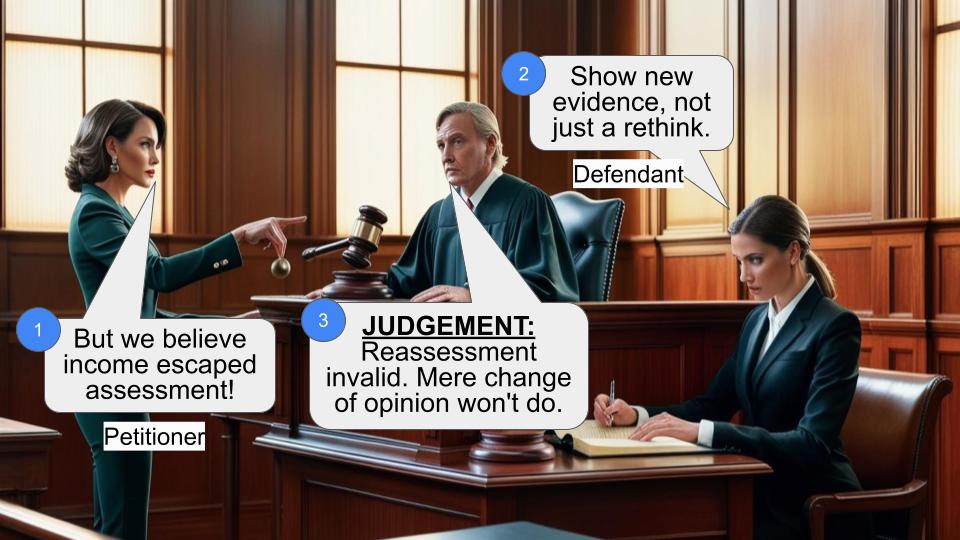
This case involves an appeal by an assessee against a judgment of the Income Tax Appellate Tribunal (ITAT) that had allowed the Revenue's appeal. The High Court ultimately ruled in favor of the assessee, quashing the ITAT's order and holding that the reassessment under Section 147 (of Income Tax Act, 1961) was not valid as it was based on a mere change of opinion.
Get the full picture - access the original judgement of the court order here
Case Name:
Rayman Glues & Chemicals (Asst.) Vs Deputy Commissioner of Income Tax (High Court of Gujarat)
Tax Appeal No. 343 of 2002
Date: 5th December 2014
Key Takeaways:
1. Reassessment under Section 147 (of Income Tax Act, 1961) cannot be initiated based on a mere change of opinion on the same set of facts.
2. Audit objections alone are not sufficient grounds for reopening an assessment.
3. The Assessing Officer must have independent reasons to believe that income has escaped assessment.
Issue:
Whether the Tribunal was justified in upholding the legality of reassessment under Section 147 (of Income Tax Act, 1961), which sought to reopen a completed scrutiny assessment under Section 143(3) (of Income Tax Act, 1961) on the basis of audit objection and mere change of opinion on the same set of evidence and record?
Facts:
1. The original assessment was completed under Section 143(3) (of Income Tax Act, 1961) on 26.03.1992, determining total income at Rs.24,18,150/-
2. The assessment was reopened under Section 147 (of Income Tax Act, 1961) on 31.12.1992
3. A new assessment order was passed on 28.02.1995 under Section 143(3) (of Income Tax Act, 1961) read with Section 147 (of Income Tax Act, 1961)
4. The assessee appealed to the CIT(A), who allowed the appeal
5. The Revenue appealed to the ITAT, which allowed the Revenue's appeal.
Arguments:
Assessee's Arguments:
1. The reassessment was based on audit objections and a mere change of opinion on the same set of evidence
2. The Assessing Officer had no subjective satisfaction for initiating reassessment proceedings
Revenue's Arguments:
1. There were sufficient reasons for the Assessing Officer to believe that assessment needed to be reopened based on the audit report
2. The facts of the case were properly evaluated by the Assessing Officer and the Tribunal
Key Legal Precedents:
1. Praful Chunilal Patel v. M.J. Makwana, [1999] 236 ITR 832 (Guj) - Cited by the ITAT to support reopening of assessment
2. Commissioner of Income-tax, Ahmedabad IV Vs. Shilp Gravures Ltd. reported in [2013] 40 Taxmann 309 (Gujarat) - Cited by the assessee to argue against reassessment based on audit objections
3. Vodafone West Ltd. Vs. Assistant Commissioner of Income-tax reported in [2013] 37 Taxmann 158 (Gujarat) - Also cited by the assessee
4. Calcutta Discount Co. Ltd. v. Income-Tax Officer, Companies District, Calcutta and Another, [1961] 41 ITR 191 - Cited by the Revenue to support the Assessing Officer's reasons for reopening
Judgement:
The High Court allowed the appeal in favor of the assessee, quashing and setting aside the ITAT's order. The court held that:
1. The reassessment was based on primary facts already furnished by the assessee and available on record.
2. The successor Assessing Officer had simply sat over the decision of the earlier Assessing Officer.
3. The CIT(A) was justified in annulling the order of the successor Assessing Officer.
FAQs:
1. Q: What is the significance of Section 147 (of Income Tax Act, 1961)?
A: Section 147 (of Income Tax Act, 1961) allows the Assessing Officer to reassess income that has escaped assessment, but it cannot be used for a mere change of opinion on the same set of facts.
2. Q: Can an assessment be reopened based solely on audit objections?
A: No, audit objections alone are not sufficient grounds for reopening an assessment under Section 147 (of Income Tax Act, 1961).
3. Q: What is the time limit for reopening an assessment under Section 147 (of Income Tax Act, 1961)?
A: Generally, it's four years from the end of the relevant assessment year, but there are exceptions if income has escaped assessment due to failure to disclose material facts.
4. Q: How does this judgment impact future reassessment cases?
A: It reinforces the principle that reassessments cannot be based on a mere change of opinion and emphasizes the need for the Assessing Officer to have independent reasons to believe income has escaped assessment.
5. Q: What should taxpayers do if they receive a notice under Section 147 (of Income Tax Act, 1961)?
A: They should carefully examine the reasons given for reopening and consult with a tax professional to determine if the reopening is valid based on the principles laid out in this and other relevant judgments.

1. This appeal u/s.260A (of Income Tax Act, 1961) is filed against the judgment and order dated 28.08.2002 passed by the Income Tax Appellate Tribunal, Ahmedabad ‘A’ Bench in ITA No.3237/AHD/1996 whereby, the appeal filed by the Revenue was allowed for statistical purpose only.
2. Briefly stated, the facts are that the original assessment was completed u/s.143(3) (of Income Tax Act, 1961) on 26.03.1992 determining total income at Rs.24,18,150/-. Thereafter, it was noticed that certain income chargeable to tax has escaped assessment. Consequently, the assessment completed on 26.03.1992 was re-opened by invoking the provisions of Section 147 (of Income Tax Act, 1961) in pursuance of the Notice u/s.148 (of Income Tax Act, 1961) issued on 31.12.1992. The Assessing Officer passed the order u/s.143(3) (of Income Tax Act, 1961) r/w. Section 147 (of Income Tax Act, 1961) on 28.02.1995.
3. Being aggrieved by the order of the Assessing Officer, appeal was preferred before the CIT(A). Vide order dated 15.05.1996, the CIT(A) allowed the appeal of the assessee. Against the above order of the CIT(A), the Revenue filed an appeal before the Tribunal.
4. Before the Tribunal, the following was the main ground of appeal;
“On the facts and in the circumstances of the case and in law, the learned CIT(A) erred in anulling the order u/s.143(3) (of Income Tax Act, 1961) r.w.s. 147 (of Income Tax Rules, 1962) of the Act.”
5. After hearing both the sides, the Tribunal allowed the appeal of the Revenue, vide impugned judgment and order dated 28.08.2002, by holding that the CIT(A) was not justified in cancelling the assessment by relying upon the decision of this Court rendered in the case of Praful Chunilal Patel v. M.J. Makwana, [1999] 236 ITR 832 (Guj). Being aggrieved by the impugned order, the assessee has filed the present appeal.
6. This appeal was admitted on 17.12.2002 on the following substantial question of law;
“Whether, on the facts and in the circumstances of the case, the Tribunal was justified in upholding the legality of reassessment u/s.147 (of Income Tax Act, 1961) which sought to reopen a completed scrutiny assessment u/s.143(3) (of Income Tax Act, 1961) on the basis of audit objection and mere change of opinion on the same set of evidence and record?”
7. Learned counsel Mr. RK Patel appearing for the assessee took us through the order passed by the CIT(A) as also the impugned judgment rendered by the Appellate Tribunal. It was submitted that the Tribunal has erred in interpreting the scope and ambit of Section 143(3) (of Income Tax Act, 1961), 147 and 148 of the Act. The reassessment proceedings could not be said to be valid since it was based on audit objection and mere change of opinion on the same set of evidence on record, which was already processed at the time of original scrutiny assessment. It was, therefore, submitted that the present appeal deserves to be allowing by quashing and setting aside the impugned judgment and order of the Tribunal.
7.1 Learned counsel Mr. Patel placed reliance upon a decision rendered by the coordinate Bench of this Court in Special Civil Application No.8754 of 2014 and allied matters decided on 08.07.2014 and more particularly, on the observations made in Paras – 5 & 6 therein, which reads thus;
“5. Shri Patel, learned advocate appearing on behalf of the petitioner has vehemently submitted that the initiation of the reassessment proceedings for the Assessment Years under consideration is absolutely illegal and bad in law. It is submitted that as such the reassessment proceedings have been initiated solely on the audit objections raised by the audit party and, therefore, the same is colourable exercise of jurisdiction by the Assessing Officer. It is submitted that as such the reassessment proceedings cannot be initiated merely on the basis of the audit objections, more particularly, when the Assessing Officer has no subjective satisfaction. Relying upon the decisions of the Division Bench of this Court in the case of Commissioner of Income-tax, Ahmedabad IV Vs. Shilp Gravures Ltd. reported in [2013] 40 Taxmann 309 (Gujarat) and in the case of Vodafone West Ltd. Vs. Assistant Commissioner of Income-tax reported in [2013] 37 Taxmann 158 (Gujarat), it is requested to allow the present Special Civil Applications and quash and set aside the reassessment proceedings.
6. To satisfy ourselves whether the reassessment proceedings have been initiated solely at the instance of the audit part and solely on the audit objections, we called for the original file from the office of the Assessing Officer. Ms. Bhatt, learned advocate appearing on behalf of the revenue has produced the relevant files from the office of the Assessing Officer. On perusal of the files and the notings and the relevant documents, it appears that the reassessment proceedings have been initiated at the instance of the audit party solely on audit objections. Under such factual aspects, the present petitions are required to be considered.”
8. Mr. KM Parikh learned Standing Counsel appearing for the Revenue placed reliance upon a decision of the Apex Court in the case of Calcutta Discount Co. Ltd. v. Income-Tax Officer, Companies District, Calcultta and Another, [1961] 41 ITR 191 and submitted that there were sufficient reasons for the Assessing Officer to believe that the assessment is required to be reopened on the basis of audit report and that the facts, as they emerge in this case, have been properly evaluated by the Assessing Officer and the Tribunal.
8.1 Mr. Parikh further submitted that the decision of this Court in SCA No.8754/2014 on which reliance is placed by Mr. Patel cannot be made the basis for allowing the appeal for the reason that correspondence on which reliance is placed were latter in point of time after the order of the CIT(A) was passed. It was submitted that the assessee cannot get the benefit of the factual aspect which was not before the Tribunal in the appeal filed by the Revenue and which held in favour of the Revenue. It is submitted that, at the most, the matter may be remitted for reconsideration. He, therefore, submitted that the Tribunal has rightly allowed the appeal of the Revenue and hence, the present appeal deserves to be dismissed.
9. We have heared learned counsel for both the sides and perused the record of the case. While disposing of the appeal filed by the Revenue, the Tribunal observed in Para-4.4 as under;
“4.4 The gist of reasons recorded were furnished by Assessing Officer to the assessee vide his letter dated 22.12.1995. The reasons for reopening were duly recorded by A.O. The original assessment was made on 26.03.1992. This was reopened within 4 years and fresh assessment u/s.143(3) (of Income Tax Act, 1961) r.w.s. 147 (of Income Tax Rules, 1962) was made on 28.02.1995. The action under the main section 147 (of Income Tax Act, 1961) is possible in spite of the fact that complete disclosure of material facts was made as held by Hon’ble Gujarat High Court in the case of Praful Chunilal Patel (supra). In this decision, jurisdictional High Court held that the power to make assessment or reassessment where the initiation has been made within four years of the relevant assessment year would be attracted even in cases where there has been a complete disclosure of all relevant facts upon which a correct assessment might have been based in the first instance. Explanation 2 substituted by the Direct Tax Laws (Amendment) Act, 1987 w.e.f. 01.04.1989, Section 147 (of Income Tax Act, 1961) clarified that for the purpose of this section, there can be deemed escapement of income and A.O can initiate the proceedings on finding or discovering such cases and no doubt whether they constitute cases of escapement of income, would be permissible. This is also held in the case of Praful Chunilal Patel reported in 240 ITR 240 (Guj) relates to A.Y. involved was 1986-97. Therefore, both the decisions relied by learned counsel of the assessee are not relevant for deciding this appeal which has to be decided. Keeping in view the provisions of Section 147 (of Income Tax Act, 1961) to 151 as substituted / amended with effect from 01.04.1989.”
10. The main argument of the assessee before the Tribunal was that the income sought to be brought to tax by invoking the provisions of Section 147 (of Income Tax Act, 1961) is not such as can be said to have “escaped assessment” within the meaning of that Section. It is well settled that the provisions of Section 147 (of Income Tax Act, 1961) are not intended to be employed in a cse of mere change of opinion on a given set of facts in context of a specific provision of the Act.
11. It appears from the record that the formation of belief by the Assessing Officer that certain income has escaped assessment for the year under appeal has been borne only only because of the primary facts furnished by the assessee for the purpose of assessment of its income and other material information available on record. The details of payments made by the assessee to the persons specified in Section 40-A (of Income Tax Act, 1961), Audit report u/s.44 (of Income Tax Act, 1961)-AB and the controversy in relation thereto were well within the knowledge of the Assessing Officer who had passed the original order u/s.143(3) (of Income Tax Act, 1961). The information regarding the assessee’s claim u/s.80 (of Income Tax Act, 1961)-HHC was also filed along with the return of income in the form of Chartered Accountant’s Certificate, which was also referred to by the A.O in his order u/s.143(3) (of Income Tax Act, 1961) r.w.s. 147 (of Income Tax Rules, 1962) of the Act.
12. At this stage, it would be relevant to refer the provisions of Sections 143(1), 143(3) and 147 of the Act, which read thus;
“143. Assessment : (1) Where a return has been made under section 139 (of Income Tax Act, 1961), or in response to a notice under sub-section (1) of section 142 (of Income Tax Act, 1961), such return shall be processed in the following manner, namely:-
(a) the total income or loss shall be computed after making the following adjustments, namely:-
(i) any arithmetical error in the return; or
(ii) an incorrect claim, if such incorrect claim is apparent from any information in the return;
(b) the tax and interest, if any, shall be computed on the basis of the total income computed under clause (a);
(c) the sum payable by, or the amount of refund due to, the assessee shall be determined after adjustment of the tax and interest, if any, computed under clause(b) by any tax deducted at source, any tax collected at source, any advance tax paid, any relief allowable under an agreement under section 90 (of Income Tax Act, 1961) or section 90A (of Income Tax Act, 1961), or any relief allowable under section 91 (of Income Tax Act, 1961), any rebate allowable under Part A of Chapter VIII, any tax paid on self-assessment and any amount paid otherwise by way of tax or interest.
(d) an intimation shall be prepared or generated and sent to the assesee specifying the sum determined to be payable by, or the amount of refund due to, the assessee under clause (c); and
(e) the amount of refund due to the assessee in pursuance of the determination under clause © shall be granted to the assessee: Provided that an intimation shall also be sent to the assessee in a case where the loss declared in the return by the assessee is adjusted but no tax or interest is payable by, or no refund is due to, him: Provided further that no intimation under this sub-section shall be sent after the expiry of one year from the end of the financial in which the return is made.
Explanation.- For the purpose of this sub- section,-
(a) “an incorrect claim apparent from any information in the return” shall mean a claim, on the basis of an entry, in the return,-
(i) of an item, which is inconsistent with another entry of the same or some other item in such return;
(ii) in respect of which the information required to be furnished under this Act to substantiate such entry has not been so furnished; or
(iii) in respect of a deduction, where such deduction exceeds specified statutory limit which may have been expressed as monetary amount or percentage or ratio or fraction;
(b) the acknowledgement of the return shall be deemed to be the intimation in a case where no sum is payable by, or refundable to, the assessee under clause (c), and where no adjustment has been made under clause (a).” “143(3) : On the day specified in the notice,-
(i) issued under clause (I) of sub- section (2), or as soon afterwards as may be, after hearing such evidence and after taking into account such particulars as the assessee may produce, the Assessing Officer shall, by an order in writing, allow or reject the claim or claims specified in such notice and make an assessment determining the total income or loss accordingly, and determine the sum payable by the assessee on the basis of such assessment;
(ii) issued under clause(ii) of sub- section (2), or as soon afterwards as may be, after hearing such evidence as the assessee may produce and such other evidence as the Assessing Officer may required on specified points, and after taking into account all relevant material which he has gathered, the Assessing Officer shall, by an order in writing, make an assessment of the total income or loss of the assessee, and determine the sum payable by him or refund of any amount due to him on the basis of such assessment: ...”
147. Income escaping assessment. If the Assessing Officer has reason to believe that any income chargeable to tax has escaped assessment for any assessment year, he may, subject to the provisions of sections 148 to 153, assess or reassess such income and also any other income chargeable to tax which has escaped assessment and which comes to his notice subsequently in the course of the proceedings under this section, or recompute the loss or the depreciation allowance or any other allowance, as the case may be, for the assessment year concerned (hereafter in this section and in sections 148 to 153 referred to as the relevant assessment year) : Provided that where an assessment under sub-section (3) of section 143 (of Income Tax Act, 1961) or this section has been made for the relevant assessment year, no action shall be taken under this section after the expiry of four years from the end of the relevant assessment year, unless any income chargeable to tax has escaped assessment for such assessment year by reason of the failure on the part of the assessee to make a return under section 139 (of Income Tax Act, 1961) or in response to a notice issued under sub- section (1) of section 142 (of Income Tax Act, 1961) or section 148 (of Income Tax Act, 1961) or to disclose fully and truly all material facts necessary for his assessment, for that assessment year: Provided further that nothing contained in the first proviso shall apply in a case where any income in relation to any asset (including financial interest in any entity) located outside India, chargeable to tax, has escaped assessment for any assessment year: Provided also that the Assessing Officer may assess or reassess such income, other than the income involving matters which are the subject matters of any appeal, reference or revision, which is chargeable to tax and has escaped assessment.”
13. The aforesaid provisions are clear and unambiguous. We find that by invoking the provision of Section 147 (of Income Tax Act, 1961), the successor Assessing Officer has simply sat over the decision of the earlier Assessing Officer passed u/s.143(3) (of Income Tax Act, 1961) with respect to the issues sought to be covered u/s.147 (of Income Tax Act, 1961). Hence, the CIT(A) was completely justified in anulling the order of the successor Assessing Officer. Accordingly, we answer the question raised in this appeal in favour of the assessee and against the Revenue.
14. In view of the above, the appeal is allowed and the impugned judgment and order dated 28.08.2002 is quashed and set aside.
(K.S.JHAVERI, J.)
(K.J.THAKER, J)
×
Similar Ripples
Questions
Court Quashes Reassessment: Mere Change of Opinion Not Grounds for Section 147 (of Income Tax Act, 1961)
Write your CommentSimilar Posts


Generic
- Reportdata/4272.pdf
