


Court Upholds Interest Deduction on Borrowed Funds for Share Investment



Full News
Court Upholds Interest Deduction on Borrowed Funds for Share Investment
Court Upholds Interest Deduction on Borrowed Funds for Share Investment
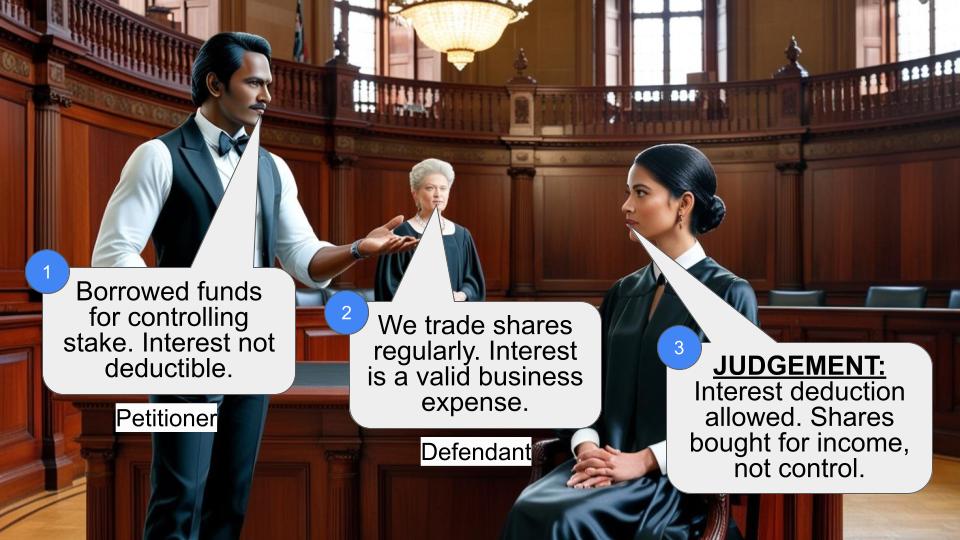
This case involves the Commissioner of Income Tax (appellant) challenging the decision of the Appellate Tribunal, which allowed the assessee company, Amola Holdings (P) Ltd., to deduct interest on borrowed funds used for purchasing shares and partly convertible debentures. The High Court dismissed the appeal, affirming the Tribunal's decision that the interest was a legitimate business expense.
Get the full picture - access the original judgement of the court order here
Case Name:
Commissioner of Income Tax Vs Amola Holdings (P) Ltd (High Court of Gujarat)
Tax Appeal No.1519 & 1520 of 2007
Date: 15th January 2008
Key Takeaways:
1. Interest on borrowed funds for share investment can be considered a revenue expenditure if the primary purpose is not to acquire controlling rights in another company.
2. The nature of the assessee's business (e.g., whether they regularly trade in shares) is crucial in determining the allowability of such interest deductions.
3. Concurrent findings of lower appellate authorities carry significant weight in higher courts.
Issue:
Was the Appellate Tribunal correct in law and on facts in confirming the CIT(A)'s order deleting the disallowance of interest made by the Assessing Officer under section 36(1)(iii) (of Income Tax Act, 1961) on the ground that the purchase of shares was mainly for acquiring controlling rights in another company?
Facts:
1. Amola Holdings (P) Ltd. borrowed funds to invest in shares of Nachmo Knitex Ltd. and Ashima Syntex Ltd., as well as partly convertible debentures of three other companies.
2. The Assessing Officer disallowed the interest claimed on these borrowed funds, treating it as capital expenditure.
3. The assessee appealed to the CIT(A), who deleted the disallowance.
4. The Appellate Tribunal upheld the CIT(A)'s decision, finding that the shares were purchased for non-business purposes, specifically for earning interest and dividends.
Arguments:
Revenue's Argument:
- The investment was made to acquire controlling rights in another company, making it a capital expenditure.
Assessee's Argument:
- The company's main business included the sale/purchase of shares and debentures.
- The investment was made for earning interest and dividends, not for acquiring control.
Key Legal Precedents:
1. Sarabhai & Sons Pvt. Ltd v/s. CIT (201 ITR 465-471) (Guj.):
This case held that interest on borrowed funds is not allowable when shares are acquired to gain controlling rights over another company. However, the Tribunal found this case distinguishable from the present facts.
2. Akalu Holdings Pvt. Ltd. case (ITA No. 2329/Ahd/2000):
The Tribunal relied on this decision, which was in favor of the assessee in a similar situation.
Judgement:
The High Court dismissed the Revenue's appeal, upholding the Tribunal's decision. The court found that:
1. The assessee was primarily engaged in the business of sale/purchase of shares and debentures.
2. The shares were purchased for non-business purposes, specifically for earning interest and dividends, not for acquiring controlling rights.
3. The assessee owned only 2.53% to 3% shares of Ashima Syntex Ltd., which was insufficient to gain control over the company.
FAQs:
Q1: Why was the interest allowed as a deduction?
A1: The interest was allowed because the court found that the shares were purchased for earning income (interest and dividends) rather than acquiring control of another company.
Q2: What role did the assessee's business nature play in the decision?
A2: The fact that the assessee's main business included sale/purchase of shares was crucial in determining that the interest was a legitimate business expense.
Q3: How much of Ashima Syntex Ltd. did the assessee own?
A3: The assessee owned only 2.53% to 3% of Ashima Syntex Ltd., which the court deemed insufficient to acquire control.
Q4: What's the significance of this judgment for other businesses?
A4: This judgment suggests that companies regularly dealing in shares may be able to claim interest on borrowed funds used for share purchases as a business expense, provided the primary purpose isn't to acquire control of another company.
Q5: Why didn't the High Court interfere with the Tribunal's decision?
A5: The High Court respected the concurrent findings of both the CIT(A) and the Tribunal, which is a common practice in appellate proceedings.

Heard learned counsel for the appellant.
The following substantial question of law is proposed for admission of these appeals.
“Whether the Appellate Tribunal is right in law and on facts in confirming the order passed by the CIT(A) deleting the disallowance of interest which was made by the Assessing Officer u/s.36(1)(iii) (of Income Tax Act, 1961) on the ground that the purchase of shares was mainly for acquiring controlling rights in another company?”
The Tribunal has considered the issue raised in the question as under :
“5. The brief facts of the case are that the impugned sum stood disallowed out of the assessee's claim of interest at a total amount of Rs.789.58 lacs, on account of utilization of borrowed capital for investment in the shares in Nachmo Knitex Ltd. and Ashima Syntex Ltd., as well as in the partly convertible debentures of three other companies, who, it ws claimed had, in turn, invested the same in the shares in the aforesaid two companies. The Revenue's case, therefore, is one of investment in a capital asset for acquiring controlling rights, so that the resultant expenditure is a capital expenditure. The Assessing Officer (A.O.) made the addition following the similar disallowance made in the year A.Y.199697, finding no difference in the facts and circumstances of the present case. The assessee's case, for 199697 has since been decided by the Tribunal in its favour, vide the aforesaid order, on the basis that the assessee company by the purchase of shares and convertible debentures (supra), was not making any capital investment for the purpose of requiring controlling rights, but only engaging in the business of purchase and sales of shares, so that the ratio of the decision in the case of Sarable Sons (P) Ltd. Vs. CIT 201 ITR 465 (Guj.), being relied upon by the Revenue, would not apply. The relevant findings and conclusion of the Tribunal are reproduced as under for the sake of ready reference :
9. We have considered the rival submissions, facts and circumstances of the case and decisions relied upon by the parties.
10. First of all, we are of the opinion that the first question for our decision is, as to whether, on the facts and in the circumstances of the case, the assessee could be said to have been carrying on the business of sale purchase of shares or not, because it is found to have been carrying on the business of sale purchase of shares, then the facts and circumstances of the case will be same as in the case of Akalu Holdings, and assessee's case will be covered in favour of Assessee and against the Revenue by the decision of Tribunal in the case of Akalu Holdings Pvt. Ltd. and Ataku Holdings Pvt. Ltd (Supra). To find the answer to this question, the assessee was required to place copies of Memorandum of Association and Articles of Association on record which was submitted at the Bench itself and has been considered.
10.1 From the copy of the Memorandum of Association and Articles of Association of Amola Holdings Pvt. Ltd. the assessee; it is noticed that first of the main objects of the company to be pursued on its corporation reads as under :
“(1) To subscribe for, take, acquire, and hold sell and exchange shares, debentures, debenturesstocks, bonds, obligations or securities of any kind or authority, supreme, municipal, local or otherwise or any company or body corporate or incorporated or association or society and to guarantee the subscription thereof and to exercise and on force all rights and powers conferred by or incidental tot he ownership or holding thereof.”
10.2 From the aforesaid, first main object of the company, we have no hesitation to hold that the assesseecompany's main object was to carry on the business of sale purchase of shares, debentures, stocks, bonds, etc.
11.1 So far as factual carrying on the business of sale purchase of shares by the assesseecompany during the Asst. Year 199697 is concerned, it is noticed from the para No.4.3 of the order of the CIT(A), where the assessee's submissions have been reproduced, that the assessee had purchased shares during the period, relevant to assessment years 199596, 199697 and 199798 and had sold some of the shares during the period relevant to assessment year 199798 as detailed below :
(i) Purchased shares of Ashima Syntex Ltd (61,17,025 equity shares of Ashima Syntex Ltd. ) fully paid up from the open market, during the period January to March, 1995 for Rs.4,17,16,069/
(ii)Purchased optional convertible debentures during the period relevant to assessment year 199697 worth Rs.5,36,53,000/
(iii)Purchased 20,000 fully paid up equity shares of Nachmo Knitex Ltd from open market during the period relevant to assessment year 199697 for Rs.10,67,025/.
(iv)Sold 800 equity shares of Nahmo Knitex Ltd in open market through broker in May, 1996 i.e. relevant to assessment year 199798 for Rs.4,15,200/.
11.2 In view of above facts and circumstances, we are of the opinion that objection raised by the ld. DR that facts of the present assessee were different from the facts and circumstances in the case of Akalu Holdings (P) Ltd., because the present assessee was not carrying on the business of sale/purchase of shares and securities is devoid of any merit.
In other words, the assessee is found to have been carrying on main business in sale/purchase of shares and debentures from the market itself and that being the case, we are further of the opinion that the issue involved in this case, we are further of the opinion that the issue involved in this case is squarely covered in favour of Assessee and against the Revenue by the decision of Tribunal in the case of Akalu Holdings Pvt. Ltd. in ITA No.2329 /Ahd/2000 , dated 9th November2005 and the relevant part as contained in para 3 to 7 of that Tribunal's order has already been reproduced by us in foregoing para No.7.3 of this order.
11.3 Respectfully following the decision of Tribunal in the case of Akalu Holdings Pvt. Ltd.(Supra), we confirm the order of the CIT (Appeals) in deleting the addition of Rs1,24,96,574/
11.4 On merits, in view of the fact that the assessee had only 2.53 % to 3 % shares of Ashima Syntex Ltd. could not have any reason to acquire the control over the business of Ashima Syntex Ltd. Further, it is not the Revenue's case that the assessee had purchased shares/optional debentures of associate concerns to acquire its own interest. The Revenue's case is that acquisition of shares of optional debentures by the assessee was to hold its associateconcerns and their Directors to acquire control over Ashima Syntex Ltd., but that fact cannot be relevant for considering the utilization of borrowings by the assessee for nonbusiness purpose.
12. In view of above facts and circumstances that the decision of Hon'ble Gujarat High Court in the case of Sarabhai & Sons Pvt. Ltd v/s. CIT (201 ITR 465471) (Guj.) wherein the Hon'ble High Court has held that when the shares which are acquired not for the purpose of earning the income, but only with the purpose of acquiring the controlling rights over another company, the interest on the borrowed funds cannot be treated as per the business purpose of the assessee- company and was not allowable and relied upon by the Assessing Officer, is not applicable to the present case, because of distinguishable facts and circumstances.
12.1 In view of above facts and circumstances of the case, we are of the opinion that on merits also, the assessee was entitled to deduction of interest paid on borrowings utilized for earning interest and for purchase of shares to earn the dividend and for purchase of optional debentures to earn the interest.
12.2 In view of the totality of the facts and circumstances of the case, we do not find any infirmity in the order of the CIT(A), which is confirmed.”
5. The factual findings having not rebutted by the Ld. D.R., the A.O. himself basing the Revenue's case on the assessee's assessment for A.Y. 199697, we have no hesitation in dismissing Revenue's appeal by following the decision by the Coordinate Bench of the Tribunal in the assessee's own case for A.Y. 199697. We decide accordingly.”
The CIT(A) as well as the Tribunal both found that the shares were purchased not for acquiring the controlling rights in another company, but the shares were purchased for non business purpose, especially, for earning interest and dividend.
Considering the concurrent findings of the CIT(A) and the Tribunal, we see no justification to interfere with the impugned order. Both appeals stand dismissed at admission stage.
( Y. R. MEENA, C. J. )
( J. C. UPADHYAYA, J. )
×
Similar Ripples
Questions
Court Upholds Interest Deduction on Borrowed Funds for Share Investment
Write your CommentSimilar Posts


Generic
- Reportdata/5012.pdf
