


Cash deposits deemed unexplained; High Court upholds tax addition


Full News

Cash deposits deemed unexplained; High Court upholds tax addition
Cash deposits deemed unexplained; High Court upholds tax addition
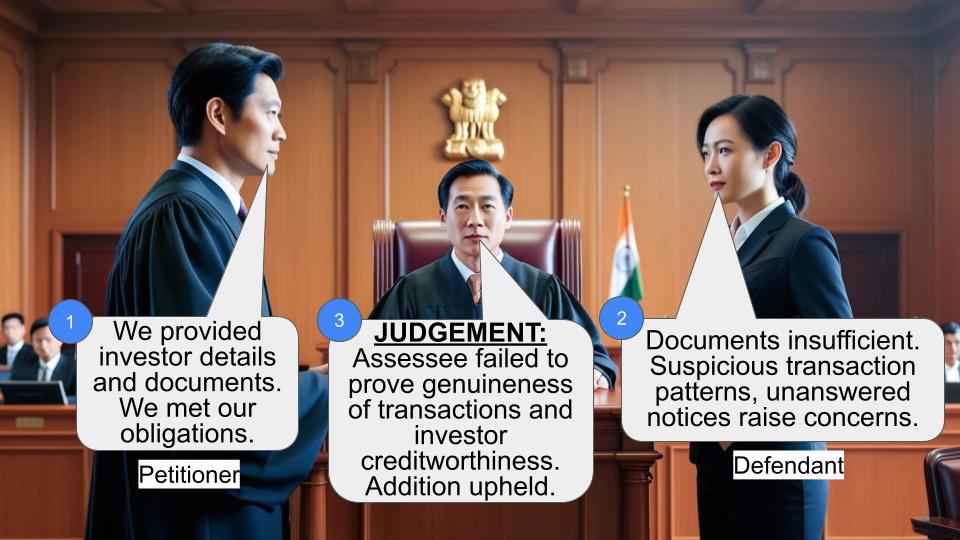
Ravinder Kumar was fighting against the Income Tax Department. The tax folks added a hefty sum to his taxable income because he couldn't explain some cash deposits in his bank account. Kumar appealed this decision all the way up to the High Court, but unfortunately for him, the court sided with the tax department. They basically said, "If you can't explain where this money came from, we're going to tax it."
Get the full picture - access the original judgement of the court order here
Case Name:
Shri Ravinder Kumar Vs Income Tax Officer (High Court of Delhi)
ITA 8/2020 & CM APPL. 1166/2020
Date: 14th January 2020
Key Takeaways:
1. If you're depositing cash in your bank account, you better be ready to explain where it came from.
2. The tax department can add unexplained cash deposits to your taxable income under Section 68 (of Income Tax Act, 1961).
3. If you're claiming business income, you need proper documentation to back it up.
4. Ignoring notices from the tax department is a bad idea and can lead to unfavorable outcomes.
Issue:
The main question here was: Was the Income Tax Department justified in adding Rs.15,86,000 to Ravinder Kumar's taxable income as unexplained cash deposits under Section 68 (of Income Tax Act, 1961)?
Facts:
1. Ravinder Kumar didn't file his income tax return for the 2010-11 assessment year.
2. The tax department noticed he had deposited Rs. 15,86,000 in cash in his bank account during that year.
3. They reopened his case and sent him notices, but Kumar didn't show up for the proceedings.
4. Eventually, Kumar filed a return declaring an income of Rs. 1,26,999, claiming he ran a Kirana (grocery) store.
5. The tax department wasn't convinced and added the entire Rs. 15,86,000 to his taxable income.
6. Kumar appealed this decision, but both the Commissioner of Income Tax (Appeals) and the Income Tax Appellate Tribunal upheld the addition.
Arguments:
Kumar's side:
- He claimed the cash deposits were from his Kirana store sales.
- He said he was using the presumptive taxation scheme under Section 44AD (of Income Tax Act, 1961), so he didn't need to explain each deposit.
- He argued that he wasn't given enough time to submit documents.
Tax Department's side:
- Kumar failed to provide any evidence to support his claims about the Kirana store.
- He didn't produce any books of accounts or purchase bills.
- The cash seemed to be deposited just to generate funds in the bank account for making cheque payments.
Key Legal Precedents:
Interestingly, this judgment doesn't cite any specific legal precedents. Instead, it relies on the provisions of the Income Tax Act, particularly Section 68 (of Income Tax Act, 1961) (which deals with unexplained cash credits) and Section 44AD (of Income Tax Act, 1961) (which covers presumptive taxation for small businesses).
Judgement:
The High Court sided with the tax department. They said:
1. Kumar failed to produce any material to back up his claims about the Kirana store.
2. He didn't join the assessment proceedings despite several notices.
3. He couldn't give a convincing explanation for the cash deposits when asked.
4. The lower tax authorities had made consistent findings, so there was no reason for the High Court to interfere.
The court dismissed Kumar's appeal, essentially saying, "Look, if you can't explain where this cash came from, we have to assume it's taxable income."
FAQs:
Q1: What if I'm running a small business and depositing cash regularly?
A1: Keep proper records! Even if you're using presumptive taxation, you should be able to explain large cash deposits if asked.
Q2: Can the tax department really add all my unexplained deposits to my income?
A2: Yes, they can. Under Section 68 (of Income Tax Act, 1961), unexplained cash credits can be treated as income.
Q3: What should I do if I receive a notice from the Income Tax Department?
A3: Don't ignore it! Respond promptly and provide all the information they're asking for.
Q4: Does this mean I need to keep records of every cash transaction in my business?
A4: While you might not need to document every small transaction, it's a good idea to keep records of significant cash inflows and outflows.
Q5: What if I genuinely forgot where a particular deposit came from?
A5: It's always better to provide some explanation rather than none. If you can't remember the exact source, try to provide as much context as possible.

1. The appellant who has been unsuccessful before all the Income Tax Authorities has now filed the present appeal under Section 260A (of Income Tax Act, 1961) (hereinafter referred as “the Act”) against the order dated 02.09.2019 passed by the Income Tax Appellate Tribunal (ITAT) for the assessment year (AY) 2010-11 in ITA No. 196/Del/2019 whereby the ITAT has sustained the additions made by the CIT (A).
2. The present case originates with the Assessing Officer (AO) receiving information for non-filing of ITR for AY 2010-11 through NMS Cycle. On perusal of ITS data, it came to the notice of the AO that the assessee had deposited cash of Rs. 15,86,000/- in his bank account with Khatri Co-OP (U) Bank Ltd., during the period of 01.04.2009 to 31.03.2010. The case was re- opened under Section 147 (of Income Tax Act, 1961) and notice under Section 148 (of Income Tax Act, 1961) dated 31.03.2017 was issued. Thereafter, notice under Section 142(1) (of Income Tax Act, 1961) dated 11.10.2017 was issued and the proceedings before the AO were fixed for 17.10.2017. The appellant failed to attend the same and as a result, a fresh notice dated 29.11.2017 under Section 142(1) (of Income Tax Act, 1961) along with show cause was issued, fixing the next date for proceeding for 07.12.2017.
This time again, the appellant failed to attend the proceedings. On 08.12.2017, AR of the assessee filed a copy of return of income for the Assessment Year 2010-11 declaring an income of Rs. 1,26,999/- in response to the notice under Section 148 (of Income Tax Act, 1961). Thereafter, notice under Section 143(2) (of Income Tax Act, 1961)/142(1) dated 08.12.2017 was issued and served upon the assessee and yet again the appellant chose to stay away. Under these circumstances, the AO proceeded to finalize the assessment under Section 144 (of Income Tax Act, 1961) on the basis of material available on record and made addition of Rs.15,86,000/- on account of unexplained cash deposited in the assessee’s bank account, in terms of Section 68 (of Income Tax Act, 1961). The income was accordingly, assessed as Rs. 17,13,000/-.
3. In the appeal proceedings before the CIT (A), the appellant urged that the AO had not provided time to submit the required documents and has not considered the return filed and the declaration accompanying the same. The appellant-assessee contended that he had made sale of Rs. 15,86,000/- and computed his income under Section 44AD (of Income Tax Act, 1961) @ 8% as Rs. 1,26,999/- and as a result, he was not liable to file income tax return for the relevant year but when the notice under Section 148 (of Income Tax Act, 1961) was received, he filed the same, declaring his income as Rs. 1,26,999/-. The CIT(A) held that the averments made by the appellant were not substantiated and it was a case where cash had been deposited merely to generate funds in the bank account, whenever payments were required to be made by cheque. No evidence of Kirana business had been presented and no books of account had been produced. Accordingly, the addition made by the AO was confirmed.
4. The findings of the CIT (A) read as under;
“Findings/Determination
4. The appellant's grievance arises from assessment order u/s 1471144 (of Income Tax Act, 1961), dated 22.12.2017, whereby income of the appellant has been determined at Rs. 17,13,000/-.
5. The AO notes in his assessment order as follows-
In this case, information for non-filing of ITR for the A.Y. 2010-11 was received through NMS cycle. On perusal of ITS data for the A. Y. 2010-11. It came to notice that the assessee company had deposited cash of Rs.15,86,000/- in her bank account with The Khatri Co-Op (U) Bank Ltd during the period 01.04.2009 to 31.03.2010. Therefore, the case was reopened u/s 147 (of Income Tax Act, 1961) of the I.T Act and notice u/s 148 (of Income Tax Act, 1961) dated 31.03.2017 was issued. Thereafter. notice u/s 142(1) (of Income Tax Act, 1961) dated 11.10.2017 fixing the proceedings for 17.10.2017 was issued but non attended. Again notice u/s 142(1) (of Income Tax Act, 1961) dated 29.10.2017 along with show cause was issued fixing the proceedings for 07.12.2017 but none attended. On 08.12.2017, the AR of the assessee has filed a copy of return of income for the A.Y. 2010-11 declaring income of Rs. 1,26,9991- on 08.12.2017 in response to notice issued u/s 148 (of Income Tax Act, 1961). Thereafter, notice u/s 143(2) (of Income Tax Act, 1961)/142(1) dated 08.12.2017 were issued fixing the proceedings for 13.12.2017 and served upon the assessee but on 13.12.2017, neither anybody attended the proceedings nor any return was filed by the assessee company within stipulated time period.
Since, no compliance was made to the above mentioned notices. Under the circumstances as stated above when the assessee has not been co-operating and the assessment is getting barred by time shortly. I have no option but to finalize the assessment proceedings exparte u/s 144 (of Income Tax Act, 1961) on the basis of the materials available on record. As the assessee has failed to comply with the notices, u/s 148 (of Income Tax Act, 1961)/142(1) and show cause and the cash deposited of Rs. 15.86,000/- of the assessee remain unexplained, Since the assessee has failed to provide any information/details, therefore, the assessment is completed on the basis of best judgment assessment as per material available on record. In view of the above facts and circumstances, it is justified to assess the income of the assessee by making addition of Rs. 15,86,000/- on account of explained cash deposits in bank account u/s 68 (of Income Tax Act, 1961), 1951. I am satisfied that the assessee has failed to furnish return of income and not disclosed true particulars of him income, therefore, penalty proceedings u/s 271(1)(c) (of Income Tax Act, 1961) are being initiated separately. With these remands the total income of the assessee is calculated as under:-
Income as declared Rs. 1,26,999/- Add:-
Unexplained cash deposit in bank account as discussed above
Rs. 15, 86,000/-
Total Taxable Income Rs. 17, 12,999/-
Total Taxable income to rounded off Rs. 17,13,000/-
Assessed at an income of Rs. 17, 13,000/ charge interest, if any, as per Act, issue notice u/s 156 (of Income Tax Act, 1961) of I. T. Act and ITNS- 150, issue necessary forms. Penalty proceedings u/s 271(1)(c) (of Income Tax Act, 1961) are initiated for filing inaccurate particulars/concealing the income and non furnishing of return separately.
6. The submission of the appellant before AO dated 08.12.2017 as follows-
It is clarified that assess not buying any movable and immovable assets like plot of Land or any Building etc in concerned previous year. It is also informed that assess doing business of general store (kiryana items trading) at 49F, Subhash Chowk, Laxmi Nagar, Delhi and nor having any other income other than interest. Balance Sheet and Profit & Loss account was not prepared because not required to prepare And Bank statement is enclosed.
It is clarified that assessee is running a kiryana store so cash was deposit of sales mode.
It is also clarified that assessee not having taxable income so that assessee not filed his ITR for A. Y. 2010-
11. So please look at the matter and please close our case because there is no tax evasion on our behalf.
7. The appellant submitted vide write up dated 13.11.2018, as follows-
To,
PEEYUSH JAIN
Commissioner of Income Tax (Appeal)-XIX,
D-Block, Vikash Bhawan, New Delhi
Sub: Submissions of statements and replies in respect of Assessee Mr.Ravinder Kumar (Pan:BKLPK2219M), AY 2010-11
Respected Sir
With due respect we are submitting the papers as required in respect of Mr. Ravinder Kumar having pan number BKLP K2 219M for completing the assessment proceedings.
Sir I am clarifying that assessee was running a general store shop and cash deposited in his bank account was from sales made no other income made by the assessee such as no sale of land or building or any fixed assessts and no rented income, otherwise how can be possible that cash is deposited in bank regularly in 2-3 days gap. The assessee was running a general store shop near Shubhash chowk, Laxmi Nagar, Delhi and same shop is now running by his son.
Sir I have submitted the required documents such as copy of ITR, Computation of Total Income, Source of Cash Deposit, Declarations, Bank statements, address of shop and other clarifications, for assessment to A. 0. Mr. Mahavir Singh sir but he was not taking in his record and not taking any attendance in his register so that assessment done by A. 0. is not as per documents and clarifications submitted.
Now Sir I am again submitting the said papers of the assessee that was submit to A. 0.
1. Bank Statement
2. Copy of ITR and computation of total income
3. Copy of submission made to A. 0.
Thanking You
Yours Faithfully
For Ravinder Kumar
PAN: BKLPK2219M
Brijraj
A.R.
8. I have examined the facts at hand. I have perused the appellant's explanation. The appellant claims that it was the proceeds of Kirana Shops sale that were deposited in the bank account. In this connection, I find that the averments of the appellant are-not substantiated. This is a case where cash has been deposited merely to generate funds in the bank account, whenever payments were required to be made by cheque. No evidence of Kirana business has been presented. No books of account etc. have been reported. In this view of the matter, I upheld the action of the Assessing Officer and confirm the addition.
9. In final analysis, the appellant fails in appeal.”
5. In the appeal before the ITAT, again the assessee reiterated his contentions. The ITAT observed that it is not disputed that the assessee made cash deposits to the tune of Rs. 15,86,000/- during the period 01.04.2009 to 31.03.2010; since the assessee had failed to explain the nature and source of cash deposited in his bank accounts before the lower tax authorities or produce any evidence in the nature of purchase bills to substantiate his plea that the purchases were made through banking channel from the same bank account in which the cash had been deposited, the contention of the assessee was rejected. Thus, ITAT found no justification in the request made by the assessee for remanding back the matter to the file of the AO and dismissed the appeal.
6. We have heard the learned counsels for the parties and find that the income tax authorities have rendered concurrent findings of fact that the assessee has failed to produce any material to authenticate his contentions that the cash deposits in his account were on account of the sales being made by him from the Kirana business. In absence of any purchase bill to justify that the deposits in the bank account were sale receipts, the tax authorities cannot be faulted for making the addition of the unexplained cash entries in the bank account. Firstly, the appellant chose to abstain from joining the assessment proceedings despite several notices. Then, he did not render any cogent explanation or documentary evidence to support his contentions before the CIT (A) or ITAT. Pertinently, the assessee had not filed his income tax return for AY 2010-11 and justified his action by contending that he was not liable to file the same as he had adopted presumptive taxation scheme under Section 44AD (of Income Tax Act, 1961) and had availed the benefit thereof, wherein there was no obligation to explain individual entry of cash deposit in his bank account unless such entry had no nexus with the gross receipts.
However, when confronted with the cash entries, he could not give any convincing justification.
7. The tax authorities upheld that the cash has been deposited merely to generate funds in the bank account, whenever payments were required to be made by cheque. Therefore, indeed there is no nexus with the gross receipts. The appellant has not produced any material in support to explain the entries of cash such as books of accounts or purchase bills, etc and we find no merit in the Appellant’s contentions.
8. In view of the above and also for the reason that there are consistent and concurrent findings of the fact by the lower tax authorities, no question of law arises for our consideration.
9. Accordingly, the appeal is dismissed. Pending application is disposed of. No order as to costs.
SANJEEV NARULA, J
VIPIN SANGHI, J
JANUARY 14, 2020
×
Questions
Cash deposits deemed unexplained; High Court upholds tax addition
Write your CommentSimilar Posts


Generic
- Reportdata/6126.pdf
