Cash Deposits Unexplained: High Court Upholds Addition Under Section 68 (of Inc…


Full News

Cash Deposits Unexplained: High Court Upholds Addition Under Section 68 (of Income Tax Act, 1961)
Cash Deposits Unexplained: High Court Upholds Addition Under Section 68 (of Income Tax Act, 1961)
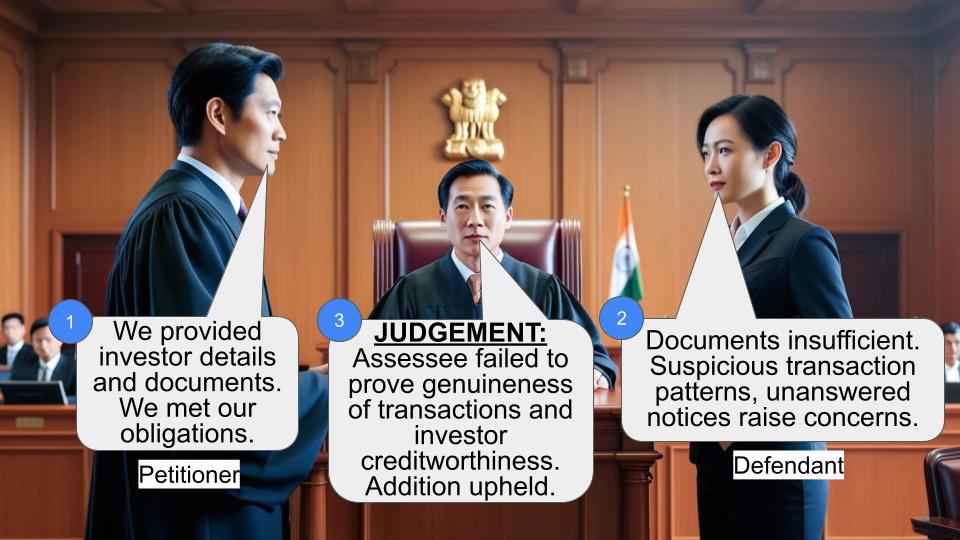
This case involves Shashi Garg (the appellant-assessee) appealing against an order by the Income Tax Appellate Tribunal for the Assessment Year 2011-12. The High Court dismissed the appeal, upholding the addition of Rs. 26,25,000/- to the assessee's taxable income under Section 68 (of Income Tax Act, 1961), due to unexplained cash deposits.
Get the full picture - access the original judgement of the court order here
Case Name:
Shashi Garg vs Principal Commissioner of Income Tax (High Court of Delhi)
Income Tax Appeal No.1235 of 2018 & CM No.46157 of 2018
Date: 2nd November 2018
Key Takeaways:
1. The burden of explaining the source of cash deposits lies with the assessee.
2. Factual findings by lower authorities will not be interfered with unless they are irrational or absurd.
3. Implausible explanations for cash transactions can lead to adverse inferences by tax authorities.
Issue:
Was the addition of Rs.26,25,000/- to the assessee's taxable income under Section 68 (of Income Tax Act, 1961), justified based on unexplained cash deposits?
Facts:
1. The assessee made cash withdrawals of over Rs.75,50,000/- between June 3, 2009, and March 3, 2010 (FY 2009-10).
2. Cash deposits of Rs.35,25,000/- were made between April 5, 2010, and November 18, 2010 (FY 2010-11).
3. The assessee claimed the deposits were from the earlier withdrawals, meant for a property purchase that didn't materialize.
4. The Assessing Officer rejected this explanation and added Rs. 35,25,000/- to the taxable income.
5. The Commissioner of Income Tax (Appeals) reduced the addition to Rs. 26,25,000/-.
6. The Income Tax Appellate Tribunal upheld this decision.
Arguments:
Assessee's Argument:
- The cash deposits were from earlier withdrawals made for a potential property purchase.
- A real estate agent had advised keeping 50% of the property price (Rs. 85,00,000/-) in cash.
Tax Authorities' Arguments:
- The explanation was implausible as withdrawals far exceeded the required amount.
- The time gap between withdrawals and deposits was significant.
- The pattern of withdrawals and deposits was suspicious.
Key Legal Precedents:
The judgment doesn't explicitly cite any legal precedents. However, it relies on the principle that the burden of proving the source of unexplained cash credits lies with the assessee, as per Section 68 (of Income Tax Act, 1961).
Judgement:
1. The High Court dismissed the appeal, upholding the addition of Rs. 26,25,000/- to the assessee's taxable income .
2. The court found the factual findings of lower authorities to be based on cogent and weighty reasoning .
3. The assessee failed to discharge the burden of explaining the source of cash deposits .
4. The court noted that implausible justifications for cash withdrawals undermined the explanation for cash deposits .
FAQs:
1. Q: What is Section 68 (of Income Tax Act, 1961)?
A: Section 68 (of Income Tax Act, 1961) deals with unexplained cash credits. It allows tax authorities to add unexplained money to an assessee's taxable income if they fail to satisfactorily explain its source .
2. Q: Why was the entire amount of cash deposits not added to the taxable income?
A: The Commissioner of Income Tax (Appeals) deleted the addition of Rs. 9,00,000/- due to a small time gap between its withdrawal and deposit .
3. Q: Can the High Court interfere with factual findings of lower tax authorities?
A: The High Court generally doesn't interfere with factual findings unless they are irrational or absurd .
4. Q: What was the main flaw in the assessee's explanation?
A: The assessee's explanation was deemed implausible due to the large amount withdrawn (more than double the alleged requirement), the significant time gap between withdrawals and deposits, and the suspicious pattern of transactions .
5. Q: What lesson can taxpayers learn from this case?
A: Taxpayers should maintain clear records and provide plausible explanations for large cash transactions to avoid adverse inferences by tax authorities.

This appeal by Shashi Garg the (appellant-assessee, for short) under Section 260A (of Income Tax Act, 1961) (the Act, for short) pertains to the Assessment Year ('AY' for short) 2011-12 and arises from the order of the Income Tax Appellate Tribunal ('Tribunal' for short) dated 26th March, 2018.
2. The appeal being belated and delayed by 59 days, an application C.M. No. 46157/2018 has been preferred by the appellant-assessee for condonation of delay. However, before issuing notice on this application, we have deemed it appropriate to examine the appeal on merits.
3. Findings in the impugned order of the Tribunal affirming addition of Rs.26,25,000/- sustained by the Commissioner of Income Tax (Appeals) are entirely factual.
4. Learned counsel for the appellant-assessee challenging the findings submits that they are perverse. The appellant-assessee had made withdrawals of more than Rs.75,50,000/- from her bank account in cash between 3rd June, 2009 to 3rd March, 2010. Hence, the source of cash deposit of Rs. 35,25,000/- in the bank account between 5thApril, 2010 to 18th November, 2010, it is submitted, stood explained.
5. Aforesaid arguments fail to take into account compelling findings recorded by the Assessing Officer, who had queried and cross checked the submission by asking the appellant-assessee to explain the reason for said cash deposits for the AY 2011-12 (FY 2010-11). The appellant-assessee in response had asserted that cash was withdrawn for purchasing disputed property in Hargovind Enclave, Delhi-92, for consideration of Rs. 85,00,000/-. This deal was being negotiated through a real estate agent who had asked the appellant-assessee to be ready with 50% of the total price in cash. This explanation was rejected by the Assessing Officer for the following reasons:-
“3.1.7 Now, the assessee submits that a real estate agent advised her to keep the cash ready to the amount of at least 50% of the total price of the property (total consideration of Rs.85,00,000/-). Accordingly assessee withdrew the cash from her savings account and maintained balance in her hand.
Following has been observed form the bank statement of PNB for the F.Y. 2009-10:
S.No. Date Withdrawals Deposits
1. 02.04.2009 6,75,000/-
2. 06.04.2009 5,00,000/-
3. 16.04.2009 5,00,000/-
4. 24.04.2009 3,00,000/-
5. 25.05.2009 2,00,000/-
6. 26.05.2009 4,00,000/-
7. 03.06.2009 9,00,000/-
8. 06.06.2009 1,00,000/-
9. 09.06.2009 8,00,000/-
10. 25.06.2009
11. 07.07.2009 9,00,000/-
12. 08.07.2009 9,00,000/-
13. 10.07.2009 9,00,000/-
14. 30.07.2009 2,00,000/-
15. 14.08.2009 9,00,000/-
16. 18.08.2009 7,50,000/-
17. 08.09.2009 9,00,000/-
18. 12.11.2009 4,00,000/-
19. 14.11.2009 3,50,000/-
20. 05.02.2010 8,00,000/-
21. 16.02.2010 1,00,000/-
22. 03.03.2010 9,00,000/-
TOTAL 99,25,000 32,50,000
3.1.8 Now, if the assessee was already advised by the real estate agent to keep ready 50 % of the total consideration which comes out to be approx. Rs. 42,50,000/- , why she withdrew the cash totaling to Rs. 99,25,000/- ? It is also quite surprising that assessee first withdraws the cash and then to maintain the balance in her hand equivalent to the 50 % of the total price of the property, she deposits back some amount. Had she been already advised to keep ready 50 % of the total consideration which comes out to be approx. Rs.42,50,000/-, she would have withdrawn only that much amount. First of all why would she withdraw the cash approx. morethan double the amount she was advised to keep ready in hand? Secondly, any prudent person would never withdraw the huge cash without any need just to keep it at home. It is also worth mentioning here that if we closely observe the pattern of withdrawals & deposits, on the date 10/07/2009 assessee was already having cash balance of Rs. 50,75.000/- in her hand which was any way more than the 50 % of total price of the property that she was advised to maintain in her hand, then why would she withdraw more cash to the tune of Rs. 99,25,000/- without any purpose or use?? AR of the assessee was countered with these questions during the proceedings but no explanation was offered in this regard.
3.1.9 Assessee was also asked, can she produce the real estate agent with supporting proofs regarding property deal? AR responded they can produce him but he will not be able to verify and establish the facts of property deal. Since assessee herself submits that the agent will not be able to prove anything in this regard, exercise would have been futile only.
3.1.10 Thus, it's quite apparent & logical to draw the conclusion that all these withdrawals were not meant for any property transaction. But these withdrawals were for some other purpose which assessee does not want to reveal for the obvious reasons. Hence, the consequent cash deposits are not the same cash which assessee is saying that she has accumulated during the year, but this is unaccounted income of the assessee, source of which again the assessee does not want to reveal for the obvious reasons.
3.1.11Now if we observe the cash deposits as reported in AIR information during the relevant financial year 2010-11 (A.Y. 2011- 12), following pattern emerges: (Scanned copy of savings account in Panjab National Bank showing cash deposits during the F.Y.2010-11) 05-04-2010
Less Deposit At: DELHI, RADHEY PURI
9,00,000.00 9,16,20847 Cr 05-04-2010
Paid to : TD PKG MKT P LTD
746119 9,00,000.00 16,20847 Cr 17-04-2010
Transfer from A/c 1504008700002092 VIDKRTS Retails Store Pvt. Ltd
10,800.00 27,008.47 Cr
20.04.2010 Transfer from Ale 1504008700002092 VIDKRTS Retails Store Pvt. Ltd
10,800.00 37,808.47 Cr
25.04.2010 NEFT From RELIANCE Lfie Insura
3,188.00 40,996.47 Cr
01.05.2010 PKG 35,000.00 5,996.47 Cr
04.05.2010 Cash Deposit at : Delhi, RadheyPuri
8,50,000.00 8,55,996.47 Cr
04.05.2010 PKG 8,50,000.00 5,996.47 Cr
07.05.2010 Cash Deposit at: Delhi, RadheyPuri
4,75,000.00 4,80,996.47 Cr
07.05.2010 Paid To : To PKG 746120 4,75,000.00 5,996.47 Cr Mkt. P. Ltd. 19.05.2010 Cash Deposit at: Delhi RadheyPuri
5,00,000.00 5,05,996.47Cr
19.05.2010 PKGMkt 5,00,000.00 5,996.47 Cr
Cummulative Totals: 19,73,65,317.0019, 73,71,323.47 5,996.47 Cr
Cumulative Totals: 20,44,70,602.00 20,45,10,247.74 39,645.74 Cr
23.10.2010 By CLEARING 714 200.00 7,090.41 Cr
04-11-2010 By CLEARING 535125 120.00 7,210.41 Cr
08-11-2010 By CLEARING 120420 1,525.00 8,735.41 Cr
18·11·2010 Cash deposit at DELHI RADHEY PURI
8,00,000.00 8,08,735.41 Cr
18-11-2010
CPR 8,00,000.00 8,735.41 Cr
19-11-2010
Cash Handling Chrg 10-11-2010 At Br. DELHI, RADHEY PURI
200.00 8,455.41 Cr
22-11-2010
By CLEARING 128737 1,360.00 9,815.41 Cr
23-11-2010
TFDVIDKRIS 40,000.00 49,815.41 Cr 23-11-2010
CPR 30,000.00 19,815.41 Cr
25-11-2010
ECS/POWER GRID CORPI1103950549 (MUMBAI COPe)
74,142.00 93,957.41 Cr
01-12-2010
CPR CAPITAL 70,000.00 23,957.41 Cr
01-12-2010
ADVANCE INDIA
15,000.00 8,957.41 Cr
01-12-2010
NEFT FROM RELIANCE LIFE INSURA
30,222.33 39,179.74 Cr
02-12-2010
ISO TRANSFER- 01-12-2010
5.00 39,174.74 Cr
07-12-2010
By CLEARING 514248 471.00 39,645.74
3.1.12 On perusal of above bank statement it was observed that assessee has deposited cash of Rs. 9,00,000/- in the month of April, Rs. 18,25,000/- in the month of May and Rs. 8,00,000/- in the month of November. Now for time being if we accept the explanation of the assessee that she had accumulated cash for purchase of property. Following questions still remains:
i. The question remains when the deal was not materialized why did she deposit the cash first in the month of April, then in May & then in almost end of the year i.e. in the month of November? Why not in one or two lots in the month ofApril?
ii. Why the accumulated cash was deposited in very specific amounts like, Rs.9,00,000/- in April, Rs. 8,50,000/-, Rs.4,75,000/- & Rs. 5,00,000/- in the month of May and then, Rs. 8,00,000/- in the fag end of the year, in the month of November ?
iii. On 31.03.2010 assessee was having total cash deposits of Rs.66,75,000/-in hand (Rs.99,25,000-Rs. 32,50,000), then why assessee deposited back only Rs.35,25,000/- ? Where did the remaining amount go? 3.1.13 Hence, it's quite apparent & logical to draw the conclusion that all the cash deposits are unaccounted income of the assessee, sources of which assessee does not want to reveal for the very obvious reasons. Moreover when countered with the above discussed queries/questions, assessee did not give any explanation. Submission of the assessee is only an afterthought and that too to avoid incidence of tax, which clearly indicate involvement of component of mens-rea.
Submissions of the assessee are not at all tenable and rejected straight away. Hence, in view of the facts under consideration, sequence of events and above discussion, cash deposits of Rs.35,25,000/- has been considered unexplained cash credits within the mandate of section 68 (of Income Tax Act, 1961) and added back to the taxable income of the assessee. Penalty proceedings u/s 271(1)(c) (of Income Tax Act, 1961) are initiated separately for filing inaccurate particulars of income/concealment of income.
(Addition of Rs.35,25,000/-)"
6. Withdrawal in excess of Rs. 75,50,000/- pertains to the period relevant to the financial year ('FY' for short) 2009-10 whereas the cash deposits of Rs. 35,25,000/- which the appellant-assessee has to explain pertains to the period relevant to the FY 2010-11.
7. The Commissioner of Income Tax (Appeals) upheld the addition to the extent of Rs. 26,25,000/-. Addition to the extent of Rs. 9,00,000/- was deleted noticing the small time gap between the withdrawal of Rs. 9,00,000/- on 3rd March, 2010 and deposit of Rs. 9,00,000/- in cash on 5th April, 2010. Explanation of the appellant-assessee connecting the other cash withdrawals to cash deposits was rejected noticing the time difference between the withdrawals and deposits. The dates of withdrawal and deposits in cash, we observe, are not disputed and challenged. This reasoning has merit in view of rather illusionary explanation given by the appellant- assessee for making withdrawal of more than Rs.99,00,000/- in cash during 12 months from April, 2009 to March, 2010. Pertinently, the alleged deal did not materialize. Reasoning of the assessing officer was for additional reason confirmed by the Commissioner of Income Tax (Appeals).
8. Aforesaid factual findings have been upheld by the Tribunal, which is the final fact finding authority.
9. Burden to explain the source of cash deposit was on the appellant- assessee, who as per the finding has not been able to discharge this burden.
The evidence on record is undisputed, and the inference and factual findings recorded we would observe are supported by cogent and weighty reasoning.
Explanation of the appellant-assessee has been duly considered and not ignored. Implausible and lame justification for making cash withdrawals has exposed and dented the concocted explanation regarding source of the cash deposit. Factual findings are based on cumulative effect of all facts covering all essential points. We would not interfere with factual findings unless they are irrational and absurd, which no person acting judicially and properly instructed in the field of law of taxation would have passed.
10. In view of the aforesaid position, we are not inclined to issue notice in the present application for condonation of delay. Accordingly, the application for condonation of delay and the appeal are dismissed.
SANJIV KHANNA, J.
ANUP JAIRAM BHAMBHANI, J.
NOVEMBER 02, 2018
×