


Full News
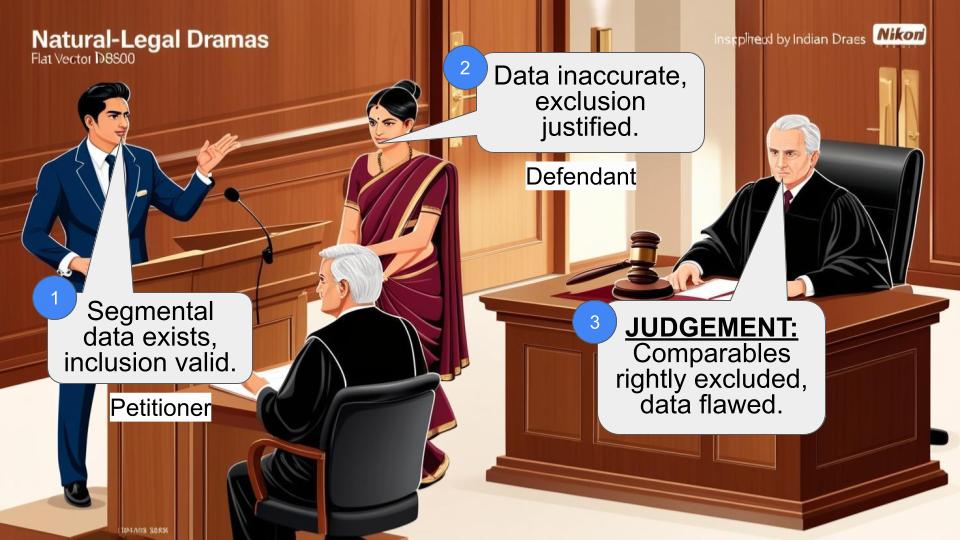
Court Upholds Exclusion of Comparables in Transfer Pricing Case, Emphasizing Accurate Segmental Data
Court Upholds Exclusion of Comparables in Transfer Pricing Case, Emphasizing Accurate Segmental Data
This case involves a dispute between the Principal Commissioner of Income Tax and Saxo India (P) Ltd. regarding the determination of Arm's Length Price (ALP) for international transactions. The Income Tax Appellate Tribunal (ITAT) had directed the exclusion of five comparables in the ALP determination. The revenue department appealed this decision, but the High Court dismissed the appeal, upholding the ITAT's decision.
Get the full picture - access the original judgement of the court order here
Case Name:
Principal Commissioner of Income Tax Vs Saxo India (P) Ltd. (High Court of Delhi)
ITA 682/2016, C.M. APPL.35744-35746/2016
Date: 28th September 2016
Key Takeaways:
1. The nature of the transaction and appropriate filter determine the elements to be considered in the Transactional Net Margin Method (TNMM).
2. Mere availability of turnover proportion for software product sales doesn't imply availability of segmental data for profitability determination.
3. Accurate data is crucial for TNMM, including costs, sales, and assets employed where relevant.
Issue:
Was the ITAT correct in excluding five comparables from the Arm's Length Price determination for the assessee's international transactions?
Facts:
1. Saxo India (P) Ltd., formerly known as Saxo IT India Private Limited, is part of the Initto Group.
2. The company designs and develops customized software applications and provides technical support services.
3. For the Assessment Year 2011-12, the company reported four international transactions, including software development services worth ₹20,72,25,235/-.
4. The Transfer Pricing Officer (TPO) accepted TNMM as the most appropriate method for ALP determination.
5. The TPO added 20 comparables and made an adjustment of ₹8,23,72,723/- to the income.
6. The Dispute Resolution Panel (DRP) reduced the adjustment to ₹7,76,66,682/-.
7. The ITAT excluded four comparables, which the revenue department challenged in this appeal.
Arguments:
Revenue's Arguments:
1. The ITAT's rationale for excluding comparables due to lack of segmental data is contrary to records.
2. Documentary evidence and internet resources were analyzed to segregate software product sales from software technology services.
3. The exclusion of Wipro Technology Services Limited was unjustified.
Assessee's Arguments:
1. Transfer pricing exercise requires accurate data on Operating Cost and Operating Profits.
2. Rule 10B(1)(e) (of Income Tax Rules, 1962) specifies that cost, assets, and sales are relevant denominators in TNMM.
3. Lack of accuracy in data could lead to incorrect results.
Key Legal Precedents:
The judgment primarily relies on Rule 10B(1)(e) (of Income Tax Rules, 1962), which outlines the Transactional Net Margin Method for determining arm's length price in relation to international transactions.
Judgement:
1. The High Court dismissed the revenue's appeal.
2. It held that the nature of the transaction and appropriate filter determine the elements to be considered in TNMM.
3. The court emphasized that mere availability of turnover proportion for software product sales doesn't imply availability of segmental data for profitability determination.
4. The court agreed with the ITAT's decision to exclude the comparables due to lack of accurate segmental data.
FAQs:
1. Q: What is TNMM in transfer pricing?
A: TNMM (Transactional Net Margin Method) is a method used to determine the arm's length price in international transactions by comparing the net profit margin of the transaction with that of comparable uncontrolled transactions.
2. Q: Why is segmental data important in transfer pricing?
A: Segmental data is crucial because it provides accurate information about specific business segments, allowing for more precise comparisons and fairer arm's length price determinations.
3. Q: What was the main reason for excluding the comparables in this case?
A: The main reason was the lack of accurate segmental data, which is necessary for a proper TNMM analysis.
4. Q: How does this judgment impact transfer pricing assessments?
A: This judgment emphasizes the importance of accurate and detailed segmental data in transfer pricing assessments, potentially raising the bar for data quality in future cases.
5. Q: What is the significance of Rule 10B(1)(e) (of Income Tax Rules, 1962) in this case?
A: Rule 10B(1)(e) (of Income Tax Rules, 1962) outlines the TNMM method, which was central to this case. It specifies that costs, sales, and assets employed are relevant factors in the TNMM analysis.

1. The question of law urged by the revenue in this appeal is with respect to the Income Tax Appellate Tribunal’s (ITAT) direction to exclude five comparables in the Arm’s Length Price (ALP) of the assessee’s for Assessment Year (AY) 2011-12 based on the Transfer Pricing Officer’s (TPO) report/Transfer Pricing study report.
2. The assessee earlier known as Saxo IT India Private Limited is a part of the Initto Group which teamed up with Saxo Bank. It designs and develops customised software applications. Besides, it also provided technical support services during the relevant AY to some unrelated enterprises in India. It reported four international transactions, including provision for software development – for 20,72,25,235/-. This transaction is the one in controversy. As regards the other three, the revenue did not raise any dispute.
3. In the proceedings before the TPO, the assessee’s Transactional Net Margin Method (TNMM) was accepted as the most appropriate one for carrying out the ALP determination. The assessee’s profit margin from this transaction was shown as 22.63% as against the mean margin of five comparables at 17.91%. The TPO observed that the overall Profit Level Indicator (PLI), upon application of the Operating Profit to Operating Cost (OP/OC) on the assessee’s Profit and Loss account was (-)15.34% whereas it has shown profit margin on international transactions at 22.63%. After considering the record, the TPO decided to add 20 comparables and according to its determination, an adjustment of 8,23,72,723/- had to be made to the income. Aggrieved, the assessee approached the Dispute Resolution Panel (DRP). This body, after considering the submissions of the assessee held that of the 20 comparables considered by the TPO, 7 were not really comparables, and added some more comparables, swelling the list again to 20. The DRP directed deletion of 2 comparables which resulted in Profit and Loss adjustment and income adjustment; its decision led to a reduced overall income adjustment of 7,76,66,682/-.
4. The assessee appealed to the ITAT, which upon its detailed consideration of the materials, accepted the plea with respect to four comparables and directed that they should be excluded. The assessee’s contention with respect to E-Infochips, Persistent Systems & Solutions Ltd., Larsen and Toubro Infotech Ltd. and Sasken Communications Technologies Ltd. were accepted. The revenue is aggrieved by these as well as exclusion of Wipro Technology Services Limited.
5. It is argued on behalf of the revenue that the rationale adopted by the ITAT with respect to lack of segmental data vis-a-vis four of the comparables is contrary to the records. Learned counsel highlighted that with respect to each of the four companies, i.e. E-Infochips, Larsen and Toubro Infotech Ltd., Persistent Systems & Solutions Ltd. and Saken Communications Technologies Ltd., the documentary evidence pertaining to each of them in the form of annual reports and other material collected from internet resources were analysed elaborately. On the basis of these, the TPO was able to accurately segregate the volume of transactions allocable to software product sales as opposed to software technology services. In these circumstances, the argument about lack of segmental data could not have been a broad brush reasoning by the ITAT to reject the comparables which otherwise indicated high profit margins. It was also contended that apart from this, there is no reason worthwhile for the exclusion of Wipro Technology Services Limited on the list of comparables.
6. Learned counsel for the assessee appearing on advance notice contends that the transfer pricing exercise in the Profit Loss filter to be adopted invariably is premised upon accurate – as opposed to approximation, with respect to Operating Cost and Operating Profits. The comparison which the assessee or the entity is subjected to is with respect to its transaction with the Associated Enterprise, characterised as “international transaction” under the Chapter read with Rules 10B to 10D of the Income Tax Rules. Specific reliance is placed upon Rule 10B(1)(e) (of Income Tax Rules, 1962) to say that cost apart from assets and sales are the relevant denominators in carrying out the TNMM exercise. In the absence of accuracy, the result could be widely off the mark.
7. As far as Wipro Technology Services Limited is concerned, it is submitted that the revenue has not articulated any ground in its appeals nor indicated precisely why the exclusion of Wipro Technology Services Limited is erroneous. The narrow question which requires determination is whether the exclusion of the four comparables which were taken into consideration while carrying out the ALP determination by the TPO was erroneous.
8. The revenue urges that the figures of sales with respect to software products in respect of some of the comparables was available and was sufficient for their exclusion as comparables. The TNMM method – amongst the other three mandated by the statute requires adoption of appropriate filters. Rule 10B(1)(e) (of Income Tax Rules, 1962) which specifically talks of TNMM, presupposes that when such method is the most appropriate, the TPO would conduct/carry out the exercise of ALP determination. It reads as follows:
“10B . (1) For the purposes of sub-section (2) of section 92C (of Income Tax Act, 1961), the arm's length price in relation to an international transaction [or a specified domestic transaction] shall be determined by any of the following methods, being the most appropriate method, in the following manner, namely :—
e) transactional net margin method, by which,—
(i) the net profit margin realised by the enterprise from an international transaction [or a specified domestic transaction] entered into with an associated enterprise is computed in relation to costs incurred or sales effected or assets employed or to be employed by the enterprise or having regard to any other relevant base;
(ii) the net profit margin realised by the enterprise or by an unrelated enterprise from a comparable uncontrolled transaction or a number of such transactions is computed having regard to the same base;
(iii) the net profit margin referred to in sub-clause (ii) arising in comparable uncontrolled transactions is adjusted to take into account the differences, if any, between the international transaction [or the specified domestic transaction] and the comparable uncontrolled transactions, or between the enterprises entering into such transactions, which could materially affect the amount of net profit margin in the open market;
(iv) the net profit margin realised by the enterprise and referred to in sub-clause (i) is established to be the same as the net profit margin referred to in sub-clause (iii);
(v) the net profit margin thus established is then taken into account to arrive at an arm's length price in relation to the international transaction 55c[or the specified domestic transaction];”
9. It is evident, therefore, that the international transactions which are the subject of scrutiny is to be through a filter, and computation is arrived at “in relation to costs incurred or sales effected or assets employed or to be employed by the enterprise”.
10. On a comparison with the data available and made available, undoubtedly, the object of the statute is to “pull in transactions which otherwise escaped the radar of tax assessment under one head or the other. The transfer pricing methodology – shorn of its details is an attempt by each nation to locate the incidents of income which would be subjected to levy within its jurisdiction where international transactions are involved. This exercise does not compare with other income assessments where the methodology adopted in their domestic jurisdiction will differ”. The TNMM method depends on accurate data with respect to all the three elements – wherever they apply. In the Comparable Uncontrolled Price (CUP) method - which is premised upon the elements in Rule 10B(1)(a) (of Income Tax Rules, 1962), the methodology adopted is the price charged or paid for property transfer or services provided in the Comparable Uncontrolled transaction. Therefore, the nature of the transaction and the appropriate filter determines the elements that are to be considered in TNMM. Therefore, the costs, sales and assets employed wherever relevant are to be applied. From this perspective, the revenue’s contention that segmental data was available, cannot be accepted. The mere availability of proportion of the turnover allocable for software product sales per se cannot lead to an assumption that segmental data for relevant facts was available to determine the profitability of the concerned comparable.
11. For the above reasons, no substantial question of law arises.
The appeal is accordingly dismissed along with the pending applications.
S. RAVINDRA BHAT, J
DEEPA SHARMA, J
SEPTEMBER 28, 2016
×
Similar Ripples
Questions
Court Upholds Exclusion of Comparables in Transfer Pricing Case, Emphasizing Accurate Segmental Data
Write your CommentSimilar Posts


Generic
- Reportdata/2390_IvmxxSm.pdf
