Court Upholds Short-Term Capital Gains Tax on Converted Leasehold Property


Full News
Court Upholds Short-Term Capital Gains Tax on Converted Leasehold Property
Court Upholds Short-Term Capital Gains Tax on Converted Leasehold Property
This case involves an appeal by the Commissioner of Income Tax against an order passed by the Income Tax Appellate Tribunal. The main issue was whether the conversion of leasehold property to freehold affects the taxability of profits as short-term capital gains. The High Court dismissed the appeal, ruling in favor of the assessee (taxpayer).
Get the full picture - access the original judgement of the court order here
Case Name:
Commissioner of Income Tax vs. Brigitta Sio (High Court Allahabad)
Income Tax Appeal No.37 of 2014
Date: 14th February 2017
Key Takeaways:
1. Conversion of leasehold to freehold is considered an improvement of title, not a new acquisition.
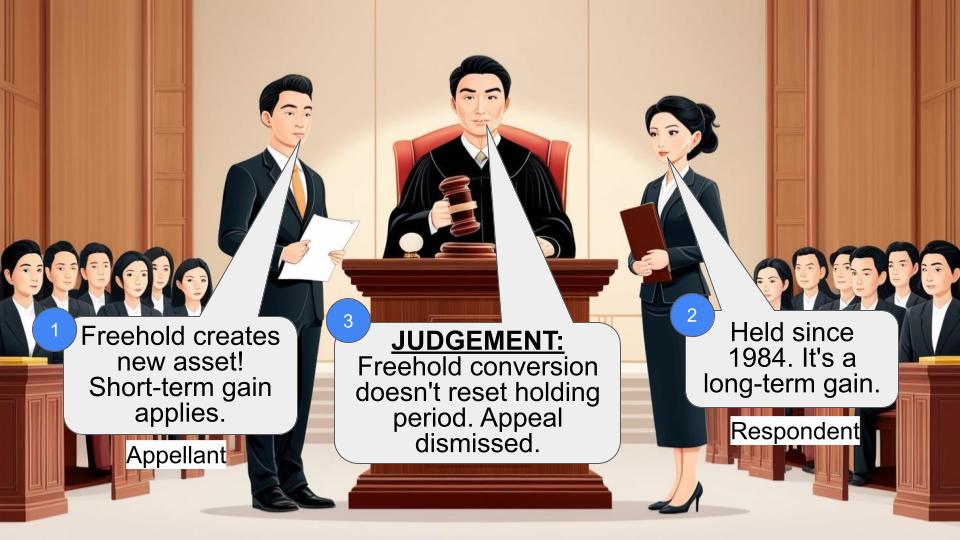
2. The holding period for capital gains tax is calculated from the original lease date, not the freehold conversion date.
3. The nature of title (leasehold or freehold) does not affect the classification of short-term or long-term capital gains.
Issue:
Does the conversion of leasehold property to freehold property affect the calculation of the holding period for determining short-term capital gains tax?
Facts:
1. The assessee held a leasehold property since 1984.
2. On March 29, 2004, the property was converted from leasehold to freehold.
3. The property was sold on March 31, 2004, just two days after the conversion.
4. The tax authorities treated the gain as short-term capital gain, which the assessee disputed.
Arguments:
Revenue's Arguments:
1. After conversion to freehold, superior rights accrued to the assessee.
2. The period between freehold conversion and sale was only three months, justifying short-term capital gains tax.
3. The decision in CIT vs. Dr. V.V. Mody should be considered.
Assessee's Arguments:
1. The property had been held since 1984, exceeding the 36-month threshold for long-term capital gains.
2. Conversion to freehold was merely an improvement of existing rights, not a new acquisition.
Key Legal Precedents:
1. Commissioner of Income-Tax vs. Smt. Rama Rani Kalia (2013) 358 ITR 499 (All): This case established that the difference between short-term and long-term capital assets is based on the holding period, not the nature of the title.
2. Income Tax Appeal No. 36 of 2014 (Commissioner of Income Tax vs. Late Vijay Kumar Soi and another): This case dealt with similar questions and was relied upon by the court in the present judgment.
Judgment:
The High Court dismissed the appeal, ruling in favor of the assessee. Key points of the judgment include:
1. The conversion from leasehold to freehold is considered an improvement of title, not a new acquisition.
2. The holding period is calculated from the original date of acquiring the leasehold (1984), not from the date of freehold conversion.
3. As the property was held for more than 36 months, the gain should be treated as long-term capital gain, not short-term.
4. The court relied on the precedent set in Commissioner of Income-Tax vs. Smt. Rama Rani Kalia, which addressed similar issues.
FAQs:
Q1: What's the difference between short-term and long-term capital gains?
A1: Short-term capital gains arise from assets held for 36 months or less, while long-term capital gains are from assets held for more than 36 months.
Q2: Does converting a property from leasehold to freehold reset the holding period?
A2: No, the conversion is considered an improvement of title and does not reset the holding period for tax purposes.
Q3: How did the court determine the holding period in this case?
A3: The court considered the original date of acquiring the leasehold (1984) as the start of the holding period, not the date of freehold conversion.
Q4: What impact does this judgment have on similar cases?
A4: This judgment reinforces the principle that the nature of title (leasehold or freehold) doesn't affect the classification of capital gains. The holding period is the key factor.
Q5: Can the tax authorities appeal this decision further?
A5: While the judgment doesn't mention further appeals, generally, decisions of High Courts can be appealed to the Supreme Court if there's a substantial question of law involved.

1. Heard Sri Ghan Shyam Chaudhary, learned counsel for appellant; and, Sri Pradeep Agrawal, Advocate, for respondents.
2. This appeal under Section 260A (of Income Tax Act, 1961) (hereinafter referred to as "Act, 1961") has arisen from judgment and order dated 23.06.2014 passed by Income Tax Appellate Tribunal, Lucknow Bench, Lucknow (hereinafter referred to as "Tribunal") in Income Tax Appeal No. 08/LKW/2012 for the Assessment Year 2006- 07. It was admitted on following substantial questions of law:
"I. Whether the learned Income Tax Appellate Tribunal has erred in law in upholding the order of CIT (A) without taking into account the fact that after conversion to freehold, superior right had accrued to the assessee.
II. Whether the learned Income Tax Appellate Tribunal was justified in law in dismissing the appeal of the revenue without taking into account the fact that the difference of period between the date of freehold and date of sale is only three months and, hence, tax is leviable on short term capital gain.
III. Whether the learned Income Tax Appellate Tribunal was justified in giving relief to the assessee without taking into account the decision of CIT Vs. Dr. V.V. Mody 281 ITR page 1.
IV. Whether the learned Income Tax Appellate Tribunal has erred in dismissing the appeal of the department while simply relying upon an order passed by the jurisdictional High Court without establishing that the facts involved therein were identical the facts of the present case."
3. Both the learned counsels for parties, at the outset, stated that similar questions earlier came up for consideration before this Court in Income Tax Appeal No. 36 of 2014 (Commissioner of Income Tax Vs. Late Vijay Kumar Soi and another) and vide judgment dated 11.01.2017 the same have been answered in favour of Assessee and against revenue. The said judgment reads as under:
"1. Heard Sri Ghan Shyam Chaudhary, learned counsel for appellant. Vakalatnama has been filed by Sri Pradeep Agrawal, Advocate, appearing on behalf of respondent. Let the same be taken on record.
2. This appeal under Section 260-A (of Income Tax Act, 1961) (hereinafter referred to as "Act 1961"), preferred by Revenue, relates to Assessment Year 2006-07 and has arisen from judgment and order dated 13.06.2014 passed by Income Tax Appellate Tribunal, Lucknow Bench ''B' Lucknow (hereinafter referred to as ''Tribunal") in Income Tax Appeal no. 278/LKW/2012. It was admitted on following substantial questions of law:
"1. Whether the learned Income Tax Appellate Tribunal has erred in law in upholding the order of CIT (A) without taking into account the fact that after conversion to freehold, superior right had accrued to the assessee.
2. Whether the learned Income Tax Appellate Tribunal was justified in law in dismissing the appeal of the revenue without taking into account the fact that the difference of period between the date of freehold and date of sale is only three months and, hence, tax is leviable on short term capital gain.
3. Whether the learned Income Tax Appellate Tribunal was justified in giving relief to the assessee without taking into account the decision of CIT Vs. Dr. V.V. Mody 281 ITR page 1.
4. Whether the learned Income Tax Appellate Tribunal has erred in dismissing the appeal of the department while simply relying upon an order passed by the jurisdictional High Court without establishing that the facts involved therein were identical the facts of the present case."
3. Learned counsel for parties, at the outset pointed out that these very issues have been considered by this Court in Commissioner of Income-Tax Vs Smt. Rama Rani Kalia, (2013) 358 ITR 499 (All), wherein this Court answered following questions formulated therein:-
"1. Whether the Income-Tax Appellate Tribunal has erred in law upholding the order of Commissioner of Income- Tax (Appeals) without taking into account the fact that after conversion to freehold superior rights accrued to the assessee?
2. Whether the Income-Tax Appellate Tribunal was justified in law in dismissing the appeal of the Revenue without taking into account the fact that the difference of period of between date of freehold and date of sale is only three days, therefore, short term capital gains are to be levied?
3. Whether the Income-Tax Appellate Tribunal was justified in giving relief to the assessee without taking into account the decision of CIT Vs. Dr. V.V. Modi (1996) 218 ITR 1 (Karn).
4. Whether the Income-Tax Appellate Tribunal was justified in law in ignoring the Departmental Valuation Officer's report regarding the stamp valuation?"
4. While answering the aforesaid questions this Court considered the meaning of short-term capital asset, short-term capital gain, long-term capital asset and long-term capital gain, and held as under:-
"The terms 'short-term capital asset' & short-term capital gain' and 'long-term capital asset' & long-term capital gain' have been defined in the Act as follows.
"2 (42-A) "short-term capital asset" means a capital asset held by an assessee for not more than thirty six months immediately preceding the date of its transfer;
2 (42-B) "short term capital gain means capital gain arising from transfer of a short-term capital asset;
2 (29-A) "long term capital asset" means a capital asset which is not a short-term capital asset;
2 (29-B) "long term capital gain" means capital gain arising from the transfer of a long-term capital asset."
The difference between the 'short-term capital' asset and 'long-term capital asset' is the period over which the property has been held by the assessee and not the nature of tittle over the property. The lessee of the property has rights as owner of the property subject to covenants of the lease, for all purposes. He may, subject to covenants of the lease deed, transfer the lease hold rights of the property with the consent of the lessor. The conversion of the rights of the lessee in the property from having lease hold right into free hold is only by way of improvement of her rights over the property, which she enjoyed. It would not have any effect on the taxability of gain from such property, which is related to the period over which the property is held. If the period is less than 36 months, the gain arising from such transfer would be of short-term capital gain.
In the present case, the property was held by the assessee as a lessee since 1984, and the same was transferred on 31.03.2004, after the lease hold rights were converted into free hold rights on the same property which was in her possession, in her favour on 29.03.2004. The conversion was by way of improvement of title, which would not have any effect on the taxability of profits as short term capital gains.
There is no error of law in the order of the Tribunal. The question Nos. 1 and 2, framed in the appeal, are thus decided in favour of the assessee and against the department."
5. The aforesaid judgment is fully applicable to the issues raised in this appeal. In absence of any substantial argument advanced by learned counsel for appellant so as to pursue us to take a different view and in absence of any binding authority of superior Court having taken a different view, we find no hesitation in holding that in the light of discussion made and exposition of law laid down in Commissioner of Income-Tax Vs Smt. Rama Rani Kalia (supra) the questions formulated above in this appeal have to be answered against appellant and the view taken by Tribunal and other Revenue authorities have to be upheld.
6. Accordingly the substantial questions of law raised in this appeal are answered in favour of Assessee and against Revenue.
7. Appeal is dismissed."
4. For the reasons stated in Commissioner of Income Tax Vs. Late Vijay Kumar Soi and another (supra) and following the same, we answer the substantial questions of law, formulated in this appeal, against Revenue and in favour of Assessee.
5. The appeal is, accordingly, dismissed.
Dt. 14.02.2017
×