


Assessing Officer's Limited Power in Book Profit Computation Upheld


Full News

Assessing Officer's Limited Power in Book Profit Computation Upheld
Assessing Officer's Limited Power in Book Profit Computation Upheld
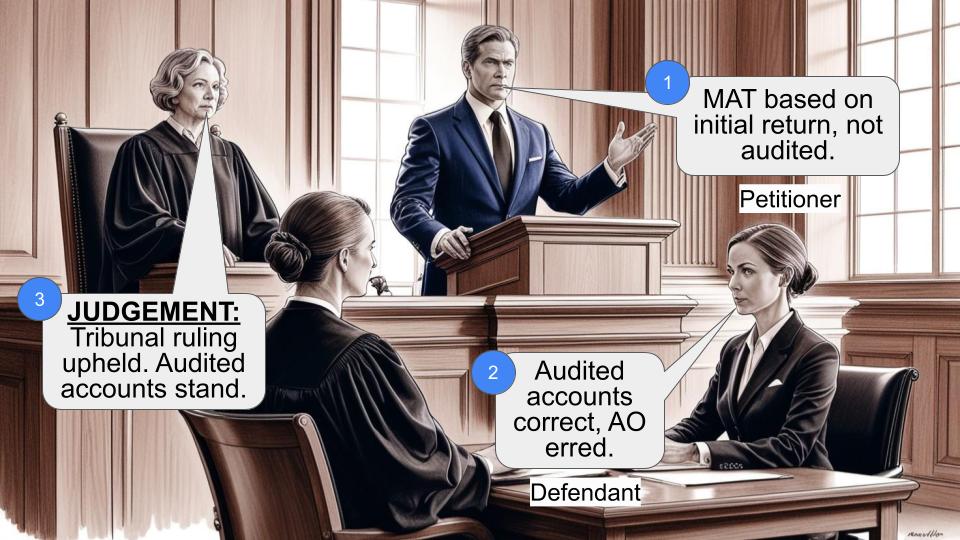
The case involves SRI HARIRAM HOTELS (P) LTD. and the Commissioner of Income Tax-III, focusing on whether capital gains should be included in the book profit for tax purposes under Section 115JB (of Income Tax Act, 1961). The court ruled in favor of the assessee, emphasizing that the Assessing Officer (AO) cannot alter the book profits certified under the Companies Act, except as specified in the Act.
Get the full picture - access the original judgement of the court order here
Case Name:
Sri Hariram Hotels (P) Ltd. Vs Commissioner of Income Tax-III (High Court of Karnataka)
ITA No. 53 of 2009
Date: 16th December 2015
Key Takeaways:
- The AO's power is limited to making specific adjustments as per the explanation to Section 115JB (of Income Tax Act, 1961).
- The court reinforced that the AO cannot conduct a fresh inquiry into the company's certified accounts.
- The judgment aligns with the precedent set by the Supreme Court in Apollo Tyres Ltd. vs Commissioner of Income Tax.
Issue
Should capital gains be included in the book profit for computing tax under Section 115JB (of Income Tax Act, 1961)?
Facts
- SRI HARIRAM HOTELS (P) LTD. was incorporated to run a hotel and purchased land for this purpose.
- The land was later sold, resulting in a capital gain, which the company directly credited to the capital reserve instead of the profit and loss account.
- The AO argued that this capital gain should be included in the profit and loss account for computing book profit under Section 115JB (of Income Tax Act, 1961).
Arguments
- Assessee's Argument: The company maintained its accounts as per the Companies Act, and the AO has no jurisdiction to alter the certified book profits. They relied on the Supreme Court's decision in Apollo Tyres Ltd. vs Commissioner of Income Tax.
- Revenue's Argument: The capital gains should be included in the profit and loss account as per the Companies Act's Schedule VI, and the AO is justified in recomputing the book profit.
Key Legal Precedents
- Apollo Tyres Ltd. vs Commissioner of Income Tax (2002) 255 ITR 273: The Supreme Court held that the AO cannot alter the book profits certified under the Companies Act, except for specific adjustments allowed by the Act.
- C.I.T. Vs. HCL COMNET SYSTEMS AND SERVICES LIMITED (2008) 305 ITR 409: Reinforced the limited power of the AO in adjusting book profits.
Judgement
The court ruled in favor of SRI HARIRAM HOTELS (P) LTD., stating that the AO does not have the power to recompute book profits beyond the specific adjustments allowed under Section 115JB (of Income Tax Act, 1961). The court emphasized reliance on the certified accounts as per the Companies Act.
FAQs
Q1: What was the main legal question in this case?
A1: Whether capital gains should be included in the book profit for tax purposes under Section 115JB (of Income Tax Act, 1961).
Q2: What did the court decide?
A2: The court decided in favor of the assessee, stating that the AO cannot alter the book profits certified under the Companies Act, except for specific adjustments allowed by the Act.
Q3: What precedent did the court rely on?
A3: The court relied on the Supreme Court's decision in Apollo Tyres Ltd. vs Commissioner of Income Tax, which limits the AO's power to adjust book profits.
Q4: What does this mean for companies?
A4: Companies can rely on their certified accounts under the Companies Act for tax purposes, with limited adjustments allowed by the AO under Section 115JB (of Income Tax Act, 1961).

1. This appeal is directed against the order of the Income Tax Appellate Tribunal, Bangalore Bench “A” relating to the assessment year 2003-04.
2. The appeal was admitted to consider the following substantial question of law:
“Whether on the facts and circumstances of the case, the Tribunal is
justified in holding that the income from capital gain should be included for the purpose of computing Book Profit under Section 115JB (of Income Tax Act, 1961)?”
3. Facts in brief are:
The appellant/company was incorporated on 3.2.1992 with an object to commence business of running a hotel. It transpires that for this purpose, it had purchased a land measuring 2 acres 32 guntas at Mahadevapura through public auction from the appropriate authority of the Income Tax Department for Rs.26,60,000/-. The appellant borrowed unsecured loan of Rs.24.00 lakhs from its directors for meeting the purchase consideration of the land. As the Appellant/company could not commence the hotel project in the said land, it was decided to sell the land and the same was sold for Rs.1,22,50,000/- on 23.01.2003. In the books of accounts of the appellant, the loan was capitalized during the financial year ended on 31.03.2003. The appellant created the capital gain of Rs.51,71,820/- arising out of the sale of the land directly to the capital reserve and not to the profit and loss account. The Assessing Officer took the view that the capital gains ought to have been included to the profit and loss account, according to the accounting
standard referred to by him in the assessment order and hence, arrived at a conclusion that the profit shown in the profit and loss account should be increased by the amount of capital gain of Rs.51,71,820/-. The assessee
objected to the inclusion of capital gain to the book profit. However, the Assessing Officer confirmed that the capital gain has to be shown in the profit and loss account, it cannot be straight away credited to the capital reserve.
4. On appeal before the Commissioner of
Income Tax, the appellate authority, following the
judgment of the Bombay High Court in the case of
COMMISSIONER OF INCOME TAX vs VEEKAYLAL
INVESTMENT CO.(P) LTD. ((2001)249 ITR 597 (Bom)
has held that, even under clause 3(xii)(b) of Part II of
Schedule VI to the Companies Act, 1956 (‘Companies
Act’, for short), profit or losses in respect of transactions
of an exceptional or non-recurring nature are to be
disclosed. Thus, held that capital gains should be
included for the purpose of computing book profit. On
further appeal by the assessee before the ITAT, the
Tribunal confirmed the orders passed by the authorities
following the judgment of the Bombay High Court in
Veekaylal’s case (supra) and held that capital gains
should be included for the purpose of computing book
profit. This order passed by the ITAT is challenged in the
present appeal.
5. Learned counsel Sri.S P Bhat appearing along
with Sri C Basavaiah for the appellant submitted that the
authorities under the Income Tax Act,1961 (hereinafter
referred to as the ‘Act’ for brevity) exceeded the
jurisdiction in rescrutinising book profit, declared by the
assessee and approved by the Registrar of Companies.
The Assessing Officer has no power to disturb the profit
shown by the assessee in compliance with the standard
of accounting to be maintained under the Companies
Act. The provisions of Companies Act do not require any
capital gain to be disclosed in the profit and loss account
as a matter of sound accepted accounting practice, the
assessee is entitled to treat the capital gain as a capital
reserve.
The learned counsel would contend that the
purpose of Parts II and III of Schedule VI of the
Companies Act would be only for a limited purpose of
empowering the assessing authority to rely upon the
authentic statements of the account of the company. The
company is obligated to maintain its accounts in the
manner provided by the Companies Act, the same to be
scrutinized and certified by the statutory auditors and
will have to be approved by the Company in its general
meeting and thereafter to be filed before the Registrar of
Companies who has a statutory obligation to examine
and satisfy that the accounts of the company are
maintained in accordance with the requirements of the
Companies Act. In support of this contention, the
learned counsel strongly places reliance on the
Judgment of the Apex Court in APOLLO TYRES LTD. vs
COMMISSIONER OF INCOME TAX (2002) 255 ITR 273.
6. It is vehemently contended that all these
statutory obligations that were required to be followed by
the assessee in accordance with the Companies Act were
followed. The only objection raised by the Income Tax
Authorities was that capital gains cannot be directly
taken into the account of the capital reserve, first, it has
to be included in the profit and loss account for the
purpose of computing book profit under Section 115JB (of Income Tax Act, 1961)
of the Act. The Act provides that income prepared in
accordance with the Companies Act shall be ‘deemed
income’ for the purpose of Section 115JB (of Income Tax Act, 1961).
The Assessing Officer while computing the income under
Section 115JB (of Income Tax Act, 1961) has no power to rescrutinise
the books of accounts certified by the authorities under
the Companies Act. The Authorities as well as the
Tribunal not properly appreciating the Judgment relied
on by the Assessee in the case of Apollo Tyres (supra),
which is subsequent to the Judgment of VEEKAYLAL
(supra), wrongly held that the capital gains should be
included in the profit and loss account for the purpose of
computing book profit.
7. The learned Counsel further places reliance
on the Judgment of the Apex Court in the case of ‘C.I.T.
Vs. HCL COMNET SYSTEMS AND SERVICES LIMITED’
reported in 2008 [305] ITR 409 and the Judgment of
the Calcutta High Court in the case of ‘COMMISSIONER
OF INCOME TAX. WEST BENGAL VS N. GUIN &
COMPANY PVT LTD’ reported in 116 ITR 475.
8. On the other hand, Sri. E.R. Indra Kumar,
learned Senior Counsel assisted by Sri. E.I. Sanmathi
appearing for the Revenue contended that the assessee
has not followed standard accounting system in
maintaining the books of accounts as per the Companies
Act. Clause 3[XII](b) of Part II of Schedule VI to the
Companies Act, contemplates that profit or losses in
respect of transactions of a kind, not usually undertaken
by the company or undertaken in circumstances of an
exceptional or non recurring nature if, material in
amount and miscellaneous income as per Clause-
3(XII)(b) & [c] has to be disclosed in the profit and loss
account which is mandatory requirement, as set out in
these provisions under Schedule VI of the Companies
Act, having not been followed, the Income Tax
Authorities are justified in rescrutinizing the book profit
as per Sub-section (2) of Section 115JB (of Income Tax Act, 1961). It is
further contended that the Judgment of Veekaylal
(supra) is squarely applicable to the facts of the case, as
such the authorities are justified in following the said
Judgment, that the capital gains should be included in
the profit and loss account for the purpose of computing
book profit.
9. It is also submitted that the Judgments of the
Apex Court in the case of Apollo Tyres (supra), and HCL
Comnet Systems (supra), clarifies that the Assessing
Officer does not have the jurisdiction to go behind the
net profit shown in the profit and loss account except to
the extent provided in the explanation to Section 115JB (of Income Tax Act, 1961).
Much emphasis is placed on the explanation appended
to section 115JB (of Income Tax Act, 1961) to contend that the Income Tax
Authorities are empowered to increase the net profit as
shown in the profit and loss account prepared under
Sub-section [2] of Section 115JB (of Income Tax Act, 1961) in the case of amounts
carried to any reserves, by whatever name called, as
specified in clause [b] of the said explanation. The
learned senior counsel has filed a memo placing on
record the copy of Directors’ Report to the Members and
the Auditor’s Report and placed reliance on these reports
to substantiate his contention that Clause[d] of the
Auditor’s report specifies that the profit and loss account
and balance sheet referred to in the report complies
substantially in all material respects, except as stated in
Note-B[2] on accounts which refers to transferring of the
capital gain amount of Rs.51,71,819.20/- to capital
reserve account instead of crediting to profit and loss
account. Thus, it is argued that the books of accounts
maintained by the assessee is not as per the standard of
accounting to be maintained in accordance with the
Companies Act as disclosed in the Auditor’s report. In
view of not maintaining the statutory accounts as per the
Companies Act, the Income Tax Authorities have every
right to rescrutinize the net profit as per the book profit.
The Judgment passed by the Tribunal confirming the
orders of the Authorities is in accordance with the
provisions of the Act and the same cannot be faulted
with. As such, he seeks for dismissal of the appeal
answering the question of law in favour of the Revenue.
10. Heard the learned Counsel appearing for the
parties and perused the record.
11. Section 115JB (of Income Tax Act, 1961) during the relevant
period provides that notwithstanding anything contained in
any other provisions of this Act, in the case of an
assessee being a company, the income tax payable on
the total income as computed under the Act is less than
71⁄2% of the book profit, the tax payable for the relevant
previous year shall be deemed to be 71⁄2% of such book
profit. Thus, the assessee has to first compute the total
income in accordance with the Act and if the total income
is less than 71⁄2% of the book profit, then the assessee has to
prepare profit and loss account for the previous year,
then fictionally, it will be deemed that its total income
chargeable to tax would be an amount equal to 71⁄2% of
such book profit. The Income Tax Officer has computed
the book profit and the regular income. As tax on
regular income is more than tax on book profit, tax on
regular income is adopted. The Authorities have
consistently relied upon Clause 3 (XII[b]) of Part–II of
Schedule VI to the Companies Act, to come to a
conclusion that capital gains has to be mandatorily
taken into profit and loss account while computing the
book profit. That having not been done by the Assessee,
the authorities have recomputed the book profit. At this
juncture, it would be beneficial to refer to the Judgment
of the Apex Court in Apollo Tyres (supra) which is
rendered while dealing with an identical provision of
Section 115J (of Income Tax Act, 1961). It is held thus:
“Therefore, we are of the opinion, the
Assessing Officer while computing the income
under section 115J (of Income Tax Act, 1961) has only the power of
examining whether the books of account are
certified by the authorities under the
Companies Act as having been properly
maintained in accordance with the
Companies Act. The Assessing Officer
thereafter has the limited power of making
increases and reductions as provided for in
the Explanation to the said section. To put it
differently, the Assessing Officer does not
have the jurisdiction to go behind the net
profit shown in the profit and loss account
except to the extent provided in the
Explanation to section 115J (of Income Tax Act, 1961).”
12. In the subsequent Judgment of the Apex
Court in HCL Comnet Systems (supra), following the
Judgment of Apollo Tyres (supra), it is held that the
adjustment required to be made to the net profit
disclosed in the profit and loss account for the purpose
of section 349 of the Companies Act are quite different
from the adjustment required to be made under the
explanation to be made under section 115JA (of Income Tax Act, 1961).
For the purpose of section 115JA (of Income Tax Act, 1961), the Assessing Officer
can increase the net profit determined as per the profit
and loss account prepared as per Parts II and III of
Schedule VI to the Companies Act only to the extent
permissible under the explanation thereto.
13. The explanation appended to Section 115JB (of Income Tax Act, 1961)
provides certain Items which if debited to the profit and
loss account can be added back to the net profit for
computing the book profit. Clause (b) of the said
explanation provides for the amount carried to any
reserves by whatever name called. In the present case,
it is true that the capital gains are directly taken to
capital reserve without taking the said amount of capital
gain to the profit and loss account however, no such
capital gain is debited to the profit and loss account, as
such, the said explanation is not applicable to the facts
of the present case.
14. We have noticed the auditor’s report,
certified with a qualification that the profit and loss
account and balance sheet referred to in the report
comply substantially in all material respects with the
applicable accounting standards referred to in Section
211(3C) of the Companies Act except the land and
building sold during the year, the capital gain has been
transferred directly to capital reserve account instead of
crediting to profit and loss account, which in the opinion
of the directors is more appropriate. However, it is not
disputed that this auditor’s report is accepted by the
General Body, the books of account and the balance
sheet are filed before the Registrar of Companies. It is
also noticed by us that Clause 3(XII)(b) and (c) of Part II
of Schedule VI of the Companies Act provides that profit
and losses in respect of transactions of a kind, not
usually undertaken by the Company or undertaken by
the company or undertaken in circumstances of an
exceptional or non-recurring nature, if material in
amount and miscellaneous income, are required to be
disclosed in the profit and loss account. Considering,
the capital gain income falling under these clauses, it is
incumbent on the Company to disclose the said amount
of capital gain in the profit and loss account. Section
211 of the Companies Act contemplates, form and
contents of balance sheet and profit and loss account.
Sub-sections 3(A),3(B) and 3(C) of Section 211 (of Income Tax Act, 1961) provides
that every profit and loss account and balance sheet of
the company shall comply with the accounting
standards, where the profit and loss account and
balance sheet of the company do not comply with the
accounting standards, such companies shall disclose in
its profit and loss account and the balance sheet the
following mainly:
(a) the deviation from the accounting standards;
(b) the reasons for such deviation; and
the financial effect, if any, arising due to such deviation.
15. For the purpose of Section (3C) of Sec.211 (of Income Tax Act, 1961) of
the Companies Act, the expression “accounting
standards” means the standards of accounting
recommended by the Institute of Chartered Accountants
of India constituted under the Chartered Accountants
Act, 1949 (38 of 1949) as may be prescribed by the
Central Government in consultation with the National
Advisory Committee on Accounting Standards
established under sub-section (1) of Section 210(A) (of Income Tax Act, 1961).
16. The proviso to the said Section 211(3)(C) (of Income Tax Act, 1961) of
the Companies Act makes it clear that the standards of
accounting specified by the Institute of Chartered
Accountants of India shall be deemed to be the
accounting standards until the accounting standards are
prescribed by the Central Government under the sub-
section 3(C) (of Income Tax Act, 1961). The Assessing Officer has placed reliance
on the accounting standards, vide No.9949 dated
25.1.1996 and has held that the transaction of sale
property should have been brought into the profit and
loss account as an extraordinary item since the assessee
has failed to follow the accounting standards,
determined the book profit after allowing the deduction
towards cost as per provision to Section 115JB(2) (of Income Tax Act, 1961) of the
Act. This order is confirmed by the appellate authority
as well as by the ITAT. However, this exercise of the
assessing authorities, in recomputing the book profit of
the assessee is contrary to the principles of law laid
down by the Apex Court in Appollo Tyres (supra). The
Apex Court has held that the only power vested with the
Assessing Officer is to make increases and deductions as
provided in the explanation to Section 115JB (of Income Tax Act, 1961).
Assessing Officer has no power to embark upon a fresh
enquiry in regard to the entries made in the books of
accounts of the company. In the light of the judgment of
Apollo Types (supra), we are of the opinion that the
Assessing Officer has no power to recompute the book
profit and has to rely upon the authentic statements of
accounts of the company, the accounts being
scrutinized and certified by the statutory auditors
though with a qualification, approved by the company in
general body meeting and thereafter filed before the
Registrar of Companies, who has a statutory obligation
to examine and be satisfied that the accounts of the
company are maintained in accordance with the
requirements of the Companies Act.
17. Accordingly, we answer the substantial
question of law in favour of the assessee and against the
revenue. For the foregoing reasons, appeal is allowed.
Sd/-
JUDGE
Sd/-
JUDGE
×
Similar Ripples
Questions
Assessing Officer's Limited Power in Book Profit Computation Upheld
Write your CommentSimilar Posts


Generic
- Reportdata/3229.pdf
