


Charitable Trust Eligible for Tax Exemption Despite Mixed Religious and Charita…


Full News
Charitable Trust Eligible for Tax Exemption Despite Mixed Religious and Charitable Objectives
Charitable Trust Eligible for Tax Exemption Despite Mixed Religious and Charitable Objectives
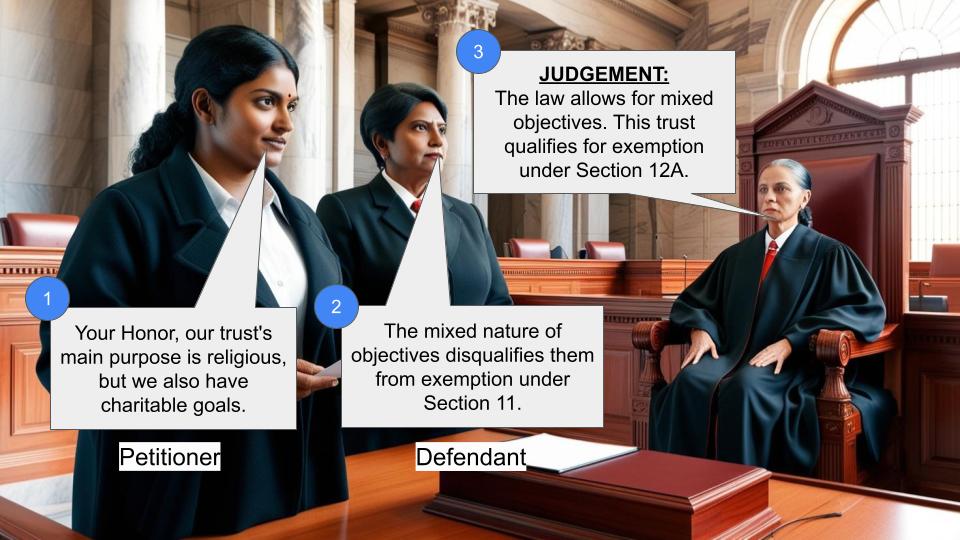
This case involves a dispute between the Commissioner of Income Tax and a charitable trust called the Katie Wilcox Education Association. The key issue was whether the trust was eligible for tax exemption under Section 12A (of Income Tax Act, 1961), given that its main objective was religious in nature, with other objectives being a mix of charitable and religious purposes. The High Court ultimately ruled in favor of the trust, finding that it was eligible for the exemption.
Case Name:** Commissioner of Income Tax vs. Katie Wilcox Education Association **Key Takeaways:** 1. A charitable trust can still qualify for tax exemption under Section 12A (of Income Tax Act, 1961) even if its main objective is religious in nature, as long as its other objectives are a mix of charitable and religious purposes. 2. The court relied on the precedent set in the Seervi Samaj Tambaram Trust case, which established that a trust with mixed charitable and religious objectives can be eligible for exemption. 3. The court dismissed the revenue's appeal, finding no substantial question of law that warranted further consideration. **Issue:** Whether the charitable trust was eligible for tax exemption under Section 12A (of Income Tax Act, 1961), given that its main objective was religious in nature and its other objectives were a mix of charitable and religious purposes. **Facts:** The Katie Wilcox Education Association is a charitable trust that was seeking tax exemption under Section 12A (of Income Tax Act, 1961). The main objective of the trust was religious in nature, while its other objectives were a mix of charitable and religious purposes. The Commissioner of Income Tax challenged the trust's eligibility for the exemption, arguing that the mixed nature of its objectives meant it was not eligible under Section 11 (of Income Tax Act, 1961). **Arguments:** - The Commissioner of Income Tax argued that the trust's mixed objectives, with some being religious in nature, meant it was not eligible for exemption under Section 11 (of Income Tax Act, 1961) and therefore should not be granted exemption under Section 12A (of Income Tax Act, 1961). - The trust argued that despite its mixed objectives, its main purpose was religious in nature, and it should still be eligible for exemption under Section 12A (of Income Tax Act, 1961). **Key Legal Precedents:** - The court relied on the decision in the case of Director of Income Tax (Exemptions) v. Seervi Samaj Tambaram Trust, [2014] 362 ITR 199, which established that a trust with mixed charitable and religious objectives can still be eligible for tax exemption. - The court also referenced Section 13(1)(a) (of Income Tax Act, 1961) and (b) of the Income Tax Act, which deal with the conditions for forfeiting tax exemption. **Judgment:** The High Court ruled in favor of the Katie Wilcox Education Association, finding that it was eligible for tax exemption under Section 12A (of Income Tax Act, 1961). The court followed the precedent set in the Seervi Samaj Tambaram Trust case, which held that a trust with mixed charitable and religious objectives can still qualify for exemption. The court dismissed the revenue's appeal, finding no substantial question of law that warranted further consideration. **FAQs:** 1. **Q:** Why was the trust eligible for tax exemption despite having mixed religious and charitable objectives? **A:** The court found that even though the trust's main objective was religious in nature, its other objectives were a mix of charitable and religious purposes. Based on the precedent set in the Seervi Samaj Tambaram Trust case, the court ruled that a trust with such mixed objectives can still be eligible for tax exemption under Section 12A (of Income Tax Act, 1961). 2. **Q:** What were the key legal principles established in this case? **A:** The key legal principles established in this case were: - A charitable trust can still qualify for tax exemption under Section 12A (of Income Tax Act, 1961) even if its main objective is religious in nature, as long as its other objectives are a mix of charitable and religious purposes. - The court relied on the precedent set in the Seervi Samaj Tambaram Trust case, which established that a trust with mixed charitable and religious objectives can be eligible for exemption. 3. **Q:** What was the outcome of the case? **A:** The High Court ruled in favor of the Katie Wilcox Education Association, finding that it was eligible for tax exemption under Section 12A (of Income Tax Act, 1961). The court dismissed the revenue's appeal, finding no substantial question of law that warranted further consideration.

PRAYER in T.C.(A) No.270 of 2014: Appeal under Section 260A (of Income Tax Act, 1961) against the order of the Income Tax Appellate Tribunal 'A' Bench, Chennai, dated 19.8.2011 made in I.T.A.No.1446/Mds/2011.
PRAYER in T.C.(A) No.829 of 2013: Appeal under Section 260A (of Income Tax Act, 1961) against the order of the Income Tax Appellate Tribunal 'C' Bench, Chennai, dated 22.2.2013 made in I.T.A.No.2147/Mds/2012.
For Appellant : Mr.M.Swaminathan in both appeals Standing Counsel Tax Case (Appeal) No.270 of 2014 is filed by the Revenue challenging the order of the Income Tax Appellate Tribunal 'A' Bench, Chennai, dated 19.8.2011 made in I.T.A.No.1446/Mds/2011, raising the following questions of law:
(i) Whether the Tribunal was right in granting exemption under Section 12A (of Income Tax Act, 1961) when the main object of the assessee is religious in nature and other objects are admixture of charitable and religious in nature which are not eligible for exemption under Section 11 (of Income Tax Act, 1961)?
(ii)Whether the Tribunal was right in its perverse inference when the assessee trust has mixed objects and the assessee was hit by the provisions of Clauses (a) and (b) of Section 13(1) (of Income Tax Act, 1961), because of the objects contained in III.A.1 and III.A.6 of the Memorandum?
(iii)Whether the Tribunal was right in following the decision of the Supreme Court in State of Kerala v. M.P.Shanthi Verma Jain, (1998) 231 ITR 787?
2. T.C.(A) No.829 of 2013 is filed by the Revenue challenging the order of the Income Tax Appellate Tribunal 'C' Bench, Chennai, dated 22.2.2013 made in I.T.A.No.2147/Mds/2012, for the assessment year 2009-2010, raising the following questions of law:
(i) Whether the Tribunal was right in granting exemption under Section 10(23C)(iiiab) (of Income Tax Act, 1961) when the institution was neither wholly nor substantially financed by the Government during the assessment year?
(ii)Whether the Tribunal was right in granting exemption when the assessee forfeited the exemption under Sections 11 (of Income Tax Act, 1961) and 12 (of Income Tax Act, 1961) read with Section 13(1)(b) (of Income Tax Act, 1961) in view of clause IIIA(1) and IIIA(6) of the Memorandum of Association?
(iii)Whether the Tribunal was right in dismissing the department appeal when the earlier order of the same assessee is under challenge by the department before this Court and the same is pending disposal?
3. Mr.M.Swaminathan, learned Standing Counsel appearing for the Revenue fairly submits that the questions of law raised in T.C.(A) No.270 of 2014 have already been answered against the Revenue by this Court in Director of Income Tax (Exemptions) v. Seervi Samaj Tambaram Trust, [2014] 362 ITR 199.
4. He further submits that the order passed by the Tribunal, which is the subject matter of appeal in T.C.(A) No.829 of 2013, is a consequential order passed on the basis of the order impugned in T.C.(A) No.270 of 2014 and, therefore, the T.C.(A) No.829 of 2013 may be disposed of in terms of the order to be passed in T.C.(A) No.270 of 2014.
5. In the light of the decision of this Court in Seervi Samaj Tambaram Trust case, referred supra, the substantial questions of law raised in T.C.(A) No.270 of 2014 are answered against the Revenue and T.C.(A) No.270 of 2014 is dismissed.
6. It is seen that the order impugned in T.C.(A) No.829 of 2013 is passed based on the order under challenge in T.C.(A) No.270 of 2014. As this Court is dismissing T.C.(A) No.270 of 2014, nothing survives for determination in T.C.(A) No.829 of 2013 and accordingly, the same is dismissed finding no question of law, much less substantial question of law, warranting consideration of this Court.
In the result, both the appeals are dismissed.
(R.S.J.) (R.K.J.)
18.11.2014
×
Similar Ripples
Questions
Charitable Trust Eligible for Tax Exemption Despite Mixed Religious and Charitable Objectives
Write your CommentSimilar Posts


Generic
- Reportdata/4343.pdf
