


Court Allows Deduction of Pre-Project Expenses for Industrial Development Corpo…



Full News
Court Allows Deduction of Pre-Project Expenses for Industrial Development Corporation
Court Allows Deduction of Pre-Project Expenses for Industrial Development Corporation
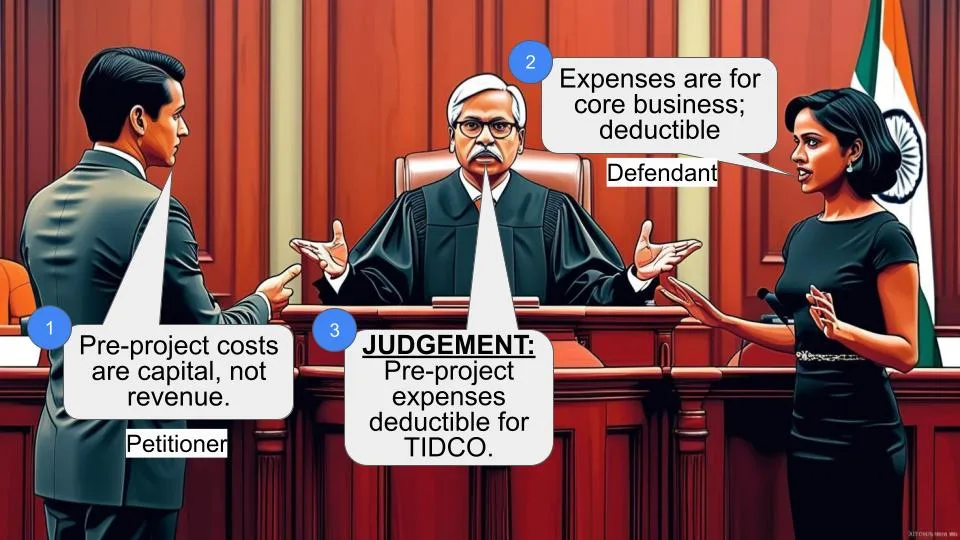
An interesting case here involving the Tamil Nadu Industrial Development Corporation Ltd. (TIDCO) and the Commissioner of Income Tax. Basically, TIDCO wanted to deduct some pre-project expenses from their taxes, but the tax department wasn't having it. The case went through a few rounds of appeals, and finally, the High Court sided with TIDCO, allowing them to deduct these expenses. It's a win for companies involved in promoting industrial development.
Get the full picture - access the original judgement of the court order here
Case Name:
Commissioner of Income Tax Vs Tamilnadu Industrial Development Corporation Ltd. (High Court of Madras)
Tax Case (Appeal) Nos.1485 and 1486 of 2007
Date: 28th November 2007
Key Takeaways:
1. State industrial development corporations can deduct pre-project expenses as revenue expenditure.
2. The court distinguished between expenses for setting up new industries and those for promoting industrial development.
3. This decision supports the business model of state-run industrial development corporations.
Issue:
The main question here is: Can a state industrial development corporation deduct pre-project expenses as revenue expenditure, even when the projects haven't been shelved?
Facts:
1. TIDCO is a corporation that promotes industrial development in Tamil Nadu through partnerships with private enterprises.
2. For the 1994-95 assessment year, TIDCO tried to write off Rs. 8,98,706 as pre-project expenses for 13 projects they were promoting.
3. The tax officer said, "Hold up, these projects haven't even started yet!" and disallowed the claim.
4. In the 1999-2000 assessment year, TIDCO made a similar claim for Rs. 18,31,054, which was actually allowed by the tax officer.
5. The case went through multiple appeals, eventually landing at the High Court.
Arguments:
TIDCO's side: "Hey, these expenses are part of our regular business of promoting industrial development. We should be able to deduct them!"
Tax department's side: "Not so fast! These projects aren't even off the ground yet. It's too early to write off these expenses. Plus, they might be capital expenditure, not revenue."
Key Legal Precedents:
1. CIT V. SESHASAYEE BROTHERS P.LTD (127 ITR 218): This case supported TIDCO's position. It involved a managing agency company that was allowed to deduct expenses for investigating and promoting new industrial projects.
2. E.I.D. PARRY (INDIA) LTD., VS. CIT (257 ITR 253): The tax department cited this case, where expenses for setting up a new project were considered capital expenditure. However, the court found this case different from TIDCO's situation.
Judgement:
Good news for TIDCO! The High Court agreed with the Income Tax Appellate Tribunal and allowed the deduction of pre-project expenses. They said:
1. TIDCO's main business is promoting industrial development, not setting up new industries themselves.
2. The expenses were incurred as part of their regular business activities.
3. The case is similar to the Seshasayee Brothers case, where such expenses were allowed as deductions.
4. The court dismissed the tax department's appeal.
FAQs:
1. Q: What does this mean for other state industrial development corporations?
A: They might also be able to deduct similar pre-project expenses, but it would depend on their specific circumstances and business model.
2. Q: Does this apply to all companies trying to set up new projects?
A: Not necessarily. The court distinguished between companies setting up their own new projects and those promoting industrial development. It's best to consult with a tax professional for specific cases.
3. Q: Why did the court treat this case differently from the E.I.D. Parry case?
A: The court noted that TIDCO's business model of promoting industrial development was different from a company setting up its own new industrial unit.
4. Q: Does this mean all pre-project expenses are now deductible?
A: Not exactly. The court's decision was based on TIDCO's specific business model. Each case would need to be evaluated based on its own facts and circumstances.
5. Q: What's the main takeaway for businesses from this judgment?
A: The nature of the business and the purpose of the expenses are crucial in determining whether pre-project expenses can be deducted as revenue expenditure.

1. The Revenue has filed these ta 1994-95 and 1999-2000.
2. The assessee is Tamilnadu Industrial Investment Corporation Ltd., and the main object of the assessee is to promote industrial development in the State through partnership with private enterprises, either as Joint sector or as associate sector or as escort sector. During the course of its business for the assessment year 1994-95 the assessee claimed to write off a sum of Rs.8,98,706/- being the pre project expenses in respect of 13 projects. Those projects were being promoted by the assessee in joint venture. The assessing officer found that the prox case appeals against the order of the Income Tax Appellate Tribunal, Madras 'B' Bench dated 04.09.2006 made in I.T.A.Nos.1413/Mds/2000 & 937(Mds)/2003. The relevant assessment years arejects were yet to come up and there was no situation to warrant that the projects have been shelved. He disallowed the claim as prematured. For the assessment year 1999-2000, the assessee made a similar claim in a sum of Rs.18,31,054/-, which was allowed by the assessing officer.
3. The assessee filed appeals in respect of both the assessment years although the order for the year 1999-2000 in respect of the pre project expenses was favourable to the assessee, before the Commissioner of Income Tax (Appeals). The Commissioner of Income Tax (Appeals) confirmed the order of the assessing officer in respect of the pre project expenses for the assessment year 1994-95. In respect of the assessment year 1999-2000 though the Commissioner of Income Tax (Appeals) considered a sum of Rs.29,52,391/- being expenditure on unsuccessful project written off, which was the subject matter of appeal, ultimately concluded that the working of the business loss arrived at by the assessing officer made it clear that he had not made a disallowance of the sum of Rs.29,52,391/- as has been represented by the assessee and thus concluded that the issue did not survive.
4. Against the orders of the Commissioner of Income Tax Appeals, the assessee and the revenue filed second appeals before the Income Tax Appellate Tribunal. The Tribunal held in favour of the assessee by following the decision of this Court in the case of CIT V. SESHASAYEE BROTHERS P.LTD (127 ITR 218). The correctness of the said order is now canvassed in the present tax case appeals by formulating the following substantial question of law :
Whether on the facts and circumstances of the case, the Tribunal was right in holding that the write off of pre-project expenses was correct in law, when there is a clear factual finding that the projects had not been shelved as not viable and that the write off was premature?
5. Learned counsel appearing for the revenue submitted that this Court in somewhat similar set of facts in the case of E.I.D. PARRY (INDIA) LTD., VS. CIT (257 ITR 253) observed that when the assessee incurred the expenditure for the purpose of setting up a new project, it was clearly in the capital field and not in the revenue field. The abandonment of that project was the abandonment of a project on which capital expenditure had been incurred. The expenditure incurred on that capital project was not something which could be regarded as revenue expenditure laid out exclusively and wholly for the purposes of business of the assessee as what the assessee was trying to start was a new business for the manufacture of a new product. The expenditure incurred therein was clearly capital expenditure and not revenue expenditure. Relying on the said decision the counsel appearing for the revenue sought to argue that the order of the Tribunal is erroneous in nature and requires consideration from this Court.
6. We heard the arguments of the counsel appearing for the revenue and perused the materials available on record.
7. We are not able to concur with the argument of the counsel for the revenue. The assessee, in the above cited decision, was a company which has expended the amounts for the purpose of putting up a new industrial unit. Here, in this case, the assessee is not an industry and it is a State Industrial Development Corporation Ltd., with the object of financing private parties for the purpose of promotion of industrial development either as joint sector or as associate sector or as escort sector. It financed the private parties for the purpose of putting up industries. That makes a total difference between the case with which reliance has been made by the learned counsel for the revenue. However, the Tribunal placed reliance on the decision of this Court in the case of CIT v. SESHASAYEE BROTHERS P. LTD. (127 ITR 218), wherein the assessee, a managing agency company had been investigating several projects and wherever feasible, promoting new industrial undertakings. If the new undertakings materialised the expenses were transferred and recovered from the new unit and the assessee secured the office of managing agents of technical consultancy or the like and earned profits. If, however, the project was unsuccessful, the assessee company wrote off the expenses. In its assessment for 1966-67 and 1967-68 the assessee claimed deduction of the sum of Rs.9,865/- and Rs.10,785/- respectively which were project expenses incurred by it in a newsprint paper mill project which did not materialise. The Tribunal held that as the assessee's business was promotion of new ventures, the project expenditure was incidental to the business and hence could not be treated as preliminary or capital in nature and accordingly, allowed the same. The revenue carried the matter on appeal before this Court. This Court, after analysing the various judgments, ultimately held that the expenses incurred by the assessee were in the course of the business as promoters of companies or as managing agents and with a view to augmenting their income and consequently held that the Tribunal was right in its conclusion that the sums in question were allowable as revenue expenditure.
8. The case on hand would be squarely covered by the ratio laid down by the Division Bench of this Court in the case of CIT v. SESHASAYEE BROTHERS P. LTD. (127 ITR 218). Hence, we do not find any question of law for entertainment of the appeals. The appeal are dismissed. No costs. The connected miscellaneous petition is dismissed.
(K.R.P.,J.) (C.V.,J.)
28.11.2007
Index : Yes
Internet :Yes
To
1. The Assistant Registrar, Income Tax Appellate Tribunal, III Floor, Rajaji Bhavan, Besant Nagar, Madras 90.
2. The Secretary, Central Board of Revenue, New Delhi.
3. The Deputy Commissioner of Income Tax, Special Range VIII, Chennai 34.
K.RAVIRAJA PANDIAN, J.
And
CHITRA VENKATARAMAN, J.
×
Similar Ripples
Questions
Court Allows Deduction of Pre-Project Expenses for Industrial Development Corporation
Write your CommentSimilar Posts
Generic
- Reportdata/5135.pdf
