


Court Clarifies Turnover Calculation for Tax Deduction: Sundry Sales In, Conver…


Full News

Court Clarifies Turnover Calculation for Tax Deduction: Sundry Sales In, Conversion Charges Out
Court Clarifies Turnover Calculation for Tax Deduction: Sundry Sales In, Conversion Charges Out
This case involves the Commissioner of Income Tax (CIT) and a metal powder manufacturing company. The dispute centered around the calculation of turnover for tax deduction purposes under Section 80HHC (of Income Tax Act, 1961). The court ruled that conversion charges should not be included in the turnover, but sundry sales should be included.
Get the full picture - access the original judgement of the court order here
Case Name:
Commissioner of Income Tax Madurai VS Metal Powder Company Limited (High Court of Madras)
TC(A). Nos. 1246 and 1247 of 2005
Date: 7th June 2012
Key Takeaways:
1. Conversion charges are not part of turnover for Section 80HHC (of Income Tax Act, 1961) deduction calculations.
2. Sundry sales, being part of gross total income, must be included in turnover for Section 80HHC (of Income Tax Act, 1961) deductions.
3. The court relied on previous judgments to make these distinctions.
4. The case provides clarity on what constitutes turnover for tax deduction purposes.
Issue:
Should conversion charges and sundry sales be included in the total turnover for calculating deductions under Section 80HHC (of Income Tax Act, 1961)?
Facts:
1. The case pertains to the assessment year 1994-95.
2. The assessee (Metal Powder Company Limited) is engaged in the manufacture of metal powder.
3. The dispute arose over various aspects of the company's tax assessment, including the calculation of turnover for deduction purposes.
4. The case went through multiple levels of appeal, from the Assessing Officer to the Income Tax Appellate Tribunal, before reaching the High Court.
Arguments:
Revenue's Argument:
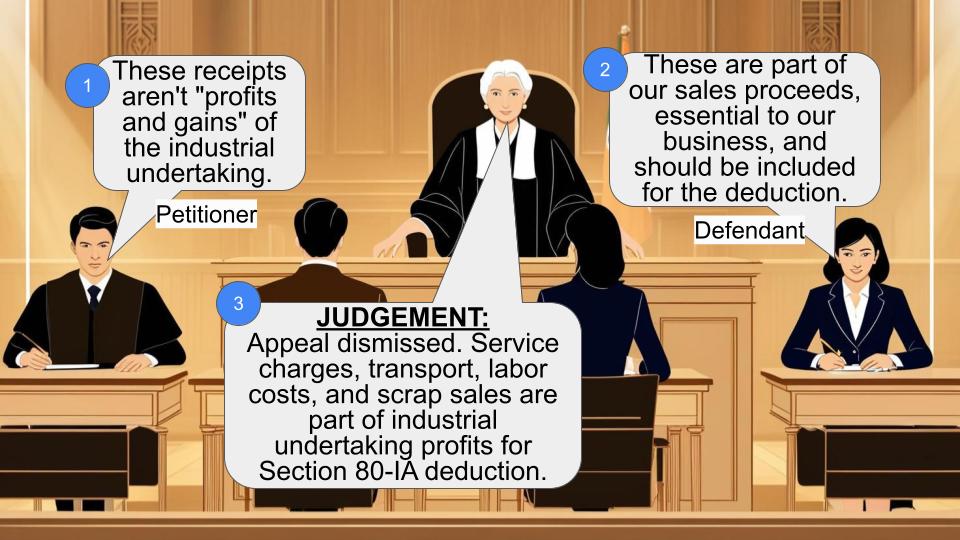
- Conversion charges and sundry sales should be included in the total turnover for calculating deductions under Section 80HHC (of Income Tax Act, 1961).
Assessee's Argument:
- Conversion charges and sundry sales should not be part of the turnover calculation for Section 80HHC (of Income Tax Act, 1961) deductions.
Key Legal Precedents:
1. CIT v. Coimbatore Twisters Pvt Ltd (330 ITR 45): This case established that conversion charges are not includible in total turnover for Section 80HHC (of Income Tax Act, 1961) deduction calculations.
2. CIT v. Ravindranathan Nair (295 ITR 228): This Supreme Court decision was applied to determine that sundry sales should be included in the turnover calculation.
3. CIT v. Madras Motors Ltd (257 ITR 60): This case was initially referenced by the Tribunal but was superseded by the Supreme Court decision in Ravindranathan Nair.
Judgement:
1. Conversion Charges: The court agreed with the previous decision in CIT v. Coimbatore Twisters Pvt Ltd, ruling that conversion charges are not includible in the total turnover for Section 80HHC (of Income Tax Act, 1961) deduction calculations.
2. Sundry Sales: The court ruled in favor of the Revenue, stating that sundry sales, being part of the gross total income as profit of the business, must be included in the total turnover for Section 80HHC (of Income Tax Act, 1961) deduction purposes. This decision was based on the Supreme Court's ruling in CIT v. Ravindranathan Nair.
FAQs:
1. Q: What is Section 80HHC (of Income Tax Act, 1961)?
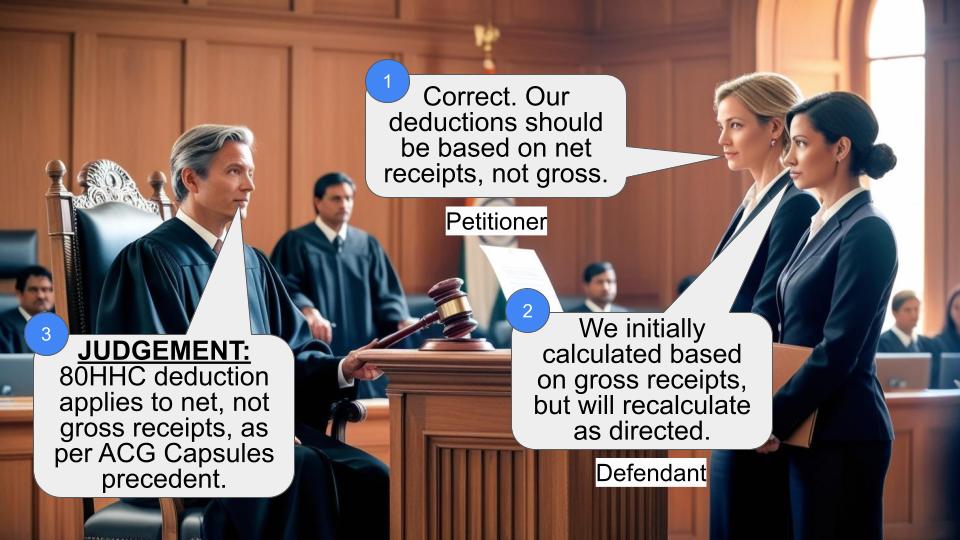
A: Section 80HHC (of Income Tax Act, 1961) provides for deductions on profits from export business. The calculation of these deductions depends on the total turnover of the business.
2. Q: Why are conversion charges not included in the turnover?
A: The court followed the precedent set in the Coimbatore Twisters case, which established that conversion charges are not part of the main business turnover for this specific tax deduction.
3. Q: Why are sundry sales included in the turnover?
A: Sundry sales, typically from scraps of manufactured goods, are considered part of the gross total income and profit of the business. Therefore, they must be included in the turnover calculation.
4. Q: How does this judgment affect businesses?
A: This judgment provides clarity on what should be included in turnover calculations for Section 80HHC (of Income Tax Act, 1961) deductions. Businesses will need to include sundry sales but can exclude conversion charges when calculating their turnover for this purpose.
5. Q: Is this judgment final?
A: While this is a High Court judgment, it relies on Supreme Court precedents, particularly for the sundry sales issue. However, it could potentially be appealed to the Supreme Court if either party chooses to do so.

1. The Revenue has preferred the appeals as against the order of the Income Tax Appellate Tribunal relating to assessment year 1994-95. The above Tax Case (Appeals) was admitted on the following substantial questions of law:-
"(i) Whether in the facts and circumstances of the case, the Tribunal was right in holding that conversion charges and sundry sales does not form part of the turnover, for the purpose of calculation of deduction under Section 80HHC (of Income Tax Act, 1961)?
(ii) Whether in the facts and circumstances of the case, the Tribunal was right in allowing a deduction of the amounts spent on replacement of independent machinery as revenue expenditure?
(iii) Whether in the facts and circumstances of the case, the Tribunal was right in holding that the profit margin of goods captively consumed is to be excluded for the purpose of deduction under Section 80HH (of Income Tax Act, 1961)?
(iv) Whether in the facts and circumstances of the case, the Tribunal was right in allowing depreciation on the windmills when the actual commissioning of the windmill took place only after the end of the relevant accounting period?"
2. Although notice was served on the respondent, there is no appearance in person or through the counsel. As such, after hearing learned standing counsel for the Revenue and on going through the records, present order is passed.
3. The assessee herein is engaged in the manufacture of metal powder. In the return filed by the assessee for the assessment year 1994-95, the Assessing Officer disallowed the claim on replacement expenditure of machinery and held that expenditure is capital in nature. Apart from this, the Assessing Authority also disallowed the claim of depreciation on wind mills on the ground that the actual commissioning of the windmill took place only after the relevant accounting period. Yet another issue considered by the Assessing Authority related to exclusion of profit margin of goods captively consumed for the purpose of deduction under Section 80HH (of Income Tax Act, 1961) and conversion charges and sundry sales as forming part of the turnover for the purpose of calculation of deduction under Section 80HHC (of Income Tax Act, 1961). In the appeal preferred against the order of the Assessing Authority, the first Appellate Authority pointed out that as far as the claim on expenditure on replacement of machinery is concerned, one of the items related to oxygen analyser which was necessary to maintain oxygen in the ball mill. Since the whole machinery was not performing well, new machines were installed. They being independent item of machinery, the Commissioner of Income Tax (Appeals) held that the addition of sum of Rs.7,32,277/- was in order and disallowed the claim on the expenditure incurred on the purchase of new machinery. Thus, the Commissioner of Income Tax (Appeal) took the view that replacement had brought about enduring benefit by the installation of new machines, the expenditure was capital in nature.
4. As far as the expenditure incurred on replacement of SS Shell and SS 304 Shell is concerned, the Income Tax Officer pointed out that the assessee got this fabricated and packed with refractories, bricks etc. The Commissioner of Income Tax (Appeals) held that the assessee had replaced the machines purchased from outside parties and they being independent machinery, they could not be regarded as revenue expenditure. Thus, a sum of Rs.11,04,654/- plus Rs.5,52,750/- was confirmed.
5. As regards the other machineries, the Commissioner of Income Tax (Appeals) however agreed with the assessee that they were revenue expenditure. As regards the disallowance of claim in depreciation of wind mill, the Electricity Board certified that the wind mills were put on use on 31.3.1994, thus the Commissioner of Income Tax (Appeals) agreed with the assessee and directed to grant the depreciation on wind mill as per law.
6. As regards the claim on inclusion of conversion charges and sundry sales, the Commissioner of Income Tax (Appeals) held that they form part of the turnover, hence, includable for the purpose of working out the relief under Section 80HHC (of Income Tax Act, 1961). On the question of captively consumed materials, for which profit margin was to be included for the purpose of deduction under Section 80HH (of Income Tax Act, 1961), the Commissioner of Income Tax (Appeals) held against the assessee. Thus, the appeal filed by the assessee was partly allowed and partly confirmed the assessment order. Aggrieved by the same, the assessee and the Revenue went on appeal before the Tribunal.
7. As far as the assessee's appeal is concerned, it is related to claim under Section 80HH (of Income Tax Act, 1961) on the inclusion of conversion charges and sundry sales as part of the turnover and the claim on capital expenditure on the cost of fabrication and supply of S.S.Shell and computation of deduction under Section 80HH (of Income Tax Act, 1961) with regard to wind mill as well as with regard to transfer price of brass powder and copper powder to the gold bronze unit which was increased by including the gross profit. The Tribunal upheld the contention of the assessee in respect of all the claims. As regards the Revenue's appeal, the depreciation claim on wind mills was however rejected by accepting the fact that the State Electricity Board had given a certificate that the wind mill was commissioned. As regards the replacement of certain machinery, considered as revenue expenditure, the Tribunal confirmed the order of the Commissioner of Income Tax (Appeals) and hence the present appeal.
8. As far as the claim on depreciation on wind mill is concerned, considering the fact that the department itself had not questioned the State Electricity Board's certificate that the wind mill was commissioned during the year under consideration, being a factual finding, we have no hesitation in rejecting the Revenue's appeal. Consequently, the fourth question is answered against the Revenue.
9. As regards the inclusion of profit margin of goods captively consumed, herein too, the Tribunal considered in the assessee's appeal that the items were transferred from one unit to another by the same company, hence, the assessee could not make profit from itself. Therefore, the profit margin element had to be excluded. Considering the above fact, we have no hesitation in rejecting the Revenue's appeal.
10. As far as the question regarding inclusion of conversion charges and sundry sales as forming part of the turnover is concerned, the Tribunal held that the conversion charges and the sundry charges did not form part of the turnover for the purpose of deduction under Section 80HH (of Income Tax Act, 1961). Learned standing counsel for the Revenue fairly submitted that this Court had already considered the similar claim in the decision reported in 330 ITR 45 CIT v. COIMBATORE TWISTERS PVT. LTD, wherein this Court held that conversion charges were not includable in the total turnover for the purpose of working out the deduction under Section 80 (of Income Tax Act, 1961) HHC. Consequently, the said issue is necessarily answered against the Revenue.
11. As far as sundry sales are concerned, it is seen from the order of the Commissioner of Income Tax (Appeals) that the Commissioner of Income Tax (Appeals) pointed out that it related to scraps from manufactured goods by the assessee. Being a sale, it formed part of the turnover. In considering the said issue, the Tribunal however referred to the decision of this Court reported in 257 ITR 60 CIT v. MADRAS MOTORS LIMITED. However, considering the decision of the Apex Court reported in 295 ITR 228 CIT v. RAVINDRANATHAN NAIR, we have no hesitation in applying the said decision to sundry sales. The sundry sales being part of the gross total income as profit of the business, the same has to be included in the total turnover. Thus, applying the decision of the Apex Court referred to above, as far as sundry sales are concerned, we answer the question in favour of the Revenue and that the sundry sales form part of the turnover for the purpose of deduction under Section 80HHC (of Income Tax Act, 1961).
12. This leaves us with one question to consider as regards the amount spent on replacement of independent machinery. Except for a general question raised that the Tribunal was not correct in allowing the deduction of the amounts spent on replacement of independent machinery as revenue expenditure, there is no specific question raised as regards any one of those expenditure. As already pointed out, the Commissioner of Income Tax (Appeals) considered the cost of oxygen analyser as replacement of old one and held it to be a capital expenditure. So too, as regards the SS shell. As far as the first item, oxygen analyser is concerned, going by the narration in the order of the Commissioner of Income Tax (Appeals) as well as in the order of the Assessing Authority, we have no hesitation in agreeing with the Revenue's contention that the cost of replacement of the machinery has to be capitalised.
13. As far as replacement of SS Shell is concerned, considering the fact that what was done was only refurnishing of the existing one and packed with refractories, bricks etc., applying the decision of the Apex Court reported in 293 ITR 201 CIT v. SARAVANA SPINNING MILLS P. LTD, we have no hesitation in holding that it is a current repairs. As regards other machineries considered as revenue expenditure, we confirm the order of the Tribunal since the all items of the parts of the machines were replaced. Hence, the said question stands answered against the Revenue.
14. In the light of the above, only as regards first question of law, the other questions of law are answered against the Revenue. The Tax Case (Appeals) are partly allowed. No costs.
To
1. The Commissioner of Income Tax Madurai
2. The Income Tax Appellate Tribunal, B Bench, Chennai
×
Questions
Court Clarifies Turnover Calculation for Tax Deduction: Sundry Sales In, Conversion Charges Out
Write your CommentSimilar Posts

Generic
- Reportdata/5799.pdf
