


Full News

Court Denies Interest Claim for Non-Commercial Advances to Related Parties
Court Denies Interest Claim for Non-Commercial Advances to Related Parties
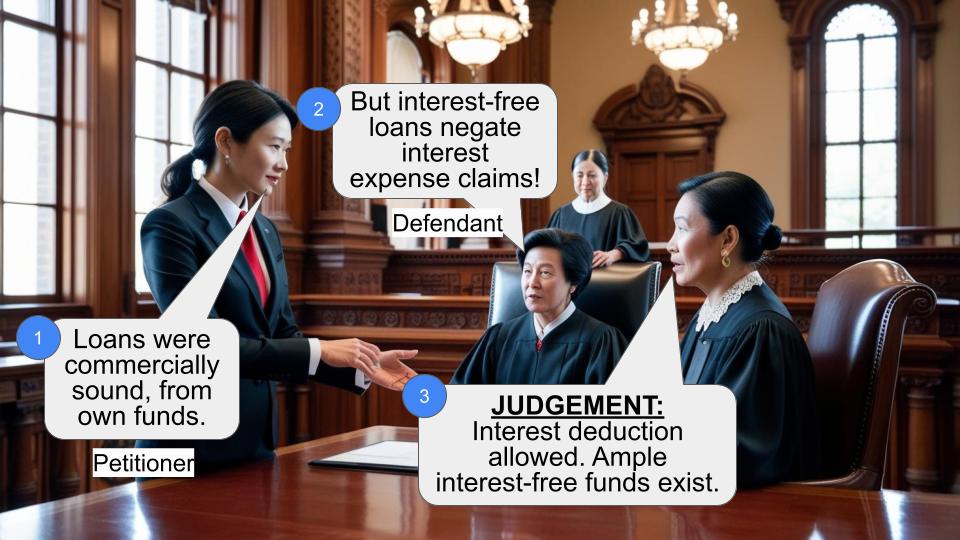
Hey there! So, we've got a case here where a company (the assessee) tried to claim interest payments as a deduction on their taxes. The catch? They were borrowing money and paying interest on it, but then giving interest-free loans to related companies. The tax authorities weren't having it, and the court agreed. Basically, they said, "If you're not making money on these loans, why should we let you deduct the interest you're paying?"
Case Name**: TNK GOVINDARAJU CHETTY & CO. PVT. LIMITED VS ASSISTANT COMMISSIONER OF INCOME TAX **Key Takeaways**: 1. Companies can't claim interest deductions if they're giving interest-free loans to related parties without good business reasons. 2. The court looks at the whole picture - if you're borrowing at interest but lending for free, that's a red flag. 3. "Commercial expediency" is key - you need to prove that these interest-free loans somehow benefit your business. **Issue**: The main question here is: Can a company claim interest payments as a deduction when it's giving interest-free advances to related parties without any clear business reason? **Facts**: Alright, let's break this down: 1. The assessee is a private company that shows movies (they're in the business of exhibiting films) 2. In their tax returns, they tried to offset their interest payments against interest income 3. They gave big interest-free loans to related companies 4. At the same time, they were borrowing money and paying interest on it 5. The tax officer noticed that the borrowed funds were less than what the company had given as interest-free loans 6. This happened in the assessment years 2004-05 and 2005-06 **Arguments**: The assessee's side: - They claimed they had enough non-interest bearing funds to give these interest-free loans - They argued it was done for "commercial expediency" (basically, it was good for business) The tax department's side: - They said there was no evidence that these loans were necessary for the assessee's business - They pointed out that the assessee was paying interest on borrowed money while giving interest-free loans, which doesn't make business sense **Key Legal Precedents**: The judgment doesn't mention specific case laws, but it does refer to the principle of "commercial expediency". This is a common concept in tax law where expenses need to be justified as necessary for the business to be tax-deductible. **Judgement**: The court sided with the tax department. Here's why: 1. They found no "commercial expediency" in the assessee's actions 2. The court pointed out that the assessee borrowed money from a person, paid interest on it, and then gave interest-free loans to the same person. They asked, "Where's the commercial expediency in that?" 3. The assessee couldn't prove that these interest-free loans benefited their business in any way 4. The court also didn't buy the argument about having enough non-interest bearing funds, saying profits can't be determined until the end of the year In the end, the court dismissed the assessee's appeal and upheld the tax department's decision to disallow the interest claim **FAQs**: 1. Q: What does "commercial expediency" mean in this context? A: It means having a valid business reason for an expense. The court is looking for proof that the interest-free loans somehow benefited the company's business. 2. Q: Can companies never give interest-free loans to related parties? A: They can, but if they want to claim interest payments as a tax deduction, they need to show how these loans benefit their business. 3. Q: What's the main lesson for businesses from this case? A: Be careful with related-party transactions. If you're borrowing money and paying interest, but then giving interest-free loans, the tax department might question your interest deductions. 4. Q: Does this mean all interest payments were disallowed? A: In this case, yes. The court restored the Assessing Officer's original decision to disallow the interest payments. 5. Q: What could the company have done differently? A: They could have either charged interest on the loans to related parties or provided clear evidence of how these interest-free loans benefited their business operations.

The above Tax Case (Appeals) are filed by the assessee as against the orders of the Income Tax Appellate Tribunal raising the following substantial questions of law:
"i) Whether on the facts and in the circumstances of the case, the Income Tax Appellate Tribunal was right in law in disallowing the interest payment of Rs.7,08,742/- for the assessment year 2004 -05 and Rs.6,56,783/- for the assessment year 2005-06?
ii) Whether on the facts and in the circumstances of the case, the Tribunal was right in law in disallowing the interest payment when the interest free advances given to sister concern is out of own funds and out of commercial expediency?
iii) In any event, whether on the facts and in the circumstances of the case, the Tribunal was right in law in disallowing the interest payment of Rs.6 lakhs which represents interest paid on Fixed Loan of Rs.50.00 lakhs received from M/s.T.N.K.Govindaraju chetty a firm in earlier years and which has no relation to subsequent interest free advances?"
2. The appellant/assessee is a private limited company engaged in the business of exhibition of cine films. The assessee, in the Profit and Loss Account, netted the interest payments against the interest income received and had admitted only the balance as income for the assessment years in question. It is seen from the order of the Assessing Officer that the assessee had given substantial non-interest bearing advances to related parties with outstanding balances due to the assessee. The Assessing Officer found that the total interest payment incurred by the assessee includes payment to an associated firm of the assessee. The Assessing Officer also found that the assessee was found to be diverting its funds to its associate concerns without charging any interest, but on the other hand, was incurring substantial interest outlay by borrowing funds, which were less than own funds of the assessee company lying with associated concerns. The Assessing Officer observed that no evidence has been adduced by the assessee to prove that the said expenditure had to be necessarily incurred in the interests of the business and no explanation has been furnished as to how the said advances/loans to related parties, which were totally interest free, have benefitted the assessee company. Accordingly, the Assessing Officer,apart from other claims, disallowed the claim of interest paid by the assessee.
3. Aggrieved by the order of the Assessing Officer, the assessee preferred an appeal before the Commissioner of Income Tax (Appeals), who after relying upon various decisions, directed the Assessing Officer to delete the addition made, thereby allowed the claim made by the assessee.
4. Aggrieved by the order of the Commissioner of Income Tax (Appeals), the Revenue preferred appeals before the Income Tax Appellate Tribunal. The Tribunal, agreed with the view of the Revenue, allowed the appeals filed by the Revenue holding that the advancement of non-interest bearing funds to related parties was not compelled by any commercial expediency and the assessee had not proved any commercial expediency.
5. Aggrieved by the order of the Income Tax Appellate Tribunal, the assessee is before this Court.
6. Heard learned counsel appearing for the assessee and the learned standing counsel appearing for the Revenue.
7. We have perused the order of the Tribunal and we find no merits in these appeals. As we find from the order of the Tribunal, in paragraph 13, the facts are very lucid and clear that the assessee had borrowed from a person by paying interest, but has given non-interest bearing advances to the same person and hence, there is no commercial expediency. For better clarity, the relevant portion of the order of the Tribunal reads as follows:
"13. We have considered the rival submissions. A perusal of the assessment order clearly shows that for the assessment year 2004-05 out of an interest payment of Rs.7,09,530/-, an amount of Rs.6,00,000/- has been paid to M/s.TNK Govindaraju Chetty. Further a perusal of the assessment order clearly shows that for the assessment year 2004-05 the non-interest bearing advance given to M/s.TNK Govindaraju Chetty is Rs.36,17,000/- and for the assessment year 2005-06 it increased to Rs.46,82,779/-. Thus what is noticed is that the assessee has borrowed from the same person by paying interest but has given non- interest bearing advances to the same person. Where is the commercial expediency? The assessee has been unable to explain this transaction. Once this interest portion is removed, the interest payments to the banks are but minor. This clearly shows that the advancement of non-interest bearing funds to related parties is not compelled by any commercial expediency. The assessee has also not proved before us any commercial expediency in regard to any of the interest-free advances given to the related parties. The claim of the assessee that it had adequate non-interest bearing funds to give the interest-free advances is seen otherwise insofar as the non-interest bearing funds available with the assessee is in the form of profits of the year which obviously cannot be determined until the end of the year. Even assuming that these funds were available, it would have to be seen in line with the cash book of the assessee. Here it would be pertinent to note that the resolution to advance the amounts to one of the concerns, namely M/s.Glenrock Estates P. Ltd. to an extent of Rs.250 lakhs was held on 22.04.2002, i.e. at the beginning of the financial year whereas the profits could be determined only during the end of the financial year. In the circumstances, we are of the view that the finding of the learned CIT(A) on this issue is liable to be reversed and we do so. In the circumstances, the disallowance of interest as made by the Assessing Officer stands restored and the finding of the learned CIT(A) stands reversed on the issue."
8. It is evident from the findings of the Tribunal that there is no commercial expediency for the assessee to pay interest. Hence, we find no error in the order of the Tribunal. Accordingly, we find no question of law much less any substantial question of law arises for consideration in the above appeals.
R.SUDHAKAR,J.
AND
R.KARUPPIAH,J.
9. In the result, both the Tax Case (Appeals) stand dismissed. No costs. Consequently, M.P.No.1 of 2014 is also dismissed.
Index :Yes/No (R.S.,J) (R.K.,J)
Internet:Yes/No 29.10.2014
To
1. The Income Tax Appellate Tribunal 'B' Bench, Chennai.
2. The Commissioner of Income Tax (Appeals)-VI, Chennai.
3. The Joint Commissioner of Income-tax, Media Range, Chennai - 600 034.
T.C.(A) Nos.763 & 764 of 2014
×
Similar Ripples
Questions
Court Denies Interest Claim for Non-Commercial Advances to Related Parties
Write your CommentSimilar Posts


Generic
- Reportdata/4456.pdf
