


Court Invalidates Reassessment Notice: Full Disclosure Bars Reopening Beyond 4 …


Full News
Court Invalidates Reassessment Notice: Full Disclosure Bars Reopening Beyond 4 Years
Court Invalidates Reassessment Notice: Full Disclosure Bars Reopening Beyond 4 Years
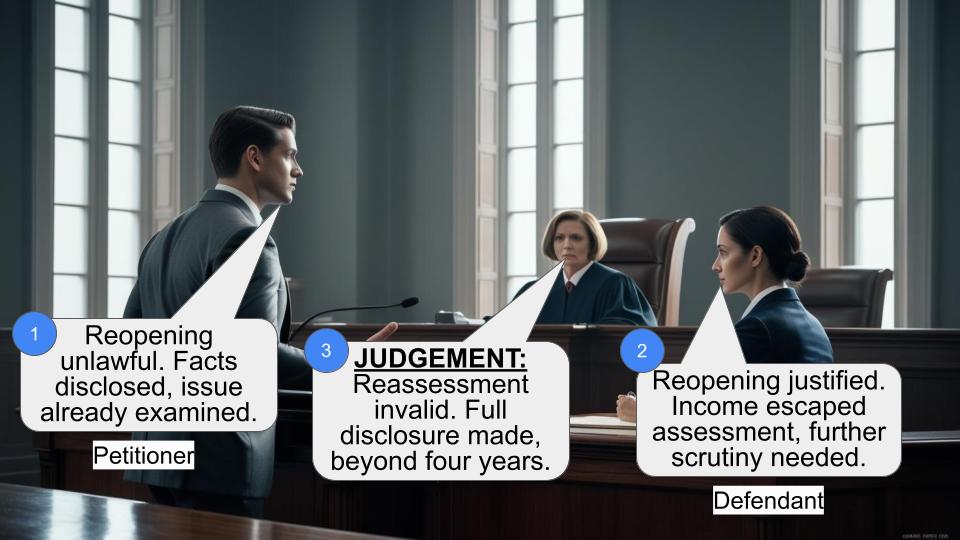
This case involves Mastek Ltd. (the assessee) and the Assistant Commissioner of Income Tax. The dispute centers around the tax department’s attempt to reopen an assessment beyond the four-year limitation period. The High Court ruled in favor of the assessee, invalidating the reassessment notice due to the assessee’s full disclosure of material facts in the original return.
Get the full picture - access the original judgement of the court order here
Case Name
Mastek Ltd. Vs Assistant Commissioner of Income Tax (High Court of Gujarat)
Special Civil Application No. 14571 of 2015
Date: 11th September 2015
Key Takeaways
- Reassessment beyond four years is not allowed if the assessee has fully disclosed all material facts.
- The tax department can’t reopen assessments just to change their original opinion.
- Full disclosure in the original return and explanations during scrutiny protect against reassessment.
- The court’s decision reinforces the importance of taxpayers providing complete information upfront.
Issue
Can the tax department reopen an assessment beyond four years when the assessee had made full disclosures in the original return and provided explanations during the scrutiny assessment?
Facts
- Mastek Ltd. filed their tax return, disclosing details about telecommunication charges for exporting computer software.
- They explained that these charges weren’t considered for computing export turnover as they were fixed in nature.
- During the original assessment, the Assessing Officer examined this issue.
- The assessee provided a detailed six-page explanation on December 26, 2011, clarifying the telecommunication expenses and freight and insurance charges.
- Later, the tax department tried to reopen the assessment beyond the four-year limitation period.
- Mastek Ltd. challenged this reopening by filing a petition in the High Court.
Arguments
Here’s what both sides were saying:
Mastek Ltd. (the assessee):
- They argued that they had fully disclosed all material facts in their original return.
- They pointed out that the issue was already examined during the original assessment.
- They contended that reopening the assessment would allow the tax officer to change their original opinion, which isn’t permitted by law.
Tax Department:
- While the judgment doesn’t explicitly state their arguments, we can infer that they believed there was some income that had escaped assessment.
- They likely argued that they had the right to reopen the assessment to examine this issue further.
Key Legal Precedents
The judgment doesn’t mention specific legal precedents, but it does refer to some important legal principles:
- The requirement for reopening an assessment beyond four years is that income chargeable to tax must have escaped assessment due to the assessee’s failure to disclose all material facts fully and truly.
- The principle that changing an opinion is not a valid ground for reopening an assessment.
Judgement
The High Court ruled in favor of Mastek Ltd., invalidating the reassessment notice. They said:
- The assessee had made full disclosures in the original return.
- The issue was already examined during the original assessment, and the assessee had provided a detailed explanation.
- Allowing reassessment would essentially permit the tax officer to change their original opinion, which isn’t allowed.
- The court emphasized that reopening an assessment beyond four years is not permissible when the assessee has fully disclosed all material facts.
The court also issued an interim order allowing the reassessment proceedings to continue but prohibited passing a final order without the court’s permission.
FAQs
Q: Why is the four-year period significant in this case?
A: The Income Tax Act typically allows reassessment within four years. Beyond that, stricter conditions apply, including proving that the assessee didn’t disclose all material facts.
Q: What does “changing opinion” mean in this context?
A: It means the tax officer can’t reopen an assessment just because they’ve changed their mind about a decision they made during the original assessment.
Q: Does this mean assessments can never be reopened after four years?
A: Not exactly. They can be reopened if the tax department can prove that the assessee failed to disclose material facts fully and truly.
Q: What’s the takeaway for taxpayers from this case?
A: It highlights the importance of making full and true disclosures in your original tax returns and during any scrutiny assessments. This can protect you from reassessments beyond the four-year period.
Q: Did the court completely stop the reassessment proceedings?
A: No, the court allowed the proceedings to continue but ordered that no final decision could be made without the court’s permission.

1. Mr. B. S. Soparkar, learned advocate for the petitioner has invited the attention of the court to an order dated 17.2.2014 made by this court in the assessee’s own case in Special Civil Application No.2147 of 2014 wherein the court had on identical facts, issued notice to the respondents and restrained them from passing final order without the leave of the court.
2. Having heard the learned advocate for the petitioner as well as having regard to the above order passed by this court, Issue Notice returnable on 6th October, 2015. By way of ad- interim relief, the respondent is permitted to proceed further with the re-assessment proceedings, however, the final order shall not be passed thereon without the leave of this court.
3. Direct service is permitted.
(HARSHA DEVANI, J.)
(A.G. URAIZEE, J.)
×
Questions
Court Invalidates Reassessment Notice: Full Disclosure Bars Reopening Beyond 4 Years
Write your CommentSimilar Posts


Generic
- Reportdata/3188.pdf
