


Court mandates extension of income tax return filing deadlines amid COVID-19 ch…







Full News

Court mandates extension of income tax return filing deadlines amid COVID-19 challenges.
Court mandates extension of income tax return filing deadlines amid COVID-19 challenges.
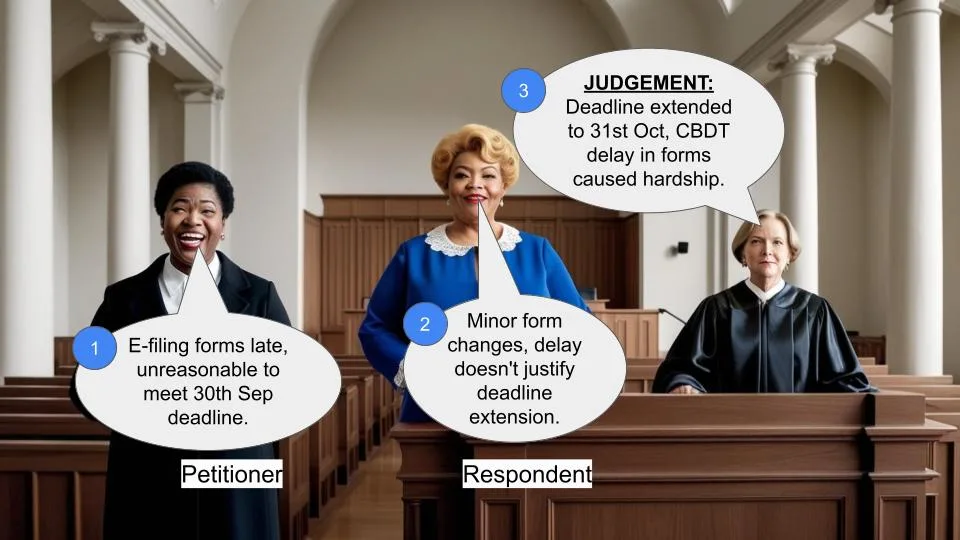
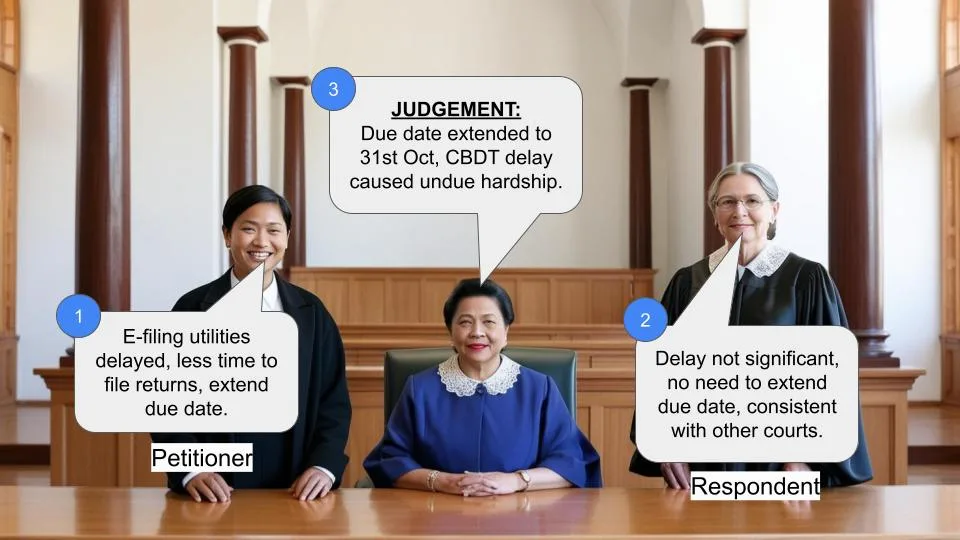
In this case, the petitioners, represented by S.N. Soparkar, sought a writ of mandamus to compel the Central Board of Direct Taxes (CBDT) to extend the due dates for filing income tax returns and tax audit reports due to the difficulties posed by the COVID-19 pandemic. The court ultimately ruled in favor of the petitioners, granting the requested extensions.
Get the full picture - access the original judgement of the court order here
Case Name:
All Gujarat Federation of Tax Consultants Vs Union of India (High Court of Gujarat)
R/Special Civil Application No. 13653 of 2020
Date: 8th January 2021
Key Takeaways:
- The court recognized the extraordinary circumstances of the COVID-19 pandemic as a valid reason for extending tax filing deadlines.
- The decision emphasizes the importance of providing taxpayers and tax practitioners adequate time to comply with tax regulations.
- The ruling reinforces the court’s role in ensuring that government agencies act fairly and justly, especially during crises.
Issue
Did the CBDT have the authority to extend the deadlines for filing income tax returns and tax audit reports in light of the COVID-19 pandemic?
Facts
- The petitioners included a trust and a practicing Chartered Accountant, who argued that the pandemic severely hindered their ability to meet tax compliance deadlines.
- The CBDT had previously extended the due date for filing tax audit reports from September 30, 2020, to October 31, 2020, but the petitioners sought further extensions.
- The petitioners claimed that the last-minute changes in tax compliance requirements created undue hardship.
Arguments
- Petitioners’ Arguments: They argued that the pandemic made it impossible to complete necessary audits and file returns on time. They requested an extension of the deadlines to January 31, 2021, to allow adequate time for compliance.
- Respondents’ Arguments: The CBDT contended that sufficient time had already been provided for filing returns and that the deadlines should not be extended further, as it would disrupt tax collection processes.
Key Legal Precedents
- The court referenced Section 119 (of Income Tax Act, 1961), which grants the CBDT the authority to issue orders and directions for the proper administration of tax laws.
- The court also cited UCO Bank v. CIT, (1999) 4 SCC 599, emphasizing that the CBDT’s powers are beneficial and should be exercised to prevent undue hardship to taxpayers.
Judgement
The court ruled in favor of the petitioners, directing the CBDT to extend the due dates for filing income tax returns and tax audit reports. The court highlighted the need for the government to act justly and efficiently, especially during the pandemic, and ordered that the necessary notifications be issued to reflect the new deadlines.
FAQs
Q1: What does this ruling mean for taxpayers?
A1: Taxpayers now have extended deadlines to file their income tax returns and tax audit reports, providing them with more time to comply with tax regulations.
Q2: How did the court justify the extension?
A2: The court recognized the extraordinary circumstances of the COVID-19 pandemic, which created significant challenges for taxpayers and tax practitioners.
Q3: What is the significance of Section 119 (of Income Tax Act, 1961)?
A3: This section empowers the CBDT to issue orders that can relax tax compliance requirements, ensuring that taxpayers are not unduly burdened.
Q4: Will this ruling affect future tax compliance deadlines?
A4: While this ruling specifically addresses the pandemic situation, it sets a precedent for considering extraordinary circumstances in future tax compliance matters.

1. The draft amendment is allowed. The same shall be carried out at the earliest.
2. By this writ application under Article 226 of the Constitution of India, the writ applicants have prayed for the following relief:
“The petitioners, therefore, prays that this Hon'ble Court be pleased to issue a writ of mandamus or a writ in the nature of mandamus or a writ of certiorari or a writ in the nature of certiorari or any other appropriate
writ, direction or order and be pleased to:
(a) direct the respondent No.2 henceforth not make any alternations in
Forms and Utilities or changes in tax compliance requirements, after the
beginning of the Assessment year in which the same are made applicable;
providing the tax payers and the tax practitioners a clear period of 183
and 214 days to prepare and submit the due reports and forms
respectively.
(b) direct the respondent No.2 to extend the due date for filing the Income
Tax Returns (ITR) and Tax Audit Reports (TAR) for AY 202021 to
31.01.2021.
(c) any other and further relief deemed just and proper be granted in the
interest of justice.
(d) to provide for the cost of this petition.”
3 The facts giving rise to this writ application may be summarised as
under:
3.1 The writ applicant No.1 is a Trust formed and registered in
accordance with the provisions of the Bombay Public Trust Act, 1950
(for short, “the Act, 1950”) and has, as it members, the various
professions and various associations of professionals from the State of
Gujarat engaged in the field of practicing taxation. The writ applicant
No.2 is a practicing Chartered Accountant and a CoChairman of the
representation committee of the writ applicant No.1. Mr. S. N. Soparkar,
the learned Senior Counsel assisted by Mr. B. S. Soparkar, the learned
counsel appearing for the writ applicant would submit that having
regard to the covid19 pandemic situation, the CBDT i.e. the respondent
No.2 herein thought fit to extend the due date for filing the tax audit
report from 30th September 2020 to 31st October 2020 in the case of all
those assessees who are required to get their books of account audited.
Mr. Soparkar wants this Court to issue a writ of mandamus to the Union
of India, Ministry of Finance, to ask the CBDT to exercise its powers
vested in it under Section 119 (of Income Tax Act, 1961) (for short,
“the Act, 1961”) by extending the due date of 31st October 2020 at least
for three months i.e. upto 31st January 2021 for the purpose of both : (1)
filing the ITR and (2) tax audit report in case of assessees whose
accounts are required to be audited. Mr. Soparkar would submit that in
line with the reality of covid 19 pandemic and due to orders and
directives for work places from the Central Government Home Ministry
regarding “Work for Home”, “Staggering of work / Business hours” and
“reduced workforce” it is impossible for the Tax Practitioners to
complete the Audit work to issue a certificate required under section
44AB within the extended due date of 30.10.2020. It is submitted that as
reflected in the data released by the respondent No.2, for 2019 as many
as 55% of the Income Tax Returns and Tax Audit Reports were filed
outside of office hours which shows the sheer burden of workload upon
the Tax Practitioners to work overtime to complete the assignment. It is,
therefore, submitted that in the year 2020 with covid infections and
safety measures, such work is not possible. Mr. Soparkar would submit
that the Ministry of Law and Justice has in fact recognized the reality of
the situation and extended en mass time limits (except otherwise
specified) of the specified Acts to 31st March 2021 which falls during the
period from 30th March 2020 to 31st December 2020 vide the Taxation
and Others Laws (Relaxation and Amendment of Certain Provisions) Act,
2020. Even in the specified extensions, in many cases, the effective
extensions are substantial ranging to 3 to 6 months. It is, therefore,
submitted that a meagre extension of one month in case of the filing of
return of income under Section 139 (of Income Tax Act, 1961) is violative of Article 14 and Article
19(1)(g) of the Constitution of India being manifestly arbitrary,
discriminatory and unreasonable. Mr. Soparkar would submit that as
stated by this High Court in Special Civil Application No.15075 of 2015,
there is a duty cast upon the respondents to ensure that necessary utility
for efiling of the incometax returns is made available to various
categories of assessees at the beginning of the assessment year so that
the assessees can plan their tax matters accordingly. However, the
amendment in the forms with additional requirements and utilities for e-
filing of returns being available only belatedly curtails the time available
for filing the incometax returns. It is submitted that the amendment in
rules and disclosure requirements as late as on 1st October 2020 has
effectively given only 30 days (as opposed to extended 214 days) to the
Chartered Accounts to furnish the Tax Audit Report. Also, the belated
issuance of the ITR forms have also curtailed the effective time period.
Any user who file ereturn will have to create an XML file based on the
schema. The schema is needed by those, software companies and
organizations who wish to use this code to help create their own
software utility for filing up these forms. Due to frequent changes in
schema or utility, third party services providers will have to upgrade
their software which may take about 5 to 6 days to upgrade, depending
upon nature of change. It is further submitted that more than 50% of the
Income Tax Returns and Tax Audit Reports were efiled in 2019 using
private softwares and therefore, the issuance of Schema and Validation
Rules before sufficient time is also crucially important for the same. Mr.
Soparkar further submitted that due to delay in eenabling of return of
forms, the effective time available for filing return of income becomes
very less and cause severe hardship to the assessees and the tax
practitioners. Tax Audit of accounts of an assessee is a detailed and time
consuming exercise, wherein the Chartered Accountant is required to
vouch for and certify the correctness of the details provided in the TAR.
Understanding the need for the thoroughness of the Audit, the
legislators, in their wisdom, have statutorily granted a reasonable time
beginning from the Assessment Year on 1st of April. It may be noted that
only after such thorough audit of accounts of an assessee is carried out,
then a computation of the actual tax liability of an assessee can take
place and ITR can be filed. Arbitration alternation of such mandatorily
required details causes genuine and grave hardship upon the assessees,
and the principle of natural justice only mandates that such introduction
be made in systematic manner accounting for time line to take into
account the changes brought in.
3.2 Mr. Soparkar invited the attention of this Court to the chart as
below to give a fair idea as regards the delay caused in release of the
utility to efile the forms:
ITR/Form Due date of filing(original)
Due date of filing (extended) Time available (extended)
Date of availability of efiling utility
Effective time available
ITR 1 31.07.2020 30.11.2020 244 days 02.06.2020 182 days
ITR 2 31.07.2020 30.11.2020 244 days 26.06.2020 158 days
ITR 3 31.07.2020 30.11.2020 244 days 31.07.2020 123 days
ITR 4 31.07.2020 30.11.2020 244 days 05.06.2020 179 days
ITR 5 31.07.2020 30.11.2020 244 days 25.08.2020 98 days
ITR 6 31.07.2020 30.11.2020 244 days 10.10.2020 52 days
ITR 7 31.07.2020 30.11.2020 244 days 03.09.2020 89 days
Form Due date of filing (original)
Due date of filing (extended) Time available (extended)
Date of updation of utility
Effective time available
3CA, 3CB, 3CD
30.09.2020 31.10.2020 214 days 25.08.2020 67 days
DELAY IN AMENDING 3CA/3CB/3CD FORM
Date on which form / rules are amended Date of providing amended form / utility'1.10.2020 Awaited as on 19.10.2020
4. It is submitted that the decision of the respondent No.2 to
introduce the new forms to be made applicable 30 days prior to the due
date and to subsequently amend the utility without corresponding
extension of the due date to efile is without any basis and contrary to
law.
5. Mr. Soparkar, in support of his aforesaid submissions, has placed
strongly reliance on the following two decisions of this High Court:
(1) All Gujarat Federation of Tax Consultants vs. Central
Board of Direct Taxes [2014] 50 taxmann.com 115 (Gujarat)
[Special Civil Application No.12571 and 12656 of 2014
decided on 22nd September 2014]
(2) All Gujarat Federation of Tax Consultants vs. Central
Board of Direct Taxes [2014] 50 taxmann.com 115 (Gujarat)
[Special Civil Application No.15075 of 2015 decided on 29th
September 2015]
6. Mr. Soparkar would submit that in both these cases upon which
reliance is placed, the tendency of the respondents to make multiple last
minute changes was criticized. In both the judgements, directions were
issued to grant additional time for filing returns.
7. Mr. Soparkar also pointed out that a detailed representation has
been filed addressed to the Union Finance Minister of India dated 12th
October 2020 at Annexure : I to this writ application (page : 108).
However, there is no response in this regard at the end of the respondent
No.1 till this date.
8. In such circumstances referred to above, Mr. Soparkar prays that
there being merit in this writ application, the same may be considered
accordingly.
9. On the other hand, this writ application has been vehemently
opposed by Mr. Varun Patel, the learned Senior Standing Counsel
appearing for the respondents Nos.2 and 3 respectively. Mr. Patel
pointed out that so far as ITR – 1 and ITR – 4 is concerned, the time
limit expires on 10th January 2021. The Tax Audit Reports are to be
submitted by 15th January 2021 and the returns are to be filed by 15th
February 2021. He would submit that for the Assessment year 202021,
the due date for filing the ITR and TAR under the Act has been extended
earlier considering the covid19 pandemic as under:
[a] The due date for filing income tax returns for A.Y.202021 was
extended vide the Taxation and Other Laws (Relaxation and
Amendment of Certain Provisions) Act, 2020 to 30th November
2020. Subsequently, vide notification S.O. 3906 (E) dated 29th
Oct, 2020, the due dates were further extended to 31st Jan. 2021
for cases in which tax audit report under section 44AB (of Income Tax Act, 1961) is required
to be filed and 31st Dec. 2020 for others.
[b] Since as per Section 44AB (of Income Tax Act, 1961) due date for filing tax audit report
is one month prior to the due date for return, the due date for
filing of tax audit report was also extended to 31st Oct. 2020 vide
Taxation and Other Laws (Relaxation and Amendment of Certain
Provisions) Act, 2020 and extended further to 31st Dec. 2020 vide
notification S.O. 3906(E) dated 20th Oct. 2020.
[c] Subsequently vide notification S.O. 4805(E), the due dates
were further extended to 15th February, 2021 for cases in which
tax audit report under Section 44AB (of Income Tax Act, 1961) is required to be filed and
10th January, 201 for others.
10. Mr. Patel would submit that based on Notified Forms, the software
for preparation of ITRs have been prepared and the date of release of 1st
version of ITR utilities in efiling portal is as per table below. Due to
changes in Notified Form or Press releases the ITR preparation software
have been modified / are being modified:
ITR utility Date of release of ITR utility in efiling portal
ITR1 '02 June 2020
ITR2 '26 June 2020
ITR3 '31 July 2020
ITR4 '05 June 2020
ITR5 '25 Aug 2020
ITR6 '22 Sept 2020
ITR7 '03 Sept 2020
11. Mr. Patel would further submit that ITRs 1 and 4 meant for
salaried tax payers and business reporting income on presumptive basis,
constitute 81% of all ITRs filed, and were available for filing within 1
week of Notification of the forms by CBDT. Til 28th Dec 4.37 Cr. ITRs
had been filed for only AY 202021 as compared to 4.51 Cr for only AY
201920 as on 28th Aug 2019.
12. Mr. Patel would also submit that utility for filing TAR – Form
No.3CA3CD & 3CB3CD for A.Y. 202021, incorporating amendments as
per notification dated 01Oct2020 was released in efiling portal on22
Oct2020. The utility before the date of notification for amendment of
Form was already available in efiling portal which would be used for
filing the Form No.3CA3CD & 3CB3CD A.Y. 2020221 till Oct. 1st Form
No.3CEB for A.Y. 202021, incorporating amendments as per notification
dated 01Oct2020 was released in efiling portal on 28Oct2020. The
utility before the date of notification for amendment of Form was
already available in efiling portal which could be used for filing the
Form No.3CEB for A.Y. 202021 till Oct. 1st. Therefore, except for the
gap from Oct 1st to Oct 21st necessitated to incorporate changes as per
notification dated 01Oct2020 in the software/portal CAS/Tax payers
could submit their Tax Audit Reports at all other dates. It is submitted
that till 28th Dec 2020, 1,51,855 FORM 3CA and 13,63,277 FORM 3CB
under Section 44AB (of Income Tax Act, 1961) have been filed.
13. Mr. Patel would further submit that the changes incorporated in
the various forms and utilities during an assessment year are to give
effect to the relevant Finance Act which comes into effect at the start of
the said assessment year. Further, apart from the above, any changes to
the forms and utilities, if made, are only to bring about simplification of
procedure, clarify in understanding and ease of compliance of the tax
payers.
14. Mr. Patel would submit that the Government has been proactive in
analyzing the situation and providing relief to assessee. However, it
should also be appreciated that filing of tax returns/audit reports are
essential part of the compliance obligations of assessee and cannot be
delayed indefinitely. Many functions of the Income tax Department start
only after the filing of the returns by the assessee. Filing of tax returns
by assessee also results in collections of taxes either through payment of
self assessment tax by the asessee or by the subsequent collection by the
department post processing or assessment of the tax returns. The tax
collections assume increased significance in these difficult times and
Government of India needs revenue to carry out relief work for poor and
other responsibilities. Any delay in filing returns affects collection of
taxes and hence providing relief to poor. It may also be noted that
sufficient time has already been given to taxpayers to file their tax
returns and a large number of taxpayers have already filed their returns
of income.
15. In the last, Mr. Patel pointed out that the last extension for filing
the ITRs and TARs has been given by press release dated 30th December
2020. The Government Notification dated 31st December 2020 has also
been issued with respect to the extension for fling the ITRs and TARs.
16. Mr. Patel pointed out that having regard to the same, the Bombay
High Court thought fit not to entertain an identical petition and the
same came to be rejected vide order dated 31st December 2020. Mr.
Patel invited out attention to page : 138 of the paper book on which the
order passed by the Bombay High Court has been annexed.
17. In such circumstances referred to above, Mr. Patel prays that there
being no merit in this writ application, the same may be rejected.
18. Having heard the learned counsel appearing for the parties and
having gone through the materials on record, we intend to keep this writ
application pending and pass an interim order in the larger interest of
justice.
19. In All Gujarat Federation of Tax Consultants (supra), a
Coordinate Bench of this High Court had the occasion to consider
identical situation. We quote few relevant observations made in the said
judgement:
“38. We do not have very clear details as to what was the period made
available for the receipt of the suggestion and consultation from the
stakeholders and what was the extra time consumed by the Law Ministry
for the purpose of vetting. However, without going into these details, when
it could be noted that this change of utility and non availability of the new version till 20th August, 2014 is the cause for the issue to have cropped up,the assesses cannot be put to the hardship nor can the professionals be made to rush only because the department chose to change the utility during the mid year.
51.1 It would be apt to reproduce the relevant paragraphs of the judgment
of this Court rendered in the case of Vaghjibhai S. Bishnoi v. Income
Tax Officer and another reported in [2013] 36 taxmann.com 371
(Gujarat), at this stage.
14....On the contrary, we are of the firm opinion that
computerization in every Department is objected with a view to
facilitate easy access to the assessee and make the system more
viable and transparent. In the event of any shortcoming of software
programme or any genuine mistake, the Department is expected to
respond to such inadvertence spontaneously by rectifying the
mistake and give corresponding relief to the assessee. Instead of
that, even when it is being brought to the notice of the Department
by the assessee, by a rectification application and subsequent
communication, not only it has chosen not to rectify the mistake,
but, the lack of inter departmental coordination has driven the
assessee to this Court for getting his legitimate due. This attitude
for sure does not find favour with the Court, as more responsive
and litigant centric system is expected; particularly in the era of
computerization. Tax payers friendly regime is promised in this
electronic age. For want of necessary coordination between the two
departments, the assessee cannot be expected to be sent from pillar
to the post.
14.1 Thus, from the discussion above, it can be very well said that
the respondent no. 2 has failed to perform its duty as provided
under section 154 (of Income Tax Act, 1961). When a glaring mistake was pointed
out to the authority, it ought to have amended the order of
assessment by exercising powers under section 154 (of Income Tax Act, 1961), which
in the present case, the authority failed to exercise and
consequently, the petitioner was compelled to approach this Court
by way of the present petition.
We could not resist ourselves from taking note of details provided in
the official website of Income tax Department which reveals the
extension of computerization in the department so far and their
vision for the same in this field. With a view to improve the
efficiency and effectiveness of Direct Taxes administration and to
create a database on its various aspects, a Comprehensive
Computerization programme was approved by the Government in
October 1993. In accordance with the programme, computerization
was taken up on a threetier system. In the apex level, a National
Computer Centre [NCC] having large computers to maintain data
base and to execute processing work of a global nature was
envisaged. At the second level, 36 Regional Computer Centres
[RCCs] were to be established across the country equipped with
large computers to maintain regional databases and to cater to
regional processing needs. All the RCCs were to be connected to the
National Computerization Centre through high speed data
communication lines. At the third level, computers were to be
installed in the rooms of all the Assessing Officers and connected
with the respective Regional Computer Center for data/information
exchange, in a phased manner. Accordingly, in the first phase,
Delhi, Mumbai and Chennai City regions were taken up and
provided with state of art hardware and software connected with
RCC, through intercity and intracity linkages. After stabilizing of
the computer systems in the 3 RCCs, computerization of 33 other
centres covering the rest of the country was taken up in the second
phase.
The Director General of Income Tax [Systems], {DIT [S]}, New Delhi was
made the main nodal authority for overall planning and implementation
of the computerization programme; including procurement of hardware
and software and development/installation of application software. In
addition, at each RCC, the Chief Commissioner of Income Tax [CCIT] was
required to monitor and coordinate with the DIT [S]. He would be
assisted by CIT [Computer Operations] who would monitor the
functioning of the RCC.
The main objectives of the computerization programme, as approved by
the Committee on NonPlan Expenditure [CNE], were (a) to improve the
efficiency and effectiveness of tax administration; (b) to ensure timely
availability and utilization of information; (c) to reduce compliance
burden on honest tax payers; (d) to enhance equitable treatment of tax
payers of incometax and procedures; (e) to ensure better enforcement of
tax laws; (f) to provide management with reliable and accurate
information in time so as to assist them in tax planning and legislation
and also in decision making; (g) to broaden th tax base; and (h) to keep
the cost of administration at an acceptable level over a period of time.
15.1 Thus, computerization of the Income Tax Department when
has undergone the exercise of a comprehensive business process re-
engineering, it is expected that Departments wish to herald Tax
payers friendly regime becomes the reality. A paradigm shift is
programmed as tax payers population has been growing
exponentially, ushering all the imperative changes and
modernization of administration.
15.2 If the Centralized Processing Center meant for return
processing, accounts, refund, storage of data etc. adds to the
difficulties of the Tax payers, due to lack of distribution of work
between back office and front office, and that too, after having been
pointed out the actual error, a serious relook is expected.
55. While examining the CBDT's powers exercisable under section 119 (of Income Tax Act, 1961) of
the Act, of course, in some other context, the Apex Court has held and
observed thus:
9. What is the status of these circulars? Section 119(1) (of Income Tax Act, 1961) of the
Incometax Act, 1961 provides that, "The Central Board of Direct
Taxes may, from time to time, issue such orders, instructions and
directions to other Incometax authorities as it may deem fit for the
proper administration of this Act and such authorities and all other
persons employed in the execution of this Act shall observe and
follow such orders, instructions and directions of the Board.
Provided that no such orders, instructions or directions shall be
issued (a) so as to require any Incometax authority to make a
particular assessment or to dispose of a particular case in a
particular manner: or (b) so as to interfere with the discretion of
the Appellate Assistant Commissioner in the exercise of his
appellate functions." Under subsection (2) of Section 119 (of Income Tax Act, 1961) without
prejudice to the generality of the Board's power set out in sub-
section (1) a specific power is given to the Board for the purpose of
proper and efficient management of the work of assessment and
collection of revenue to issue from time to time general or special
orders in respect of any class of incomes or class of cases setting
forth directions or instructions, not being prejudicial to assesses, as
the guidelines, principles or procedures to be followed in the work
relating to assessment. Such instructions may be by way of
relaxation of any of the provisions of the sections specified there or
otherwise. The Board thus has power, inter alia, to tone down the
rigour of the law and ensure a fair enforcement of its provisions, by
issuing circulars in exercise of its statutory powers under Section
119 of the Incometax Act which are binding on the authorities in
the administration of the Act. Under Section 119(2)(a) (of Income Tax Act, 1961) however,
the circulars as contemplated therein cannot be adverse to the
assessee. Thus, the authority which wields the power for its own
advantage under the Act is given the right to forego the advantage
when required to wield it in a manner it considers just by relaxing
the rigour of the law or in other permissible manners as laid down
in Section 119 (of Income Tax Act, 1961). The power is given for the purpose of just, proper
and efficient management of the work of assessment and in public
interest. It is a beneficial power given to the Board for proper
administration of fiscal law so that undue hardship may not be
caused to the assessee and the fiscal laws may be correctly applied.
Hard cases which can be properly categorised as belonging to a
class, can thus be given the benefit of relaxation of law by issuing
circulars binding on the taxing authorities.
55.1 Thus as held by the Apex Court the powers given to the Board are
beneficial in nature to be exercised for proper administration of fiscal law
so that undue hardship may not be caused to the taxpayers. The purpose is
of just, proper and efficient management of the work of assessment and the
public interest.
56. Not that the Revenue is not alive to the vital importance of TAR in
filing the ITR and the possible complications and genuine hardship that
may arise in future in all those tax returns filed without the aid of TAR,
however, noncollection of the tax for a period of two months and possible
loss of Rs.220 crore in terms of interest for a period of two months in the
event the selfassessed tax not paid, appear clearly as the reasons in the
foundation for CBDT to deny such extension. For the purpose of filing ITR
and furnishing TAR difference in due date possibly may lead many assesses
not to file the ITR without the aid of the TAR and thereby the angle of
gaining the interest under the provision of law for such late filing of the
returns would not have been missed by the Revenue. The Revenue can
surely safeguard the interest of both the collection of tax, as also of
possible loss of interest on the tax collected, the Revenue cannot be
permitted to take advantage of its own error or delay, by putting forth
magnified figures of loss and thereby also possibly in the process gaining
interest for late filing of return in complete disregard to requirement of
efficient management.
58. Consequences that would follow on account of the delay in filing the
return of income also are weighing factors for the Court to consider such
request. Being conscious of the fact that the writ of mandamus, which is
highly prerogative writ is for the purpose of compelling the authorities of
any official duties, officially charged by the law either refuses or fails to perform the same, the writ of mandamus is required to be used for the
public purpose,particularly, when the party has not other remedy
available. It is essentially designed to promote justice.
59. The Apex Court in the case of Secretary, Cannanore District Muslim
Educational Association, Karimbam v. State of Kerala and others,
reported in (2010) 6 SCC 373, while emphasizing the importance of
writ of mandamus and its applicability held and observed thus :
29. While dismissing the writ petition the Hon'ble High Court with
respect, had taken a rather restricted view of the writ of
Mandamus. The writ of Mandamus was originally a common law
remedy, based on Royal Authority. In England, the writ is widely
used in public law to prevent failure of justice in a wide variety of
cases. In England this writ was and still remains a prerogative writ.
In America it is a writ of right. (Law of Mandamus by S.S. Merrill,
Chicago, T.H. Flood and Company, 1892, para 62, page 71).
30.About this writ, SA de Smith in 'Judicial Review of Administrative
Action', 2nd edn., pp 378 and 379 said that this writ was devised
to prevent disorder from a failure of justice and defect of police and
was used to compel the performance of a specific duty. About this
writ in 1762 Lord Mansfield observed that 'within the past century
it had been liberally interposed for the benefit of the subject and
advancement of justice'.
31.The exact observations of Lord Mansfield about this writ has been
quoted in Wade's 'Administrative Law, Tenth Edition' and those
observations are still relevant in understanding the scope of
Mandamus. Those observations are quoted below :
"It was introduced, to prevent disorder from a failure of justice, and
defect of police. Therefore it ought to be used upon all occasions
where the law has established no specific remedy, and where in
justice and good Government there ought to be one.....The value of
the matter, or the degree of its importance to the public police, is
not scrupulously weighed. If there be a right, and no other specific
remedy, this should not be denied. Writs of mandamus have been
granted, to admit lecturers, clerks, sextons, and scavengers and c.,
to restore an alderman to precedency, an attorney to practice in an
inferior court, and c." (H.W.R. Wade and C.F. Forsyth:
Administrative Law, 10th Edition, page 52223).
32. De Smith in Judicial Review, Sixth Edition has also
acknowledged the contribution of Lord Mansfield which led to the
development of law on Writ of Mandamus. The speech of Lord
Mansfield in R v. Blooer, (1760) 2 Burr, runs as under :
"a prerogative writ flowing from the King himself, sitting in
his court, superintending the police and preserving the peace
of this country". (See De Smith's Judicial Review 6th
Edition, Sweet and Maxwell page 795 para 15 036.
33. Almost a century ago, Darling J quoted the observations in Rex
v. The Justices of Denbighshire, (1803) 4 East, 142, in The King v.
The Revising Barrister etc. {(1912) 3 King's Bench 518} which
explains the wide sweep of Mandamus. The relevant observations
are :
"...Instead of being astute to discover reasons for not
applying this great constitutional remedy for error and
misgovernment, we think it our duty to be vigilant to apply
it in every case to which, by any reasonable construction, it
can be made applicable...."
34. At KB page 531 of the report, Channell, J said about
Mandamus :
"It is most useful jurisdiction which enables this Court to set
fight mistakes".
35. In Dwarka Nath v. Income Tax Officer, Special Circle, D. Ward,
Kanpur and another AIR 1966 SC 81, a threeJudge Bench of this
Court commenting on the High Court's jurisdiction under Article
226 opined that this Article is deliberately couched in
comprehensive language so that it confers wide power on High
Court to 'reach injustice whenever it is found'. Delivering the
judgment Justice Subba Rao (as His Lordship then was) held that
the Constitution designedly used such wide language in describing
the nature of the power. The learned Judge further held that the
High Court can issue writs in the nature of prerogative writs as
understood in England; but the learned Judge added that the scope
of these writs in India has been widened by the use of the
expression "nature".
36. The learned Judge made it very clear that the said expression
does not equate the writs that can be issued in India with those in
England but only draws an analogy from them. The learned Judge
then clarifies the entire position as follows :
"4. ...It enables the High Courts to mould the reliefs to meet
the peculiar and complicated requirements of this country.
Any attempt to equate the scope of the power of the High
Court under Article 226 of the Constitution with that of the
English Courts to issue prerogative writs is to introduce the
unnecessary procedural restrictions grown over the years in
a comparatively small country like England with a unitary
form of Government to a vast country like India functioning
under a federal structure. Such a construction defeats the
purpose of the article itself...."
37. The same view was also expressed subsequently by this Court in
J.R. Raghupathy etc. v. State of A.P. and Ors. AIR 1988 SC 1681.
Speaking for the Bench, Justice A.P. Sen, after an exhaustive
analysis of the trend of Administrative Law in England, gave His
Lordship's opinion in paragraph (29) at page 1697 thus:
"30. Much of the above discussion is of little or academic
interest as the jurisdiction of the High Court to grant an
appropriate writ, direction or order under Article 226 of the
Constitution is not subject to the archaic constraints on
which prerogative writs were issued in England. Most of the
cases in which the English courts had earlier enunciated
their limited power to pass on the legality of the exercise of
the prerogative were decided at a time when the Courts took
a generally rather circumscribed view of their ability to
review Ministerial statutory discretion. The decision of the
House of Lords in Padfield's case (1968 AC 997) marks the
emergence of the interventionist judicial attitude that has
characterized many recent judgments."
38. In the Constitution Bench judgment of this Court in Life
Insurance Corporation of India v. Escorts Limited and others,
[(1986) 1 SCC 264] : (AIR 1986 SC 1370), this Court expressed
the same opinion that in Constitution and Administrative Law, law
in India forged ahead of the law in England (para 101, page 344).
39. This Court has also taken a very broad view of the writ of
Mandamus in several decisions. In the case of The Comptroller and
Auditor General of India, Gian Prakash, New Delhi and another v.
K.S. Jagannathan and another (AIR 1987 SC 537), a threeJudge
Bench of this Court referred to Halsbury's Laws of England, Fourth
Edition, Volume I paragraph 89 to illustrate the range of this
remedy and quoted with approval the following passage from
Halsbury about the efficacy of Mandamus :
"89. Nature of Mandamus: ... is to remedy defects of justice
and accordingly it will issue, to the end that justice may be
done, in all cases where there is a specific legal right and no
specific legal remedy for enforcing that right, and it may
issue in cases where, although there is an alternative legal
remedy yet that mode of redress is less convenient beneficial
and effectual." (See para 19, page 546 of the report)
In paragraph 20, in the same page of the report, this Court further
held :
"20. ...and in a proper case, in order to prevent injustice
resulting to the concerned parties, the Court may itself pass
an order or give directions which the Government or the
public authority should have passed or given had it properly
and lawfully exercised its discretion."
40.In a subsequent judgment also in Shri Anadi Mukta
Sadguru Shree Muktajee Vandasjiswami Suvarna Jayanti
Mahotsav Smarak Trust and Ors. v. V.R. Rudani and Ors.
AIR 1989 SC 1607, this Court examined the development of
the law of Mandamus and held as under :
"22. ...mandamus cannot be denied on the ground that the
duty to be enforced is not imposed by the statute.
Commenting on the development of this law, Professor De
Smith states: "To be enforceable by mandamus a public duty
does not necessarily have to be one imposed by statute. It
may be sufficient for the duty to have been imposed by
charter common law, custom or even contract." (Judicial
Review of Administrative Act 4th Ed. P. 540). We share this
view. The judicial control over the fast expanding maze of
bodies affecting the rights of the people should not be put
into watertight compartment. It should remain flexible to
meet the requirements of variable circumstances. Mandamus
is a very wide remedy which must be easily available 'to
reach injustice wherever it is found'. Technicalities should
not come in the way of granting that relief under Article
226. We, therefore, reject the contention urged for the
appellants on the maintainability of the writ petition." (See
page 1613 para 21).
60. Keeping in mind the scope of writ jurisdiction as detailed in the
decision hereinabove, these petitions deserve consideration. In absence of
any remedy available, much less effective to the stakeholders against the
nonuse of beneficial powers by the Board for the larger cause of justice,
exercise of writ jurisdiction to meet the requirements of circumstances has
become inevitable.
61. Here, we notice that subsequent to the representation made on 21st
August, 2014, the CBDT could have responded to such representation by
either acceding or refusing to the request of extending the period of filing
of ITR and making it extendable upto 30th November, 2014. Ordinarily, in
such circumstances, the Court would direct the authority to consider the
representation and pass a specific order. In wake of the constrains of time,
as the due date of the filing of the return is expiring on 30th September,
2014 and when the respondent Board has chose not to respond to the
same, but, later on by offering the comments before this Court in writing
in no uncertain terms, it has termed such a request impermissible and has
chosen to refuse the same on the ground that all the grievance made by the
petitioners are not sustainable. Therefore, considering the larger cause of
public good and keeping in mind the requirement of promotion of justice,
we chose to exercise the writ of mandamus directing the CBDT to extend
the date of filing of return of income to 30th November, 2014, which is due
date for filing of the TAR, as provided in the Notification dated 20th
August, 2014.
64. We are not inclined to stay new utility for one year as sufficient
measures are already taken by the Board to redress this grievance.
However, it needs to be observed at this juncture that any introduction or
new utility/software with additional requirement in the middle of the year
ordinarily is not desirable. Any change unless inevitable can be planned
well in advance, keeping in focus that such comprehensive process re-
engineering may not result in undue hardship to the stakeholders for
whose benefit the same operates.
76. Besides, no grave prejudice would be caused to the revenue if the
due date for filing the return of income is also extended till the date of
filing of the tax audit report, whereas the assessee would be visited with
serious consequences as referred to hereinabove in case of nonfiling of
return of income within the prescribed period as he would not be in a
position to claim the benefit of the provisions referred to hereinabove.
The apprehension voiced by the revenue that in case due date for filing
return of income is extended, due date for selfassessment also gets
automatic extension, resulting into delay in collection of selfassessment
tax which is otherwise payable in September, 2014, can be taken care of
by providing that the due date shall stand extended for all purposes,
except for the purposes of Explanation 1 to section 234A (of Income Tax Act, 1961).”
20. In the second judgement, in the case of All Gujarat Federation of
Tax Consultants (supra), this Court observed as under:
“11.1 The controversy involved in the present case lies in a very narrow
compass. The petitioners and other assessees covered under the categories
to which the petition relates, are ordinarily required to file their returns of income any time from 1st April till 30th September of the relevant
assessment year. By virtue of rule 12 (of Income Tax Rules, 1962), all the assessees have to file the income tax returns electronically, that is, online. For this purpose,the corresponding utility relating to each category of assessees in the nature of Forms No.ITR3, ITR4, ITR5, ITR6 and ITR7 are required to
be provided by the respondents. It is an admitted position that in the year
under consideration, the relevant utility has been provided only with effect
from 7th August, 2015. Therefore, prior to 7th August, 2015, it was not
possible for any of the assessees who were required to file income tax
returns in the above referred forms, to file their returns of income.
Therefore, while in the ordinary course, the assessees falling in the above
categories have a period of 180 days to compile relevant details and to file
the income tax returns by 30th September, in view of the fact that the
utility for filing the income tax returns has been furnished only on 7th
August, 2015, such period stands substantially curtailed. Having regard to
the difficulties faced by the Chartered Accountants and other professionals
as well as the assessees, the petitioners made representations to the
respondent Board for exercising powers under section 119 (of Income Tax Act, 1961) and
extending the due date for filing the income tax returns prescribed under
Explanation 2 to section 139 (of Income Tax Act, 1961). However, by the announcement
dated 9th September, 2015, such request has been turned down and it has
been stated that the last date for filing of returns being 30th September,
2015 will not be extended. As noticed hereinabove, in case of other
categories of assessees who are required to file tax returns in Form ITR1,
ITR2, ITR2A, ITR4S, in whose case also, there was a delay in furnishing
the necessary utility, the Board had extended the due date for filing the
income tax returns. The stand of the Board is that the period of seven
weeks which is available to the petitioner and other assessees for filing
online income tax returns, is sufficient and therefore, there is no reason for extending the due date for filing the income tax returns.
12. While it is true that the powers under section 119 (of Income Tax Act, 1961) are
discretionary in nature and it is for the Board to exercise such powers as
and when it deems fit. However, it is equally true that merely because such
powers are discretionary, the Board cannot decline to exercise such powers
even when the conditions for exercise of such powers are shown to exist. At
this juncture reference may be made to the decision of the Supreme Court
in the case of UCO Bank v. CIT, (1999) 4 SCC 599?/I> (1999) 237 ITR
889, wherein the court had occasion to interpret section 119 (of Income Tax Act, 1961).
The court held thus:
9. What is the status of these circulars? Section 119(1) (of Income Tax Act, 1961) of the
Income Tax Act, 1961 provides that:
119. (1) The Central Board of Direct Taxes may, from time to time,
issue such orders, instructions and directions to other Income Tax
Authorities as it may deem fit for the proper administration of this
Act, and such authorities and all other persons employed in the
execution of this Act shall observe and follow such orders,
instructions and directions of the Board:
Provided that no such orders, instructions or directions shall be
issued
(a) so as to require any Income Tax Authority to make a particular
assessment or to dispose of a particular case in a particular
manner; or
(b) so as to interfere with the discretion of the Appellate Assistant
Commissioner in the exercise of his appellate functions.
(emphasis supplied)
Under subsection (2) of Section 119 (of Income Tax Act, 1961), without prejudice to the
generality of the Boards power set out in subsection (1), a specific
power is given to the Board for the purpose of proper and efficient
management of the work of assessment and collection of revenue to
issue from time to time general or special orders in respect of any
class of incomes or class of cases setting forth directions or
instructions, not being prejudicial to assessees, as the guidelines,
principles or procedures to be followed in the work relating to
assessment. Such instructions may be by way of relaxation of any
of the provisions of the sections specified there or otherwise. The
Board thus has power, inter alia, to tone down the rigour of the
law and ensure a fair enforcement of its provisions, by issuing
circulars in exercise of its statutory powers under Section 119 (of Income Tax Act, 1961) of the
Income Tax Act which are binding on the authorities in the
administration of the Act. Under Section 119(2)(a) (of Income Tax Act, 1961), however, the
circulars as contemplated therein cannot be adverse to the assessee.
Thus, the authority which wields the power for its own advantage
under the Act is given the right to forego the advantage when
required to wield it in a manner it considers just by relaxing the
rigour of the law or in other permissible manner as laid down in
Section 119 (of Income Tax Act, 1961). The power is given for the purpose of just, proper and
efficient management of the work of assessment and in public
interest. It is a beneficial power given to the Board for proper
administration of fiscal law so that undue hardship may not be
caused to the assessee and the fiscal laws may be correctly applied.
Hard cases which can be properly categorised as belonging to a
class, can thus be given the benefit of relaxation of law by issuing
circulars binding on the taxing authorities.
13. Thus, the power under section 119 (of Income Tax Act, 1961) is a beneficial power
given to Board for proper administration of fiscal law so that undue
hardship may not be caused to the assessee and the fiscal laws may be
correctly applied. In the case at hand, as is evident from the facts noted
here in above, in the normal course, assessees who are subject to audit as
well as other categories of assessees referred to here in above, can file their returns of income from 1st April to 30th September of the year in question.
In view of the provisions of rule 12 (of Income Tax Rules, 1962), whereby, the assessees who are subject to tax audit, as well as the assessees referred to here in above,are required to file the tax returns electronically, that is, online.
However,for filing the tax returns, appropriate utility is required to be made available by the respondents to the assessees. Therefore, till such utility is provided by the respondents, it is not possible for the assessees to file their returns of income. Therefore, there is a duty cast upon the respondents to ensure that necessary utility for efiling of the income tax returns is made available to various categories of assessees at the beginning of the assessment year so that the assessees can plan their tax matters accordingly. However, as noted here in above, the utilities for efiling of returns have been made available only with effect from 7th August, 2015,thereby curtailing the time available for filing the income tax returns to a great extent. According to the petitioners, such curtailment of time causes immense hardship and prejudice to the petitioners and other assessees
belonging to the above categories, whereas the respondent Board, on the
other hand, has taken an adamant stand not to extend the time for efiling
of the returns despite the fact that the entire situation has arisen on
account of default on the part of the Department and not the assessees.
14. It may be recalled that in relation to assessment year 201415, the
respondent Board had extended the time for filing the tax audit reports,
but had not extended the time for filing the returns and the petitioners
were constrained to approach this court for extension of the due date for
filing return of income. In that case, this court has, inter alia, observed
thus :
50. We are also actuated by the fact that the entire situation is
arising not on account of any contribution on the part of either the
professionals or the assesses leading to such a situation. In the
present case, with the advancement of the technology, it is always
commendable that the department takes recourse to the technology
more and more. With the possible defects having been found in
utility software in use in the previous year, the required changes in
the clarification or the new format of such utility, if brought to the
fore, the same would be desirable. At the same time, the complete
black out for nearly a months time would not allow accessibility to
such utility software to the assessees, which has put them to a great
jeopardy.
53. The CBDT derives its powers under the statute which enjoins
upon the Board to issue from time to time such orders, instructions
and directions to other incometax authorities if found expedient
and necessary for proper administration of the Act. Without
prejudice to the generality of powers provided under subsection (1)
of section 119 (of Income Tax Act, 1961), the CBDT also has specific powers to pass
general or special orders in respect of any class or class of cases by
way of relaxation of any of the provisions of section, which also
includes section 139 (of Income Tax Act, 1961). If the Board is of the opinion that it
is necessary in the public interest to so do it. For avoiding the
genuine hardship in any case or class of cases, the CBDT if
considers desirable and expedient, by general or special order, it
can issue such orders, instructions and directions for proper
administration of this Act. All such authorities engaged in
execution of the Act are expected to follow the same. Any
requirement contained in any of the provisions of Chapter IV or
Chapter VIA also can be relaxed by the CBDT for avoiding genuine
hardship in any case or class of cases by general or special orders.
This provision, therefore, gives very wide powers to the CBDT to
pass general or special orders whenever it deems it necessary or
expedient to so do it in respect of any class of income or class of
cases. It has not only to see the public interest for so doing, but also
for avoiding the genuine hardship in any particular case or class of
cases, such powers can be exercised.
54. Reverting to the matters on hand, a very peculiar situation has
arisen portraying the genuine hardship to the assessee, as also to
the tax consultants, by way of representations made to the Board,
it would have been desirable and expedient on the part of the CBDT
to have considered such request and exercise the powers by way of a
relaxation. What all that has been sought is to make the due date
for filing the tax return harmonious with the filing of the TAR and
without jeopardizing the issue of collection of tax, it was not
impossible to exercise such powers of relaxation of provision
prescribing extension of the due date.
55.While examining the CBDT's powers exercisable under section 119 (of Income Tax Act, 1961)
of the Act, of course, in some other context, the Apex Court has held
and observed thus:
9. What is the status of these circulars? Section 119(1) (of Income Tax Act, 1961) of the
Income tax Act, 1961 provides that, "The Central Board of Direct
Taxes may, from time to time, issue such orders, instructions and
directions to other Income tax authorities as it may deem fit for the
proper administration of this Act and such authorities and all other
persons employed in the execution of this Act shall observe and
follow such orders, instructions and directions of the Board.
Provided that no such orders, instructions or directions shall be
issued (a) so as to require any Income tax authority to make a
particular assessment or to dispose of a particular case in a
particular manner: or (b) so as to interfere with the discretion of
the Appellate Assistant Commissioner in the exercise of his
appellate functions." Under sub-section (2) of Section 119 (of Income Tax Act, 1961) without
prejudice to the generality of the Board's power set out in sub-
section (1) a specific power is given to the Board for the purpose of
proper and efficient management of the work of assessment and
collection of revenue to issue from time to time general or special
orders in respect of any class of incomes or class of cases setting
forth directions or instructions, not being prejudicial to assesses, as
the guidelines, principles or procedures to be followed in the work
relating to assessment. Such instructions may be by way of
relaxation of any of the provisions of the sections specified there or
otherwise. The Board thus has power, inter alia, to tone down the
rigor of the law and ensure a fair enforcement of its provisions, by
issuing circulars in exercise of its statutory powers under Section
119 of the Income tax Act which are binding on the authorities in
the administration of the Act. Under Section 119(2)(a) (of Income Tax Act, 1961) however,
the circulars as contemplated therein cannot be adverse to the
assessee. Thus, the authority which wields the power for its own
advantage under the Act is given the right to forgo the advantage
when required to wield it in a manner it considers just by relaxing
the rigour of the law or in other permissible manners as laid down
in Section 119 (of Income Tax Act, 1961). The power is given for the purpose of just, proper
and efficient management of the work of assessment and in public
interest. It is a beneficial power given to the Board for proper
administration of fiscal law so that undue hardship may not be
caused to the assessee and the fiscal laws may be correctly applied.
Hard cases which can be properly categorised as belonging to a
class, can thus be given the benefit of relaxation of law by issuing
circulars binding on the taxing authorities.
55.1 Thus as held by the Apex Court the powers given to the Board
are beneficial in nature to be exercised for proper administration of
fiscal law so that undue hardship may not be caused to the
taxpayers. The purpose is of just, proper and efficient management
of the work of assessment and the public interest.
58. Consequences that would follow on account of the delay in
filing the return of income also are weighing factors for the Court
to consider such request. Being conscious of the fact that the writ of
mandamus, which is highly prerogative writ is for the purpose of
compelling the authorities of any official duties, officially charged
by the law either refuses or fails to perform the same, the writ of
mandamus is required to be used for the public purpose,
particularly, when the party has not other remedy available. It is
essentially designed to promote justice.
60. Keeping in mind the scope of writ jurisdiction as detailed in the
decision here in above, these petitions deserve consideration. In
absence of any remedy available, much less effective to the
stakeholders against the nonuse of beneficial powers by the Board
for the larger cause of justice, exercise of writ jurisdiction to meet
the requirements of circumstances has become inevitable.
62. Such extension needs to be granted with the qualification that
the same may not result into noncharging of interest under section
234 A. Simply put, while extending the period of filing of the tax
return and granting benefit of such extension for all other
provisions, interest charged under section 234A (of Income Tax Act, 1961) for late filing of
return would be still permitted to be levied, if the Board so choses
for the period commencing from 1.10.2014 to the actual date of
filing of the return of income. Those tax payers covered under these
provisions if choose to pay the amount of tax on or before the 30th
September, 2014, no interest in any case would be levied despite
their filing of return after the 30th September, 2014.
64. We are not inclined to stay new utility for one year as sufficient
measures are already taken by the Board to redress this grievance.
However, it needs to be observed at this juncture that any
introduction or new utility/software with additional requirement
in the middle of the year ordinarily is not desirable. Any change
unless inevitable can be planned well in advance, keeping in focus
that such comprehensive process reengineering may not result in
undue hardship to the stakeholders for whose benefit the same
operates.
76. Besides, no grave prejudice would be caused to the revenue if
the due date for filing the return of income is also extended till the
date of filing of the tax audit report, whereas the assessee would be
visited with serious consequences as referred to here in above in case
of nonfiling of return of income within the prescribed period as he
would not be in a position to claim the benefit of the provisions
referred to here in above. The apprehension voiced by the revenue
that in case due date for filing return of income is extended, due
date for self assessment also gets automatic extension, resulting
into delay in collection of self assessment tax which is otherwise
payable in September, 2014, can be taken care of by providing that
the due date shall stand extended for all purposes, except for the
purposes of Explanation 1 to section 234A (of Income Tax Act, 1961).
15. It may be noted that despite the fervent hope expressed by the court
that the respondents in future may plan any change well in advance, a
similar situation has prevailed in the present year also and the utilities for efiling of income tax returns have been made available as late as on 7th
August, 2015, leaving the petitioners and other assessees with less than
one third of the time that is otherwise available under the statute.
16. t may be noted that in the facts of the above case, there was a
blackout for a period of one month, whereas in the year under
consideration, the utility was not made available till 7th August, 2015.
Thus, it was not possible for any of the assessees who are required to file
returns in Forms No.ITR3, ITR4, ITR5, ITR6 and ITR7, to file income
tax returns before such date.
17. Another notable aspect of the matter is that as contended on behalf
of the petitioners, nonfiling of returns before the due date would result
into the assessees being deprived of their right to file the revised return or claiming loss, whereas insofar as the revenue is concerned, no hardship or prejudice is likely to be caused, inasmuch as the interest of the revenue can be taken care of by providing that the due date shall stand extended for all purposes, except for the purposes of Explanation 1 to section 234A (of Income Tax Act, 1961). Under the circumstances, when no prejudice is caused to the revenue
and the assessees are put to great hardship on account of the short period
within which the income tax returns are to be filed, it was expected of the
Board to exercise the discretionary powers vested in it under section 119 (of Income Tax Act, 1961) of
the Act to ameliorate the difficulties faced by the assessees on account of no default on their part, at least to a certain extent, by extending the due date for filing the income tax returns for a reasonable time. In the opinion of this court, the Board should not create a situation whereby the assessees
are required to knock the doors of the court year after year, more so, when
on account of the delay on the part of the respondents, it is the assessees
who would have to face the consequences of not filing the returns in time.
The contention that no prejudice is caused to the petitioners/assessees,
therefore, does not merit acceptance.
18. Unfortunately, however, despite the aforesaid position, the Board
has declined to exercise the discretion vested in it under section 119 (of Income Tax Act, 1961) to come to the rescue of the assessees and grant them some relief,
leaving the court with no option but to direct the Board to extend the due
date for filing the income tax returns under section 139 (of Income Tax Act, 1961) from
30th September, 2015 to 31st October, 2015 so as to alleviate to a certain
extent, the hardships caused to the assessees on account of delay in
providing the utilities.
19. Significantly, one of the factors which appears to have weighed
with the Board while turning down the request for extension of the due
date for filing returns is that as per the guidelines of ICAI, a practicing
Chartered Accountant, as an individual or as a partner of a firm, can
conduct only up to sixty tax audits under section 44AB (of Income Tax Act, 1961) and
corresponding number of tax returns are required to be filed, in respect of
which, the seven weeks available to them should be sufficient. In this
regard it may be germane to refer to rule 12 (of Income Tax Rules, 1962), which prescribes
the different forms under which assessees belonging to various categories
enumerated thereunder are required to file their returns. Clause (c) of sub-
rule (1) of rule 12 (of Income Tax Rules, 1962) prescribes Form No.ITR3 in case of a person being an
individual or Hindu Undivided family who is a partner in a firm and
where income chargeable to incometax under the head Profits and gains
of business and profession does not include any income except the
categories enumerated therein. Clause (d) of rule 12(1) (of Income Tax Rules, 1962) prescribes Form
No. ITR4 in the case of a person being an individual or a Hindu undivided
family or other than the individual or Hindu undivided family referred to
in clause (a) or (b) or (c) or (ca) deriving income from a proprietory
business or profession. Clause (e) prescribes Form No. ITR5 in the case of
a person not being an individual or a Hindu undivided family or a
company or a person to which clause (g) applies. Clause (f) prescribes
Form No. ITR6 in the case of a company not being a company to which
clause (g) applies and clause (g) prescribes Form No.ITR7 in the case of a
person including a company whether or not registered under section 25 (of Income Tax Act, 1961) of
the Companies Act, 1956 which is required file return under the relevant
sub-sections of section 139 (of Income Tax Act, 1961) mentioned thereunder. Not all the
aforesaid classes of assessees are required to be audited under section 44AB (of Income Tax Act, 1961)
of the Act. Therefore, it is not just assessees who are subject to tax audit
under section 44AB (of Income Tax Act, 1961) who are affected by the nonextension of due
date but assessees belonging to all the above categories who may not be
subject to tax audit under section 44AB (of Income Tax Act, 1961). The number of tax audits
conducted by a Chartered Accountant may be limited to 60, but the total
number of assessees that he deals with is not limited to 60, as a large
number of assessees may belong to the categories which are not subject to
tax audit under section 44AB (of Income Tax Act, 1961).
20. The Board while not extending the due date for filing return was
also of the view that due date should not be extended just for the benefit of those who have remained lax till now for no valid reason in discharging
their legal obligations. It may be noted that despite the fact that ordinarily the ITR Forms which should be prescribed and made available before the 1st of April of the assessment year, have in fact, been made available only on 7th August, 2015 and the assessees are given only seven weeks to file their tax returns. Therefore, laxity, if any, evidently is on the part of the authority which is responsible for the delay in making the utility for E-Filing the return being made available to the assessees. When the default lies at the end of the respondents, some grace could have been shown by the Board instead of taking a stand that such a trend may not be
encouraged. Had it not been for the laxity on the part of the respondents
in providing the utilities, there would not have been any cause for the
petitioners to seek extension of the due date for filing tax returns.
21. As regards the decision of the Delhi High Court on which reliance
has been placed by the learned counsel for the petitioners, it may be noted
that the learned Single Judge has observed that the claim of the petitioners
that it is entitled to 180 days for filing the return of income is not
prescribed either in the statute or rules, whereas as noticed here in above,
the scheme of the Act clearly indicates that ordinarily a period of 180 days
is available to an assessee who is required to file the income tax return by
30th September, 2015 and consequently, the time prescribed by the Act
gets curtailed on account of nonavailability of the necessary utility for
filing the return online. Besides, the Delhi High Court has not taken into
consideration the factor that unless the utility is made available, the
assessees would not be aware of the details which they are required to
furnish, inasmuch as, the delay in providing the utilities is on account of
the changes made in the corresponding forms. It may also be pertinent to
note that the court in paragraph 22 of the judgment has expressed the
view that there is some merit, if not legal then otherwise, in the grievance
of the petitioner. The court noticed that the counsel for the respondents
was unable to give reasons for the forms etc. not being available at the
beginning of the assessment year on 1st April of every year and the same
thereby causes inconvenience to the practitioners of the subject. The court
further observed that there is sufficient time available to the Government,
after the Finance Act of the financial year, to finalise the forms and if no
change is intended therein, to notify the same immediately. The court
found no justification for delay beyond the assessment year in prescribing
the said forms. Accordingly, while not granting relief to the petitioner for
the current assessment year, the court directed the respondents to, with
effect from the next assessment year, at least ensure that the forms etc.
which are prescribed for the Audit Report and for filing the ITR are
available as on 1st April of the assessment year unless there is a valid
reason therefor and which should be recorded in writing by the
respondents themselves, without waiting for any representations to be
made. The court further observed that the respondents, while doing so, to
also take a decision whether owing thereto any extension of the due date is
required to be prescribed and accordingly notify the public.
22. As regards the decision of the Karnataka High Court, the court has
merely relegated the petitioners therein to the CBDT for the consideration
of their representation and does not lay down any proposition of law. The
Rajasthan High Court has expressed the view that the decision contained
in the announcement dated 9th September, 2015 being a policy decision,
the court should not interfere. The court, therefore, has not considered the
non exercise of discretionary powers under section 119 (of Income Tax Act, 1961) on the
part of the Board despite the fact that the circumstances so warrant
exercise of discretion in favour of the assessee.
23 The Punjab and Haryana High Court in the case of Vishal Garg v.
Union of India (supra) has, having regard to the totality of facts and
circumstances of the case, considered it appropriate to extend the due date
for efiling of returns upto 31st October, 2015. Therefore, instead of
extending the due date to 30th November as prayed for in the petition,
with a view to maintain consistency in the due date for efiling of returns,
this court is of the view that, the same date is required to be adopted.
24. The contention that once the Delhi High Court has taken a
particular view, in relation to an all India statute, it is not permissible for this court to take a different view, does not merit acceptance in the light of the view taken by this court in N R Paper Board Limited v. Deputy
Commissioner of Income tax (supra). Besides, even if such contention were
to be accepted, there are conflicting decisions of different High Courts,
inasmuch as, the Punjab and Haryana High Court has taken a view
different from the Delhi High Court and hence, it is permissible for the
court to adopt the view with which it agrees.
25. In the light of the above discussion, the petition partly succeeds and
is accordingly allowed to the following extent. The respondent Board is
hereby directed to forthwith issue requisite notification under section 119 (of Income Tax Act, 1961)
of the Act extending the due date for efiling of the income tax returns in
relation to the assessees who are required to file return of income by 30th
September, 2015 to 31st October, 2015. The respondents shall henceforth,
endeavour to ensure that the forms and utilities for efiling of income tax
returns are ordinarily made available on the 1st day of April of the
assessment year. Rule is made absolute to the aforesaid extent with no
order as to costs.”
21. We are of the view that the respondent No.1 – Union of India,
Ministry of Finance should immediately look into the issue, more
particularly, the representation dated 12th October 2020 at Annexure : I
of the paper book (page 108) and take an appropriate decision at the
earliest in accordance with law. We, accordingly, direct the respondent
No.1 to do so. While taking an appropriate decision, the Union shall bear
in mind the observations made by this High Court in the two above
noted judgements, more particularly, the observations of the Supreme
Court in the case of Vaghjibhai S. Bishnoi (supra) that the powers
given to the CBDT are beneficial in nature to be exercised for proper
administration of fiscal law so that undue hardship may not be caused to
the taxpayers. The purpose is of just, proper and efficient management
of the work of assessment and the public interest. One additional aspect
needs to be kept in mind before taking any appropriate decision that the
time period for the officials of the tax department has been extended
upto 31st March 2021 having regard to the current covid19 pandemic
situation. If that be so, then some extension deserves to be considered in
accordance with law. Let an appropriate decision be taken by 12th
January 2021.
22. Post this matter on 13th January 2021 on top of the Board.
23. Mr. Patel, the learned Senior Standing Counsel appearing for the
respondents Nos.2 and 3 shall apprise this Court of any decision or
development in the matter on the next date of hearing.
(J. B. PARDIWALA, J)
(ILESH J. VORA,J)
CHANDRESH
×
Similar Ripples
Questions
Court mandates extension of income tax return filing deadlines amid COVID-19 challenges.
Write your CommentSimilar Posts

Generic
- Reportdata/6367.pdf
