


Court Denies Extension for Tax Filing Deadline Amid COVID-19 Challenges





Full News

Court Denies Extension for Tax Filing Deadline Amid COVID-19 Challenges
Court Denies Extension for Tax Filing Deadline Amid COVID-19 Challenges
In the case of All Gujarat Federation of Tax Consultants vs. Union of India, the court addressed the request for an extension of the deadline for filing tax audit reports and income tax returns due to hardships caused by the COVID-19 pandemic. Ultimately, the court ruled against the extension, emphasizing the importance of maintaining filing discipline and the government’s need for tax revenue.
Get the full picture - access the original judgement of the court order here
Case Name:
All Gujarat Federation of Tax Consultants Vs. Union of India (High Court of Gujarat)
R/Special Civil Application No. 13653 of 2020 With R/SCA No 660 of 2021
Date: 13th January 2021
Key Takeaways:
- The court emphasized that a writ of mandamus is an extraordinary remedy, not granted as a matter of course.
- The decision highlighted the importance of maintaining tax filing deadlines to ensure government revenue.
- The court noted that the Central Board of Direct Taxes (CBDT) had already extended deadlines multiple times and had valid reasons for not extending them further.
Issue
Should the court issue a writ of mandamus to extend the deadline for filing tax audit reports and income tax returns?
Facts
- The All Gujarat Federation of Tax Consultants sought an extension for filing tax audit reports and income tax returns, citing delays in the release of necessary utilities and the ongoing COVID-19 pandemic.
- The CBDT had previously extended deadlines multiple times due to the pandemic, but ultimately decided not to extend them further.
- The court had to consider whether the CBDT’s decision was reasonable and justified.
Arguments
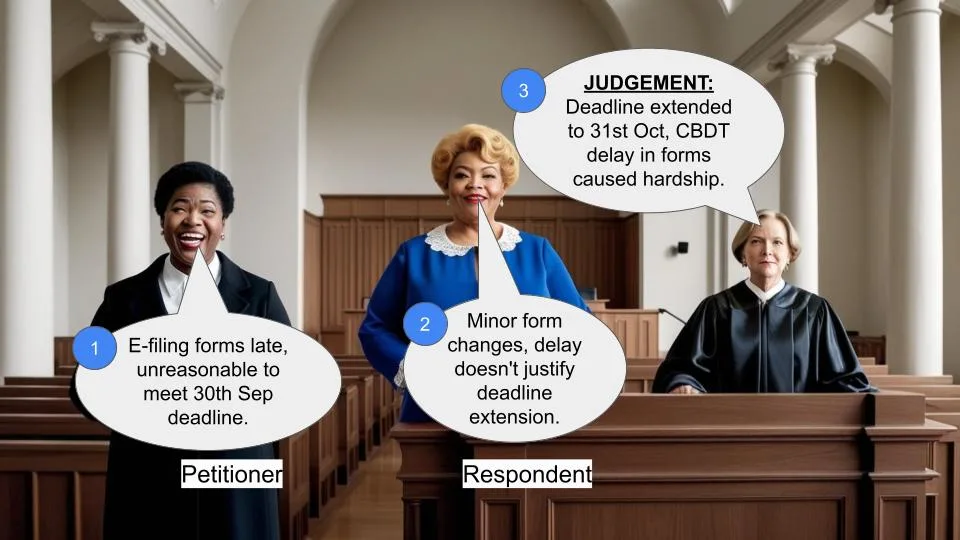
- Petitioners’ Arguments: The Federation argued that the delays in releasing filing utilities significantly hindered tax practitioners’ ability to meet deadlines. They claimed that the pandemic created genuine hardships that warranted an extension.
- Respondents’ Arguments: The CBDT contended that the filing compliance was increasing and that extending the deadline could disrupt the filing discipline. They argued that the government needed timely tax revenue to support relief efforts during the pandemic.
Key Legal Precedents
- The court referenced the principles surrounding the issuance of a writ of mandamus, stating that it is not a right but a discretionary remedy. It must be shown that:
- The applicant has a legal right.
- The opposite party has a legal duty.
- There is no alternative remedy available.
- The court cited previous cases, including State of Bihar vs. Ramjee Prasad and Union of India & Anr. vs. Sudhir Kumar Jaiswal, to illustrate the standards for issuing a writ of mandamus and the necessity of a clear legal duty on the part of the authority.
Judgement
The court denied the request for an extension of the filing deadline. It concluded that the CBDT had acted within its discretion and had valid reasons for its decision. The court emphasized that while the pandemic posed challenges, the need for timely tax filings was crucial for government revenue and public interest. The court also noted that the CBDT had already provided multiple extensions and that further interference could disrupt the functioning of the government.
FAQs
Q1: What does this ruling mean for tax practitioners?
A1: Tax practitioners must adhere to the existing deadlines for filing tax audit reports and income tax returns, as the court has ruled against any further extensions.
Q2: Why did the court deny the extension?
A2: The court found that the CBDT had valid reasons for not extending the deadline, including the need for timely tax revenue and the importance of maintaining filing discipline.
Q3: Can the CBDT extend deadlines in the future?
A3: Yes, the CBDT has the discretion to extend deadlines in the future if circumstances warrant it, but this decision will depend on the specific situation at that time.
Q4: What is a writ of mandamus?
A4: A writ of mandamus is a court order compelling a government authority to perform a duty that it is legally obligated to complete. However, it is not granted as a matter of right and requires specific conditions to be met.

1. The operative part of the order passed by this Court dated 8th January 2021 in the Special Civil Application No.13653 of 2020 reads as under:
“21 We are of the view that the respondent No.1 – Union of India, Ministry of Finance should immediately look into the issue, more particularly, the representation dated 12th October 2020 at Annexure : I of the paper book (page 108) and take an appropriate decision at the earliest in accordance with law. We, accordingly, direct the respondent No.1 to do so. While taking an appropriate decision, the Union shall bear in mind the observations made by this High Court in the two above noted judgements, more particularly, the observations of the Supreme Court in the case of Vaghjibhai S. Bishnoi (supra) that the powers given to the CBDT are beneficial in nature to be exercised for proper administration of fiscal law so that undue hardship may not be caused to the taxpayers. The purpose is of just, proper and efficient management of the work of assessment and the public interest. One additional aspect needs to be kept in mind before taking any appropriate decision that the time period for the officials of the tax department has been extended up to 31st March 2021 having regard to the current covid19 pandemic situation. If that be so, then some extension deserves to be considered in accordance with law. Let an appropriate decision be taken by 12th January 2021. 22 Post this matter on 13th January 2021 on top of the Board. 23 Mr. Patel, the learned Senior Standing Counsel appearing for the respondents Nos.2 and 3 shall apprise this Court of any decision or development in the matter on the next date of hearing.”
2. Pursuant to the directions issued by this Court referred to above,
the CBDT looked into the representation dated 12th October 2014
preferred by the All Gujarat Federation of Tax Consultants and is said to
have also taken into consideration the other observations made by this
Court in the order dated 8th January 2021.
3. The order under Section 119 (of Income Tax Act, 1961) dated
11th January 2021 declining to extend the time limit any further reads
thus:
“F.NO. 370153/39/2020TPL
GOVERNMENT OF INDIA
MINISTRY OF FINANCE DEPARTMENT OF REVENUE (CENTRAL BOARD OF DIRECT TAXES)
(TAX POLICY AND LEGISLATION DIVISION)
New Delhi, 11th January, 2021
ORDER UNDER SECTION 119 OF INCOME TAX ACT, 1961
The Hon'ble Gujarat High Court vide judgement dated 8th January, 2021
in the case of The All India Gujarat Federation of Tax Consultants Vs.
Union of India, SCA 13653 of 2020, has directed the Ministry of Finance
to look into the issue of extension of due dates for filing of Audit Report
under section 44AB (of Income Tax Act, 1961) more particularly the
representation dated 12.10.2020 and take an appropriate decision in
accordance with law.
2. In the wake of the global pandemic due to COVID19 the due dates
for filing of income tax returns for A.Y. 202021 was extended vide the
Taxation and Other laws (Relaxation and Amendment of Certain
Provisions) Act, 2020 (which was enacted on 29th September,2020) to
30th November, 2020. Subsequently, vide notification s.o. 3906(E) dated
29th October, 2020 the due dates for filing of returns were further
extended to 31st January, 2021 for cases in which tax audit report under
section 44AB (of Income Tax Act, 1961) ("the Act") is required to be filed and
31 st December, 2020 for all other cases. Further vide notification S.O.
4805 (E) dated 31st December, 2020 the above due dates were further
extended to 15th February, 2021 and 10th January, 2021 respectively.
3. As per the provisions of the Act the due date for filing of the audit report under section 44AB (of Income Tax Act, 1961) is one month prior to the due date of filing of income tax return. Therefore, the said due date was extended to 31st October,2020 vide the Taxation and Other laws (Relaxation and Amendment of
Certain Provisions) Act, 2020, 31st December, 2020 vide notification s.o.
3906(E) dated 29th October, 2020 and further to 15th January, 2020
vide notification s.o. 4805 (E) dated 31st December, 2020.
4. The due dates for payment of self assessment tax, for taxpayers whose
amount due does not exceed rupees one lakh, also coincide with the due
dates for filing of income tax returns. The table below summarises the
various due date extensions given:
S. No. Action Original Due date
1st Extension vide TOLA, 2020
2nd Extension vide Notification S.O.3906 (E) dated 29.10.2020
3rd Extension vide Notification S.O. 4805 (E) dated 31.12.2020
1. Return for Non-Audit Cases 31.07.2020 30.11.2020 31.12.2020 10.01.2021
2. Tax Audit 30.09.2020 31.10.2020 31.12.2020 15.01.2021
3. Return for Tax Audit Cases 31.10.2020 30.11.2020 31.01.2021 15.02.2021
5. Thus, it is apparent that the Government has not only considered
representations of various stakeholders but also has been proactive in
providing relaxation to the taxpayers by extending due dates regularly.
The table below gives the statistical data comparing the return filing
statistics of A.Y. 2019-20 and A.Y. 2020-21
Date –this year
AY 20-21 ITRs filed Daily figures Date – last year
AY 19-20 ITRS filed DAILY Figures 05-Jan-21
5,08,48,022 7,26,177 26-Aug-19 4,14,13,558 13,65,348
06-Jan-21
5,16,71,398 8,23,376 27-Aug-19 4,30,99,600 16,86,042
07-Jan-21
5,27,14,751 10,43,353 28-Aug-19 4,51,44,749 20,45,149
08-Jan-21
5,41,54,435 14,39,684 29-Aug-19 4,77,39,460 25,94,711
09-Jan-21
5,64,10,561 22,56,126 30-Aug-19 5,12,55,607 35,16,147
10-Jan-21
5,95,15,322 31,04,761 31-Aug-19 5,61,79,905 49,24,298
From the above table, it is apparent that the number of returns filed this
year has already exceeded the number of returns filed last year up to 31 st
August which was the last day of filing of the all the returns other than the company/tax audit returns, by about 6%.
The table below gives the statistical data comparing the filing statistics of tax audit report for A.Y. 2019-20 and A.Y. 2020-21.
Date Form 3CA Form 3CB Date Form 3CA Form 3CB
20-Oct-19
2,741 29,760 04-Jan-21 3,079 27,492
21-Oct-19
5,598 51,069 05-Jan-21 3,238 28,875
22-Oct-19
7,626 62,938 06-Jan-21 3,190 30,582
23-Oct-19
9,125 75,031 07-Jan-21 3,323 31,035
24-Oct-19
10,977 87,350 08-Jan-21 3,316 29,924
25-Oct-19
11,841 93,575 09-Jan-21 2,824 26,924
26-Oct-19
10,366 91,397 10-Jan-21 1,416 16,370
27-Oct-19
2,309 30,861 11-Jan-21
28-Oct-19
6,138 59,785 12-Jan-21
29-Oct-19
10,119 1,00,569 13-Jan-21
30-Oct-19
23,125 1,87,444 14-Jan-21
31-Oct-19
42,280 3,15,190 15-Jan-21
Grand Total cumulative 2,88,236 25,37,444 Grant Total cumulative
2,14,804 18,49,461
6. The above table also show that majority of the audit reports under
section 44AB (of Income Tax Act, 1961) as well as income tax returns are filed within the
last few days of the dates only. For A.Y. 201920 it is seen that 24% of
total audit reports were filed in last 3 days before the due date.
Therefore,lesser filing compliances having been made much before the due date cannot be said to be an anomalous situation.
7. A look at the relaxation of similar nature provided by other economies
globally makes it clear that the Government of India has been very
empathetic to the needs of the taxpayers as compared various other
countries. It is apparent from the table no other country has extended the
due dates as much as India. Even countries which are comparatively worse
hit by COVID19, like the USA, UK etc., have provided n o or lesser
extensions in due dates. The table below lists such extensions given by a
few countries:
Country Financial period
Individual Corporate Due date Extended due date
Due date Extended due date
USA 2019 15th April 2020
15th October 2020
15th April 2020
15th October 2020
UK 2019-2020 31 January 2021
No extension 31st December 2020
No extension
Australia 2018-2019 5th May 2020
5th June 2020 15th May 2020
5th June 2020
South Africa 2019 16th November 2020
No extension 31st December 2020
No extension
Netherlands 2019 1st May 2020
No extension 1st June 2020
No extension
Ireland 2019 12th November 2020
10th December 2020
12th November 2020
10th December 2020
Singapore 2019 18th April 2020
31st May 2020
15th December 2020
15th January 2020
Canada 2019 30th April 2020
30th September 2020
May August 2020
30th September 2020
Brazil 2019 1st March 2020
30th April 2020
30th April 2020
30th June 2020
8. From the above it may be seen that Government has been proactive
in analyzing the situation and providing relief to assessee. However, it
should also be appreciated that filing of tax returns/audit reports are
essential part of the obligations of assessee and cannot be delayed
indefinitely. Many functions of the Income tax Department start only after
the filing of the returns by the assessee. Filing of tax returns by assessee
also results in collections of taxes either through payment of self-
assessment tax by the assessee or by the subsequent collection by the
department post processing or assessment of the tax returns. The tax
collections assume increased significance in these difficult times and
Government of India needs revenue to carry out relief work for poor and
other responsibilities. Any delay in filing returns affects collection of taxes and other welfare functions of the state for the vulnerable and weaker
sections of society which is funded through the revenue collected. Sufficient time has already been given to taxpayers to file their tax returns and a large number of taxpayers have already filed their returns of income.
9. From the above discussion, it is apparent that,
• The due dates for filing of return/tax audit have already been
extended on 3 occasions.
• Internationally, the extension provided by India is more
generous as compared to other countries.
• The return filing statistics of the current year indicates that
returns filed in this financial year already far exceeds the returns
filed which were due on the last date of filing of returns.
Any further extension would adversely affect the return filing discipline
and shall also cause injustice to those who have taken pains to file the
return before the due date. It would also postpone the collection of revenue
thereby hampering the efforts of the Government to provide relief to the
poor during these COVID times.
11. In fact several decisions of the Hon'ble Supreme Court have gone to
the extent of saying that the choice of a cut off date cannot be dubbed as
arbitrary even if no particular reason is given for the same in the counter
affidavit filed by the Government, (unless it is shown to be totally
capricious or whimsical). [State of Bihar vs. Ramjee Prasad 1990(3) SCC
368, Union of Indian & Anr. vs. Sudhir Kumar JaiswaI1994(4) SCC 212
(vide para 5), Ramrao & Ors. vs. All India Backward Class Bank
Employees Welfare Association & Ors. 2004 (2) SCC 76 (vide para 31),
University Grants Commission vs. Sadhana Chaudhary & Ors. 1996(10)
SCC 536, etc .] When it is seen that a line or a point there must be and
there is no mathematical or logical way of fIxing it precisely, the decision
of the legislature or its delegated must be accepted unless it can be said
that it is very wide off the reasonable mark. (See Union of India & Anr. v.
Mis Parameshwaran match works Ltd., 1975 (2) SCR 573, at p. 579; and
Dr. (Mrs.) Sushma Sharma etc. etc. v. State of Rajasthan & Ors. 1985 (3)
SCR 243, at p. 269)
2. In view of the above reasons, all the representations for further
extension of the due date are hereby rejected.”
4 Thus, it appears that the CBDT has taken the final decision not to
extend the due date any further and accordingly, rejected all the
representations.
5 The decision taken by the CBDT vide order dated 11th January
2021 referred to above is sought to be produced by way of further
affidavit filed on behalf of the respondents Nos.2 and 3 respectively. The
same is ordered to be taken on record.
6 We proceeded with the further hearing of this litigation today at
sharp 11:00 A.M.
● SUBMISSIONS ON BEHALF OF THE WRIT APPLICANTS:
7 Mr. S. N. Soparkar, the learned Senior Counsel appearing for the
writ applicants vehemently submitted that the decision of the CBDT
placed on record is nothing, but an eyewash. It is argued that the core
issue arising in this litigation has not been addressed by the CBDT.
8. It is argued that the CBDT has very conveniently and consciously
not addressed itself to the hard reality that the utilities for filing the Tax Audit Report and the Income Returns were released at a belated stage.
In fact, those were released almost after a period of more than five
months despite there being a mandate from this Court in the previous
litigation referred to in the order dated 8th January 2021 that the utilities should be released not later than 1st April of the financial year. The CBDT has failed to appreciate that by inordinate delay in releasing the
utilities, the time available with the tax practitioners could be said to
have been considerably curtailed. The tax practitioners are finding it
very difficult to prepare the Returns of Income and Tax Audit Reports
before the due date.
9. It is argued that the issues raised in the present writ applications
are identical to the one decided in 2014(50) taxmann.com 115(Guj)
paras 37 to 39 and 2015 (61) taxmann.com 431 (Guj) (para 6). It is
argued that in the present case also, the Income Tax Return utilities
were issued at a belated stage. Substantive amendments were
introduced in the form of Tax Audit Reports in the middle of the order
i.e. 1st October 2020 and even thereafter, the utility was not issued till
22nd October 2020 creating a complete state of disarray.
10. It is argued that even if the two subsequent extensions are taken
into consideration, then the total time available is only 85 days instead
of 183 days.
11. There is no fault on the part of the writ applicants and the case is
one of genuine hardship on account of the delay on the part of the
CBDT.
12. Way back in the year 2014, this Court had directed the CBDT not
to introduce new utility with additional requirements in the midst of the
year. The directions issued by this Court in the two judgements referred
to above have been completely defied.
13. It is argued that this High Court extended the due date in the
decision reported in 2015 (61) taxmann.com 431, even while the other
High Courts declined to do so.
14. It is argued that by extending the time period, as prayed for, no
hardship is going to be caused to the Revenue, whereas, if the time
period is not extended, the writ applicants will be put to immense
difficulties.
15. Mr. Soparkar, once again, invited our attention to the following
chart:
ITR/TAR Form Due date of filing (original) Clear days expected
from 01.04.2020 Date of availability of e-filing utility
Schema up dation date
Utility updation date
Extended due date
Effective days available with taxpayers and the tax
professional ls from utility availability
ITR 3 31.10.2020 214 days 31.07.2020 29.08.2020
09.11.2020
11.01.2021
11.01.2021 15.02.2021 199 days
ITR 5 31.10.2020 214 days 25.08.2020 30.09.2020
13.11.2020
11.01.2021
11.01.2021 15.02.2021 174 days
ITR 6 31.10.2020 214 days 10.10.2020 22.11.2020
& 11.01.2021
11.01.2021 15.02.2021 128 days
ITR 7 31.10.2020 214 days 03.09.2020 15.10.2020
08.12.2020
11.01.2021
11.01.2021 15.02.2021 165 days
TAR 3CA 3CB 3CD
30.09.2020 183 days 22.10.2020
(Rules amended on 01.10.2020)
15.01.2021 85 days
ITR 3: for individuals having income from business/ profession head
ITR 5: For Firm /LLP/AOP/BOI
ITR 6: For company
ITR 7: for charitable organisation/political party/university (claiming
exemption)
16. It is argued that on account of the covid pandemic situation, there
has been frequent disruption as regards the availability of the staff,
employees, working hours, client meetings and audit work. The hardship
faced by the taxpayers and tax professionals in finishing the audit
assignments and collecting the requisite details to file the Returns of
Income and Tax Audit Reports is genuine and real. Adequate time period
is needed to finish the work. It is pointed out that not less than 18
organizations (including the Institute of Chartered Accountants of India)
have made representations for this purpose.
17. It is argued that through the Taxation and other Laws (Relaxation
and Amendment of Certain Provisions) Act, 2020, the due dates for
completion of any proceedings or passing of any order or issuance of any
notice, intimation, notification, sanction or approval or such other
action, by whatever name called, by any authority, Commission or
Tribunal, by whatever name called under the provisions of the specified
Act is extended upto 31st March 2021. If the adequate time period
determined for such purposes is extended upto 31st March 2021 than the
same should also be granted to the writ applicants. It is argued that the
CBDT has recognized the need to extend the time period and has already
extended the same for three times for A.Y. 202121. Therefore, the need
to extend the time period from the original due dates is genuine and not
superfluous. Only the adequacy of extension is in question. It is argued
that that the pandemic has not come to an end.
18. In such circumstances referred to above, Mr. Soparkar prays that
there being merit in his writ application, the same may be considered
appropriately and the time period, as prayed for, may be extended in the
interest of not only the tax payers but also the tax professionals.
19. Mr. Avinash Poddar, the learned counsel appearing with Mr.
Vishal J. Dave and Mr. Nipun Singhvi, the learned counsel for the writ
applicants of the connected writ application submitted that they would
adopt all the submissions canvassed by Mr. S. N. Soparkar referred to
above and noted above.
● SUBMISSIONS ON BEHALF OF THE RESPONDENTS:
20. On the other hand, both the writ applications have been
vehemently opposed by Mr. Zoheb Hossain assisted by Mr. Varun K.
Patel and Mr. Nikunt K. Raval, the learned counsel appearing for the
respondents.
21. Mr. Hossain would submit that the principal argument canvassed
on behalf of the writ applicants as regards the delay in releasing the
utilities for filing the Tax Audit Reports and Income Tax Returns has
been blown out of proportion. It is argued that the changes brought
about in the ITR by way of an update do not amount to adding or
extending the fields. It is only increasing or making changes in the
character of the existing fields to enable certain minuscule taxpayers to
report correctly which they might not have been able to otherwise.
22. It is argued that the Tax Audit work undertaken by the writ
applicants is in no manner affected by such amendment minuscule
changes or updates which are provided in the existing fields. No
prejudice could be said to have been caused warranting any interference
at the end of this Court in exercise of writ jurisdiction under Article 226
of the Constitution of India. It is argued that the Tax Audit Report Utility
has been made available from 1st April of the relevant year. Reliance
placed on the two decisions of this High Court referred to above are
completely misplaced because in the said case by a Notification dated 1st
May 2013, the CBDT had made it mandatory for the assessees to
electronically file the Income Tax Returns relevant for the assessment
year 201314 and onwards. In relation to the assessment year 201415,
the respondents therein had failed to make the utility specified for filing
the Tax Audit Report until 31st August 2014. Various representations
were made to the CBDT in that regard which in exercise of power under
Section 119 (of Income Tax Act, 1961) extended the due date for filing the Tax Audit
Report under Section 44AB (of Income Tax Act, 1961) to 30th September 2014.
However, the due date for filing of Returns of Income was not extended.
It is in such factual background prevailing at the relevant point of time
that this Court thought fit to issue the writ of mandamus directing the
CBDT to extend the due date for filing the Income Tax Returns. It is
argued that after deliberations at the highest level in the Ministry of
Finance, it was decided that the time limit for filing of the Audit Reports,
which is presently fixed as 15th January 2021 should not be extended
any further for the following reasons:
(1) The Compliance in filing the Tax Audit Reports is rapidly increasing
each day as is evident from the following table:
Date FORM 3CA AY 20-21
FORM 3CB AY20-21
Cumulative figure – AY 20-21
Date FORM3CA
AY 19-21 FORM3CB AY 19-20
Cumulative figure AY 19-20
Difference
04-Jan-21
3,079 27,492 18,84,075 20-Oct-19 2,791 29,760 15,30,967 3,53,108
05-Jan-21
3,238 28,875 19,16,188 21-Oct-19 5,598 51,069 15,87,634 3,28,554
06-Jan-21
3,190 30,582 19,49,960 22-Oct-19 7,628 62.938 16,58,198 2,91,762
07-Jan-21
3,323 31,035 19,84,318 23-Oct-19 9,125 75,031 17,42,354 2,41,964
8-Jan-21
3,316 29,924 20,17,558 24-Oct-19 10,977 87,350 18,40,681 1,76,877
09-Jan-21
2,824 26,097 20,46,479 25-Oct-19 11,841 93,575 19,46,097 1,00,382
10-Jan-21
1,416 16,370 20,64,265 26-Oct-19 10,366 91,397 20,47,860 16,405
11- 4,320 41,970 21,10,555 27-Oct-19 2,309 30,861 20,81,030 29,525
Jan-21,12-Jan-21
8,690 85,663 22,04,908 28-Oct-19 6,138 59,785 21,46,953 57,955
13-Jan-21
29-Oct-19 10,119 1,00,569 22,57,641
14-Jan-21
30-Oct-19 23,125 1,87,444 24,68,210
15-Jan-21
31-Oct-19 42,280 31,15,190 28,25,680
Grand Total cumulative
2,27,814 19,77,094 22,04,908 Grand
Total cumulative
2,88,236 25,37,444 28,25,680 -6,20,772
(2) From the above data, it is evident that there has been a huge leap in
filing of the tax audit reports and from 10.01.2021 the daily filings have
increased 4 to 5 times as on 12.01.2021. On 10.01.2021, the daily filing
of Form 3CB was 16,370 which jumped to 41,970 on 11.01.2021 which
has again more than doubled to 85,663 on 12.01.2021. The assessees are
rapidly complying with the filing of the tax audit report across the country
and any interference at this stage may affect the discipline of filings by the Assessees as well as the larger interest of the Revenue and public interest.
(3) Notably, from the above table it is also evident that as against last
year with 3 days remaining from the deadline, the cumulative figure of the
TAR filings for AY 201920 was 21,46,953 as against the cumulative
figure of the TAR filings this year with three days remaining from the last
date is 22,04,908 which is 57,955 already in excess of the last year’s TAR
filings. Therefore, there is disciplined compliance taking place by the
assessees.
(4) The TAR utility was available from the beginning of the year, and
therefore, there is no justification in seeking an extension for filing the tax audit report.
(5) Moreover, the submission that certain ITR Forms were released in June
2020, July 2020, August 2020 and September 2020 respectively and
therefore filing of the ITRs should be extended is misplaced since the
preparation of the Final Accounts, which is done on the basis of the
Income Tax Act and the Rules therein is nowhere dependent on the date of
release of the ITR utility and is an independent exercise. It is nobody’s case that the assessee was ready to file his returns prior to June 2020, July 2020, August 2020 or September 2020 the various dates when the
different ITR Forms became available but could not file the same and
thereafter they were prevented from filing till the last date of filing such
return on 15.02.2021. There is nothing in the Act or Rules which
mandates that the portal should be open and available from 1st April of
the relevant year itself provided that a reasonable time is given to the
assessees to file their return of income. In fact the ITR forms which were
made available contained only minimal changes to reflect the amendments
made in the Finance Act 2020 which were already known to all assessees
and Tax practitioners.
(6) The Filing of returns in the tax audit cases demonstrate that even as
on 12.01.2021 which is 34 days before the extended due date, the returns
filed in the tax audit cases far exceed the returns filed in comparison to
last year on a similar date. A chart to this effect is as under:
Asst year AY 2020-21 a on 12th Jan 2021
AY 2019-20 as on 28th Sep 2019
Difference
ITR – 3 83,98,573 79,18,513 4,80,060
ITR -5 10,68,479 7,68,756 2,99,723
ITR - 6 4,82,981 2,38,168 2,44,813
This is comparison for AY 201920 (due date 31st Oct 2019 for all
ITRs with TAR) and AY 2021 (due date 15th Feb 2021 for all ITRs
with TAR): 34 days prior to extended due date for equivalent
comparison
(7) Indisputably, the assessees would have at least 148 days to upload
their returns from 22/09/2020 the date when the ITR6 was made
available till 15.02.2021 which is the date when the return for the Audit
Cases is to be filed. The writ applicants have not been able to establish any prejudice caused to the Assessee or indicate any rational nexus between
their inability to prepare their Final Accounts and Tax Audit Reports and
the availability of the utility for various forms from June 2020/September
2020 on wards.
(8) The Supreme Court has consistently held that in financial matters
judicial deference may be shown to the executive pragmatism and free play
in the joints may be given to the executive especially in fixing cutoff dates.
(9) It has also been demonstrated that the various updates the Petitioner
has referred to made to various forms did not amount to changing or
increasing any existing fields, rather only the size of such fields were
increased in the number of characters or in some cases the field was
modified to accommodate from numeric characters to alpha numeric
characters keeping in mind certain special cases. A list of such Schema
changes and justification was presented before this Court.
(10) The consequence of late filing of a tax audit report is provided under
Section 271B (of Income Tax Act, 1961) which reads as under:
“Failure to get accounts audited.
271B. If any person fails to get his accounts audited in respect of
any previous year or years relevant to an assessment year or
furnish a report of such audit as required under section 44AB (of Income Tax Act, 1961), the
Assessing Officer may direct that such person shall pay, by way of
penalty, a sum equal to onehalf per cent of the total sales,
turnover or gross receipts, as the case may be, in business, or of the
gross receipts in profession, in such previous year or years or a sum
of one hundred fifty thousand rupees, whichever is less.”
(11) However, Section 273B (of Income Tax Act, 1961) containing the consequence of nonfiling of
tax audit report provides that if in a given case the assessee proves
reasonable cause for failure to file tax audit report in accordance with
Section 44AB (of Income Tax Act, 1961), no penalty will be imposable on the person or the assessee.
The relevant portion of Section 273B (of Income Tax Act, 1961) is reproduced hereunder:
“Penalty not to be imposed in certain cases.
273B. Notwithstanding anything contained in the provisions of
clause (b) of subsection (1) of...section 271B (of Income Tax Act, 1961), ..., no penalty shall
be imposable on the person or the assessee, as the case may be, for
any failure referred to in the said provisions if he proves that there
was reasonable cause for the said failure.”
(12) Therefore in exceptional cases, if an assessee is able to make out a
case of reasonable cause for his failure to file tax audit report within the
relevant time as required under Section 44AB (of Income Tax Act, 1961), then the case of such person
or assessee will be considered in accordance with law under Section 273B (of Income Tax Act, 1961).
23 In support of the aforesaid submissions, the learned counsel have
relied upon the following case law:
(1) Government of Andhra Pradesh vs. N. Subbarayudue
and others (2008) 14 SCC (paras 5 to 8)
(2) Ramrao and others vs. All India Backward Class Bak
Employees Welfare Association (2004) 2 SCC 76 (para 31 to
33)
(3) Union of India and another vs. Sudhir Kumar Jaiswal
(1994) 4 SCC 212 (paras 5 to 7)
(4) University Grants Commission vs. Sadhana Chaudhary
(1996) 10 SCC 536 (para 21)
(5) RK Garg vs. Union of India (1981) 4 SCC 675 (para 8)
(6) Union of India vs. Nitdip Textile Processors Pvt Ltd
(2013) 1 SCC 226 (para 66)
(7) Supreme Court's order dated 20th March 2020 In Union
of India vs. PD Sunny and others in SLP(C) No.10669 of 2020
24. It is also brought to our notice that the High Court of Kerala and
the High Court of Allahabad had passed orders issuing general directions
to the various departments like the banks, financial institutions, income
tax authorities, authorities dealing with the erstwhile KVAT, GST,
recovery of tax on motor vehicles and building tax to defer the recovery
proceedings or coercive measures till a particular point of time. The
Revenue challenged the two orders before the Supreme Court by filing
the Special Leave to Petition (Civil) No.10669 of 2020. The Supreme
Court passed the following order dated 20th March 2020, which reads
thus:
“The Registry is directed to accept these special leave petitions against the judgment and order(s) passed by the High Court of Judicature at Kerala,
Ernakulam Bench in Writ Petition (Civil)No.8231/2020 and of the High
Court of Judicature at Allahabad, Allahabad Bench in Writ Petition (Civil)
No.7014/2020.
Permission to file special leave petitions is granted.
Issue notice.
In the meantime, there shall be exparte adinterim stay of the impugned
judgment and order(s) passed in the aforesaid writ petitions and of further
proceedings before the High Court(s), in view of the stand taken by the
Government of India through learned Solicitor General, before us, that the
Government is fully conscious of the prevailing situation and would itself
evolve a proper mechanism to assuage concerns and hardships of every
one.”
25. In such circumstances referred to above, the learned counsel
appearing for the respondents pray that there being no merit in these
two writ applications, those be rejected.
● SUBMISSIONS IN REJOINDER:
26. Mr. Soparkar, in rejoinder, submitted that the Revenue has raised
the following five contentions:
“(1) Comparing number of income tax returns filed on 31.08.2019 (5.51
crores) and 10.01.2021(5.95 crores) – an argument is advanced that a
greater number of returns are already filed by the time 10.01.2021 and
therefore no further extension is required.
(2) Comparing number of Tax audit reports filed on 31.10.2019 (2.88
lakhs/25.37 lakhs) and 10.01.2021(2.14 lakhs/18.49 lakhs) – an
argument is advanced that a lesser number of returns filed before a due
date is not anomaly as 24% of total reports were filed in last five days.
(3) Comparing the extension granted by other countries around the world
– an argument is made that the CBDT has been generous in granting
extension that it has granted already and no further extension is required.
(4) It is also argued that return filing is an obligation of the assessee
which cannot be delayed indefinitely. Many functions of the tax
department begin after filing of the returns. Filing of the returns results in tax payment that the government needs. Further extension will adversely
affect return filing discipline and shall cause injustice to those who have
filed before due date.
(5) Reliance is placed on Supreme Court decisions to submit that due date
is not arbitrarily decided and the same may not be disturbed.”
27 Mr. Soparkar would submit that the CBDT still owes an answer to
the following:
(a) the delay in releasing the utilities by 46 months despite
repeated orders of various High Courts.
(b) amendments in the Rules and Tax Audit Return form in the
middle of the year
(c) No hardship is likely to be caused to the revenue if the due
date is extended
(d) Why the writ applicants should not be treated at par with the
revenue officers for whom the due date is extended to 31.03.2021
28. Mr. Soparkar submitted that the comparison of the ITR filed on
31st August 2019 and 10th January 2015 is fundamentally flawed. The
reason being that by 31st August 2019, only the non Tax Audit Returns
would have been filed, whereas by 10th January 2015, both the Tax
Audit as well as the nonTax Audit Returns would have been filed.
29. It is pointed out from the table produced by the Revenue itself
that the daily Tax Audit Reports filed in 2021 are less than half
compared to what was filed in 2019. In such circumstances, it is
unrealistic to expect that 25% shortfall can be met in last five days the
way it did in 2019.
30. It is pointed out that the United States has given extension of six
months, whereas the CBDT has given extension of 3.5 months. It is
further submitted that for all other countries (except U.K.), the financial
period is the calendar year 2019 i.e. when there was no pandemic. The
Audit and Return filing preparation would have begun and materially
completed before the pandemic in such cases. Such is not the scenario
with India and therefore, such comparison is not valid. It is pointed out
that the population of India and the number of returns are substantially
large compared to other countries.
31. In the last, it is argued that the case law relied upon on behalf of
the Revenue is completely misplaced and not applicable in any manner
as in each of those cases relied upon, the challenge was to the fixing of
date. The writ applicants do not seek to challenge Section 139(1) (of Income Tax Act, 1961) or
Section 44AB (of Income Tax Act, 1961). The writ applicants only seek judicious
exercise of powers under Section 119 (of Income Tax Act, 1961).
32. In such circumstances, it is prayed that this Court may consider
the prayer sympathetically keeping in mind the practical difficulties
faced by one and all in this hard times of the covid pandemic.
● ANALYSIS:
33. Having heard the learned counsel appearing for the parties and
having gone through the materials on record, the only question that falls
for our consideration is whether this Court should issue a writ of
mandamus to the CBDT for the purpose of extending the time limit to
file the Tax Audit Reports and the Income Tax Returns.
34. There is no denying to the fact that the year 2020 was a
challenging one. The challenge still continues in the new year 2021
which has just dawned. There has been loss of life and there has been
loss of livelihood. There has been anxiety, anguish and even, a degree of
anger which stems from helplessness or our inability to be in control of
the situation. The Union and the State Government has been striving
hard since a long period of time to combat the situation. It is not as if the Government is completely oblivious of the difficulties which have been
pointed out by the learned Senior Counsel appearing for the writ
applicants so far as the present litigation is concerned. However, the
moot question for this Court to consider is as to where to draw the line.
In other words, to what extent the High Court in exercise of its writ
jurisdiction should interfere with the decision taken by the respondents,
more particularly, when it comes to Revenue.
35. Before an applicant could get a writ of mandamus or an order in
the nature of mandamus, he has to satisfy the court that the following
conditions are fulfilled.
(a) The applicant has a legal right;
(b) The opposite party has a legal duty;
(c) The application is made in good faith;
(d) The applicant has no other alternative remedy; and
(e) The opposite party has refused relief, i.e. demand and refusal.
36. Mandamus is one of the prerogative writs issued by the superior
courts (High Court or Supreme Court), which is in the shape of
command to the State, its instrumentality or its functionaries to compel
them to perform their constitutional / statutory/public duty. 23. A writ
of mandamus is an extraordinary remedy to be invoked only upon
special occasion and in exceptional circumstances. It is intended to
supply deficiency in law. It cannot be granted merely for the asking but
has to be obtained where there is no alternative, efficacious and
adequate remedy. It cannot be used as an appeal against the decision of
a court, tribunal or an authority exercising statutory power. It can only
be issued as a last resort where the court is satisfied that without its aid
there would be failure of justice.
37. Mandamus is an action or judicial proceeding of a civil nature
extraordinary in the sense that it can be maintained only when there is
no other adequate remedy, prerogative in its character to the extent that
the issue is discretionary, to enforce only clear legal rights, and to
compel courts to take jurisdiction or proceed in the exercise of their
jurisdiction, or to compel corporations, public and private, and public
boards, commissions, or officers, to exercise their jurisdiction or
discretion and to perform ministerial duties, which duties result from an
office, trust, or station, and are clearly and peremptorily enjoined by law
as absolute and official (P.R. Aiyar, Advanced Law Lexicon, (2005), Vol.
III P. 2873.).
38. Mandamus is not a writ of right and is not granted as a matter of
course (ex debito justitiae). Its grant or refusal is at the discretion of the court. A court may refuse mandamus unless it is shown that there is a
clear legal right of the applicant or statutory duty of the respondent and
there is no alternative remedy available to the applicant. (Union of
India v. S.B. Vohra, (2004) 2 SCC 150)
39. The discretion of the court, however, is not arbitrary and it must
be exercised fairly, reasonably and on sound and well established legal
principles.
40. The court, in the exercise of discretion, must take into account
wide variety of circumstances. It must consider the facts of the case, the
exigency which calls for the exercise of discretion, the consequences of
granting or refusing the writ, the nature and extent of injury likely to
ensue by the grant or refusal of the writ, etc. In short, courts discretion
must be governed by considerations of public policy, public interest and
public good.
41. In the decision reported in (2008) 2 SCC 280, Oriental Bank of
Commerce v. Sunder Lal Jain, in paragraphs 11 and 12, the Supreme
Court held thus,
“11. The principles on which a writ of mandamus can be issued have been
stated as under in The Law of Extraordinary Legal Remedies by F.G. Ferris
and F.G. Ferris, Jr.:
Note 187.Mandamus, at common law, is a highly prerogative writ,
usually issuing out of the highest court of general jurisdiction, in the name of the sovereignty, directed to any natural person, corporation or inferior court within the jurisdiction, requiring them to do some particular thing therein specified, and which appertains to their office or duty. Generally speaking, it may be said that mandamus is a summary writ, issuing from the proper court, commanding the official or board to which it is
addressed to perform some specific legal duty to which the party applying
for the writ is entitled of legal right to have performed.
Note 192.Mandamus is, subject to the exercise of a sound judicial
discretion, the appropriate remedy to enforce a plain, positive, specific and ministerial duty presently existing and imposed by law upon officers and
others who refuse or neglect to perform such duty, when there is no other
adequate and specific legal remedy and without which there would be a
failure of justice. The chief function of the writ is to compel the
performance of public duties prescribed by statute, and to keep
subordinate and inferior bodies and tribunals exercising public functions
within their jurisdictions. It is not necessary, however, that the duty be
imposed by statute; mandamus lies as well for the enforcement of a
common law duty.
Note 196.Mandamus is not a writ of right. Its issuance unquestionably
lies in the sound judicial discretion of the court, subject always to the well-settled principles which have been established by the courts. An action in mandamus is not governed by the principles of ordinary litigation where
the matters alleged on one side and not denied on the other are taken as
true, and judgment pronounced thereon as of course. While mandamus is
classed as a legal remedy, its issuance is largely controlled by equitable
principles. Before granting the writ the court may, and should, look to the
larger public interest which may be concernedan interest which private
litigants are apt to overlook when striving for private ends. The court
should act in view of all the existing facts, and with due regard to the
consequences which will result. It is in every case a discretion dependent
upon all the surrounding facts and circumstances.
Note 206. ... The correct rule is that mandamus will not lie where the
duty is clearly discretionary and the party upon whom the duty rests has
exercised his discretion reasonably and within his jurisdiction, that is,
upon facts sufficient to support his action.
12. These very principles have been adopted in our country. In Bihar
Eastern Gangetic Fishermen Coop. Society Ltd. v. Sipahi Singh after
referring to the earlier decisions in Lekhraj Sathramdas Lalvani v. N.M.
Shah, Rai Shivendra Bahadur (Dr.) v. Nalanda College and Umakant
Saran (Dr.) v. State of Bihar this Court observed as follows in para 15 of
the Reports (SCC): (Sipahi Singh case, SCC pp. 15253)
“15. ... There is abundant authority in favour of the proposition that a
writ of mandamus can be granted only in a case where there is a statutory
duty imposed upon the officer concerned and there is a failure on the part
of that officer to discharge the statutory obligation. The chief function of a writ is to compel performance of public duties prescribed by statute and to keep subordinate tribunals and officers exercising public functions within the limit of their jurisdiction. It follows, therefore, that in order that mandamus may issue to compel the authorities to do something, it must
be shown that there is a statute which imposes a legal duty and the
aggrieved party has a legal right under the statute to enforce its
performance.... In the instant case, it has not been shown by Respondent 1
that there is any statute or rule having the force of law which casts a duty
on Respondents 2 to 4 which they failed to perform. All that is sought to
be enforced is an obligation flowing from a contract which, as already
indicated, is also not binding and enforceable. Accordingly, we are clearly
of the opinion that Respondent 1 was not entitled to apply for grant of a
writ of mandamus under Article 226 the Constitution and the High Court
was not competent to issue the same.
Therefore, in order that a writ of mandamus may be issued, there must be
a legal right with the party asking for the writ to compel the performance
of some statutory duty cast upon the authorities...."
42. Mandamus is the most valuable and essential remedy in the
Administrative Justice resorted to supply want of some appropriate
ordinary remedy. The functions of the writ court is to compel the
performance of public duty, for which, the person approaching the writ
court should statutorily, has a clear, specific and unequivocal,
constitutional or statutory or legal right to the relief sought for and the
failure on the part of those who are bound to perform certain duties and
functions, as laid down by the legislature or directions issued for the
purpose of enforcing the provisions of an enactment or of any delegated
or subordinate legislation. There must be a legal right and corresponding
legal duty.
43. In State of Kerala v. A.Lakshmi Kutty, reported in 1986 (4) SCC
632, the Supreme Court held that a Writ of Mandamus is not a writ of
course or a writ of right but is, as a rule, discretionary. There must be a
judicially enforceable right for the enforcement of which a mandamus
will lie. The legal right to enforce the performance of a duty must be in
the applicant himself. In general, therefore, the Court will only enforce
the performance of statutory duties by public bodies on application of a
person who can show that he has himself a legal right to insist on such
performance. The existence of a right is the foundation of the
jurisdiction of a Court to issue a writ of Mandamus. The present trend of
judicial opinion appears to be that in the case of non selection to a post,
no writ of mandamus lies.
44. When a Writ of Mandamus can be issued, has been summarised in
Corpus Juris Secundum, as follows:
"Mandamus may issue to compel the person or official in whom a
discretionary duty is lodged to proceed to exercise such discretion, but
unless there is peremptory statutory direction that the duty shall be
performed mandamus will not lie to control or review the exercise of the
discretion of any board, tribunal or officer, when the act complained of is
either judicial or quasijudicial unless it clearly appears that there has
been an abuse of discretion on the part of such Court, board, tribunal or
officer, and in accordance with this rule mandamus may not be invoked to
compel the matter of discretion to be exercised in any particular way. This
principle applies with full force and effect, however, clearly it may be made to appear what the decision ought to be, or even though its conclusion be disputable or, however, erroneous the conclusion reached may be, and
although there may be no other method of review or correction provided
by law. The discretion must be exercised according to the established rule
where the action complained has been arbitrary or capricious, or based on
personal, selfish or fraudulent motives, or on false information, or on total lack of authority to act, or where it amounts to an evasion of positive duty, or there has been a refusal to consider pertinent evidence, hear the parties where so required, or to entertain any proper question concerning the exercise of the discretion, or where the exercise of the discretion is in a manner entirely futile and known by the officer to be so and there are other methods which it adopted, would be effective." (emphasis supplied)”
45. A prerogative writ, like, a Mandamus cannot be demanded ex
debito justiatiae, but it can be issued by the court in its discretion, for
which, it must be shown that, there is a non discretionary legal duty
upon the authority against whom, the relief is sought for and that the
person approaching the High Court under Article 226 of the Constitution
of India, has to prove that he has a legal right to be enforced against the
authority, for the failure of performance of a legal or statutory duty, by
the authority against whom, the relief is sought for.
46. To sum up, (a) certain conditions have to be satisfied before a writ
of mandamus is issued; (b) the petitioner for a writ of mandamus must
show that he has a legal right to compel the respondent to do or abstain
from doing something; (c ) there must be in the petitioner a right to
compel the performance of some duty cast on the respondents; (d) the
duty sought to be enforced must have three qualities. It must be a duty
of public nature created by the provisions of the Constitution or of a
statute or some rule of common law; (e) the remedy of a writ of
mandamus is not intended to supersede completely the modes of
obtaining relief by an action in a Civil Court or to deny defence
legitimately open in such actions; (f) the power to issue a writ of
mandamus is a discretionary power. It is sound use of discretion to leave
the party to seek his remedy by the ordinary mode of action in a Civil
Court and to refuse to issue a writ of mandamus; (g) a writ of
mandamus is not a writ of course or a writ of right but is, as a rule a
matter for the discretion of the Court; (h) in petitions for a writ of
mandamus, the High Courts do not act as a Court of appeal and examine
the facts for themselves. It is not the function of the Court to substitute
its wisdom and discretion for that of the person to whom the judgment
in the matter in question was entrusted by law. The High Court does not
issue a writ of mandamus except at the instance of a party whose
fundamental rights are directly and substantially invaded or are in
imminent danger of being so invaded; (i) a writ of mandamus is not
issued to settle private disputes or to enforce private rights. A writ of
mandamus cannot be issued against the President of India or the
Governor of State; (j) A writ will not be issued unless the Court is certain
that its command will be carried out. The Court must not issue a futile
writ.
47. It is true that a Coordinate Bench of this Court in the year 2015
had the occasion to deal with almost a similar issue as the one involved
in the present case. This High Court had directed the CBDT to extend the
due date for filing the Income Tax Returns under Section 139 (of Income Tax Act, 1961) from 30th
September 2015 to 31st October 2015 so as to alleviate to a certain
extent, the hardships caused to the assesses on account of delay in
providing the utilities. However, this Court had to interfere in a situation
when for the first time by way of a Notification the CBDT made it
mandatory for the assessees to electronically file the Income Tax Returns
relevant for the assessment year 2013-14 and on wards.
48. Although Mr. Soparkar, the learned Senior Counsel has criticized
the manner in which the decision is taken by the CBDT not to extend the
time limit any further, yet we believe that such decision must have been
taken after due deliberations, and in taking such decision, many
financial experts must have applied their minds. It is true that the Board
is vested with the power under Section 119 (of Income Tax Act, 1961) to extend the due
date and the powers are discretionary in nature and that is the reason
why we thought fit to ask the CBDT to look into the matter and take an
appropriate decision in accordance with law. If the CBDT has looked into
the matter closely and has arrived at the conclusion that the extension of
time limit would not be in the interest of the Revenue, then it cannot be
said that the CBDT has failed to exercise its discretionary powers vested
in it under Section 119 (of Income Tax Act, 1961). When there is a power coupled with
duty, there is an obligation on the Board to exercise the same if the facts
so warrant. Upon due consideration of all the relevant aspects of the
matter, if the Board has taken the final decision not to extend the time
limit any further, then it is difficult for this Court to issue a writ of
mandamus to the Board to extend the time limit on the assumption that
undue hardship would be caused to the taxpayers and the tax
professionals, more particularly, in view of the latest data put forward
before us by the Revenue.
49. It is the case of the CBDT that it has declined to exercise its power
under Section 119 (of Income Tax Act, 1961) as the conditions for exercise of such power
do not exist. It is the case of the Revenue that the issue of hardship was
dealt with considerably at the relevant point of time and that is the
reason why three times the time limit came to be extended. The Board
has now thought fit in the interest of the Revenue not to extend the time
period any further. There are so many vital issues which the Revenue
needs to keep in mind before taking such decision. The question is
whether this Court should go into all such issues which weighed with the
CBDT in taking a particular decision one way or the other and substitute
the same with that of this Court on the ground that if the time limit is
not extended, then the people at large would be put immense hardships?
Interference at the end of this Court, at this point of time, in the matters
relating to the Revenue may have far reaching implications. This Court
may find it very easy to issue a writ of mandamus, as prayed for, saying
that if the time limit has been extended in the past on three occasions,
then why not for one last time up to 31st March 2021. However, such a
line of reasoning or approach may upset the entire functioning of the
Government and may lead to undesirable results.
50. In the overall view of the matter, we have reached to the
conclusion that we should not interfere in the matter.
51. In the result, both the writ applications fail and are hereby
rejected. At this stage, we may only observe that the CBDT may consider
issuing an appropriate circular taking a lenient view as regards the
consequences of late filing of the Tax Audit Reports as provided under
Section 271B (of Income Tax Act, 1961). We leave it to the better discretion of the CBDT
in this regard.
(J. B. PARDIWALA, J)
(ILESH J. VORA,J)
×
Similar Ripples
Questions
Court Denies Extension for Tax Filing Deadline Amid COVID-19 Challenges
Write your CommentSimilar Posts


Generic
- Reportdata/6365.pdf
