


Court Orders Disclosure of Tax Investigation Information, Rejecting Department'…



Full News
Court Orders Disclosure of Tax Investigation Information, Rejecting Department's Secrecy Claims
Court Orders Disclosure of Tax Investigation Information, Rejecting Department's Secrecy Claims
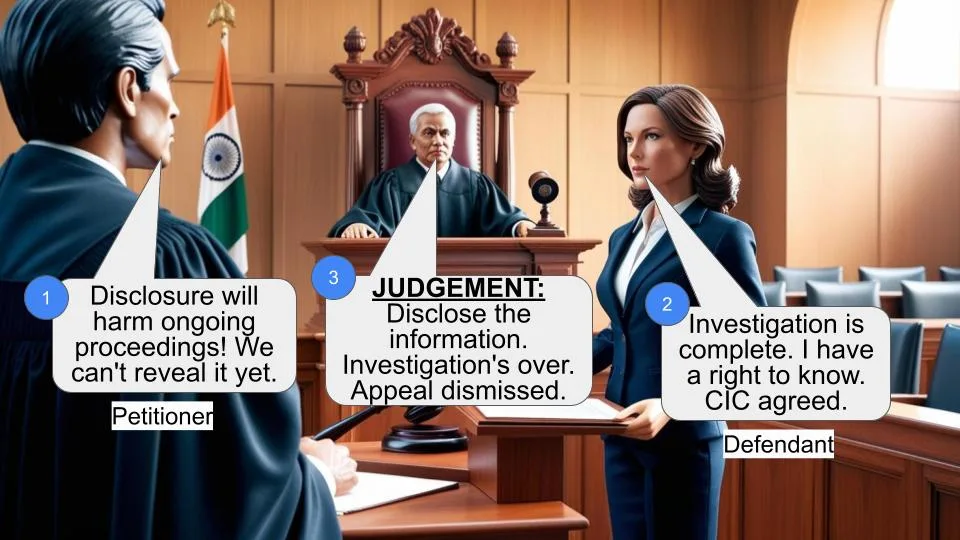
This case involves a dispute between the Director of Income Tax (Investigation) and a citizen named Bhagat Singh over access to information under the Right to Information Act, 2005. The court ruled in favor of Bhagat Singh, ordering the Income Tax Department to disclose the requested information related to a tax evasion investigation involving Singh's wife.
Get the full picture - access the original judgement of the court order here
Case Name:
Director of Income Tax (Investigation) & Anr. Vs Bhagat Singh & Anr. (High Court of Delhi)
LPA 1377/2007
Date: 17th December 2007
Key Takeaways:
1. The Central Information Commission's orders are binding if not challenged.
2. General claims of impeding investigation are insufficient to withhold information under RTI Act.
3. Information can be disclosed once the investigation process is complete, even if tax recovery is pending.
4. The Right to Information Act favors disclosure unless there's a specific, justifiable reason for withholding information.
Issue:
Should the Income Tax Department disclose information about a tax evasion investigation to the complainant once the investigation is complete, even if tax recovery proceedings are ongoing?
Facts:
1. Bhagat Singh filed a Tax Evasion Petition (TEP) in September 2003 against his wife, Smt. Saroj Nirmal, who had filed a criminal complaint alleging dowry demands.
2. Singh sought information about the status of his TEP and his wife's income sources through an RTI application in November 2005.
3. The Income Tax Department rejected Singh's request, which was upheld by the Appellate Authority.
4. Singh appealed to the Central Information Commission (CIC), which ordered disclosure of information after the investigation and tax recovery process was complete.
5. The Department partially complied but withheld some information, citing ongoing assessment proceedings.
6. Singh filed a writ petition, which the Single Judge allowed, directing full disclosure of information.
7. The Income Tax Department appealed this decision in the current case.
Arguments:
Income Tax Department:
- Disclosure would impede ongoing investigation and assessment proceedings.
- Information should only be released after tax recovery is complete.
- Willing to disclose information if summoned by the criminal court in the ongoing 498A IPC case.
Bhagat Singh:
- The investigation process is complete, and the CIC has ordered disclosure.
- The information is crucial for his defense in the criminal case.
- The Department is unjustifiably delaying and withholding information.
Key Legal Precedents:
While no specific case laws were cited, the judgment heavily relied on the interpretation of Section 8(1)(h) of the Right to Information Act, 2005, which allows withholding information that would impede investigation, apprehension, or prosecution of offenders.
Judgement:
1. The court dismissed the appeal, upholding the Single Judge's order to disclose the information.
2. It found no merit in the Department's claim that disclosure would hamper investigation or assessment proceedings.
3. The court emphasized that the CIC's order had become binding as it wasn't challenged by the Department.
4. The court extended the time for furnishing the information by one week.
FAQs:
1. Q: Why did the court rule in favor of disclosure?
A: The court found no valid reason to withhold the information, especially since the investigation was complete and the CIC had already ordered disclosure.
2. Q: Does this case set a precedent for similar RTI requests?
A: Yes, it emphasizes that government departments must provide specific reasons for withholding information and can't rely on general claims of impeding investigation.
3. Q: What impact does this have on the criminal case against Bhagat Singh?
A: The disclosed information may help Singh in his defense against the dowry charges, though the court doesn't speculate on this outcome.
4. Q: Can the Income Tax Department still withhold some information?
A: No, the court has ordered full disclosure of the requested information as per the CIC's original order.
5. Q: What's the significance of the one-week extension for providing information?
A: It gives the Department a reasonable timeframe to comply with the court's order while ensuring prompt disclosure to the requestor.

1.This appeal is directed against the order dated 3rd December, 2007 whereby the learned Single Judge has allowed the writ petition with a direction to the Income Tax Department to supply the information sought by the respondent No.1 herein.
2.The writ petition was filed by the respondent No.1 herein praying for quashing of the order of the Central Information Commission with a direction that the information sought by the respondents under the Right to Information Act, 2005 should be supplied immediately.
3.The respondent No.1 herein was married in 2000 to Smt.Saroj Nirmal, who in November, 2000 filed a criminal complaint alleging that she had spent / paid as dowry an amount of Rs.ten lacs. Alleging that the aforesaid claims are false,the respondent No.1, in order to enable him to defend the criminal prosecution, approached the Income Tax Department with a Tax Evasion Petition (TEP) dated 24th September, 2003. However, the Department summoned the wife of the respondent No.1 to present her case before them. The respondent No.1 made repeated requests to the Director of Income Tax Department (Investigation) to ascertain and know the status of the hearing and TEP proceedings.
4.Having failed in his endeavour, the respondent No.1 moved an application under the Right to Information Act in November, 2005 praying for the following information:
(i)Fate of Petitioner's complaint (tax evasion petition) dated 24.09.2003.
(ii)What is the other source of income of petitioner's wife Smt.Saroj Nirmal than from teaching as a primary teacher in a private school?
(iii)What action the Department had taken against Smt.Saroj Nirmal after issuing a notice u/s 131 (of Income Tax Act, 1961), pursuant to the said Tax Evasion Petition.?
5.The aforesaid application filed by the respondent No.1 herein was rejected by the Public Information Officer designated under the Act by the Income Tax Department as against which an appeal was filed before the Appellate Authority,which too rejected the request to have access to the aforesaid information. As against the said order of the Appellate Authority, the respondent No.1 filed a second appeal on 1st March, 2006 before the Central Information Commission praying for setting aside the orders of the respondents No.2 and 3 in the writ petition. The Central Information Commission by an order dated 8th May, 2006 allowed the second appeal and set aside the rejection of information. It was held by the Central Information Commission that as the investigation on TEP has been conducted by Director of Income Tax (Investigation), the relevant report is the outcome of public action and, therefore, the same is required to be disclosed. However, it was directed that the report should be disclosed only after the entire process of investigation and tax recovery, if any, is completed. The appellant / Department has accepted the aforesaid order of the CIC and, therefore, the said order of the CIC has become final and binding.
However, the Department has not disclosed all the information in terms of the aforesaid order on the plea that notices under Section 148 (of Income Tax Act, 1961) have been issued but no final assessment orders have been passed. It is also stated that only after recovery of taxes, if any, details could be furnished.
6.The learned Single Judge considered the pleas raised and thereafter it was held that no reason has come out as to why the aforesaid information should not be supplied to the respondent No.1 even at this stage. The learned Single Judge also held that no reason has been given as to why and how the investigation process could be said to be hampered if the aforesaid information is furnished and any prejudice being caused or suffered by the Department. These findings are challenged in this appeal on which we have heard learned counsel for the appellant.
7.On going through the records, we find that there is a categorical order of the Central Information Commission directing that the aforesaid information should be disclosed after the entire process of investigation and tax recovery, if any, is complete in every respect. The contention and defence based upon Section 8(1)(i) (of Income Tax Act, 1961) was rejected. The said direction and findings rejecting the plea under Section 8(1)(i) (of Income Tax Act, 1961) to disclose information has not been challenged by the appellant. The only question is of the stage and whether information should be furnished at this stage. There is no co-relation between the information required and recovery of taxes, if any. Recovery of taxes has nothing to do with investigation on TEP.
8. Information sought for by the respondent No. 1 relates to fate of his complaint made in September,2003, action taken thereon after recording of statement of Ms. Saroj Nirmal and whether Ms. Saroj Nirmal has any other source of income, other than teaching in a private school. This information can be supplied as necessary investigation on these aspects has been undertaken during last four years by the Director of IT (Investigation). In fact proceedings before the said Director have drawn to a close and the matter is now with the ITO i.e. the AO. Under s. 8(1)(h) information can be withheld if it would impede investigation, apprehension or prosecution of offenders. It is for the appellant to show how and why investigation will be impeded by disclosing information to the appellant. General statements are not enough. Apprehension should be based on some ground or reason. Information has been sought for by the complainant and not the assessee. Nature of information is not such which interferes with the investigation or helps the assessee. Information may help the respondent No. 1 from absolving himself in the criminal trial. It appears that the appellant has held back information and delaying the proceedings for which the respondent No. 1 felt aggrieved and filed the aforesaid writ petition in this Court. We also find no reason as to why the aforesaid information should not be supplied to the respondent No. 1. In the grounds of appeal, it is stated that the appellant is ready and willing to disclose all the records once the same are summoned by the criminal Court where proceedings under s. 498A of the Indian Penal Code are pending. If that is the stand of the appellant, we find no reason as to why the aforesaid information cannot be furnished at this stage as the investigation process is not going to be hampered in any manner and particularly in view of the fact that such information is being furnished only after the investigation process is complete as far as Director of IT (Investigation) is concerned. It has not been explained in what manner and how information asked for and directed will hamper the assessment proceedings.
9. Therefore, no prejudice would be caused in any manner to the Department even if the said information is disclosed. We find no merit in this appeal, which accordingly stands dismissed. All other applications stand consequently disposed of in terms of the aforesaid order.
10. Since the time for furnishing the information is expiring during the course of the day, we extend time for furnishing of the information by one week, during which the information shall be furnished in terms of the order of the learned Single Judge.
11. Copy of the order be given Dasti to the counsel appearing for the appellant.
×
Questions
Court Orders Disclosure of Tax Investigation Information, Rejecting Department's Secrecy Claims
Write your CommentSimilar Posts

Generic
- Reportdata/5076_.pdf
