


Court Quashes Reassessment for Lack of Mandatory Notice


Full News

Court Quashes Reassessment for Lack of Mandatory Notice
Court Quashes Reassessment for Lack of Mandatory Notice
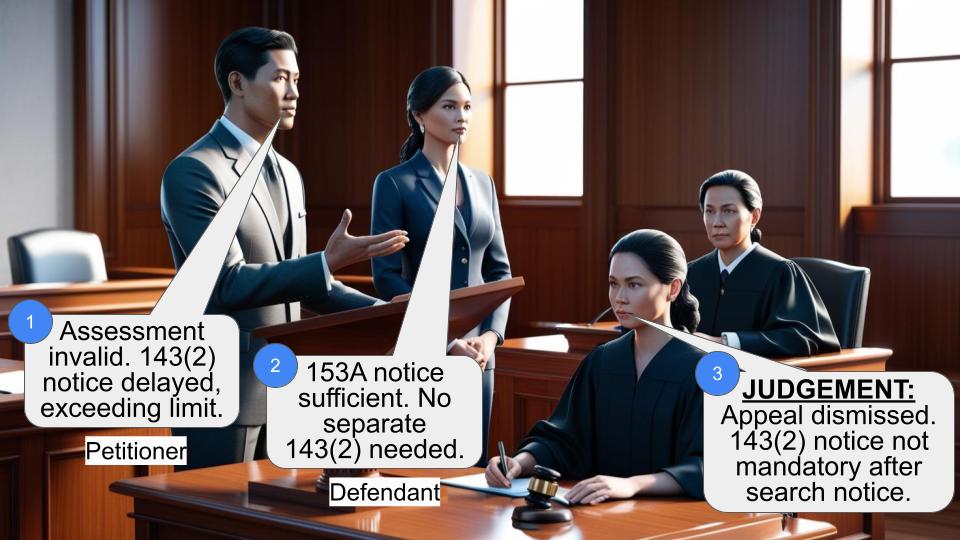
This case involves Sapthagiri Finance & Investments (the assessee) challenging a reassessment order for the 2000-01 assessment year. The main dispute was whether the Income Tax Department followed proper procedures in issuing notices for reassessment. The High Court ruled in favor of the assessee, setting aside the Income Tax Appellate Tribunal's order due to the absence of a mandatory notice under Section 143(2) (of Income Tax Act, 1961).
Get the full picture - access the original judgement of the court order here
Case Name:
Sapthagiri Finance & Investment VS Income Tax Officer (High Court of Madras)
TC(A). No. 159 of 2006
Date: 17th July 2012
Key Takeaways:
1. Issuing a notice under Section 143(2) (of Income Tax Act, 1961) is mandatory for completing reassessment under Section 148 (of Income Tax Act, 1961).
2. Failure to issue this notice is not a curable procedural irregularity.
3. There can be no waiver of statutory notice unless the assessee intentionally abandons it with full knowledge.
Issue:
Was the reassessment order valid without the issuance of a notice under Section 143(2) (of Income Tax Act, 1961)?
Facts:
- Sapthagiri Finance & Investments is a partnership firm engaged in financing.
- The firm's partners individually purchased and sold a property, but the funds came from the firm.
- The Income Tax Department initiated reassessment proceedings for the 2000-01 assessment year, claiming capital gains had escaped assessment.
- A notice under Section 148 (of Income Tax Act, 1961) was issued on 20.5.2002, followed by a notice under Section 142(1) (of Income Tax Act, 1961) on 22.10.2002.
- The assessee requested that their original return be treated as the response to the Section 148 (of Income Tax Act, 1961) notice.
- The Assessing Officer completed the reassessment without issuing a notice under Section 143(2) (of Income Tax Act, 1961).
Arguments:
Assessee:
- The reassessment was invalid due to the absence of a mandatory notice under Section 143(2) (of Income Tax Act, 1961).
- There was no intentional waiver of the right to receive this notice.
Revenue:
- The assessee's appearance and submission amounted to a waiver of the notice requirement.
- Failure to issue the notice was a curable procedural irregularity.
Key Legal Precedents:
1. ASST. CIT v. HOTEL BLUE MOON (321 ITR 362): The Supreme Court held that failure to issue notice under Section 143(2) (of Income Tax Act, 1961) is fatal to the assumption of jurisdiction and not a curable defect.
2. MOTILAL PADAMPAT SUGAR MILLS CO., v. STATE OF U.P. (118 ITR 326): The Supreme Court established that waiver must be an intentional act with full knowledge of the right being waived.
Judgement:
The High Court ruled in favor of the assessee, setting aside the Tribunal's order. Key points:
1. The court found no evidence of intentional waiver of notice by the assessee.
2. Issuing a notice under Section 143(2) (of Income Tax Act, 1961) is mandatory for completing reassessment under Section 148 (of Income Tax Act, 1961).
3. The absence of this notice rendered the reassessment invalid, despite potential merits of the case against the assessee.
FAQs:
1. Q: What was the main reason for quashing the reassessment order?
A: The main reason was the failure to issue a mandatory notice under Section 143(2) (of Income Tax Act, 1961).
2. Q: Can the Income Tax Department cure this defect and reassess?
A: No, the court ruled that this is not a curable procedural irregularity.
3. Q: What does this judgment mean for other reassessment cases?
A: It emphasizes the importance of following proper procedures, particularly issuing all mandatory notices, in reassessment cases.
4. Q: Did the court decide on whether the capital gains were actually taxable to the firm?
A: No, the court didn't rule on the merits of the case due to the procedural lapse.
5. Q: What constitutes a valid waiver of statutory notice?
A: A valid waiver must be an intentional act with full knowledge of the right being waived, not just an inference from the assessee's actions.

1. The assessee has preferred the appeal as against the order of the Income Tax Appellate Tribunal relating to assessment year 2000-01. The above Tax Case (Appeal) was admitted on the following substantial questions of law:-
"(i) Whether on the facts and in the circumstances of the case, the Tribunal was right in holding that the capital gains has to be assessed in the hands of the firm even though the properties belonged to the partners and the same was transferred by the partners in their individual capacity?
(ii) Whether on the facts and in the circumstances of the case the Tribunal was right in holding that partners and firm are not distinct and as such the transfer made by the partners in their individual capacity is deemed to be the transfer made by the firm?
(iii) Whether on the facts and in the circumstances of the case the Tribunal was right in holding that the appellant has requested the Assessing Officer to complete the assessment, which amounts to waiver of notice under Section 143(2) (of Income Tax Act, 1961)?
(iv) Whether on the facts and in the circumstances of the case the Tribunal was right in not appreciating that there cannot be any Estoppels against law and as such notice under Section 143(2) (of Income Tax Act, 1961) has to be issued within the prescribed time limit even assuming that there was waiver of such notice?"
2. The assessee herein is a partnership firm consisting of seven partners engaged in the business of financing. It is seen from the facts projected in the case that the landed property at No.7B/ 7B-1 at Valakarutheeswarar Koil Street, Kanchipuram was purchased by all the seven parties in the individual capacity under three separate sale deeds for an amount of Rs.10,30,000/-. The funds for the purchase of said property was however drawn from the funds of the firm. The property was brought in as additional capital to the firm, for which each partner's current account was credited by Rs.1,08,692/- each as on 31.3.1997. The property was also shown on the asset side of the balance sheet as on 31.3.1997 for Rs.11,66,500/-. The return of income filed for the assessment years 1997-98 and 1998-99 referred to this state of affairs. On 16.7.1999 the property was sold to Kanchipuram Kamakshiamman Silk Handloom Weavers' Co-operative Society Limited, Kanchipuram by the partners in their individual capacity. Being a going concern, the property stood in the name of the firm could not be legally distributed without valid registered sale deeds. Considering the above legal position, the transferred landed property belonging to the firm was held to attract tax on the capital gains at the hands of the firm for the assessment year 2000-01. Thus, on a perusal of the balance sheet dated 31.3.99, on a finding that the property was not there in the balance sheet, the Officer questioned each of the partners and recorded their statements. The statement recorded from the Partner B.M.K. Viswanath Sah, was affirmed by other partners. They also signed the sworn statement. Thus, the capital gains was held liable to be assessed at the hands of the firm. Consequently, notice under Section 148 (of Income Tax Act, 1961) was issued for the assessment year 2000-01 on 20.5.2002 for the reassessment of capital gains at the hands of the firm which had escaped assessment by reason of the assessee's failure to disclose the same. Since, there was no reply, further proceedings were taken. A Notice under Section 142(1) (of Income Tax Act, 1961) was issued on 22.10.2002 calling for return of income for the assessment year 2000-01. The assessee's representative appeared on 18.10.2002 and filed a reply dated 18.12.2002 wherein the assessee reiterated that the title over the property was held in the name of the partners individually; that the sale deed was executed by the partners in the individual capacity only; that the sale was made after obtaining certificate under Section 230A (of Income Tax Act, 1961) in the partners' individual capacity; that the property was owned in their individual capacity and they had also offered the taxable capital gain on their individual hands and that the advance tax due thereon had also been paid by the partners. Thus, the assessee stated that the original return filed be treated as one filed in response to Section 148 (of Income Tax Act, 1961). After going through the records, the Officer came to the conclusion that the property being held by the firm till the date of transfer on 14.7.1999, the capital gains arising from the transfer was assessable only at the hands of the firm for the assessment year 2000-01. Aggrieved by the same, the assessee went on appeal before the Commissioner of Income Tax (Appeals), who agreed with the Assessing Officer and hence, the dismissed the appeal. The Commissioner of Income Tax (Appeals) pointed out that there was no evidence recorded for transfer of property from the firm to the partners. The protective assessment made at the hands of the individual partners was also cancelled by his order dated 30.12.2004 for the assessment year 1999-2000. Aggrieved by the order of the Commissioner of Income Tax (Appeals), the assessee went on further appeal before the Income Tax Appellate Tribunal, which however dismissed the assessee's appeal. In paragraph 16 of the order, the Tribunal pointed out that the assessee appeared before the Assessing Officer on 18.12.2002 and made a submission regarding the assessability of the capital gains at the hands of the firm. The Assessing Officer for the technical reason treated the original return as the return filed for the notice issued under Section 148 (of Income Tax Act, 1961). Based on the finding that the assessee had made representation and given its submission, the Tribunal inferred that the requirement of issuance of notice under Section 143(2) (of Income Tax Act, 1961) could be waived. It further reasoned that but the appearance on the part of the assessee, it would not be possible for the Assessing Officer to treat the original return as the return filed under Section 148 (of Income Tax Act, 1961). Pointing out to the signature of the counsel in the order sheet and a note that "arguments are heard and the same will be considered for completion of assessment", the Tribunal held that there was conscious waiver of notice under Section 143(2) (of Income Tax Act, 1961). Thus, the Tribunal rejected the assessee's contention that there was no proper compliance of provisions of Section 143(2) (of Income Tax Act, 1961) by issuing a notice. As far as the facts of the present case is concerned, the Tribunal held that without registration, the transfer of the property from the firm to the individual partners could not be treated as valid transfer. Thus, the Assessing Officer was correct in treating the capital gains as exigible at the hands of the firm. Aggrieved by the same, the assessee has preferred the above appeal.
3. Learned counsel for the assessee placed before us the decision of the Apex Court reported in 321 ITR 362 ASST. CIT v. HOTEL BLUE MOON. In considering the failure of the Assessing Officer in issuing notice under Section 143(2) (of Income Tax Act, 1961), in respect of block assessment, the Apex Court held that failure to issue notice under Section 143(2) (of Income Tax Act, 1961) would be fatal to the assumption of jurisdiction. If an assessment is to be completed under Section 143(3) (of Income Tax Act, 1961) read with Section 158 (of Income Tax Act, 1961) BC, notice under Section 143(2) (of Income Tax Act, 1961) should be issued within one year from the date of filing of the block return. The Apex Court viewed that omission on the part of the Assessing Authority to issue notice under Section 143(2) (of Income Tax Act, 1961) could not be a procedural irregularity and hence was not curable and the requirement of notice under Section 143(2) (of Income Tax Act, 1961) cannot be dispensed with. Thus, in the light of the decision of the Apex Court, learned counsel for the assessee submitted that the Tribunal committed serious error in drawing an inference on mere appearance of the assessee pursuant to notice issued under Section 142(1) (of Income Tax Act, 1961) and on the note referring that "arguments are heard and the same will be considered for completion of assessment", that there was a waiver from the side of the assessee with reference to issue of notice under Section 143(2) (of Income Tax Act, 1961). He further submitted that the Revenue does not dispute the fact that there was no notice issued under Section 143(2) (of Income Tax Act, 1961) before passing an order of assessment under Section 148 (of Income Tax Act, 1961) and the notice issued under Section 142(1) (of Income Tax Act, 1961) could not be treated as notice issued under Section 143(2) (of Income Tax Act, 1961). He further pointed out that the assessee requested the Assessing Officer to treat the original return filed as one filed in response to the notice issued under Section 148 (of Income Tax Act, 1961). Thus, he submitted that the view of the Tribunal that there was no prayer for treating the original return as return in compliance with notice issued under Section 148 (of Income Tax Act, 1961) is incorrect. The view of the Tribunal is totally against the decision of the Supreme Court reported in 321 ITR 362 ASST. CIT v. HOTEL BLUE MOON, both on points of law as well as on the facts of the present case.
4. As far as the merits of the assessment is concerned, learned counsel for the assessee reiterated the stand as had been taken before Assessing Officer and the Commissioner of Income Tax (Appeals) as well as before the Tribunal.
5. As regards the reasoning of the Tribunal that there was waiver of notice under Section 143(2) (of Income Tax Act, 1961), learned counsel placed reliance on the decision of the Supreme Court reported in 118 ITR 326 MOTILAL PADAMPAT SUGAR MILLS CO., v. STATE OF U.P. and pointed out that the basic requirement of waiver is that it must be an intentional act with knowledge. Thus, when the waiver of a notice, which is very fundamental to the assumption of jurisdiction is alleged, the Revenue is duty bound to show that the assessee had abondoned his right to the notice under Section 143(2) (of Income Tax Act, 1961). In the absence of any such material available with the Revenue, that the assessee had given up its right with full knowledge of such right, the finding of the Tribunal is baseless and without material.
6. Replying to the stand of the assessee, learned standing counsel for the Revenue placed reliance on the decision reported in 294 ITR 233 AREVA T AND D INDIA LIMITED v. ASST. CIT and submitted that the failure to issue notice is only an irregularity. Consequently reassessment order could not be held as illegal and defect incurable.
7. Heard learned counsel for the assessee as well as learned Standing counsel for the Revenue and perused the materials available on record.
8. The facts led to the invoking of jurisdiction under Section 148 (of Income Tax Act, 1961) are already narrated in the preceding paragraph. As already seen, on the issue of notice under Section 148 (of Income Tax Act, 1961), the firm admittedly filed a letter through its representative, who appeared on 18.12.2002 before the Officer and stated that the original return filed be treated as one filed in response to the notice under Section 148 (of Income Tax Act, 1961). The assessment order makes no secret about this fact. Thus, on this admitted fact, we do not find any material based on which the Tribunal could arrive at this finding that there was no return in response to the notice under Section 148 (of Income Tax Act, 1961). It is also admitted in the assessment order that the notice was issued under Section 142(1) (of Income Tax Act, 1961) calling upon the assessee to file return of income for the assessment year 2000-01, in response to which alone, the assessee's representative appeared before the Officer. After issuing notice under Section 142(1) (of Income Tax Act, 1961), there is no semblance of any notice issued under Section 143(2) (of Income Tax Act, 1961). All that one finds is as the Tribunal noted in its order, the order sheet bearing the signature of the counsel for the assessee and a note "arguments are heard and the same will be considered for completion of assessment. " Section 143(2) (of Income Tax Act, 1961) as it stood at the relevant point of time before substituting by the Finance Act, 2002 with effect from 1.6.2002, reads as under:-
(2) Where a return has been made under Section 139 (of Income Tax Act, 1961), or in response to a notice under sub section (1) of Section 142 (of Income Tax Act, 1961), the Assessing Officer shall, if he considers it necessary or expedient to ensure that the assessee has not understated the income or has not computed excessive loss or has not under paid the tax in any manner, serve on the assessee a notice requiring him, on a date to be specified therein, either to attend his office or to produce, or cause to be produced there, any evidence on which the assessee may rely in support of the return"
9. Thus when the return was filed under Section 139 (of Income Tax Act, 1961) or in response to a notice under Section 142(1) (of Income Tax Act, 1961), where the Assessing Officer considers it necessary or expedient to ensure that the assessee had not understated the income or had not computed excessive loss or has not under paid the tax in any manner, the Assessing Officer shall serve a notice under Section 143(2) (of Income Tax Act, 1961) calling upon the assessee to produce evidence on which the assessee made reliance in support of the return. It is not denied by the Revenue that the proceedings taken herein is not original assessment proceedings, but reassessment proceedings under Section 147 (of Income Tax Act, 1961) and 148 of the Act on the premise that the original return filed by the assessee had not showed the capital gains arising from sale of the property. The return was found to be incorrect and that there was an escapement of income from being taxed. On this ground only, proceedings under Section 148 (of Income Tax Act, 1961) was initiated.
10. As already pointed out, the assessee reiterated its contention in the letter dated 18.12.2002, pursuant to notice issued under Section 142(1) (of Income Tax Act, 1961) stating that original return filed shall be treated as return filed in response to the notice issued under Section 148 (of Income Tax Act, 1961). Thus, on the reply to the notice under Section 142(1) (of Income Tax Act, 1961), reiterating the original return which was found incorrect, the Assessing Officer should have follow up by a notice under Section 143(2) (of Income Tax Act, 1961) issued therein. It is evident that the Officer had not proceeded with issuance of any such notice in this case. Merely because the matter was discussed with the assessee and the signature is affixed, it does not mean the rest of the procedure of notice under Section 143(3) (of Income Tax Act, 1961) stood complied with or that on placing the objection the assessee had waived the notice for further processing of the reassessment proceedings. The fact that on the notice issued under Section 143(2) (of Income Tax Act, 1961), the assessee had placed its objection and reiterated its earlier return filed as one filed in response to the notice issued under Section 148 (of Income Tax Act, 1961) and the Officer had also noted that the same would be considered for completion of assessment, would show that the Assessing Officer has the duty of issuing the notice under Section 143(3) (of Income Tax Act, 1961) to lead on to the passing of the assessment. In the circumstances, with no notice issued under Section 143(3) (of Income Tax Act, 1961) and there being no waiver, we do not find any justifiable ground to accept the view of the Tribunal that there was a waiver of right of notice to be issued under Section 143(2) (of Income Tax Act, 1961).
11. As rightly pointed out by the learned counsel for the assessee placing reliance on the decision reported in 118 ITR 326 MOTILAL PADAMPAT SUGAR MILLS CO., v. STATE OF U.P., it is difficult to find any material which would justifiably enable this Court to affirm the view of the Tribunal that there was an conscious act with knowledge to waive such right of notice being served on the assessee. The Apex Court pointed out that there can be no waiver unless the person who is said to have waived is fully informed as to his right and with full knowledge of such right, he intentionally abandons it. There is nothing on record to show or one could read from the letter written by the assessee dated 18.12.2002 that the assessee abandoned such right of a notice under Section 143(2) (of Income Tax Act, 1961). In the light of the above, we reject the Tribunal's reasoning.
12. As far as the contention of the Revenue that failure to issue notice under Section 143(2) (of Income Tax Act, 1961) is only curable defect is concerned, the decision relied on by the assessee reported in 321 ITR 362 ASST. CIT v. HOTEL BLUE MOON, also covers the said issue. It is no doubt true that the said decision dealt with the assessment done under Chapter XIV relating to block assessment. The assessee therein raised a contention that the failure to issue notice under Section 143(2) (of Income Tax Act, 1961) within the prescribed time for the purpose of block assessment could be fatal to the validity of the assessment made under Chapter XIVB of the Income Tax Act, 1961. In other words, the assessee contended that the issuance of notice under Section 143(2) (of Income Tax Act, 1961) within the prescribed period of time for the purpose of block assessment is mandatory for assessing the assessee's undisclosed income found during the search. The Revenue took the stand that issue of notice under Section 143(2) (of Income Tax Act, 1961) was only procedural irregularity which was curable. The Apex Court pointed out to Section 158BC(b) (of Income Tax Act, 1961) provided for determination of the undisclosed income of the block period in the manner laid down in Section 158BB (of Income Tax Act, 1961) and the provisions of section 142 (of Income Tax Act, 1961), sub sections (2) and (3) of Section 143 (of Income Tax Act, 1961), Section 144 (of Income Tax Act, 1961) and Section 145 (of Income Tax Act, 1961) shall, so far as may be, apply. The Apex Court pointed out after return is filed, the Assessing Officer has to follow the procedure like the issue of notice under Section 143(2) (of Income Tax Act, 1961)/142 and complete the assessment under Section 143(3) (of Income Tax Act, 1961). In the event, the assessee is not filing the return or not complying with the notice under Section 143(2) (of Income Tax Act, 1961)/142, the Officer is authorised to complete the assessment ex parte under section 144 (of Income Tax Act, 1961). The Apex Court further pointed out that notice under Section 143(2) (of Income Tax Act, 1961) would become necessary only where the block return does not conform undisclosed income inferred by the authorities. Thus, if an assessment is to be completed under Section 143(3) (of Income Tax Act, 1961) read with Section 158BC (of Income Tax Act, 1961), notice under Section 143(2) (of Income Tax Act, 1961) should be issued within one year from the date of filing of the block return. The Apex Court further held that omission on the part of the assessing authority to issue notice under Section 143(2) (of Income Tax Act, 1961) cannot be a procedural irregularity and the same is not curable, and therefore, the requirement of notice under Section 143(2) (of Income Tax Act, 1961) cannot be dispensed with. The legislation referring to the compliance of the provisions under Section 143 (of Income Tax Act, 1961), 144 and 145 of the Act is a legislation by incorporation. Thus, where the Assessing Officer repudiates the return filed by the assessee in response to notice under Section 158BC(a) (of Income Tax Act, 1961), the Assessing Officer must necessarily issue notice under Section 143(2) (of Income Tax Act, 1961). Dealing with the contention that the issue of notice is not mandatory but optional and is to be applied to the extent practicable, in view of expression "so far as may be" in Section 153BC(b) (of Income Tax Act, 1961), the Apex Court pointed out that the expression "so far as may be" has always been construed to mean that those provisions may be generally followed to the extent possible. Rejecting the contention of the Revenue that it is not expedient to follow the provisions under Sections 142 (of Income Tax Act, 1961) and 143 (2) and (3) strictly for the purpose of block assessment, the Apex Court held that in completing the assessment, when the officer repudiates the return filed under Section 158BC(a) (of Income Tax Act, 1961) proceeds to make an enquiry, he has necessarily to follow the provisions of section 142 (of Income Tax Act, 1961) and 143 (2) and (3) of the Act.
13. As far as the present case is concerned, the provisions of Section 148 (of Income Tax Act, 1961) also uses the expression "so far as may be apply accordingly as if such return were a return required to be furnished under Section 139 (of Income Tax Act, 1961)". Thus, understanding this provisions in the background of the decision of the Apex Court, on the facts available, we are of the view that in completing the assessment under Section 148 (of Income Tax Act, 1961), compliance of the procedure laid down under Sections 142 (of Income Tax Act, 1961) and 143(2) is mandatory. On the admitted fact that beyond notice under Section 142(1) (of Income Tax Act, 1961), there was no notice issued under Section 143(2) (of Income Tax Act, 1961), and in the light of the fact that the very basis of the reassessment was the failure on the part of the assessee in not disclosing the capital gains arising on the transfer of property for assessment and that admittedly the assessee had requested the officer to accept the original return as a return filed in response to Section 148 (of Income Tax Act, 1961), we hold that there was total failure on the part of the Revenue from complying with the procedure laid down under Section 143(2) (of Income Tax Act, 1961), which is mandatory one as held by the Apex Court.
14. Although on merits, we do not agree with the contention of the assesee that the capital gains would not be assessable at the hands of the firm, yet for the reasons stated in the preceding paragraph that in the absence of notice under Section 143(2) (of Income Tax Act, 1961) reassessment could not be held to be validly made . Thus, we have no hesitation in setting aside the order of the Tribunal.
CHITRA VENKATARAMAN,J
and K.RAVICHANDRABAABU,J
15. Consequently, the order of the Tribunal is set aside and the Tax Case (Appeal) is allowed. No costs.
(C.V.,J) (K.R.C.B.,J)
17.07.2012
Index : Yes/No
Internet : Yes/No
To
1. The Income Tax Officer, Ward I(4), Kanchipuram
2. The Income Tax Appellate Tribunal, B Bench, Chennai
×
Similar Ripples
Questions
Court Quashes Reassessment for Lack of Mandatory Notice
Write your CommentSimilar Posts


Generic
- Reportdata/5667.pdf
