


Court Quashes Tax Authority's Order, Demands Fresh Hearing for Co-op Society


Full News
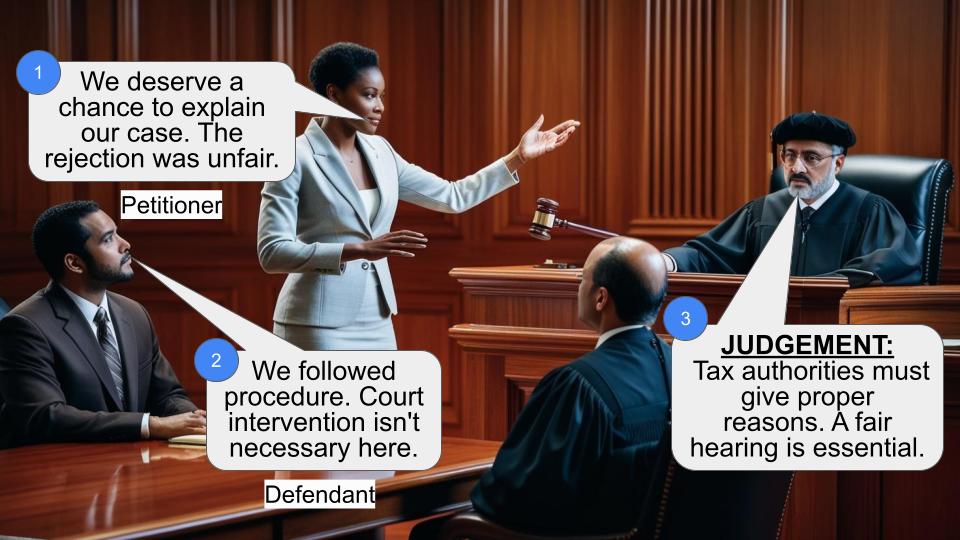
Court Quashes Tax Authority's Order, Demands Fresh Hearing for Co-op Society
Court Quashes Tax Authority's Order, Demands Fresh Hearing for Co-op Society
This case where a co-operative society called Jyothi Co-operative Credit Society Limited took the Income Tax Officer to court. The society wasn't happy with how their tax assessment was handled and wanted the court to step in. Long story short, the court agreed that the tax authorities messed up and ordered them to give the society a fair hearing.
Get the full picture - access the original judgement of the court order here
Case Name:
Jyothi Co-operative Credit Society Limited vs Income Tax Officer (High Court of Karnataka)
W.P.No.147036 of 2020(T-IT)
Date: 14th July 2020
Key Takeaways:
1. Tax authorities need to give proper reasons when rejecting stay applications.
2. Assessments should be examined for being unreasonably high-pitched or causing genuine hardship.
3. Natural justice principles are crucial - taxpayers must get a chance to present their case.
4. High Courts can intervene if tax authorities don't follow proper procedures.
Issue:
Did the tax authority (respondent No.3) violate principles of natural justice and fail to provide a reasoned order when rejecting the petitioner's stay application against a tax demand?
Facts:
1. Jyothi Co-operative Credit Society filed a tax return claiming zero taxable income after deductions.
2. The Income Tax Officer (respondent No.1) did a limited scrutiny and rejected their deduction claim.
3. The society appealed to a higher authority (respondent No.2) on January 1, 2020.
4. They also asked for a stay on the tax demand, which was rejected because they hadn't paid 20% of the disputed amount.
5. The society then approached an even higher authority (respondent No.3) for a stay, which was also rejected.
6. Frustrated, the society took the matter to the High Court.
Arguments:
The society's lawyer said:
- The appeal is pending, so the court should tell respondent No.2 to decide it quickly.
- They cited a previous High Court case (W.P.4811/2008) to support this.
The tax department's lawyer argued:
- The High Court shouldn't interfere in this matter.
- The society can ask for an early hearing in their pending appeal.
- There's no need for the court to step in.
Key Legal Precedents:
1. W.P.No.145596/2020: A similar case where the court found the tax authority's order inadequate.
2. Flipkart India (P), Ltd. Vs. Assistant Commissioner of Income-tax, Circle 3(1)(1), Bengaluru: This case established that tax authorities must consider if an assessment is unreasonably high-pitched and causes genuine hardship.
Judgement:
The court sided with the society. Here's what they said:
1. The order by respondent No.3 (Annexure-F) shows they didn't think it through properly.
2. They didn't consider if the assessment was unreasonably high or caused genuine hardship.
3. The order doesn't give proper reasons and violates natural justice principles.
4. The court quashed (cancelled) the order and told respondent No.3 to reconsider the matter after giving the society a fair hearing.
FAQs:
1. Q: What does this mean for the society?
A: They get another chance to argue their case for a stay on the tax demand.
2. Q: Does this mean the society won their tax case?
A: Not yet. This decision is just about the stay application. Their main appeal is still pending.
3. Q: What's the significance of this judgment?
A: It reinforces that tax authorities must give reasoned orders and follow natural justice principles.
4. Q: What happens next?
A: Respondent No.3 will have to hear the society's arguments again and pass a new order on their stay application.
5. Q: Could this affect other taxpayers?
A: Yes, it sets a precedent that taxpayers should get a fair hearing and reasoned orders in similar situations.

The captioned writ petition is filed seeking writ of mandamus to direct respondent No.2 authority to consider the appeal filed by the petitioner before respondent No.2 against the impugned assessment order the petitioner has filed an appeal in Form No.35, before respondent No.2 on 01.01.2020.
2. Brief facts leading to this top noted writ petition are as under:
The petitioner herein is a co-operative society registered under the Karnataka Co-operative Society Act, 1959. The case of the petitioner is that, it has filed return of income declaring gross total income to the tune of Rs.64,95,598/- and after claiming deduction under Chapter VIA amounting to Rs.64,95,598/-, declared total income as Nil. The authorities have taken up the case of the petitioner-society for limited scrutiny under CASS by way issuing notice under Section 143(2) of the Income Act, 1961 (for short ‘the Act’). The petitioner-society has submitted its replies online with a hardcopy in tapal. Respondent No.1 rejected the petitioner’s claim of deduction under Section 80P(2)(a)(i) (of Income Tax Act, 1961) by placing reliance on the judgment of the Hon’ble Apex Court in the case of Citizen Co-operative Credit Society Limited Vs ACIT. The case of the petitioner is that respondent No.1 also treated the unexplained income under Section 68 (of Income Tax Act, 1961) r/w Section 115BBE (of Income Tax Act, 1961), the cash deposits made during the demonetization period.
3. The petitioner being aggrieved by the assessment order preferred an appeal in Form No.35 before respondent No.2 on 01.01.2020 and the same is pending for consideration. Having preferred an appeal, the petitioner submitted an application on 02.01.2020 for grant of stay against the assessment order before respondent No.1. The said application was rejected by respondent No.1 on the ground that 20% of the disputed demand is not paid. This compelled the petitioner to file an application on 19.02.2020 seeking stay of demand for the assessment year 2017-18 against the assessment order before respondent No.3. Respondent No.3 has rejected the application. The grievance of the petitioner is that the order passed by respondent No.3 as per Annexure-F is contrary to the material placed on record. The order under challenge is not a speaking order. The next grievance of the petitioner is that the order passed by respondent No.3 is in gross violation of principles of natural justice. On these set of facts, the present writ petition is filed.
4. Learned counsel for the petitioner would vehemently argue and contend before this Court that since the petitioner is challenging the very assessment order pending before respondent No.2, he would request this Court to issue appropriate directions against respondent No.2 to dispose of the appeal expeditiously. To buttress his arguments, he would rely on the judgment of Co-ordinate Bench of this Court rendered in W.P.4811/2008. Relying on this judgment, he would request this Court to direct respondent No.2 to dispose of the appeal by imposing time frame.
5. Per contra, Sri.Y.V.Raviraj, learned counsel appearing for the respondents would submit to this Court that this Court exercising jurisdiction under Articles 226 and 227 of the Constitution of India cannot entertain the present writ petition. He would submit to this Court that the order passed by respondent No.3 as per Annexure-F dos not suffer from any infirmities. However, he would submit to this Court that since the petitioner has already availed remedy before respondent No.2 challenging the assessment order, it is open for the petitioner to prosecute the appeal. The petitioner cannot seek writ of mandamus when the matter is already pending before respondent No.2. The petitioner is at liberty to seek early hearing of the appeal and press for disposal also which is well within the reach of the petitioner. In this background, indulgence by this Court would not arise.
6. This Court is aware of the order passed by the Coordinate Bench of this Court rendered in W.P.No.145596/2020, which is identical and is squarely applicable to the present case on hand. Paragraph 4 and 5 would answer the lis that is raised in the present writ petition. This Court relying on the judgment rendered in Flipkart India (P), Ltd. Vs. Assistant Commissioner of Income-tax, Circle 3(1)(1), Bengaluru has held that, it is incumbent on the Principal Commissioner of Income-Tax to decide on the application for stay considering two questions, viz., whether the assessment is unreasonably high-pitched and whether the petitioner would be put to genuine hardship because of such assessment. This Court while examining the order of the authority was of the view that the order under challenge is not at all a speaking order and accordingly, this Court set aside the order and remitted back for fresh consideration. The facts in the present case are replica and identical.
7. On perusal of the impugned order passed by respondent No.3 as per Annexure-F, it is clearly evident that there is totally non-application of mind. The authority has not at all examined as to whether the assessment is unreasonably high-pitched and whether assessment order has caused genuine hardship because of such an assessment. No reasons are forthcoming in the order passed by respondent No.3 as per Annexure-F. It is also forthcoming that this order is passed in gross violation of principles of natural justice. No opportunity was granted to the petitioner to put forth his case. This Court is of the view that the order under challenge is not at all a speaking order and the same is bad in law.
8. For the reasons stated supra, the order passed by respondent No.3 as per Annexure-F is not sustainable. Accordingly, I pass the following:
ORDER
The writ petition is allowed. The impugned order passed by respondent No.3 dated 17.03.2020 as per Annexure-F is quashed. The matter is remitted back to respondent No.3 for fresh consideration. On receipt of the order passed by this Court, respondent No.3 is required to fix a date and after hearing the petitioner shall pass appropriate orders in accordance with law.
Sd/-
JUDGE
×
Similar Ripples
Questions
Court Quashes Tax Authority's Order, Demands Fresh Hearing for Co-op Society
Write your CommentSimilar Posts


Generic
- Reportdata/6223.pdf
