


Court Quashes Tax Reassessment: No New Evidence, No Extended Time Limit


Full News
Court Quashes Tax Reassessment: No New Evidence, No Extended Time Limit
Court Quashes Tax Reassessment: No New Evidence, No Extended Time Limit
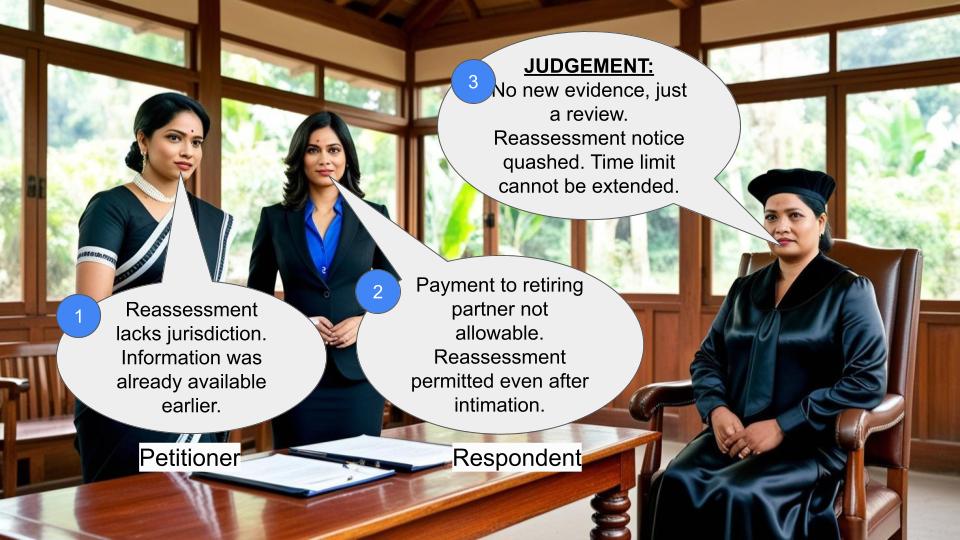
The High Court ruled in favor of Tanmac India, quashing a tax reassessment notice issued by the Deputy Commissioner of Income Tax. The court found that the tax department couldn't initiate reassessment based on information already available during the original assessment period, especially when the time for scrutiny assessment had elapsed.
To delve deeper, you can read the original judgement of the court order here.
Case Name:
Tanmac India vs Deputy Commissioner of Income Tax (High Court of Madras)
Tax Case (Appeal) No.1426 of 2007
Key Takeaways
1. Tax authorities can't initiate reassessment without new evidence.
2. 'Reason to believe' is crucial for reassessment under Section 147 (of Income Tax Act, 1961).
3. Reassessment can't be used as a tool to review past decisions.
4. Tax departments can't use extended time limits without new material.
Issue
Can the Income Tax Department initiate reassessment proceedings based on information already available during the original assessment period, when the time for scrutiny assessment has elapsed?
Facts
1. Tanmac India, a partnership firm, paid Rs. 5,50,000 to a retiring partner as compensation.
2. The firm claimed this amount as a deduction in their tax return for AY 1998-99.
3. The tax department initially processed the return under Section 143(1)(a) (of Income Tax Act, 1961) without scrutiny.
4. On 9.12.2002, the department issued a notice under Section 148 (of Income Tax Act, 1961) to reassess the income.
5. The assessee challenged the reassessment, arguing lack of jurisdiction under Section 147 (of Income Tax Act, 1961).
Arguments
Assessee:
- The reassessment lacked jurisdiction under Section 147 (of Income Tax Act, 1961).
- The tax department was attempting a review, not a reassessment.
- No new material was presented to justify the reassessment.
Tax Department:
- Reassessment was permissible as the original proceeding was only an intimation under Section 143(1)(a) (of Income Tax Act, 1961).
- The payment to the retiring partner was not an allowable business expenditure.
Key Legal Precedents
1. DCIT vs. Rajesh Jhaveri Stock Brokers Pvt. Ltd. (295 ITR 499)
2. CIT vs. Kelvinator of India (320 ITR 561)
3. Commissioner of Income Tax vs. Orient Craft Ltd (354 ITR 546)
Judgement
The High Court ruled in favor of the assessee, stating:
1. The tax department cannot initiate reassessment based on information already available during the original assessment period.
2. The 'reason to believe' for reassessment must be based on new or tangible material.
3. The department cannot use the extended time limit for reassessment without new evidence
4. The reassessment notice was an arbitrary exercise of power and a review of proceedings, which is impermissible in law.
FAQs
Q1: What is the key requirement for initiating reassessment under Section 147 (of Income Tax Act, 1961)?
A1: The assessing officer must have a 'reason to believe' that income chargeable to tax has escaped assessment, based on new or tangible material.
Q2: Can the tax department reassess based on information available during the original assessment?
A2: No, reassessment cannot be initiated based on information already available during the original assessment period.
Q3: What's the difference between review and reassessment?
A3: Review is re-examining a decision based on the same facts, while reassessment requires new information or evidence suggesting escaped income.
Q4: Does the tax department have different standards for reassessment after Section 143(1) (of Income Tax Act, 1961) intimation versus Section 143(3) (of Income Tax Act, 1961) assessment?
A4: No, the court clarified that the same rigorous standards apply in both cases.
Q5: What happens if the tax department misses the deadline for scrutiny assessment?
A5: They cannot use reassessment provisions to overcome the lapsed time limit without new evidence of escaped income.

This Tax Case (Appeal) filed by the assessee raises the following two substantial questions of law admitted for consideration of this Court.
1. Whether on the facts and in the circumstances of the case, the Appellate Tribunal was right in law on holding that the appellant is not entitled to claim the expenditure of Rs.5,50,000/- paid to the retiring partner under section 37 (of Income Tax Act, 1961) as the same was made out of business exigencies?
2. Whether on the facts and in the circumstances of the case, the Appellate Tribunal was right in law in holding that the Assessing Officer is justified in reopening the assessment by issuance of notice under section 148 (of Income Tax Act, 1961) when no new material was unearthed justifying the re-opening of the assessment?
2. The assessee is a partnership firm. One of the partners Sri.P.C.Kapur retired from the firm on 1.4.1997 and the deed of retirement provided for a sum of Rs.5,50,000/-(Rupees five lakhs and fifty thousand ) to be paid by the firm to the retiring partner 'as compensation for his agreeing to retire from the firm'. The aforesaid sum of Rs.5.5 lakhs was claimed as a deduction for the purposes of computation of tax under the provisions of the Income Tax Act (hereinafter referred to as 'Act') by the firm.
3. The return of income filed in respect of A Y 1998-99 was processed and an intimation under Section 143(1)(a) (of Income Tax Act, 1961) issued. No notice under section 143(2) (of Income Tax Act, 1961) dated 9.12.2002 was issued and the matter was allowed to rest. Thereafter, a notice under section 148 (of Income Tax Act, 1961) was issued initiating proceedings for re- assessment. The assessee claimed that the sum of Rs.5.5 lakhs represented non-compete fee and an allowable deduction. The assessing officer disallowed the same holding it to be capital in nature. He also concluded that the amount had been categorized as 'lump sum payment made as a compensation for future profits forgone by the retiring partner' in the Profit and Loss account and was, at best, contingent.
4. The appeal before the Commissioner of Income Tax (Appeals) was rejected vide order dated 30.9.2004, which order was confirmed by the Income tax Appellate Tribunal on 18.8.2006. It had been contended by the assessee before both appellate authorities that the re-assessment lacked requisite jurisdiction under section 147 (of Income Tax Act, 1961) and was thus erroneous in law. The authorities upheld jurisdiction on the ground that the original proceeding had been an intimation under section 143(1)(a) (of Income Tax Act, 1961) in respect of which re- assessment was permissible and on merits for the reason that the amount had, as per the deed, been expended only for the retirement of the partner which, does not constitute allowable business expenditure.
5. We have heard Mr.M.R.Muralidharan appearing for the assessee and Mr.J.Narayanasamy, appearing on behalf of the Income Tax Department.
6. We first address the question of jurisdiction. The present re-assessment is pursuant to a prima facie intimation in terms of section 143(1)(a) (of Income Tax Act, 1961). Tribunal concludes the issue adverse to the appellant based on the judgment of the Supreme Court in the case of DCIT Vs. Rajesh Jhaveri Stock Brokers Pvt. Ltd. (295 ITR 499) that has been rather mechanically applied. The question that now arises for our consideration is whether the assessing officer could, having taken cognizance of the return of income and annexures, issued an intimation under section 143(1) (of Income Tax Act, 1961) and allowed the matter to rest, thereafter now proceed to issue a notice for re-assessment simply based on the same material that had been available to him all along.
7. The sine qua non for the initiation of proceedings in terms of section 147 (of Income Tax Act, 1961) is ‘reason to believe’ on the part of the assessing officer that income chargeable to tax has escaped assessment. While the court cannot examine the sufficiency of reasons on the basis of which re-assessment is initiated, the existence or otherwise such ‘reason to believe’ is certainly open to verification and would be evident from the reasons recorded prior to issue of notice under section148 (of Income Tax Act, 1961) as required in terms of section 148(2) (of Income Tax Act, 1961). In order to examine this aspect of the matter, the records were called for and have been duly produced for our perusal by Mr..Narayanaswamy. The reasons recorded are as follows:
‘The debit claimed towards lump sum payment made as a compensation for future profits forgone by the retiring partner Rs.5,50,000/- is not allowable for the following reasons:
1. The payment has not been authorised by partnership deed.
2. Serving of future profit is contingent one. Contingent expenditure cannot be allowed.
3. Future profits does not relate to the AY in question. And so, the expenditure cannot be allowed in this AY.’
8. A perusal of the Reasons would indicate that the assessing officer proceeds solely on the basis of the return of income and the enclosures thereto, being the financials and the deed of partnership, to initiate proceedings for re-assessment. The aforesaid documents however are part of record and the basis on which the intimation under section 143(1)(a) (of Income Tax Act, 1961) has been issued on 1.12.98. Let us bear in mind that the intimation dated 1.2.1998 has been manually issued, being prior to the electronic era which came into force on and with effect from 2003. The assessing officer has thus evidently applied his mind to the return and annexures even at that stage.
9. The scheme of assessment as set out in section 143 (of Income Tax Act, 1961) requires an assessing officer to process the return by issue of an intimation (which has been done in the present case) and thereafter issue a notice under sub-section (2) of section 143 (of Income Tax Act, 1961) to the assessee if the assessing officer considers it necessary or expedient to ensure that the assessee has not understated income, computed excessive loss or underpaid tax calling upon him to attend his office and require him on a date to be specified therein, to produce or cause to be produced any evidence on which the assessee may rely in support of such claim. Having done so, an assessment is to be completed in terms of section 153(1) (of Income Tax Act, 1961) within a period of two years from the end of the assessment year in which the income was first assessable, in this case, on or before 31.3.2001. 10. Let us now see the sequence of events that have transpired in this case. The assessee filed a return of income pursuant to which, an intimation dated 1.12.1998 under section 143(1)(a) (of Income Tax Act, 1961) was issued. The provisions of section 143(2) (of Income Tax Act, 1961) require that if the assessing officer considered it necessary or expedient to ensure that the assesse has not understated income, claimed excessive loss or underpaid tax in any manner, the assessment is to be subject to further scrutiny, a notice under section 143(2) (of Income Tax Act, 1961) is liable to be issued and the assessment completed on or before 31.3.2001. This was not done in the present case. Subsequently, a notice under section 148 (of Income Tax Act, 1961) has been issued on 9.12.2002 under section 148 (of Income Tax Act, 1961) taking advantage of the now extended limitation of four years to re-assess income on the basis of the same materials that were available with the authority as part of the record.
11.The phrase ‘reason to believe ‘ in section 147 (of Income Tax Act, 1961) relates to such other new or tangible material as may have come to the knowledge of the assessing officer pursuant to the original proceedings for assessment. The Supreme Court in CIT Vs. Kelvinator of India (320 ITR 561) states thus in the context of the ‘belief’ that should form the basis for a re-assessment;
‘We must also keep in mind the conceptual difference between power to review and power to reassess. The Assessing Officer has no power to review, he has the power to reassess. But reassessment has to be based on fulfillment of certain pre- conditions and if the concept of ‘change of opinion’ is removed, as contended on behalf of the Department, then, in the garb of reopening the assessment, review would take place. One must treat the concept of ‘change of opinion’ as an in-built test to check abuse of power by the Assessing Officer. Hence, after 1 st April, 1989, the Assessing Officer has power to reopen, provided there is‘tangible material’ to come to the conclusion that there is escapement of income from assessment. Reasons must have a link with the formation of the belief.’
12. If the assessing officer, after issuing intimation u/s section 143(1) (of Income Tax Act, 1961) does not to issue a notice u/s 143(2) (of Income Tax Act, 1961) to initiate proceedings for scrutiny of the return of income, the obvious conclusion is that he does not consider it necessary or expedient to do so, the inference being that the Return of Income filed in order. It is this opinion that cannot be arbitrarily changed by the assessing officer, to re-assess income on the basis of stale material, already on record. If we thus keep in the mind the above fundamental requirement of section 147 (of Income Tax Act, 1961), it would be apparent that the exercise undertaken by the Revenue in this case is not one of re- assessment, but of review. The reasons make it abundantly clear that the re-assessment is sought to be initiated on the basis of the return of income and the enclosures which were available with the assessing officer since 2.11.1998 and which ought to have prompted him to issue a notice under section 143(2) (of Income Tax Act, 1961) to conduct the proceedings under scrutiny. What is sought to be done by the re-assessment ought to have been achieved by scrutiny assessment proceedings. Having missed the bus earlier, the Department cannot be permitted to avail of the extended time limit in the absence of any new or tangible material, when the time for scrutiny assessment has elapsed on 31.3.2001, prior to issue of notice u/s 148 (of Income Tax Act, 1961). The notice under section 148 (of Income Tax Act, 1961) dated 9.12.2002 is thus an arbitrary exercise of power and a review of proceedings impermissible in law.
13. The Division Bench of the Delhi High Court in the case of Commissioner of Income Tax Vs. Orient Craft Ltd (354 ITR 546) deals specifically with this aspect of the matter. The substantial question of law that was dealt with by the High Court is as follows;
‘Was the Tribunal right in law in holding that in the absence of any tangible material available with the Assessing Officer to form the requisite belief regarding escapement of income, the reopening of the assessment made under section 143 (of Income Tax Act, 1961)(10 is bad in law?’
14. The Division Bench notes that the Supreme Court in the case of Asst. CIT V. Rajesh Jhaveri stock Brokers P. Ltd, (supra) only deals with the formation of an opinion at the time of issuance of prima facie intimation and does not indicate anywhere that a re-assessment can be initiated in the absence of a reason to believe.
To conclude, the Division Bench holds thus:
‘This judgment, contrary to what the Revenue would have us believe, does not give a carte blanche to the Assessing Officer to disturb the finality of the intimation under section 143(1) (of Income Tax Act, 1961) at his whims and caprice; he must have reason to believe within the meaning of the section.’
15. There is yet another relevant aspect. Mr.Kapur, to whom the payment was made in the present case, also retired from two other firms simultaneously, M/s.Jarvis International (hereinafter referred to as ‘Jarvis’) and M/s Aryavartha Impex (hereinafter referred to as ‘Aryavartha’). The facts in the case of Jarvis, Aryavartha and TANMAC, the appellant before us, are identical. However, it appears that the Department, in the cases of Jarvis and Aryavartha, issued notices u/s.143(2) (of Income Tax Act, 1961) and completed scrutiny assessment proceedings within time. Thus, in those cases, when proceedings for re-assessment were initiated by issue of notice under section 148 (of Income Tax Act, 1961), the Tribunal in the case of Jarvis and the Commissioner of Income Tax (Appeals) in the case of Aryavartha as confirmed by the Income Tax Appellate Tribunal, took the view that the assumption of jurisdiction under section 148 (of Income Tax Act, 1961) was bad in law.
16. The facts as well as the law remain identical in all three cases. Thus merely by virtue of the non-action on the part of the assessing officer in the case of the present assessee, i.e. by his failure to issue a notice under section 143(2) (of Income Tax Act, 1961), the Department gets the advantage of another four years from 31.3.2002 to initiate proceedings for re-assessment. This obviously can neither be the proper interpretation of section 147 (of Income Tax Act, 1961) nor the intention of Legislature. The CIT (A) in order dated 30.09.2004 distinguishes the present case from the two others on precisely the ground stating thus:-
“In my opinion, the Appellant’s case stands on a different footing than that of Jarvis International. In that case, the original assessment was completed under section 143(3) (of Income Tax Act, 1961) and the Assessing Officer had duly examined the allowability of payment of Rs.5,50,000/- to Sri P.C.Kapur at the time of his retirement. After such examinations, the Assessing Officer had taken a conscious decision to allow the same as a revenue expenditure. On the other-hand, in the present case, the Appellant’s assessment was not completed after scrutiny u/s.143(3) (of Income Tax Act, 1961). That means, the Assessing Officer did not have the opportunity to examine the allowability of Rs.5,50,000/- paid to Sri P.C.Kapur. Since there was no application of mind and consequently no conscious decision on the part of the Assessing Officer to allow this amount, it cannot be said that the reopening of the assessment was due to change of opinion.”
It is incorrect to state that the Assessing Officer had no opportunity as the statute grants him full opportunity to scrutinize the assessment if he felt it was necessary and expedient for him to do so. Having chosen not to, he cannot resort to the provisions of S.147 in the absence of any new or fresh material indicating escapement of income.
17. A decision of the Delhi High Court in the case of CIT Vs Orient Craft Limited (354 ITR 536) had occasion to consider a similar question and the Division Bench, at Page 546, holds as follows;
“Having regard to the judicial interpretation placed upon the expression reason to believe”, and the continued use of that expression right from 1948 till date, we have to understand the meaning of the expression in exactly the same manner in which it has been understood by the courts. The assumption of the Revenue that somehow the words “reason to believe” have to be understood in a liberal manner where the finality of an intimation under section 143(1) (of Income Tax Act, 1961) is sought to be disturbed is erroneous and misconceived. As pointed out earlier, there is no warrant for such an assumption because of the language employed in section 147 (of Income Tax Act, 1961); it makes no distinction between an order passed under section 143(3) (of Income Tax Act, 1961) and the intimation issued under section 143(1) (of Income Tax Act, 1961). Therefore, it is not permissible to adopt different standards while interpreting the words “reason to believe” vis-à-vis section 143(1) (of Income Tax Act, 1961) and section 143(3) (of Income Tax Act, 1961). We are unable to appreciate what permits the Revenue to assume that somehow the same rigorous standards which are applicable in the interpretation of the expression when it is applied to the reopening of an assessment earlier made under section 143(3) (of Income Tax Act, 1961) cannot apply where only an intimation was issued earlier under section 143(1) (of Income Tax Act, 1961). It would in effect place an assessee in whose case the return was processed under section 143(1) (of Income Tax Act, 1961) in a more vulnerable position than an assessee in whose case there was a full-fledged scrutiny or is accepted without demur is not a matter which is within the control of the assessee; he has no choice in the matter. The other consequence, which is somewhat graver, would be that the entire rigorous procedure involved in reopening an assessment and the burden or proving valid reasons to believe could be circumvented by first accepting the return under section 143(1) (of Income Tax Act, 1961) and, thereafter, issue notices to reopen the assessment. An interpretation which makes a distinction between the meaning and content of the expression “reason to believe” in cases where assessments were framed earlier under section 143(3) (of Income Tax Act, 1961) and cases where mere intimations were issued earlier under section 143(1) (of Income Tax Act, 1961) may well lead to such an unintended mischief. It would be discriminatory too. An interpretation that leads to absurd results or mischief is to be eschewed.”
The reasons recorded by the Assessing Officer reached the belief that there was escapement of income “on going through the return of income” filed by the assessee after he accepted the return under section 143(1) (of Income Tax Act, 1961) without scrutiny, and nothing more. This is nothing but a review of the earlier proceedings and an abuse of power by the Assessing Officer, both strongly deprecated by the Supreme Court in CIT v. Kelvinator (supra).”
18. The above extracts are applicable on all fours to the present case in the facts and circumstances pointed out earlier. In the light of the aforesaid discussion, we answer question of Law No.2 in favour of the assessee. In view of our conclusion on the aspect of assumption of jurisdiction, we do not see any need to go into the merits of the case and refrain from answering the substantial question of law relating to the same. No costs.
[H.G.R.J.] [A.S.M.J.]
19. 12.2016
HULUVADI G. RAMESH, J.
and
Dr.Anita Sumanth, J.
Pre-delivery judgment in
Tax Case (Appeal) No.1426 of 2007
×
Similar Ripples
Questions
Court Quashes Tax Reassessment: No New Evidence, No Extended Time Limit
Write your CommentSimilar Posts


Generic
- Reportdata/11410-madras-HC.pdf
