


Court Rejects Tax Appeal: No Disallowance Under Section 14A (of Income Tax Act,…




Full News
Court Rejects Tax Appeal: No Disallowance Under Section 14A (of Income Tax Act, 1961) Without Clear Expenditure Link
Court Rejects Tax Appeal: No Disallowance Under Section 14A (of Income Tax Act, 1961) Without Clear Expenditu…
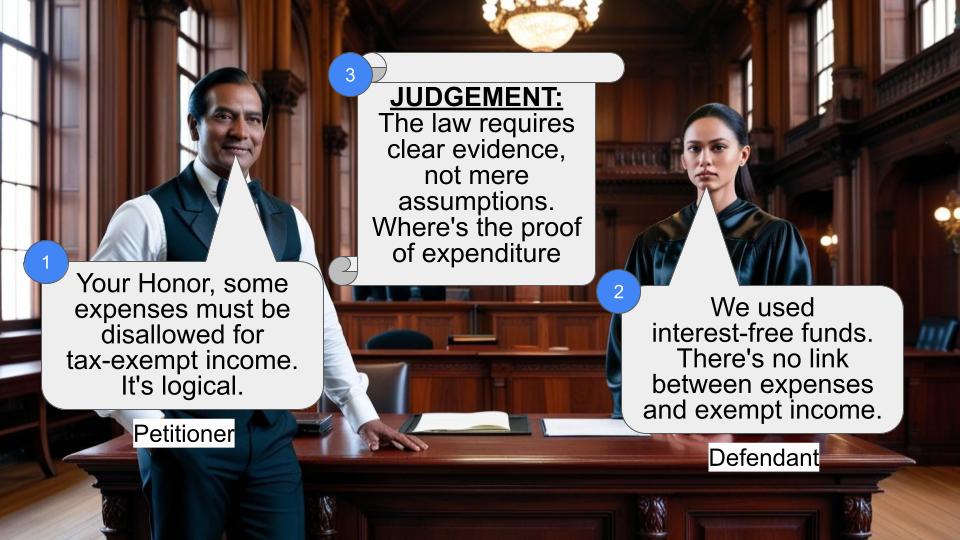
A tax appeal case where the Income Tax Department (the appellant) challenged a decision made by the Income Tax Appellate Tribunal. The main issue was about disallowing certain expenses under Section 14A (of Income Tax Act, 1961). The High Court dismissed the appeal, agreeing with the Tribunal's decision that no disallowance should be made without clear evidence of expenditure incurred for earning tax-exempt income.
Get the full picture - access the original judgement of the court order here
Case Name:
Commissioner of Income Tax vs Aura Securities (P) Ltd. (High Court of Gujarat)
Tax Appeal No.929 of 2014
Date: 09 September 2014
Key Takeaways:
1. Rule 8D (of Income Tax Rules, 1962) is prospective, not retrospective.
2. Disallowance under Section 14A (of Income Tax Act, 1961) requires proof of actual expenditure for earning exempt income.
3. Courts can't arbitrarily assume expenditure without evidence.
4. The assessee's use of interest-free funds for investments is a crucial factor.
Issue:
The main question here is: Can disallowances be made under Section 14A (of Income Tax Act, 1961) by arbitrarily bifurcating expenditure towards earning taxable and tax-exempt income, especially in the absence of Rule 8D (of Income Tax Rules, 1962) for the relevant assessment year?
Facts:
1. The case concerns the assessment year 2006-07.
2. The assessee, Aura Securities (P) Ltd., had investments in both foreign and Indian subsidiaries.
3. The Assessing Officer initially made a disallowance of Rs.12,75,912 towards interest expenditure and Rs.1 lac towards administrative expenditure.
4. The Commissioner of Income Tax (CIT) reviewed this order under Section 263 (of Income Tax Act, 1961).
5. The Income Tax Appellate Tribunal quashed the CIT's order, leading to this appeal by the Revenue.
Arguments:
Revenue's Argument:
- Rule 8D(2)(iii) (of Income Tax Rules, 1962) should be applied to calculate disallowance under Section 14A (of Income Tax Act, 1961).
- Some expenditure must always be disallowed for earning tax-exempt income.
Assessee's Argument:
- Rule 8D (of Income Tax Rules, 1962) was not applicable for the assessment year in question (2006-07).
- The assessee had sufficient interest-free funds to make investments.
- No direct nexus was established between interest-bearing borrowed funds and investments in subsidiaries.
Key Legal Precedents:
1. Commissioner of Income Tax, Ahmedabad IV v. Torrent Power Ltd. (Tax Appeal No.603 of 2013)
2. Commissioner of Incometax IV v. Suzlon Energy Ltd (2013) 33 taxmann.com 151 (Gujarat)
3. Commissioner of Incometax v. Hero Cycles Ltd. (2010) 323 ITR 518 (P&H)
4. Godrej and Boyce Mfg. Co. Ltd v. Deputy Commissioner of Income Tax (2010) 328 ITR 81(Bom)
5. Commissioner of Incometax IV v. Sintex Industries Ltd. (2013) 33 taxmann.com 240(Gujarat)
These cases established principles regarding the application of Section 14A (of Income Tax Act, 1961) and Rule 8D (of Income Tax Rules, 1962), emphasizing the need for a clear nexus between expenditure and exempt income.
Judgement:
The High Court dismissed the tax appeal, agreeing with the Tribunal's decision. They held that:
1. Rule 8D (of Income Tax Rules, 1962) is prospective and not applicable to the assessment year 2006-07.
2. Without clear evidence of expenditure incurred for earning exempt income, no disallowance can be made under Section 14A (of Income Tax Act, 1961).
3. The assessee had sufficient interest-free funds for investments, and no direct nexus was established with interest-bearing funds.
4. Arbitrary or assumed disallowances are not permissible.
FAQs:
Q1: What is Section 14A (of Income Tax Act, 1961)?
A1: Section 14A (of Income Tax Act, 1961) disallows expenses incurred in relation to income that doesn't form part of total income (i.e., tax-exempt income).
Q2: Why is Rule 8D (of Income Tax Rules, 1962) important in this case?
A2: Rule 8D (of Income Tax Rules, 1962) provides a method for calculating disallowances under Section 14A (of Income Tax Act, 1961), but it came into effect after the assessment year in question.
Q3: Can tax authorities make disallowances without clear evidence?
A3: No, the judgment emphasizes that disallowances can't be made arbitrarily or based on assumptions. There must be clear evidence of expenditure related to exempt income.
Q4: What impact does this judgment have on similar cases?
A4: It reinforces the principle that tax authorities need to establish a clear link between expenditure and exempt income before making disallowances under Section 14A (of Income Tax Act, 1961).
Q5: Why was the assessee's use of interest-free funds important?
A5: It showed that the investments could have been made without using interest-bearing funds, making it difficult to justify disallowance of interest expenses.

1. Following are the substantial questions of law raised by the appellant – revenue in the present tax appeal arising from the decision of the Income Tax Appellate Tribunal (to be referred to as “the Tribunal”) dated 28.02.2014 preferred under section 260-A (of Income Tax Act, 1961), 1961 (to be referred to as “the Act”).
“[A] Whether the Appellate Tribunal has substantially erred in holding that Rule 8D(2)(iii) (of Income Tax Rules, 1962) was not applicable for the A.Y. 2006-07 and also the order passed by the CIT was not justified in holding that the order passed by the Assessing Officer to be erroneous and prejudicial to the interest of the Revenue ?
[B] Whether the Appellate Tribunal has substantially erred in holding that the disallowance u/s 14A (of Income Tax Act, 1961) was subject matter of investigation by Assessing Officer and after taking into consideration all aspects of the case, the Assessing Officer has made an addition of Rs.12,75,912/- towards interest expenditure and Rs.1 lac towards administrative expenditure for earning exempted dividend income?
[C] Whether the Appellate Tribunal has erred in not appreciating the fact that the disallowance of 0.5% of the average value of investments (i.e. Rs.83,47,21,556/-) is required to be disallowed as per Rule 8D(2)(iii) (of Income Tax Rules, 1962), as the assessee had derived exempted income from these investments?”
2. We have heard learned Senior Standing Counsel Mrs. Mauna Bhatt for the appellant – revenue.
3. The question in the present appeal is essentially as to whether Rule 8D(2)(iii) (of Income Tax Rules, 1962) is prospective or retrospective in nature.
4. As to be noticed from the decision of the Tribunal, the Tribunal has held thus:
“7.After hearing both the parties and perusing the record, we are of the considered opinion that since all the facts in respect of the controversy are already on record, no purpose will be served to restore the matter to the file of Ld. CIT. We further find that there is no dispute that during the assessment proceedings disallowance u/s 14A (of Income Tax Act, 1961) was subject matter of investigation by AO and in this respect show cause was also issued by AO to the assessee and after taking into consideration all aspects of the case, an addition of Rs.12,75,912/- towards interest expenditure and Rs.1 lac towards administrative expenditure for earning exempted dividend income was made by AO. On these undisputed facts, Ld. CIT cannot invoke the provisions of section 263 (of Income Tax Act, 1961) simply because he was of the view that AO should have made more disallowance than made by AO. Law is now settled that Ld. CIT cannot exercise his jurisdiction under section 263 (of Income Tax Act, 1961), if AO has taken a view on facts and Ld. CIT has other opinion on same set of facts as is position in this case. We also find merit in the argument advanced by learned counsel of the assessee that since Rule 8D(2)(iii) (of Income Tax Rules, 1962) was not applicable for the assessment year under appeal, the Ld. CIT was not justified to hold the order passed by AO to be erroneous and prejudicial to the interest of revenue simply because disallowance u/s 13A (of Income Tax Act, 1961) was made without invoking this rule. In view of above, the order passed by Ld. CIT is hereby quashed.”
5. While dealing with assessment year 2006-07, identical question was raised before this Court in the decision in case of Commissioner of Income Tax, Ahmedabad IV v. Torrent Power Ltd. rendered on 04.02.2014 in Tax Appeal No.603 of 2013, has observed as follows:
“9. We notice that this Court in case of Commissioner of Incometax IV v. Suzlon Energy Ltd reported in (2013) 33 taxman.com 151 (Gujarat), has dealt with identical issue. The reasons given therein in detail profitably require to be reproduced at this stage :
“Question [2] pertains to disallowances made by the Assessing Officer under Section 14A (of Income Tax Act, 1961) in respect of interest expenses incurred for investments made in subsidiaries and administrative expenses. CIT [A] deleted such disallowances, upon which, Revenue approached the Tribunal. The Tribunal rejected Revenue’s appeal, making following observations :
“3.5 We have considered the rival submissions, perused the material on record and have gone through the orders of authorities below. Regarding the grounds raised by the revenue in respect of disallowance of interest expenditure made by the A.O under Section 14A (of Income Tax Act, 1961) and deletion made by learned CIT (A), we find that no interference is called for in the order of learned CIT (A). We hold so because we find that with regard to the investment of Rs. 5907.18 lacs in foreign subsidiaries, no disallowance can be made u/s. 14A (of Income Tax Act, 1961) because dividend income from foreign subsidiaries is taxable in India. Regarding balance investment of Rs. 38 crores approximately in Indian subsidiaries, we find that interest free own funds of the assessee is many time more than this investment because interest free funds available with the assessee as on 31.03.2005 as per the balance sheet as on that date is of Rs. 929.57 Crores.
There is no finding given by the A.O regarding any direct nexus between interest bearing borrowed funds and investment in Indian subsidiaries. Hence, in our considered opinion, no disallowance u/s. 14A (of Income Tax Act, 1961) can be made out of interest expenditure in the facts of the present case. Accordingly, ground no. 2 & 3 of the Revenue’s appeal are rejected.”
3.1 From the above portion, we noticed that the Tribunal has bifurcated the expenditure in two parts – first related to investment of Rs. 5907.18 lakhs in foreign subsidiaries, it was held that the dividend income from such subsidiaries is taxable in India and that therefore, Section 14A (of Income Tax Act, 1961) would have no applicability. The remaining amount pertain to investment of Rs. 38 Crores [rounded off] made in Indian subsidiaries. In this respect, the Tribunal noted that the assessee had to its disposal, own interest free funds many times over the investment in question. As per the balance sheet as on 31st March 2005, the assessee had interest free fund of Rs. 929.57 Crores.
Such being the facts, the Tribunal, in our opinion, committed no error. No question of law, therefore, arises.”
10. In Tax Appeal No.118/2013 in case of Commissioner of Income Tax v. UTI Bank, the issue pertaining to disallowance under section 14A (of Income Tax Act, 1961) and interpretation of Rule 8D (of Income Tax Rules, 1962) was decided in favour of the assessee and against the department holding therein that in absence of any finding as to how the administrative expenses have been incurred to earn the exempt income, disallowance made by the Assessing Officer was not sustainable. Punjab and Haryana High Court in case of Commissioner of Incometax v. Hero Cycles Ltd. reported in (2010) 323 ITR 518 (P&H) was dealing with a case where the Tribunal had deleted the disallowance of huge sum under section 14A (of Income Tax Act, 1961) by holding that a clear nexus was not been established that the interest bearing funds have been invested for generating tax free dividend income. The Tribunal had held that there was no nexus between the expenditure incurred and the income generated where the assessee had earned the dividend income which was exempted under section 10(34) (of Income Tax Act, 1961) and (35).
When the matter travelled to High Court, the High Court while dismissing the appeal held that the expenditure on interest was set off against the income from interest and the investment in the shares and funds were out of the dividend proceeds and in such set of facts, disallowance under section 14A (of Income Tax Act, 1961) was not sustainable. It further held that whether in a given circumstances any expenditure was incurred which was to be disallowed, was a question of fact. The contention of the Revenue that directly or indirectly some expenditure was always incurred which must be disallowed under section 14A (of Income Tax Act, 1961) and the impact of expenditure so incurred could not be allowed to set off against the business income which may nullify the mandate of section 14A (of Income Tax Act, 1961), was not accepted. Disallowance under section 14A (of Income Tax Act, 1961) required finding of incurring of expenditure and where it was found that for earning exempted income, no expenditure had been incurred, disallowance under section 14A (of Income Tax Act, 1961) could not stand. Accordingly, such disallowance was not permitted.
11. We notice that this appeal concerns the year 2006- 2007 and the application of Rule 8D (of Income Tax Rules, 1962) has come into being from 20072008 which has been held prospective by this Court, following the judgement of Bombay High Court in case of Godrej and Boyce Mfg. Col. Ltd v. Deputy Commissioner of Income Tax and another reported in (2010) 328 ITR 81(Bom), where Bombay High Court has quashed the order and judgement of Special Bench rendered in M/s.Daga Capital(supra), this Court in case of Commissioner of Incometax IV v. Sintex Industries Ltd. reported in (2013) 33 taxmann.com 240(Gujarat), was considering the issue pertaining to disallowance of part of remuneration paid to the Directors. The Assessing Officer noted the fact that the assessee had earned exempt income under section 10(35) (of Income Tax Act, 1961) arising out of Mutual Fund Investment and, therefore, held the opinion that the expenditure incurred for earning exempt income should be disallowed under section 14A (of Income Tax Act, 1961) and when no bifurcation was made by the assessee, the Assessing Officer disallowed the total expenditure under such head and added back the entire sum being the amount of salary of the Directors to the income of the assessee. Both the tribunal and the Commissioner did not approve such decision, relying on judgement of Bombay High Court in case of Godrej & Boyce Mfg. Co. Ltd (supra) by holding that in absence of Rule 8D of the Incometax Rules, no disallowance can be made under section 14A (of Income Tax Act, 1961). When such decision was under challenge before this court it held thus :
“4. With respect to proposition that Rule 8D (of Income Tax Rules, 1962) is not retrospective in operation, we have no hesitation in agreeing with the decision of the Bombay High Court in the case of Godrej Boyce & Manufacturing Co. (supra). Previously also, we had occasion to deal with the said Rule and held as and the Bombay High Court has done. That, however, does not mean in our primafacie opinion that no disallowances can be made under Section 14A (of Income Tax Act, 1961) by bifurcating the expenditure in a reasonable manner towards earning of the taxable income and tax exempt income.
5. In the present case, since the amount involved is not very large, we reserve our final conclusion on such an issue in appropriate case. Therefore, we are not inclined to entertain this Tax Appeal. However, we should not be seen to have confirmed the Tribunal's view on the aspect that in absence of Rule 8D (of Income Tax Rules, 1962), no disallowances can be made under Section 14A (of Income Tax Act, 1961), by proportionate bifurcation of the expenditure.”
12. In the instant case, however, as discussed hereinabove, it clearly emerges from the material on record that no expenditure was incurred for earning exempted income and that being the question of fact, we hold that disallowance of 1% of interest expenditure artificially or on the basis of assumption rightly has not been sustained by the Tribunal.
13. This tax appeal therefore, requires no further entertainment and hence dismissed.”
6. The present tax appeal is of the assessment year 2006- 07, where again the substantial question of law raised which has already been dealt with by this Court as mentioned hereinabove, application of Rule 8D (of Income Tax Rules, 1962) being prospective, we see no infirmity in the impugned decision of the Tribunal. The tax appeal is, accordingly, dismissed in limine.
(HARSHA DEVANI, J.)
(MS SONIA GOKANI, J.)
×
Similar Ripples
Questions
Court Rejects Tax Appeal: No Disallowance Under Section 14A (of Income Tax Act, 1961) Without Clear Expenditure Link
Write your CommentSimilar Posts
Generic
- Reportdata/4625.pdf
