


Court Remands Case for Fresh Adjudication on Tax Exemption Approval















Full News
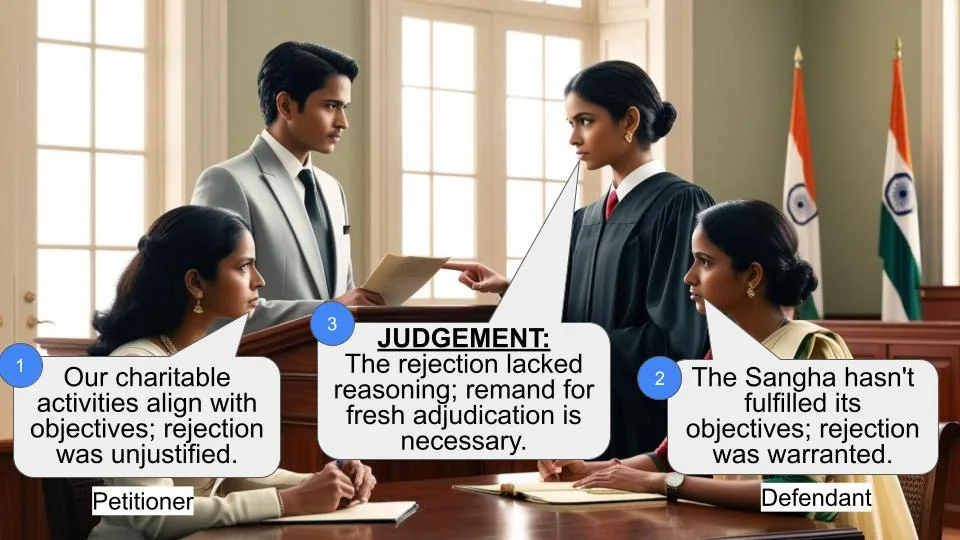
Court Remands Case for Fresh Adjudication on Tax Exemption Approval
Court Remands Case for Fresh Adjudication on Tax Exemption Approval
The case involves the Sri Narayana Guru Prasaditha Sangha and the Commissioner of Income Tax. The dispute centers around the rejection of the Sangha's application for the continuance of tax exemption approval under Section 80G (of Income Tax Act, 1961). The court found that the rejection lacked sufficient reasoning and remanded the case for fresh adjudication.
Get the full picture - access the original judgement of the court order here
Case Name:
Sri Narayana Guru Prasaditha Sangha vs. Commissioner of Income Tax (High Court of Karnataka)
ITA No. 687 of 2009
Date: 14th July 2015
Key Takeaways:
- The court emphasized the need for a detailed and reasoned order when rejecting applications for tax exemptions.
- The case highlights the importance of examining whether the activities of a trust fulfill its charitable objectives.
- The decision underscores the procedural requirements under Rule 11AA (of Income Tax Rules, 1962) for granting approval under Section 80G (of Income Tax Act, 1961).
Issue
Was the rejection of the Sangha's application for continuance of tax exemption under Section 80G (of Income Tax Act, 1961) justified?
Facts
- The Sri Narayana Guru Prasaditha Sangha, a registered society, had previously been granted tax exemption under Section 80G (of Income Tax Act, 1961).
- The Sangha applied for the continuance of this approval, which was proposed to be rejected by the Commissioner.
- The rejection was based on the alleged failure to fulfill the charitable objectives of the trust.
Arguments
- For the Sangha: The Sangha argued that the rejection was unjustified as it had undertaken activities like constructing a community hall and providing medical treatment, which aligned with its charitable objectives.
- For the Commissioner: The Commissioner contended that the Sangha had not carried out its objectives adequately, justifying the rejection of the application.
Key Legal Precedents
- Section 80G (of Income Tax Act, 1961): Governs the approval for tax exemptions for charitable institutions.
- Rule 11AA (of Income Tax Rules, 1962): Outlines the procedural requirements for granting approval under Section 80G (of Income Tax Act, 1961), including the need for a reasoned order when rejecting applications.
Judgement
The court set aside the previous orders rejecting the Sangha's application due to a lack of detailed reasoning. It remanded the case back to the Commissioner for fresh adjudication, instructing that the application be examined on its merits and in accordance with the law.
FAQs
Q1: What was the main reason for the court's decision?
A1: The court found that the rejection of the application lacked sufficient reasoning and did not adequately consider the Sangha's activities.
Q2: What does this mean for the Sangha?
A2: The Sangha's application will be reconsidered by the Commissioner, who must provide a detailed and reasoned decision.
Q3: How does this case impact other charitable institutions?
A3: It reinforces the need for detailed reasoning in decisions regarding tax exemption approvals, ensuring that charitable activities are properly evaluated.

1. Assessee has filed this appeal challenging the correctness and legality of the order passed by Income Tax Appellate Tribunal, Bangalore Bench ‘B’,
Bangalore dated 29.05.2009 in ITA No.4/Bang/2009 whereunder appeal filed by the assessee questioning the order of Commissioner for Income Tax, Mangalore
who had rejected the assessee’s application filed under Section 80G (of Income Tax Act, 1961) (for short ‘Act’) came to be affirmed.
2. Appellant (hereinafter referred to as ‘assessee’) is a society registered under the Karnataka Societies Registration Act, 1960. It was granted
registration under Section 12A (of Income Tax Act, 1961) and also approval under Section 80G(5)(vi) (of Income Tax Act, 1961) with effect from 17.02.2004 to 31.03.2005. Thereafter, continuation
of the approval granted under Section 80G(5)(vi) (of Income Tax Act, 1961) was granted with effect from 01.04.2005 to 31.03.2008. On an application made for continuance
of approval on 06.03.2008, it was proposed to be rejected by the respondent and as such, notice came to be issued which was duly replied by the assessee. Thereafter, application for continuance of recognition came to be rejected by the respondent. Assessee unsuccessfully challenged the same before Tribunal and as such, present appeal has been presented to this Court.
3. We have heard the arguments of Smt.
Jineetha Chatterjee, learned Advocate appearing on
behalf of Sri S Parthasarathy for appellant – assessee
and Sri E.I.Sanmathi, learned Advocate appearing for
Respondent – Revenue.
4. It is the contention of Smt Jineetha
Chatterjee , learned Advocate appearing for the
appellant - assessee that respondent was not justified
in rejecting the application for continuance of
recognition granted to appellant under Section
80G(5)(vi) of the Act without examining as to whether
aims and objects of the assessee – society had been
fulfilled and charitable object with which it was
formed has been achieved or not and as such, she
contends that order of the Commissioner is
erroneous. She would also contend that
Commissioner as well as Tribunal erred in not
considering the fact that assessee – Trust had not
carried on any activity which was hit by proviso to
Section 2(15) (of Income Tax Act, 1961) and reply given to the
respondent indicated that donations which had been
received by the assessee had been utilised for the
purpose envisaged under the objects of the Trust and
its fulfillment. Non-consideration of said vital
evidence available on record by the respondent has
resulted in miscarriage in the administration of
justice. Hence, she prays for answering the
substantial questions of law formulated in the appeal
memorandum in favour of the assessee and against
the revenue.
5. Per contra, Sri E.I.Sanmathi, learned
Advocate appearing for the revenue would support
the orders passed by the authorities and contends
that assessee – Trust having obtained registration
under Section 12A (of Income Tax Act, 1961) on 17.02.2004, had not
carried out the object for which Trust was established
even after lapse of four years and as such, rejection of
renewal is just and proper and as such, he prays for
dismissing the appeal by answering the substantial
questions of law in favour of the revenue.
6. This Court, vide order dated 21.10.2009
has admitted the appeal to consider the following
substantial question of law:
“(a) Whether the Tribunal was
justified in alleging that, mere
construction of a building for the
purpose of carrying out of
activities for the advancement of
any objects of general public
utility like providing venue for
public meeting to promote unity
of brotherhood would not
constitute charitable activity to
deny continuance of approval
under Section 80G(5)(vi) (of Income Tax Act, 1961) of the
Act?
(b) When Appellant has granted
registration under Section 12A (of Income Tax Act, 1961)
and also approval under Section
80G (5)(vi) of the Act and
continuance for such approval in
preceding years under similar
circumstances then, whether
Tribunal was justified in
upholding the denial of
continuance of approval
subsequently under Section
80G(5)(vi) of the Act?
(c) Whether construction of a
building to enable carrying out
Appellant’s objects can be held as
in adequate for grant of
continuance of approval under
Section 80G(5)(vi) (of Income Tax Act, 1961) when
such continuance was required
for carrying out of activity
concerning advancement of object
of general public utility as
provided under Section 2(15) (of Income Tax Act, 1961)?
(d) Whether the proviso to Section
2(15) of the Act would apply to
justify the denial of continuance
of approval under Section
80G(5)(vi) of the Act when the
construction of building for
carrying out of the object of the
Society was under progress?”
7. Having heard the learned Advocates
appearing for parties and on perusal of the records, it
would emerge that assessee –Trust was granted
registration under Section 12A (of Income Tax Act, 1961) and also
approval under Section 80G(5)(vi) (of Income Tax Act, 1961) on
17.02.2004 upto 31.03.2005. Same was continued
with effect from 01.04.2005 and upto 31.03.2008 by
order dated 04.10.2005 (Annexure-E) and thereafter
assessee sought for continuance of the approval
granted under Section 80G(5)(vi) (of Income Tax Act, 1961) by
submitting an application on 06.03.2008.
Respondent issued a show cause notice to the
assessee proposing to reject the application. Same
was resisted to by the assessee by filing detailed
objection, copy of which has been made available by
the learned Advocate appearing for the assessee
during the course of arguments. Subsequently, the
Commissioner vide order dated 28.11.2008
(Annexure-G) rejected the application for
continuation of the recognition.
8. Perusal of the said order dated
28.11.2008 which is at Annexure-G would indicate
that there is neither consideration of objections filed
by the assessee for rejecting the application of
assessee nor the respondent has examined as to
whether the conditions laid down in clause (vi) of
sub-section (5) of Section 80G (of Income Tax Act, 1961) is either
fulfilled or not fulfilled, for rejecting the application
for renewal. Assessee had carried said order of
rejection in appeal before the Tribunal by filing an
appeal and even the appellate Tribunal after
considering the grounds urged by the assessee has
held that rejection order is justifiable. Perusal of the
order of Tribunal dated 29.05.2009 would also
indicate that there are no reasons forthcoming as to
why order of rejection is sustained, except making a
passing reference to the fact that construction of the
building by the assessee would by itself not
constitute granting of relief for the poor or it would be
sufficient to hold such activity would amount
charitable purpose. It is not in dispute that
registration granted to the respondent-assessee
under Section 12A (of Income Tax Act, 1961) is in force or vogue as
on date and the Commissioner while examining the
application for approval of an institution or fund
under Section 80G (of Income Tax Act, 1961) is required to comply
with Rule 11AA (of Income Tax Rules, 1962), which
reads as under:
“Requirements for approval of an
institution or fund under Section
80G.
11AA. (1) The application for approval
of any institution or fund under clause
(vi) of sub-section (5) of Section 80G (of Income Tax Act, 1961)
shall be in Form No.10G and shall be
made in triplicate.
(2) The application shall be
accompanied by the following
documents, namely;-
(i) Copy of registration
granted under Section 12A (of Income Tax Act, 1961)
or copy of notification
issued under Section
10(23) or 10(23C);
(ii) Notes on activities of
institution or fund since its
inception or during the last
three years, whichever is
less;
(iii) Copies of accounts of the
institutions or fund since
its inception or during the
last three years, whichever
is less.
(3) The Commissioner may call for
such further documents or
information from the institution
or fund or cause such inquiries
to be made as he may deem
necessary in order to satisfy
himself about the genuineness of
the activities of such institution
or fund.
(4) Where the Commissioner is
satisfied that all the conditions
laid down in clauses (i) to (v) of
sub-section (5) of section 80G (of Income Tax Act, 1961) are
fulfilled by the institution or
fund, he shall record such
satisfaction in writing and grant
approval to the institution or
fund specifying the assessment
year or years for which the
approval is valid.
(5) Where the Commissioner is
satisfied that one or more of the
conditions laid down in clauses (i)
to (v) of sub-section (5) of Section
80G are not fulfilled, he shall
reject the application for
approval, after recording the
reasons for such rejection in
writing:
Provided that no order of
rejection of an application shall
be passed without giving the
institution or fund an
opportunity of being heard.
(6) The time limit within which the
Commissioner shall pass an
order either granting the approval
or rejecting the application shall
not exceed six months from the
date on which such application
was made:
Provided that in computing the
period of six months, any time
taken by the applicant in not
complying with the directions of
the Commissioner under sub-rule
(3) shall be excluded. “
9. Perusal of the above Rule would indicate
that an applicant is required to indicate in the
application about activities of the institution or fund
collected since its inception or during the last three
years whichever is less including furnishing of
Registration Certificate obtained under Section 12A (of Income Tax Act, 1961)
and copies of its accounts since inception or last
three years, whichever is less and in the event of
Commissioner not being satisfied with the details
furnished by the applicant, he is empowered under
sub-rule (3) of Rule 11AA (of Income Tax Rules, 1962) to call for
further documents or information from the institution
or fund or cause such enquiry as he deems necessary
in order to satisfy himself the activities of the
institution or fund is genuine. After calling for such
information or details or particulars, if the
Commissioner is satisfied that all the conditions laid
down under clauses (i) to (v) to sub-section (5) of
Section 80G (of Income Tax Act, 1961) are fulfilled, he would issue approval as
otherwise, he would reject the application for
approval by recording reasons for such rejection and
communicate the same to the applicant.
10. At the cost of repetition, it requires to be
noticed that order of rejection of renewal of
recognition dated 28.11.2008 – Annexure-G is bereft
of reasons. On the ground of order of rejection being
not a speaking order which has been affirmed by the
Tribunal in a perfunctory manner, we are of the
considered view that both the orders cannot be
sustained and are liable to be set aside. In view of
the fact that objections came to be filed by the
assessee – applicant to the rejection proposed by
respondent indicating that it had taken steps to fulfill
the objects of the Trust by not only constructing
‘Samudaya Bhavana’ but also medical treatment said
to have been given by its ‘Mumbai Samithi’ apart
from distribution of books to the needy, are all
aspects which was required to be examined by
respondent and said exercise having not been
undertaken, we are of the considered view that
matter requires to be remitted to the respondent for
being adjudicated afresh. Hence, by setting aside
order dated 28.11.2008 passed by the respondent
and order dated 29.05.2009 passed by the Tribunal,
matter is being remitted to the respondent for
adjudication afresh. It is needless to state that
respondent would be at liberty to examine the
application afresh on merits and in accordance with
law.
11. In that view of the matter, substantial
questions of law as obtained in the facts and
circumstances of the case are required to be
answered in favour of the appellant – assessee.
Hence, we proceed to pass the following order:
(1) Appeal is hereby allowed by
answering substantial questions of
law in favour of the assessee –
applicant (on facts).
(2) Matter is remitted back to the
Commissioner of Income Tax,
Mangalore for being adjudicated
afresh and he would be at liberty to
pass orders on merits and in
accordance with law without being
influenced by the observations made
in the earlier order which came to be
affirmed by the Tribunal.
(3) Costs made easy.
Sd/-
JUDGE
Sd/-
JUDGE
×
Similar Ripples
Questions
Court Remands Case for Fresh Adjudication on Tax Exemption Approval
Write your CommentSimilar Posts
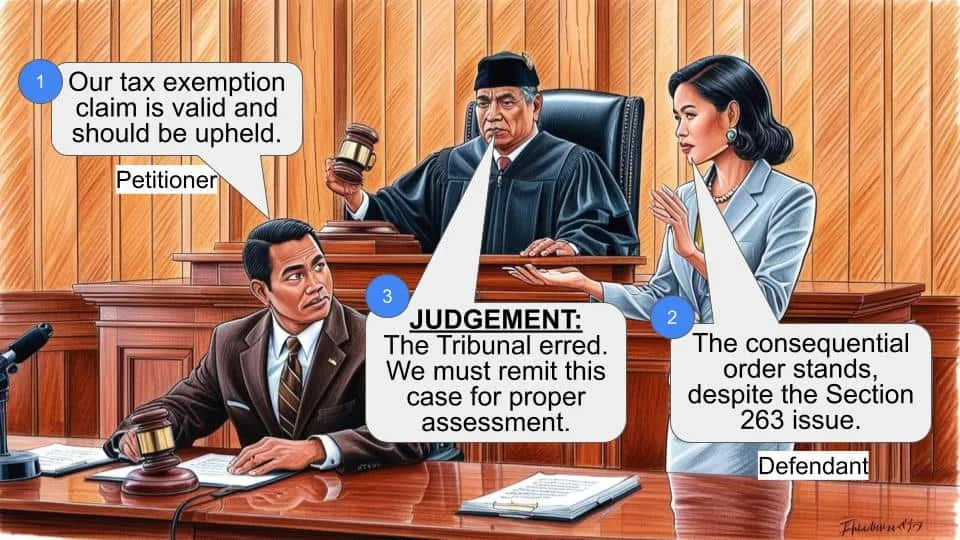

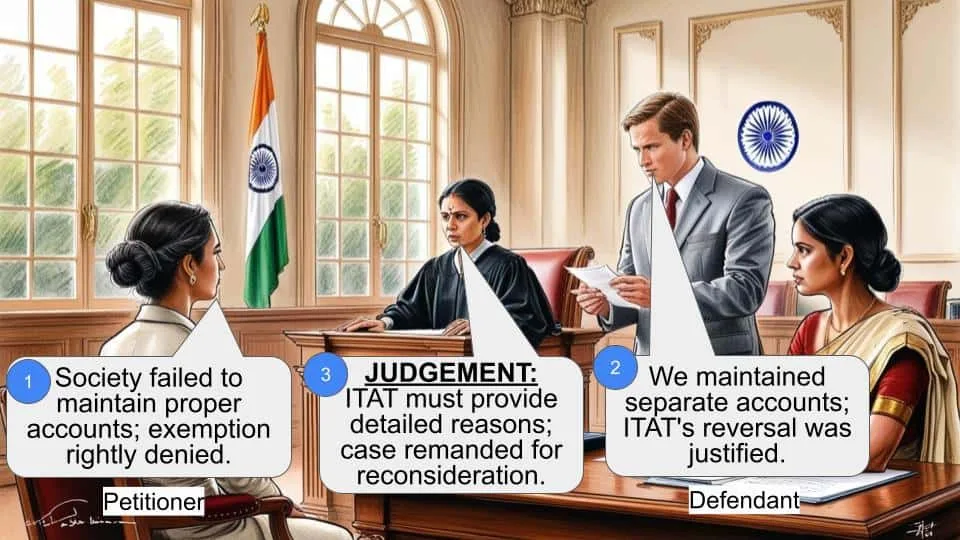
Generic
- Reportdata/3632.pdf
