


Court Rules Land Sale Profits as Capital Gains, Not Business Income




Full News
Court Rules Land Sale Profits as Capital Gains, Not Business Income
Court Rules Land Sale Profits as Capital Gains, Not Business Income
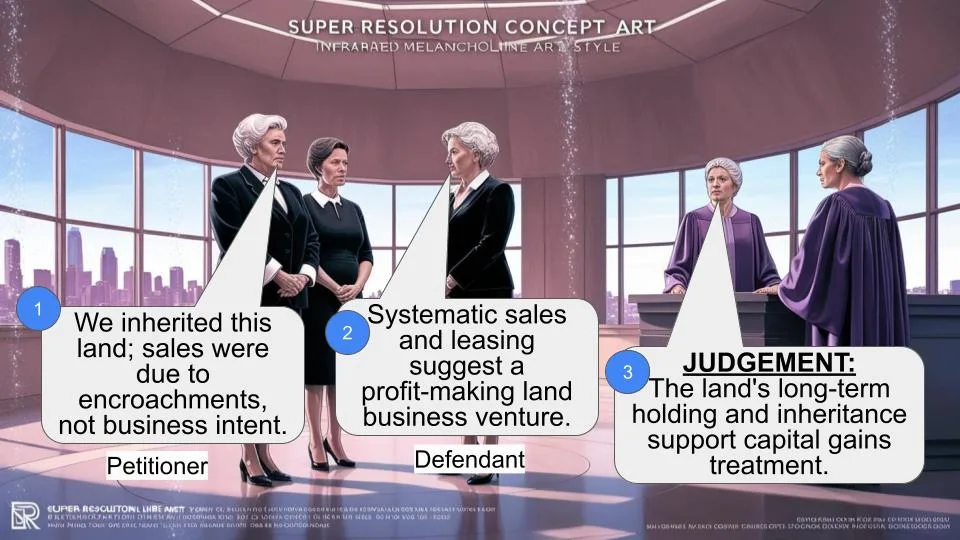
This case is all about whether the money made from selling some land should be taxed as capital gains or as business income. The court decided it should be treated as capital gains, which is generally a more favorable tax treatment for the seller. The case involved the Administrator of the Estate of late E.F. Dinshaw, who had inherited a large piece of land.
Case Name**:
COMMISSIONER OF INCOME TAX VS THE ADMINISTRATOR OF THE ESTATE OF LATE SHRI E.F. DINSHAW
**Key Takeaways**:
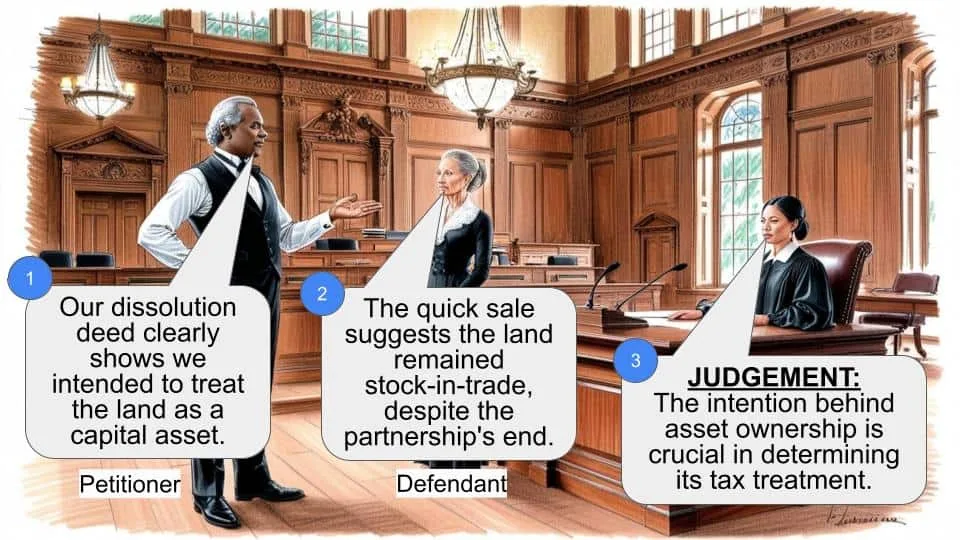
1. The intention at the time of acquiring property is crucial in determining its nature (investment vs. trading).
2. Inherited property is more likely to be seen as an investment rather than a business asset.
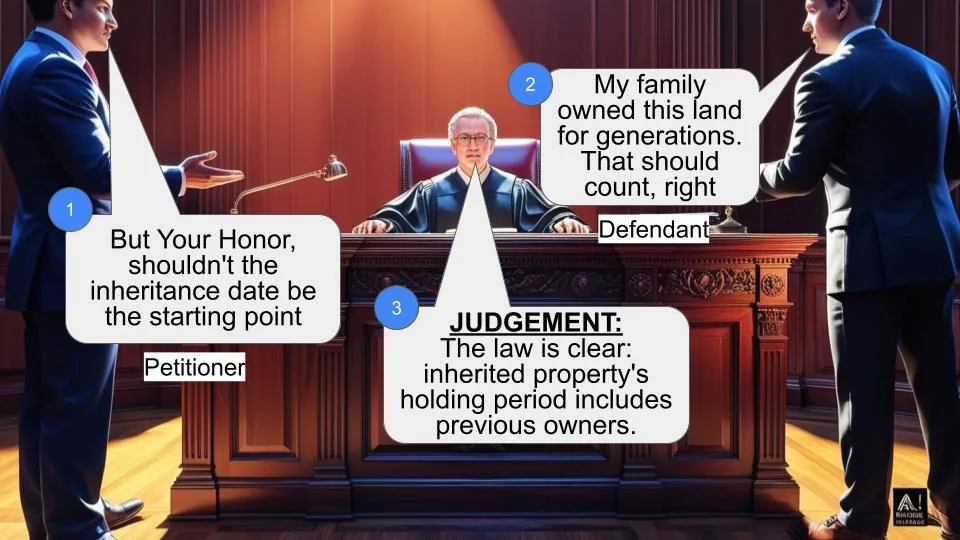
3. Long-term holding of property supports the argument for capital gains treatment.
4. Selling property due to external factors (like encroachments) doesn't necessarily make it a business activity.
**Issue**:
The main question here was: Should the money made from selling parts of a large inherited land be treated as capital gains or as business income for tax purposes?
**Facts**:
Alright, let's break this down:
1. Back in 1923, F.E. Dinshaw bought about 2,500 acres of land in Malad and Borivali.
2. F.E. Dinshaw passed away in 1936, leaving the land to his son E.F. Dinshaw and daughter Bachoobai.
3. Fast forward to the 1970s, and we see some of this land being sold off.
4. The tax department initially said, "Hey, this looks like you're running a land-selling business!" and wanted to tax it as business income.
5. The estate administrator said, "No way! This is just us selling inherited property. It should be capital gains."
**Arguments**:
The tax department's side:
- The land was divided systematically and sold off in parts.
- Some land was repurchased (though this was actually just getting back land taken under the Urban Land Ceiling Act).
- Part of the land was leased to a developer for 99 years.
The estate's side:
- This land was inherited, not bought for business.
- Sales only started happening about 65 years after the original purchase.
- They were selling because of encroachments and to protect what they had left, not to make a profit.
**Key Legal Precedents**:
The court looked at several important cases to make its decision:
1. Janki Ram Bahadur vs. Commissioner of Income Tax (Supreme Court)
2. G. Venkataswami Naidu & Co. vs. Commissioner of Income Tax (Supreme Court)
3. Commissioner of Income Tax vs. V.A.Trivedi (Bombay High Court)
4. Commissioner of Income Tax vs. Dr. Indu Bala Chhabra (Delhi High Court)
5. Commissioner of Income Tax vs. Sushila Devi Jain (Punjab and Haryana High Court)
These cases all helped establish factors to consider when deciding if property sales are business income or capital gains.
**Judgement**:
The court sided with the estate administrator. They said, "Look, this land was bought way back in 1923, not as a business venture. It was inherited, not purchased by the current owners. They only started selling after independence when encroachments became a problem. This looks more like selling an investment than running a business." So, they ruled that the money from the land sales should be treated as capital gains, not business income.
**FAQs**:
1. Q: Why does it matter if it's capital gains or business income?
A: Capital gains often have a lower tax rate than business income, so it can mean paying less tax.
2. Q: Does this mean all inherited property sales will be treated as capital gains?
A: Not necessarily. Each case is judged on its specific facts, but inheritance does support the capital gains argument.
3. Q: What if I buy land intending to sell it later for profit?
A: That would more likely be seen as a business activity, especially if you do it repeatedly.
4. Q: How long do I need to hold property for it to be considered an investment?
A: There's no fixed time, but longer holding periods (like the 65 years in this case) support the investment argument.
5. Q: Can I sell inherited property in parts and still have it treated as capital gains?
A: Possibly, especially if you're selling due to external factors (like encroachments in this case) rather than as a planned business strategy.

By this Reference, under Section 256(1) (of Income Tax Act, 1961), the Tribunal has at the behest of the Revenue, referred the following question:
“Whether on the facts and in the circumstances of the case and in law, the Tribunal was justified in holding that surplus realised on sale of land was in the nature of capital gain and that the assessee was not a trader in land.”
2. The Reference arises from an order of the Income Tax Appellate Tribunal for Assessment Years 198788, 198889 and 198990. The facts, as set out in the statement of case, are that late F.E.Dinshaw, who was a partner in a firm of Solicitors and a financial adviser to the Princely State of Gwalior, purchased large tracts of land admeasuring about 2500 acres at Malad and Borivali in or about 1923. He died in 1936 and was survived by a son, E.F. Dinshaw, and a daughter, Bachoobai Woronzow, both of whom were nonresidents and were citizens of a foreign country. Upon the death of F.E.Dinshaw, his son and daughter became joint owners of the lands. No physical division was carried out. Under the last will and testament of F.E. Dinshaw, a life interest was created in half his share in the land in favour of his daughter, Bachoobai, a reversionary interest being created in favour of two U.S. based charities. By a judgment of this Court dated 21 December 1972, Mr.Nusli Wadia was appointed as sole administrator of the estate. The other half share was bequeathed to E.F.Dinshaw.
3. On 27 December 1973, Bachoobai leased out 72 acres of the lands jointly owned by her and her brother to a company by the name of Haven Kores Real Estate Pvt. Ltd. for a period of ninety nine years. On 28 December 1973, Bachoobai created three charitable trusts :
(i) F.M.Dinshaw Foundation – with a corpus consisting of the reversionary interest of herself and the Administrator in the land leased to Haven Kores Real Estate Pvt. Ltd.;
(ii) F.E.Dinshaw Charities – consisting of the corpus of mostly tenanted properties jointly owned;
(iii) F.E.Dinshaw Trust – with a corpus consisting of mainly leased and unencumbered free land of F.E.Dinshaw Estate jointly owned by her and her late brother.
From early times, different portions of the property were leased out to various persons against the payment of ground rent for the purposes of constructing house properties. Over time, a large part of the land was encroached upon. From November 1968, agreements to sell were executed in respect of different portions of the land. Before any sale deed could be entered into, permission was required to be taken of the Charity Commissioner under Section 36 of the Bombay Public Trust Act, 1950. Since E.F.Dinshaw and Bachoobai were not citizens of India, permission was also required under the Foreign Exchange Regulation Act, 1973. The provisions of the Urban Land (Ceiling and Regulation) Act, 1971 rendered some parts of the land as surplus. Permissions were also required to be taken under Chapter XXC of the Income Tax Act, 1961. After permissions were taken and the Conveyances were finalized upon registration, there was a surplus which the assessee claimed as a long term capital gain.
4. The Assessing Officer in the course of the assessment held that there was a steady, systematic and continuous process of selling portions of the property for making profits in real estate. According to the Assessing Officer, the nature of expenses debited to the income and expenditure account, the quantum, the activities and the manner in which the value of the trust properties is reduced, was suggestive of the fact that the lands were purchased only for the purposes of earning profit. The profit arising from the sale of the land was treated as business income. In appeal, the CIT (A) held that the mere ownership of the land does not constitute trade. The CIT(A) held in favour of the assessee on the basis of the following findings : (i) Neither of the assessees had purchased the land themselves. The land had been purchased by the late F.E. Dinshaw nearly seventy years earlier when the growth of Mumbai to its present state could not have been foreseen; (ii) The land was purchased as a source of earning income from ground rent; (iii) Encroachments took place after 1947 whereupon it became difficult to protect open land. In selling the land, the assessees had been motivated more by the desire of protecting their corpus than of earning profits; (iv) The assessees were Trusts or the administrator of the estate and could not enter into the business of selling land.
5. In appeal, the Tribunal has affirmed the decision of the CIT(A). The Tribunal has relied upon the following circumstances in support of its conclusion that the income that was realised upon the sale of the lands constituted capital gains and not business income:
(i) Late F.E.Dinshaw had no intention to trade in the lands at the time of purchase. After the purchase of the lands in 1923, there was no sale thereafter for nearly thirtyfive years;
(ii) Late F.E.Dinshaw was far removed from any business in real estate and, therefore, this was not a case where a transaction can be regarded as being relatable to the business which was normally carried on by the assessee;
(iii) In the present case, there was no activity such as in the nature of improvements on the lands, for instance, by laying drainage lines, electricity, levelling or construction of roads. The fencing of the land and the construction of the compound wall were only intended to protect the property and not to carry out improvements;
(iv) Though the extent of the sales had increased over time, compared to the vast extent of holding, the sales could not be regarded as expansive. Moreover, while there were sales of some parts of the land, there was no corresponding activity involved of purchases;
(v) The repurchase of about a hundred acres of land which had been declared surplus under the Urban Land Ceiling Act was not a purchase in the commercial sense since it constituted nothing but a retention of the property which was earlier vested in the assessees;
(vi) The property was purchased nearly seventy years earlier and it could not be expected that it should remain invested indefinitely. The sale of the property was explained by the fact that there were encroachments on the lands leading to heavy litigation and expenditure on account of which it became necessary to sell parts of the land. On an evaluation of the record and having regard to the aforesaid circumstances, the Tribunal affirmed the view of the CIT(A) that the income generated from the sale of land during the assessment years in question, should be treated as capital gains.
6. Counsel appearing on behalf of the Revenue has relied upon four circumstances which, in his submission, would support the initial conclusion of the Assessing Officer that the income which was realised from the sale of the land during the assessment years constituted a profit which is chargeable under the head of business income. Firstly, it is submitted that the land was divided in a systematic way under the three Deeds of Trust executed by Bachoobai under which the trustees were given the power to purchase, sale, lease or exchange; Secondly, as the Tribunal has noted, there was an acquisition of the land in the form of repurchase under the Urban Land Ceiling Act; Thirdly, on 27 December 1973, Bachoobai had given the land on lease to a developer for ninety nine years; and fourthly, the record indicates that there was a division of the property for the purpose of sale.
7. On the other hand, Counsel appearing on behalf of the Assessee submits that (i) In the present case, fifty per cent of the interest belongs to the estate of late E.F.Dinshaw, while the balance vested in one of the charitable trusts created by Bachoobai. To accept the submission of the Revenue, would essentially imply that the Administrator of the Estate of E.F.Dinshaw, or as the case may be, the charitable trusts were engaged in business; (ii) There is a finding of fact concurrently both by the CIT(A) and by the Tribunal of the reasons why the land was required to be sold. The land involved extended over a large tract of 2500 acres which had been partly encroached upon and partly occupied by tenants and third parties. Though several sales had taken place that by itself could not determine the nature and character of the transactions. The order of assessment for Assessment Year 198990 notes in paragraph 4.3 that though there were 105 sales, in many cases sales were to persons who were already in possession of the property; (iii) The present Reference only deals with the lands which were dealt with by the Administrator of the estate of late E.F.Dinshaw; (iv) The lands in the present case were purchased by F.E.Dinshaw in or about 1923 and until his death in 1936, there were no sales. The lands were inherited by E.F.Dinshaw and by Bachoobai. The sales took place nearly sixty five years after the purchase of the lands. In these circumstances, the sales of the lands motivated as they were by the circumstance that there were increasing encroachments on the land, can never be regarded as an adventure in the nature of trade. The concurrent finding of fact is that the sales were motivated by a desire to protect the corpus and not by a desire to profit from the sale and purchase of the lands; (v) Until the assessment for the assessment years in question, the Revenue treated the income realised from the sale of the land as capital gains. There has been no specific or radical change in the circumstances of the case so as to warrant the treatment of the income as business income as opposed to capital gains.
8. The rival submissions would now fall for consideration.
9. The Reference before this Court arises under the provisions of Section 256(1) (of Income Tax Act, 1961). On the parameters of the jurisdiction of this Court, it is now well settled that it is the duty of the Tribunal to find facts. The Tribunal is constituted as the final fact finding authority. The duty of the Court is to lay down the law on the facts found by the Tribunal. The Court, under Section 256 (of Income Tax Act, 1961), has no jurisdiction to go behind the statement of facts contained in the Appellate order of the Tribunal or the statement of the case, unless there is no evidence to support them or the Tribunal has misdirected itself in law. For that matter, the Court would not be justified in disturbing or going behind a finding of fact recorded by the Tribunal even on the ground that there is no evidence to support it, unless it has been expressly challenged by a question raised in the Reference Application under Section 256(1) (of Income Tax Act, 1961) to the Tribunal. It would, however, be otherwise where mixed questions of law and facts were to be involved. A succinct statement of this principle is summarised in Kanga and Palkhiwala's The Law and Practice of Income Tax.
10. The issue as to whether income that is realised from the sale of land is chargeable to income tax as capital gains or, contrariwise, as income from business, has been the subject matter of a considerable amount of judicial precedent. In Janki Ram Bahadur vs. Commissioner of Income Tax,2 the Supreme Court laid down the following guidelines:
“If a transaction is related to the business which is normally carried on by the assessee, though not directly part of it, an intention to launch upon an adventure in the nature of trade may readily be inferred. A similar inference would arise where a commodity is purchased and subdivided, altered, treated, or repaired and sold, or is converted into a different commodity and sold. Magnitude of the transaction of purchase, the nature of the commodity, subsequent dealings and the manner of disposal may be such that the transaction may be stamped with a character of a trading venture. But a transaction of purchase of land cannot be assumed without more to be a venture in the nature of trade.”
In G. Venkataswami Naidu & Co. vs. Commissioner of Income Tax3, the Supreme Court noted that several factors assumed relevance including (i) Whether the purchaser was a trader and the purchase of the commodity and its resale were allied to his usual trade or business or incidental to it; (ii) The nature and extent of the transaction involved in the purchase and sale; (iii) Acts subsequent to the purchase for the improvement of the quality of the subject matter; (iv) Any act prior to the purchase showing a design or purpose, the incidents associated with the purchase and resale and the similarity of the transaction to operations usually associated with trade or business; (v) The repetition of the transaction; and (vi) The element of pride of possession.
11. In Commissioner of Income Tax vs. V.A.Trivedi, a Division Bench of this Court, while holding that no single test or formula can be applied in determining whether a transaction involving purchase and sale of land is an adventure in the nature of trade observed that generally speaking, the original intention of the party in purchasing the property, the magnitude of the transaction of purchase, the nature of the property, the length of its ownership and holding, the conduct and subsequent dealings of the assessee in respect of the property, the manner of its disposal and the frequency and multiplicity of transactions afforded valuable guides in determining whether the assessee was carrying on a trading activity and whether a particular transaction should be stamped with the character of a trading adventure. In Commissioner of Income Tax vs. Dr.Indu Bala Chhabra, Division Bench of the Delhi High Court dealt with a case where the assessee who derived her income from the medical profession had acquired certain properties as an asset for constructing a Nursing Home. Subsequently, after a laps of time, the assessee carried out construction on the property. The Tribunal had noted that after making the purchase, the assessee had disposed of the property nearly twenty years thereafter. No prudent person, the Tribunal held, would have waited for such a long period of time if it was a business proposition. The gain resulting from the sale transaction was treated as capital gains and not as income arising out of an adventure in the nature of trade. The Division Bench of the Delhi High Court, relying inter alia upon the judgment of the Supreme Court in G.Venkataswami Naidu (supra), affirmed the view of the Tribunal. Similarly, in a decision of the Punjab and Haryana High Court in Commissioner of Income Tax vs. Sushila Devi Jain, the assessee had acquired certain property under the will of her husband. The property consisted of a large tract of land which was sold out in part. The High Court held that the relevant test was to find out the intention of the assessee at the time of the purchase of the land. The assessee had never purchased her land since it had devolved on her through testamentary succession. The land was sold in parts because the huge area could not be sold in one transaction and such an activity was held not to amount to trade or business within the meaning of the Act.
12. These principles have again been succinctly summarised in the statement of law in Kanga and Palkhivala (supra) as follows:
“Land and buildings. Where an individual inherits or otherwise acquires land and deals with it as an owner, he may be regarded as holding it as an investment rather than as something with which to trade(Dolores v. Comr of Taxation 82 ITR 272 (PC); CIT v Raunaq Singh 85 ITR 220; CIT v Thiagarajan 129 ITR 115; CIT v. Saraswati 137 ITR 656; IR v Reinhold 34 TC 389;
Williams v Davies 26 TC 371, 15 ITR Suppl 50); and the same principle applies to a company incorporated for the purpose of management of a family estate (Ukhara v CIT 120 ITR 549 (SC). The mere fact that the owner of an immovable property takes steps to enhance its value before selling it, does not point to an adventure in the nature of trade (Taylor v Good 49 TC 277, 2967 (CA). A landlord may lay out part of his estate with roads and sewers and sell it in lots at various times for building, but if he does this as a landed proprietor and not as a land speculator, the sales would be on capital account ((Hudson v Stevens 5 TC 424, 4368 (CA); Gajalakshmi v CIT 22 ITR 502; CIT v Premji 113 ITR 785; Kaur Singh v CIT 502; CIT v Premji 113 ITR 785; Kaur Singh v CIT 144 ITR 756; CIT v Nathuram 151 ITR 767; CIT v Jolly 169 ITR 72; CIT v Mohammed Mohindeen 176 ITR 393). ...
However, the circumstances of a case may indicate that the land is acquired, developed and sold in plots by way of a venture in the nature of trade (Rameshwar v CIT 42 ITR 179 (SC); Mohammed Meerakhan v CIT 73 ITR 738 (SC); Seth v CIT 74 ITR 852; Baijnath v CIT 91 ITR 208; CIT v Krishna Rao 120 ITR 101; CIT v Jawahar 127 ITR 431; Harbans Singh v CIT 132 ITR 77; CIT v Chikkaveerayya 164 ITR 41; Parvathi v CIT 164 ITR 675; Re Mody 8 ITR 179; Thakkar v CIT 7 ITR 154; Pilkington v Randall 42 TC 662 (CA); Broadbridge v Beattie 26 TC 63; Laver v Wilkinson 26 TC 105. See also Bhanumati v CIT 119 ITR 69). A purchase and resale of land may be held to be in the nature of trade even if the land is not parcelled out or developed or advertised for sale (Venkataswami v CIT 35 ITR 594 (SC); Reynolds v Bennett 25 TC 401; Gray v Tiley 26 TC 80;
Somasundaram v CIT 47 ITR 336; Praise v CIT 60 ITR 566; Estate Inv v CIT 121 ITR 580; Bhagirath v CIT 139 ITR 916; CIT v Minal 167 ITR507. Cf. Saroj v CIT 37 242 (SC). ...
Shah J, speaking for the Supreme Court in Jankiram Bahadurram v CIT (57 ITR 21, 26, followed in CIT v Anandlal 107 ITR 677 and CIT v Gordhandas 118 ITR 81), held that “a transaction of purchase of land cannot be assumed without more to be a venture in the nature of trade”. In that case the purchase and sale of a jute press along with the land on which it stood was held to be on capital account. In Venkataswami Naidu v. CIT(35 ITR 594, 60910), purchase of lands by managing agents with the sole object of reselling them to the managed company at a profit was held by the Supreme Court, on the facts of the case, to constitute an adventure in the nature of trade.
.... The onus of proving that the land formed part of the business assets is on the Department, and in the absence of any evidence or finding to the contrary the Court would conclude that the land was treated and held as a capital investment (Wadia v CIT 17 ITR 63, 767, 1058 (FC); Alapati v CIT 35 ITR 73; Vadlamani v CIT 51 ITR 304; CIT v Nathalal 126 ITR 555).”
13. In assessing the facts of the present case, certain important considerations would have to be borne in mind. Firstly, a large tract of land of nearly 2500 acres was acquired in or about the year 1923 by late F.E.Dinshaw. F.E. Dinshaw was a Solicitor. The acquisition of the land was evidently not motivated by an adventure in the nature of trade. The statement of case makes it clear that there was no transaction involving the sale of the land during his life time. Secondly, neither E.F.Dinshaw, nor for that matter, Bachoobai purchased the land. The land had devolved on E.F. Dinshaw and upon Bachoobai by testamentary succession. Thirdly, upon the death of F.E. Dinshaw in 1936, there was no transaction involving the sale of the land for a period of nearly sixty five years since the purchase of the land. Fourthly, the assessee in the present case, is the Administrator of the estate of late E.F.Dinshaw. Half the interest of the land devolved upon E.F.Dinshaw under the will that was executed by his late father F.E.Dinshaw. Fifthly, both the CIT(A) and the Tribunal have rendered concurrent findings of fact. The finding of fact recorded by the Tribunal is that since independence encroachments gradually took over certain areas of the land. The sale of the land was not motivated by a desire to make a profit, but to protect the corpus and the resulting expenditure due to litigation. The finding of the Tribunal is also to the effect that there were no improvements on the land by way of laying out drainage, levelling or construction of roads. Though an area admeasuring about a hundred acres was repurchased, the Tribunal has recorded that this was hardly a purchase in the commercial sense since it was a repurchase of lands which were declared as surplus under the Urban Land Ceiling Act. Sixthly, the Revenue in the present case has not impugned the findings of fact recorded by the Tribunal either on the ground that they are based on no evidence whatsoever nor for that matter on the ground that the Tribunal has misdirected itself in law. The Tribunal in paragraph 17 of its decision has also noted that the expenditure or litigation expenses was treated by the Department on the capital account, declining to accede to the claim of the assessee that it should be set off against income from other sources. Having regard to the facts as found by the Tribunal, we have no hesitation in coming to the conclusion that the surplus that was realised on the sale of the land during the assessment years in question was in the nature of capital gains.
14. We accordingly answer the question of law referred in the affirmative. The Reference shall accordingly stand disposed of. There shall be no order as to costs.
( Dr.D.Y.Chandrachud, J.)
( R.D.Dhanuka, J. )
×
Similar Ripples
Questions
Court Rules Land Sale Profits as Capital Gains, Not Business Income
Write your CommentSimilar Posts

Generic
- Reportdata/5898.pdf
