


Court: Perfecting inherited property title doesn't trigger short-term capital g…






Full News

Court: Perfecting inherited property title doesn't trigger short-term capital gains tax
Court: Perfecting inherited property title doesn't trigger short-term capital gains tax
This case involves a dispute between the Commissioner of Income Tax and Aditya Kumar Jajodia. The main issue was whether perfecting the title of an inherited property from perpetual leasehold to full ownership should be considered a new acquisition, potentially triggering short-term capital gains tax. The court ruled in favor of the assessee (Jajodia), stating that such perfection of title doesn't amount to a new acquisition and that the costs involved can be considered part of the cost of acquisition.
Case Name:
Commissioner of Income Tax Vs Aditya Kumar Jajodia (High Court of Calcutta)
ITAT No. 114 of 2014 GA No. 2277 of 2014
Date: 20th July 2018
Key Takeaways:
1. Inheriting property under a Will is not considered a "transfer" for capital gains purposes.
2. Perfecting the title of inherited property from leasehold to full ownership doesn't count as a new acquisition.
3. Costs incurred to remove encumbrances on inherited property can be considered part of the cost of acquisition.
4. The court's decision aligns with the Supreme Court's judgment in R.M. Arunachalam v. CIT.
Issue:
Does perfecting the title of an inherited property from perpetual leasehold to full ownership constitute a new acquisition, potentially triggering short-term capital gains tax?
Facts:
1. Aditya Kumar Jajodia inherited a property under a Will.
2. The Will gave some interest to a trust and was subject to an agreement for sale with a third party.
3. The property was initially a perpetual lease granted around 1968.
4. Jajodia perfected the rights to full ownership by paying about Rs. 55 lakh to the Delhi Development Authority (DDA).
5. Jajodia also made payments to settle claims from the trust and the third party with the sale agreement.
Arguments:
Revenue's Arguments:
1. The short period between acquiring full ownership and transferring the property should attract short-term capital gains tax.
2. Payments made to the trust, DDA, and third party don't qualify as cost of improvement under Section 55(1)(b)(2)(ii) (of Income Tax Act, 1961).
Assessee's Arguments:
1. The property was inherited under a Will, which is not considered a "transfer" under Section 47(iii) (of Income Tax Act, 1961).
2. Removing encumbrances enhances the property's value and should be considered part of the cost of acquisition.
Key Legal Precedents:
1. CIT v. V. Indira (119 ITR 837): Initially distinguished between improving the asset itself and improving the owner's title.
2. R.M. Arunachalam v. CIT (227 ITR 222): Supreme Court held that discharging a mortgage debt created by a previous owner can be claimed as part of the cost of acquisition under Sections 48 (of Income Tax Act, 1961) and 49 (of Income Tax Act, 1961) read with Section 55(2) (of Income Tax Act, 1961).
Judgement:
The court ruled in favor of the assessee, stating:
1. Perfecting the title from perpetual leasehold to full ownership doesn't constitute a new acquisition.
2. The costs incurred to perfect the title and remove encumbrances can be considered part of the cost of acquisition.
3. The principle from R.M. Arunachalam v. CIT applies to this case.
4. The genuineness of the transactions and claims should be verified by the appropriate tax authorities.
FAQs:
Q1: Does inheriting property under a Will count as a transfer for tax purposes?
A1: No, Section 47(iii) (of Income Tax Act, 1961) excludes transfer by way of Will from the definition of "transfer" for capital gains purposes.
Q2: Can payments made to remove encumbrances on inherited property be considered part of the cost of acquisition? A2: Yes, according to this judgment, such payments can be considered part of the cost of acquisition, subject to verification of their genuineness.
Q3: What's the significance of the R.M. Arunachalam v. CIT case in this judgment?
A3: It established that payments made to discharge debts or encumbrances created by a previous owner can be considered part of the cost of acquisition.
Q4: Does perfecting the title of an inherited property from leasehold to full ownership trigger short-term capital gains tax? A4: No, this judgment clarifies that such perfection of title doesn't amount to a new acquisition and thus doesn't trigger short-term capital gains tax.
Q5: Can the tax authorities still challenge the genuineness of the payments made to remove encumbrances?
A5: Yes, while the principle of including these costs is established, the tax authorities can still verify the genuineness and validity of the claims and transactions.

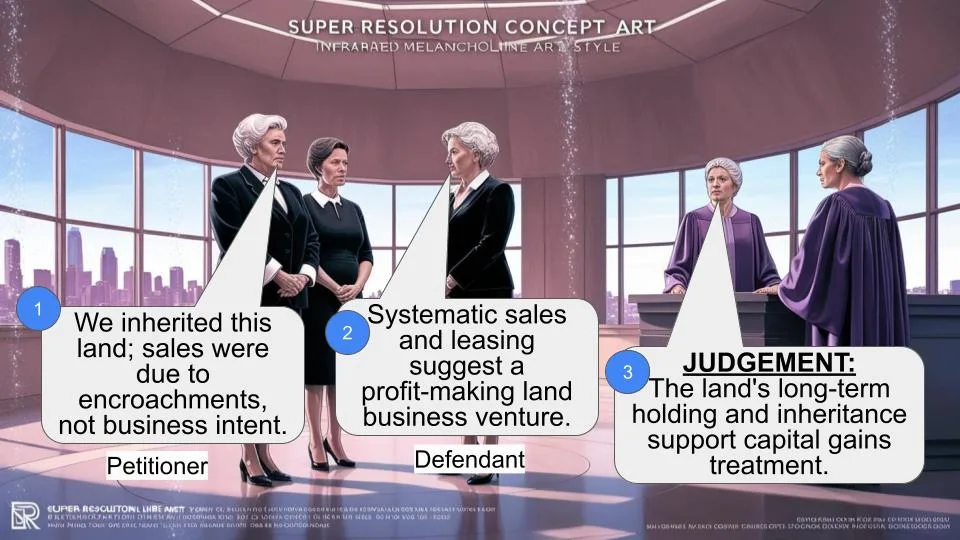
Two questions have been raised by the Revenue in this appeal: that since the perpetual lease in respect to an immovable property held by the predecessor-in-interest of the assessee was converted into outright ownership after the assessee acquired the property by way of a bequest under a Will and the period between the acquisition of full ownership and the transfer was short, the sale of such property attracted short-term capital gains tax; and, the payments allegedly made by the assessee to others asserting rights over the same immovable property could not have qualified for deduction under Section 55(1)(b)(2)(ii) (of Income Tax Act, 1961) since the payments made thereunder could not be regarded as cost of improvement to the relevant immovable property.
There is no dispute that the assessee in this case obtained the property under a Will. The Will apparently gave some interest to a trust and, thus, the assessee’s acquisition of the perpetual lease was subject to rights of the trust as flowing from the Will. In addition, the testator had entered into an agreement for sale of the property with a third party and had even obtained clearance under Chapter XX of the Act for such purpose and, when the assessee evinced a desire to transfer the property or the interest therein, such third party lodged a claim which had to be settled by the assessee. It is also not in dispute that at the time of the acquisition of the leasehold rights by the assessee’s predecessor-in-interest in or about 1968, a perpetual lease was granted by the relevant authority. After the assessee inherited such rights under the Will, the assessee perfected the rights to full ownership upon payment of a sum of about Rs.55 lakh to the Delhi Development Authority (DDA).
The Revenue claims that since the acquisition of the full ownership pertaining to the property preceded the transfer thereof by the assessee by a few months, the assessee was liable to pay tax on the short-term capital gain. It is also the Revenue’s contention that the payments made to the trust, to DDA for bettering the title of the asset qua the property and to the third party for such third party to give up his rights under the agreement for sale executed by the assessee’s predecessor would not qualify for deduction. The Revenue maintains that none of such payments were for the improvement of the property and, as such, could not be regarded as cost of improvement within the meaning of the relevant expression in Section 55(1)(b)(2)(ii) (of Income Tax Act, 1961).
In support of the Revenue’s case, a judgment reported at 119 ITR 837 (CIT v. V. Indira) has been placed. In that case, a payment was made by the assessee to the plaintiff in a suit where the plaintiff sought to assert some rights in respect of the property in question and the compromise amount was sought to be cited as cost of improvement to the asset. It was in such context that the Division Bench of the Madras High Court held that the relevant expression was “cost of any improvement thereto” and the use of the word “thereto” implied that it had to be a cost on the asset itself and not a cost for improving the owner’s title to the asset.
A distinction was made between improving the asset itself, which would be covered by the relevant expression, and improving the owner’s title thereto, which would fall beyond such expression.
On behalf of the assessee Sections 45, 47, 49 and 55 of the Act are placed. Section 47(iii) (of Income Tax Act, 1961) excludes the transfer by way of Will from the purview of “transfer” as used in the Chapter. Thus, upon a bequest under a Will in respect of an immovable property taking effect, it cannot be regarded as a transfer for the purpose of the capital gains provisions. The Act also permits the cost of acquisition incurred by the predecessor in such a situation to be taken as the cost of acquisition if the successor were to transfer the relevant property.
According to the assessee, there is no doubt that substantial interest in the property was acquired by the assessee in terms of the Will. However, the interest of the assessee was clouded by the rights conferred to the trust by the Will, the claim of the third party who entered into an agreement for sale with the predecessor of the assessee and the fact that it was a perpetual lease and not outright ownership. The assessee asserts that without taking care of the claims of the trust and of the agreement-holder for sale, there could be no meaningful transfer of the property or the leasehold interest therein as, at any rate, it would be a transfer with encumbrances. According to the assessee, when encumbrances to an immovable property are removed by payment and the removal of such encumbrances enhances the value of the property and the sale price thereof, the costs incurred for such purpose have to be regarded as part of the cost of acquisition of the capital asset.
The assessee submits that the judgment in V. Indira was referred to a larger Bench in the Madras High Court and the larger Bench judgment of such Court fell for consideration of the Supreme Court in a judgment reported at 227 ITR 222 (R.M. Arunachalam v. CIT). The appellant relies on the later part of the judgment where the law as relevant for the present purpose is discussed by the Supreme Couert in the context of the contrary views rendered by the Kerala and Gujarat High Courts in a situation where the mortgage debt was discharged prior to the transfer of the immovable property.
The Supreme Court held that if the mortgage had been created by the previous owner and the assessee after inheriting the same had discharged the mortgage debt, the amount paid by the assessee for the purpose of clearing off the mortgage could be claimed as a part of cost of acquisition under Section 48 (of Income Tax Act, 1961) and Section 49 (of Income Tax Act, 1961) read with Section 55(2) (of Income Tax Act, 1961).
The first question sought to be raised by the Revenue does not appeal since the assessee in this case inherited the relevant immovable property under a Will and the perfection of the title from perpetual leasehold rights to complete ownership did not amount to the acquisition of the property by the assessee; the acquisition took place upon the bequest under the Will being effective. The perfection of the title from perpetual leasehold rights to complete ownership had, in such circumstances, to be regarded as a cost of acquisition within the meaning of such expression in Sections 48 and 55 of the Act. Indeed, the assessee in this case was no longer transferring the leasehold rights to the assessee’s transferee; the assessee was transferring complete ownership rights therein.
As to the second issue, it will be governed by the same legal principle as in the recognition by the Supreme Court in R.M. Arunachalam that the discharge of a mortgage debt created by the predecessor-in-interest of the assessee had to be regarded as a part of the cost of acquisition. The encumbrances to the property in this case were created by the Will and the conduct of the assessee’s predecessor- in-interest. These encumbrances were got rid of by the assessee by payment. A better title to the property was acquired by the assessee and transferred to the assessee’s transferee. For the same principle as recognised in the Supreme Court judgment, the cost of getting rid of such encumbrances in any immovable property has to be accepted as a part of the cost of acquisition of the property, subject, however, to the assessment as to the genuineness and validity of such encumbrances.
To spell it out in more clear terms, merely because an assessee seeks deductions by adding to the cost of acquisition upon citing payments to other claimants in respect of the property may not pass muster unless, on facts, the claims are found to be genuine and the transactions discovered to be at arm’s length.
The final contention of the Revenue cannot be gone into in view of the limited authority available in this jurisdiction. According to the Revenue, the payments made to the trust and to the agreement-holder were not genuine and the appellate authorities below erred in not noticing the same.
Unfortunately, this inquiry cannot be conducted at this level since matters of fact are not gone into in this jurisdiction. Once it is found that the deductions were permissible in principle on the ground of cost of acquisition, as to the veracity of the relevant transactions, the Commissioner (Appeals) and the Appellate Tribunal were the final fact-finding authorities in such regard whose concurrent opinion, on facts, has to be accepted.
For the reasons indicated above, ITAT No. 114 of 2014 and GA No. 2277 of 2014 are dismissed. The order of the Appellate Tribunal is left untouched.
There will be no order as to costs.
(SANJIB BANERJEE,J.)
(ABHIJIT GANGOPADHYAY,J.)
×
Similar Ripples
Questions
Court: Perfecting inherited property title doesn't trigger short-term capital gains tax
Write your CommentSimilar Posts

Generic
- Reportdata/228_omez1o9.pdf
