


Court Rules: Leasing Property Yields House Income, Not Business Profit



Full News
Court Rules: Leasing Property Yields House Income, Not Business Profit
Court Rules: Leasing Property Yields House Income, Not Business Profit
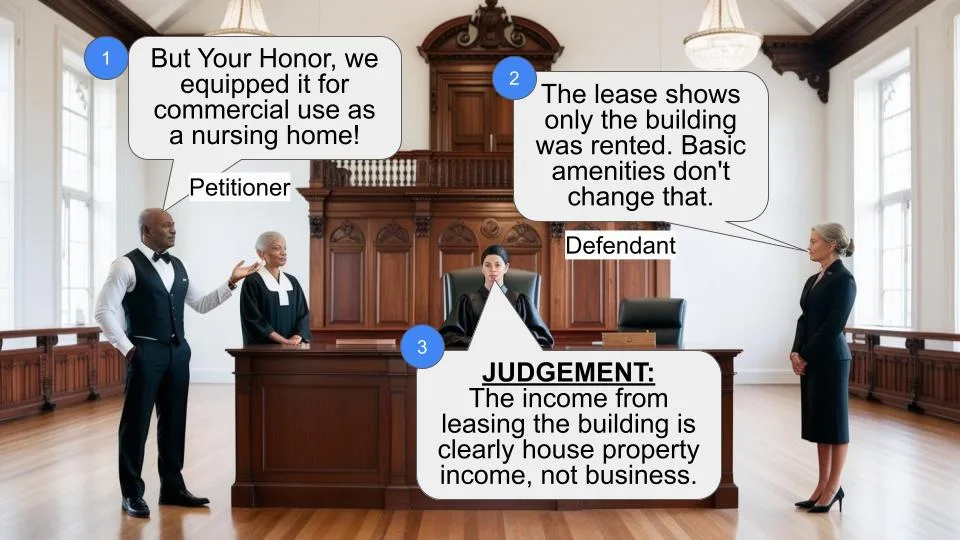
This case involves Hotel Arti Delux (Pvt.) Ltd. appealing against the Assistant Commissioner of Income Tax's decision to classify their income from leasing out a building as "income from house property" rather than "business income". The court dismissed the appeal, affirming that the income should be treated as income from house property.
Case Name**: Hotel Arti Delux (Pvt.) Ltd. vs. Assistant Commissioner of Income Tax **Key Takeaways**: 1. Income from leasing out property is generally classified as "income from house property" under the Income Tax Act. 2. The intention of the property owner and the nature of the lease are crucial in determining the classification of income. 3. Mere inclusion of basic amenities (like lifts, tubewells, electrical fittings) doesn't convert a building into a commercial asset. **Issue**: Should the income derived by Hotel Arti Delux (Pvt.) Ltd. from leasing out its property be classified as "income from business and profession" or "income from house property" for tax purposes? **Facts**: 1. Hotel Arti Delux (Pvt.) Ltd. initially constructed a building to run a hotel business. 2. Finding the location unsuitable for a hotel, they decided to lease the building for use as a nursing home. 3. A lease deed was executed on May 2, 1989, leasing the building to Deva Nursing Home Pvt. Ltd. for a monthly rent of Rs. 25,000/-. 4. The building was equipped with lifts, a generator, tubewell, and electrical fittings. 5. For the assessment year 1990-91, the appellant filed a return showing a loss of Rs. 64,482/-. **Arguments**: Appellant's arguments: 1. The leasing out was not of property simplicitor but of business premises with assets for use as a nursing home. 2. The resultant income should be treated as business income, even though they weren't running the nursing home themselves. Tax Department's arguments: 1. As per Section 14 (of Income Tax Act, 1961) and Section 22 (of Income Tax Act, 1961), income from renting properties is chargeable under "income from house property". 2. The lease deed clearly shows that only the building was let out, and basic amenities don't convert it into a commercial asset. **Key Legal Precedents**: 1. Sultan Brothers Pvt. Ltd. vs. Commissioner of Income Tax, Bombay City-II, 1964 ITR 353 2. Karnani Properties Ltd. vs. Commissioner of Income Tax, West Bengal, 82 ITR 547 3. Universal Plast Ltd. and another vs. Commissioner of Income Tax, 237 ITR 454 4. Shambhu Investment Ltd. vs. Commissioner of Income Tax, 263 ITR 143 **Judgement**: The court dismissed the appeal, ruling that: 1. The income derived by the appellant from leasing out its property was income from house property, not business income. 2. The building leased out was a building simplicitor, not equipped with specialized plant and machinery. 3. The income was derived from ownership of the building, not from personal exertion necessary to treat it as business income. **FAQs**: 1. Q: What's the main difference between "income from house property" and "business income"? A: Income from house property is derived from ownership of a building, while business income involves personal exertion and commercial exploitation of assets. 2. Q: Does including amenities like lifts and electrical fittings change the nature of the income? A: Not necessarily. The court viewed these as basic amenities necessary for any building, not specialized equipment that would convert it into a commercial asset. 3. Q: What factors does the court consider in classifying such income? A: The court considers the nature of the lease, the owner's intention, the presence of specialized equipment, and whether the income is derived from mere ownership or active business operations. 4. Q: How does this ruling impact similar cases? A: This ruling reinforces the principle that merely leasing out a property, even if originally intended for business use, doesn't automatically make the income "business income" for tax purposes. 5. Q: Can a building ever be considered a "plant" for tax purposes? A: Yes, but it would need to have specialized features or equipment that make it uniquely suited for a particular commercial purpose, beyond just basic amenities.

The main object as per the memorandum and articles of association of the appellant-company is, to carry on the business of hotel, restaurant, cafe, etc. Other objects as elucidated in the memorandum of association is, also to acquire, establish and maintain one or more nursing home, hospitals, clinics, dispensaries, etc. For the purpose of attainment of its objects for carrying on the business of hotels, the petitioner constructed a building and, after construction, it appeared that the assessee could not run the business of the hotel as the building so constructed was found to be located in a remote area and far away from the railway station and it was felt that carrying on the business of hotel was not a feasible business. The Board of Directors of the company passed a resolution dated 12th March, 1989 deciding to run a hospital or a nursing home either under its own supervision or to lease out the building with plant, machineries, generators, lifts or other amenities to any Doctor or to a medical institution. Pursuant to the said resolution, a lease deed was executed in favour of Deva Nursing Home Pvt. Ltd. dated 2nd May, 1989 to lease out the building premises at a monthly rent of Rs.25,000/- per month. The building let out was fitted with lifts, generator, tubewell and electrical fittings. The relevant portion of the lease deed is extracted hereunder:-
“And whereas the lessor has decided in its meeting held on 2.4.89 to lease out the building to the lessee for the purpose of running a nursing home and the lessee has agreed to take the said building from the lessor on lease on the terms and conditions contained herein.
From the above recital of the lease deed, it is clear that only the building was leased out by the assessee. The rent fixed under the lease and payable by the lessee was for the building and not for any other asset. For the assessment year 1990-91, the appellant filed its return of income showing a loss of Rs.64,482/-. In this return, the appellant claimed that its income was derived by leasing out the building, plant, machineries, generators, lifts and other amenities and such income was income from profits and gains of business of profession.
The Assessing Officer did not accept the contention of the appellant and treated the income as income from other sources. The appellant, being aggrieved, filed an appeal before the Commissioner of Income Tax, which was dismissed holding that such income of the assessee was income from house property. The appellant, being aggrieved, filed a second appeal before the Income Tax Tribunal. One member of the Tribunal upheld the order of the Commissioner of Income Tax holding that the income of the appellant was an income from house property, but the other member dissented holding that such income is a business income. On account of difference of opinion between the two members, the matter was referred to the third member of the Tribunal, who opined that the income of the appellant should be assessed as income from house property. In view of the opinion of the third member, the appeal of the appellant was dismissed holding its income as income from house property.
The appellant, being aggrieved, has filed the present appeal under Section 260A (of Income Tax Act, 1961), which was admitted on the following substantial questions of law:
“(i) Whether, the income of Rs.3,23,000/- is income from business and profession and not income from house property?
(ii) Whether, the learned Tribunal has totally misread and misinterpreted the lease agreement between the appellant and M/s Deva Nursing Home (P) Ltd. to hold that the receipts derived thereunder were taxable at the hands of the appellant as “income from house property” and not “income from business and profession”?
(iii) Whether, the finding of the learned Tribunal that the appellant had simply let out the building to M/s Deva Nursing Home (P) Ltd. is perverse and against the settled legal principles and tests applicable to the facts of the case?” We have heard at length Sri S.D. Singh, the learned Senior Counsel assisted by Sri Manu Ghildiyal and Sri R.K. Upadhyaya, the learned counsel for the Income Tax Department.
The learned Senior Counsel appearing for the appellant contended that it was not a case of letting out of the property simplicitor but it was a case of leasing out the business premises from where business had actually being carried out and the assets were conveniently being put to use as a nursing home. It was urged that even though the nursing home was not being run by the appellant, nonetheless, the resultant income was liable to be treated as a business income. In support of his submission, the learned Senior Counsel placed reliance upon the decision of the Supreme Court in Sultan Brothers Pvt. Ltd. Vs. Commissioner of Income Tax, Bombay City-II, 1964 ITR 353 as well as decision of the Supreme Court in Karnani Properties Ltd. Vs. Commissioner of Income Tax, West Bengal, 82 ITR 547 and Universal Plast Ltd and another Vs. Commissioner of Income Tax, 237, ITR 454.
On the other hand, Sri R.K. Upadhyaya, the learned counsel for the department submitted that in view of Section 14 (of Income Tax Act, 1961) read with Section 22 (of Income Tax Act, 1961) income from renting of properties is chargeable to income tax under the head "income from house property". The learned counsel further contended that a perusal of the terms and conditions of the lease deed would make it apparently clear that only the building was let out and the mere fact that the building had a lift, tubewell and electrical fittings would not make any material difference as these were amenities, which were necessary for the use of building and was not sufficient to convert the building into a commercial asset. In support of his submission, the learned counsel placed reliance upon a decision in Shambhu Investment Ltd. Vs. Commissioner of Income Tax, 263 ITR 143 wherein the Supreme Court held that letting out a portion of the premises with furnitures and fixtures and providing service to occupants would be an income assessable as an income from property.
Section 14 (of Income Tax Act, 1961) classifies income under five different heads. Income, which is specifically chargeable under a distinct head cannot be brought to charge under a different head for the simple reason that Rules for computing income and the deductions, which are permissible vary under each of the five different heads.
The scheme of the Act is first to classify the income under the different heads and then work out the computation under each of the heads as per the provisions relating to such head and then total up the computation so made for the purpose of arriving at a final figure and the total income liable to tax. For the purpose of charge of income tax and computation of total income under Section 14 (of Income Tax Act, 1961), all income shall be classified such as salaries, income from house property, profit and gains of business and profession, capital gains or income from other sources.
Section 14 (of Income Tax Act, 1961) starts with the words “save as otherwise provided by this Act”, which indicates that for the purpose of charge of income tax and computation of total income, all income shall be classified under the five following heads of income specified in Section 14 (of Income Tax Act, 1961) unless it is specifically provided otherwise elsewhere by the Act.
On the other hand, Section 22 (of Income Tax Act, 1961) provides that income from house property would be chargeable to income tax under the head “income from house property”. For facility, Section 22 (of Income Tax Act, 1961) is extracted hereunder:-
“Income from house property.
22. The annual value of property consisting of any buildings or lands appurtenant thereto of which the assessee is the owner, other than such portions of such property as he may occupy for the purposes of any business or profession carried on by him the profits of which are chargeable to income tax, shall be chargeable to income-tax under the head “Income from house property”.
From a perusal of Section 14 (of Income Tax Act, 1961) read with Section 22 (of Income Tax Act, 1961) it indicates that income from house property would be chargeable to income tax under the head “income from other sources”. The intention of the legislature in making rent from property chargeable under the heading income from other sources is apparently clear.
In Universal Plast Ltd. (supra) while considering as to whether the income from leasing out of assets would be a business income or income from property, the Supreme Court culled out the following principles:-
“(1) no precise test can be laid down to ascertain whether income (referred to by whatever nomenclature, lease, amount, rents, licence fee) received by an assessee from leasing or letting out of assets would fall under the head “Profits and gains of business or profession”;
(2) it is a mixed question of law and fact and has to be determined from the point of view of a business and in that business on the facts and in the circumstances of each case, including true interpretation of the agreement under which the assets are let out;
(3) where all the assets of the business are let out, the period for which the assets are let out is a relevant factor to find out whether the intention of the assessee is to go out of business altogether or to come back and restart the same;
(4) if only a few of the business assets are let out temporarily, while the assessee is carrying out his other business activities, then it is a case of exploiting the business assets otherwise than employing them for his own use for making profit for that business; but if the business never started or has started but ceased with no intention to be resumed, the assets also will cease to be business assets and the transaction will only be exploitation of property by an owner thereof, but not exploitation of business assets.”
In the light of the aforesaid principles, the learned counsel for the appellant contended that the facts in the instant case has to be gone into for the purpose of holding whether it was a business income or income from property. The learned counsel contended that the appellant's intention was to run a hospital but since it had no experience it made a transient alternate arrangement to let out the building along with the plants and machinery for commercial exploitation of its commercial assets so that the income from such letting could be treated as a business income. This contention is misplaced. We also find that reliance by the appellant on the decision of the Supreme Court in Sultan Brothers' case (supra) is misplaced. The Supreme Court in that case considered a case where the assessee constructed a building and filled it up with furnitures and fixtures and let it out on a lease fully equipped and furnished for the purpose of running a hospital. The lease provided for a monthly rent for the building and a hire charge for the furnitures and fixtures. On these facts, the Supreme Court held that letting out of the said building did not amount to the carrying on a business and the income under the lease would not, therefore, be assessed as income from business.
From the recital of the lease deed it is evident that only the building was leased out along with a lift, tubewell and electrical fittings. These cannot be treated as plant and machinery but would be treated as amenities, which are necessary for the use of any building. We find that the appellant had not placed any material on record to show that the building had peculiar amenities with which the building could be treated as a “plant” and not a building simplicitor. No material has been brought on record to indicate that the building had peculiar amenities, which could be commercially exploited such as facilities of sterilization of surgical instruments and bandages or an operation theatre. The Tribunal has given a categorical finding of fact that the building which was leased out by the appellant was nothing else but a building simplicitor and was not a building, which was equipped with specialized plant and machinery. This being a finding of fact, we are not inclined to interfere in such findings, especially when nothing has been brought on record to indicate that the said finding was perverse.
We also find that the appellant is not running the business of a hospital and has only let out the building. We are of the opinion that the income derived by the appellant was from the ownership of the building and not from the personal exertion, which is necessary to treat the income as a business income.
In the light of the aforesaid, we are of the opinion that the income derived by the appellant from the leasing out of its property was an income from house property and not a business income. Consequently, the appeal has no merit and is dismissed. The questions of law are answered accordingly.
Date:9.9.2014
Bhaskar
(Dr. Satish Chandra, J.) (Tarun Agarwala, J.)
×
Questions
Court Rules: Leasing Property Yields House Income, Not Business Profit
Write your CommentSimilar Posts
Generic
- Reportdata/4618.pdf
