


Court Sides with Taxpayer: No Penalty for Bona Fide Claim on Interest Taxation


Full News

Court Sides with Taxpayer: No Penalty for Bona Fide Claim on Interest Taxation
Court Sides with Taxpayer: No Penalty for Bona Fide Claim on Interest Taxation
Where a taxpayer (the assessee) received some interest on enhanced compensation for their acquired land. They didn't disclose this interest in their tax return, claiming it should be taxed on an accrual basis. The tax department wasn't happy and tried to impose a penalty, but the court ultimately sided with the taxpayer. Let's break it down, shall we?
Get the full picture - access the original judgement of the court order here
Case Name:
Commissioner of Income Tax Vs Kartar Singh (High Court of Punjab and Haryana)
I.T.A. No. 63 of 2008
Date: 21 April 2008
Key Takeaways:
1. Bona fide claims, even if incorrect, don't necessarily lead to penalties.
2. The timing of taxing interest on enhanced compensation is still a debatable issue.
3. Courts are lenient when taxpayers have a reasonable basis for their position.
Issue:
The main question here is: Can a penalty be imposed under Section 271(1)(c) (of Income Tax Act, 1961) for not disclosing interest on enhanced compensation when the taxpayer has a bona fide belief about how it should be taxed?
Facts:
1. Our taxpayer received Rs.11,89,053/- as interest on enhanced compensation on 26.10.1996 for some land acquisition.
2. They didn't include this in their tax return for the 1997-98 assessment
year.
3. The tax department added this amount to the taxpayer's income and initiated penalty proceedings.
4. The case went through various stages of appeal, with the Income Tax Appellate Tribunal (ITAT) ultimately ruling in favor of the taxpayer.
Arguments:
The taxpayer's side: I didn't disclose this interest because I genuinely believe it should be taxed on an accrual basis, not when I received it."
The tax department's side: "You didn't disclose the income, so you're concealing information and should pay a penalty."
Key Legal Precedents:
1. CIT vs. Hardwari Lal (HUF) & Ors. (2008) 7 DTR (P&H) 76
2. CIT vs. Tek Ram (HUF) (2008) 14 DTR (P&H) 65
3. DCIT Vs. Padam Prakash (HUF)-(2006) 10 SOT 1
4. Smt. Rama Bai Vs. CIT and Hindustan Housing & Land Development Trust-161 ITR 524
These cases all support the idea that interest on enhanced compensation should be taxed on an accrual basis and that having a reasonable interpretation of tax law shouldn't lead to penalties.
Judgement:
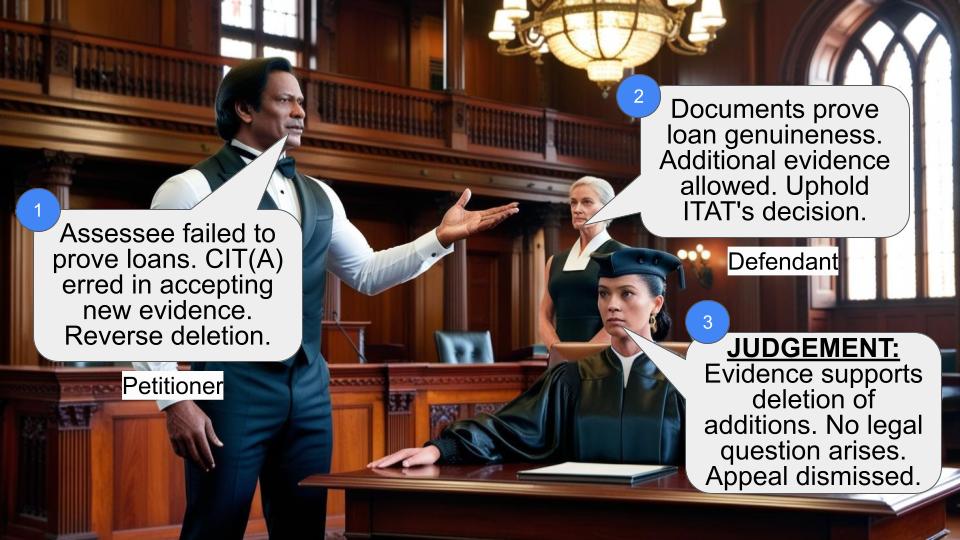
The court basically said, "Look, the taxpayer had a reasonable basis for their claim. Even if they were wrong, they weren't trying to hide anything. No penalty should be imposed." They dismissed the tax department's appeal, agreeing with the ITAT's decision.
FAQs:
Q1: Does this mean I can claim anything on my taxes without fear of penalty?
A1: Not quite. The key here is having a "bona fide" or genuine belief based on reasonable interpretation of the law.
Q2: How is interest on enhanced compensation usually taxed?
A2: According to this judgment, it's typically taxed on an accrual basis, spread over the years from when the land was possessed to when the court finalizes the compensation amount.
Q3: What's the significance of Section 271(1)(c) (of Income Tax Act, 1961)?
A3: This section deals with penalties for concealing income or furnishing inaccurate particulars. The court's interpretation here limits its application in cases of genuine disagreement about tax treatment.
Q4: Does this judgment change how interest on enhanced compensation is taxed?
A4: Not really. It's more about how penalties are applied when there's a genuine dispute about tax treatment.

The assessee has filed the present appeal under Section 260-A (of Income Tax Act, 1961), 1961 (hereinafter referred to as the “Act”) against the order dated 14.06.2007 passed by the Income Tax Appellate Tribunal, Delhi Bench `G' New Delhi in I.T.A. No. 547/Del/2006 for the assessment year 1998-99.
The assessee had received interest on enhanced compensation amounting to Rs.11,89,053/- on 26.10.1996 consequent upon acquisition of land by the Land Acquisition Officer, HUDA Gurgaon. The assessment for the assessment year 1997-98 was completed at an income of Rs. 12,49,410/- vide order dated 31.1.2003 under Section 143(3) (of Income Tax Act, 1961) against the returned income of Rs. 1,70,640/-.
Aggrieved against the assessment order, assessee preferred n appeal before the Commissioner of Income Tax (Appeals) (hereinafter referred to as the 'CIT(A)'), who vide his order dated 3.3.2004 dismissed the appeal and confirmed the additions made in the assessment order.
The penalty proceedings under Section 271(1)(c) (of Income Tax Act, 1961) were initiated in terms of notice dated 31.01.2003 requiring the assessee to show cause as to why penalty should not be imposed. Vide letter dated 04.02.2005 the assessee was given an opportunity to show cause as to why penalty under Section 271(1)(c) (of Income Tax Act, 1961) should not be imposed. The counsel for the assessee by writing a letter requested that penalty proceedings under Section 271(1)(c) (of Income Tax Act, 1961) be stayed till the decision of the Income Tax Appellate Tribunal, Delhi (hereinafter referred to as the ITAT) in his appeal filed against the order of the CIT(A).
The Income Tax Officer, Ward-4, Gurgaon vide order dated 31.3.2005 imposed a penalty upon the assessee under Section 271(1)(c) (of Income Tax Act, 1961) on account of furnishing inaccurate particulars of income leading to concealment of income.
Aggrieved against the said order, the assessee filed an appeal before the CIT(A), Panchkula, who vide order dated 21.11.2005 held that interest on enhanced compensation is taxable on accrual basis and, therefore, in such a situation, there was no deliberate defiance of law proved against the assessee.
Consequently, the penalty order under Section 271(1)(C) (of Income Tax Act, 1961) was cancelled.
Aggrieved against the order of the CIT(A), the revenue filed an appeal before the ITAT, which was dismissed vide order dated 14.6.2007, observing as under:-
“....in its recent decision rendered by Delhi Special Bench of ITAT in the case of DCIT Vs. Padam Prakash (HUF)-(2006) 10 SOT 1, it has been held that chargeability of interest income on enhanced compensation to tax is still governed by the decision of Hon'ble Supreme Court in the case of Smt. Rama Bai Vs. CIT (supra) as well as in the case of Hindustan Housing & Land Development Trust-161 ITR 524 in the absence of any change in the relevant statutory provision and accordingly, the same is to be assessed on accrual basis from year to year. This decision of the Special Bench of ITAT as well as the judicial pronouncements of Hon'ble Apex Court relied upon by the Tribunal in the said decision clearly shows that the claim of the assessee about the chargeability of interest on enhanced compensation on accrual basis was based on a possible view and making of such claim bona fide on the basis of a possible view, in our opinion, could not be treated as concealment of its income by the assessee or furnishing of inaccurate particulars of such income so as to attract the penal provisions of Section 271(1) (c) (of Income Tax Act, 1961) as rightly held by the learned CIT(A).”
The revenue has challenged the order dated 14.6.2007 passed by the Tribunal and has sought to raise the following substantial questions of law:-
“1. Whether on the facts and circumstances of the case, the Hon'ble ITAT was right in holding that the view of assessee regarding non-taxability of interest on enhanced compensation was bonafide?
2. That the Hon'ble ITAT erred in deciding that proving contumacious intent is an essential ingredient in levy of penalty in contravention of the provisions of a Civil Statute like Income Tax Act in spite of there being so many judgments that breach of a civil obligation attracts levy of penalty whether the contravention was made by the defaulter with any guilty intention or not?
3. That the order of the Hon'ble ITAT is in contravention of the many judicial pronouncements including Thirupathy Kumar Khemka Vs. Commissioner of Income Tax 210 CTR 287 (Mad)?
4. That the Hon'ble ITAT at least should have confirmed the penalty to the extent of interest on enhanced compensation received on accrual basis as the assessee had not filed return voluntarily?”
Shri Yogesh Putni, learned counsel for the Revenue has very fairly conceded that question Nos. 1 and 2 as raised by the Revenue have already been answered by the judgment of this Court passed in ITA No. 490 of 2007 decided on 26.3.2008 and ITA No. 579 of 2007 decided on 4.2.2008 respectively. He has not addressed any arguments with regard to question Nos. 3 and 4 and has stated that in fact these questions are covered by question No.2 only. In ITA No. 490 of 2007 decided on 26.3.2008, this Court has held that interest on enhanced compensation would not accrue till the issue of enhanced compensation is finally decided and thereafter on attaining the finality of determination of enhanced compensation by the court, the interest accrued to the assessee has to be spread over on an annual basis right from the date of delivery of possession till the date of order of the Court on the time basis. In ITA No. 579 of 2007 on similar facts, it was held by this Court that the matter relating to enhanced compensation and interest was still in dispute and the same was a highly debatable issue as two views were clearly possible on the said issue and thus the claim of the assessee was based on one possible view (although the said claim was not accepted in the quantum proceedings on a difference of opinion) and therefore, such claim made by the assessee could not be treated as concealment of income by the assessee or furnishing of inaccurate particulars of such income so as to attract the penal provisions of Section 271(1)(c) (of Income Tax Act, 1961).
In view of the above facts, we are not inclined to interfere in the impugned order passed by the Tribunal. The appeal being without any merit, is dismissed.
(RAKESH KUMAR GARG)
JUDGE
21.4.2008 (SATISH KUMAR MITTAL)
MK JUDGE
×
Questions
Court Sides with Taxpayer: No Penalty for Bona Fide Claim on Interest Taxation
Write your CommentSimilar Posts


Generic
- Reportdata/4644.pdf
