


Court Upholds Capital Gains Treatment for Share Sale, Not Business Income



Full News
Court Upholds Capital Gains Treatment for Share Sale, Not Business Income
Court Upholds Capital Gains Treatment for Share Sale, Not Business Income
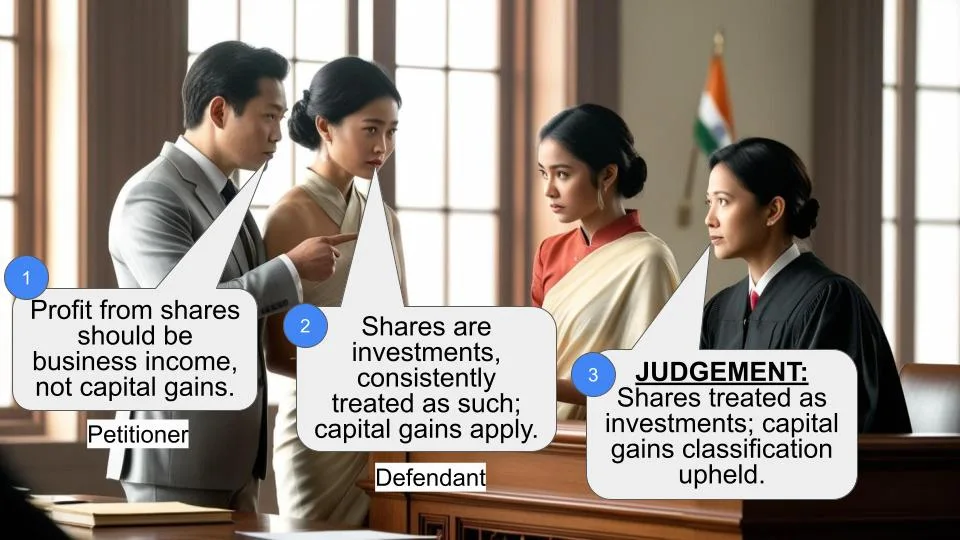
In the case of "Principal Commissioner of Income Tax and Another vs. Telestar Investments P. Ltd.," the court addressed whether the profit from the sale of shares should be treated as business income or capital gains. The court upheld the decision that the income should be treated as capital gains, supporting the company's consistent treatment of the shares as investments.
Get the full picture - access the original judgement of the court order here
Case Name:
Principal Commissioner of Income Tax and Another vs. Telestar Investments P. Ltd. (High Court of Karnataka)
ITA No. 59 of 2016
Date: 16th June 206
Key Takeaways:
- The court confirmed that the income from the sale of shares should be treated as capital gains, not business income.
- The decision emphasized the importance of consistent treatment of investments in financial statements.
- The ruling highlighted that the absence of evidence showing shares as stock-in-trade supports the capital gains classification.
Issue
Should the profit from the sale of shares be classified as business income or capital gains?
Facts
Telestar Investments P. Ltd. sold shares and reported the profit as capital gains. The Assessing Officer (AO) treated it as business income, arguing that the company intended to profit from trading. The company consistently showed these shares as investments in its balance sheet, not as stock-in-trade.
Arguments
- Revenue's Argument: The AO argued that the profit should be treated as business income, citing the company's intention to profit from share trading.
- Company's Argument: Telestar Investments maintained that the shares were held as investments, consistently valued at cost, and not acquired with borrowed funds, supporting the capital gains classification.
Key Legal Precedents
- Chennai Properties & Investments Ltd Vs. Commissioner of Income Tax (2015) 373 ITR 673 (SC): This case was referenced by the Revenue to argue for business income treatment.
- Commissioner of Income-Tax Vs. Chugandas And Co. (1965) 55 ITR 17 (SC): Cited to support the treatment of income based on the nature of holding.
- Commissioner of Income-Tax Vs. Bhoopalam Commercial Complex and Industries (P.) Ltd. (2003) 262 ITR 517: Used to discuss the treatment of income from property.
- Shambhu Investment P. Ltd., Vs. Commissioner of Income-Tax 263 ITR 143: Referenced for understanding income classification.
Judgement
The court dismissed the appeal, agreeing with the CIT (Appeals) and the Tribunal that the shares were consistently treated as investments. The court found no substantial question of law to reconsider the classification as capital gains, given the consistent treatment and lack of evidence to the contrary.
FAQs
Q1: Why was the income treated as capital gains?
A1: The shares were consistently shown as investments in the company's balance sheet, and there was no evidence to suggest they were held as stock-in-trade.
Q2: What was the Revenue's main argument?
A2: The Revenue argued that the profit should be treated as business income due to the company's intention to profit from trading shares.
Q3: How did the court view the company's treatment of shares?
A3: The court supported the company's consistent treatment of shares as investments, which aligned with the capital gains classification.
Q4: What impact does this case have on similar disputes?
A4: It reinforces the importance of consistent financial treatment of assets and the need for clear evidence when classifying income types.

The appellants-Revenue has preferred the present appeal by raising the following substantial question of law:
“Whether on the facts and in the circumstances of the case, the Tribunal is in law in holding that the assessing authority is not right in treating profit derived of Rs.10,66,425/- on sale of shares under the head business income and not under the head capital gains when the assessing authority has rightly treated the same as business income considering the intention of
assessee for making profit by making investments in shares and materials on record which disclosed that assessee is a trader in stocks?”
2. We have heard Mr. E.I. Sanmathi, learned Counsel appearing for the appellants-Revenue.
3. It appears that after the matter was remanded earlier by the Tribunal. The Assessing Officer further considered the matter and found that merely because the purchase of the shares were shown as investment in the balance sheet is no ground to conclude that it was not the stock-in-trade and ultimately, found that it is profit of business and not a capital gain. In appeal before CIT (Appeals) at paragraphs-5 and 6, it was observed thus:
“5. The Hon'ble ITAT Bangalore A-Bench vide its order dated 08.09.2006 while setting aside the case to the file of the A.O had observed as under.
"It is not clear as to whether the assessee
company used its own funds or borrowed
funds for acquiring such shares. We are not
aware as to whether the assessee company
was valuing the stock-in-trade at cost price or
market price. In case the stock-in-trade was
valued at market price and such shares were
not valued at market price while valuing the
stock-in-trade, then such shares not to be
treated to have been held as stock-in-trade. It
is therefore felt that the A.O has not
considered all the aspects before holding that
such shares were held as stock-in-trade."
6. As directed by the Hon'ble ITAT the A.O
had examined these details during course of
assessment proceedings and mentioned in his
assessment order that vide letter dated
26.11.2007 the A.R of the appellant stated
that the shares which were sold were not
acquired out of borrowed funds and all the
shares purchased by the company were held
as investments and valued at cost
consistently from its inception and year after
year. However while determining the nature of
income the A.O did not consider these crucial
points. As there is no evidence to show that
the appellant held these shares as stock-in-
trade at any point of time, I am unable to
agree with the conclusion of the A.O that the
sale proceeds represent income from
business. In view of this the A.O is directed to
treat the income on sale of shares as income
from long term capital gains and accordingly
the appeal is Allowed.
The aforesaid shows that the CIT (Appeals) found that
as the investment was made from the fund of the
Company and the investment made was shown as
investment at the cost value from the inception, it could
not be termed as stock-in-trade and therefore, it should
be treated as long term capital gain.
4. The Income Tax Appellate Tribunal in the
appeal at paragraph-5 interalia observed, the relevant of
which is as under:
“We find that the AO has not given any reasons
for not accepting the assesse’s contention and
also as to how these decisions are applicable to
the facts of the case before him. Therefore, in our
opinion the CIT(A) has rightly observed that the
assessee's statement that the shares which were
sold were not acquired out of borrowed funds
and that all the shares purchased by the
company were held as investments and valued at
cost consistently from its inception and year
after year, has not been rebutted by the AO with
any evidence of the contrary. Therefore, we do
not see any reason to interfere with the order of
the CIT(A).”
5. The Tribunal found that the view taken by the
CIT (Appeals) is right, as the investment and the value
of the cost was consistently shown from its inception
and as the said aspect was not rebutted by the
Assessing Officer, the Tribunal did not interfere with the
view taken by the CIT (Appeals).
6. The learned Counsel appearing for the
appellants-Revenue by relying upon the decision of the
Apex Court in the case of Chennai Properties &
Investments Ltd Vs. Commissioner of Income Tax
reported at (2015) 373 ITR 673 (SC) made an attempt
to contend that the income should have been treated as
that of the business income and not as that of the
investment income or capital gain.
7. We may record that more or less, similar
questions arose for consideration before this Court in
ITA No.567/2015 and the very decision of the Apex
Court in the case of Chennai Properties &
Investments Ltd (supra) was considered by this Court
and it was observed that the question of giving
treatment to the income of the property of the assessee
as that from the investment or as a business income
was also required to be considered in light of the factual
aspects that what treatment was given to the income
earned from the property whether it was that of the
business income or the income from the house property.
8. In the present case, the peculiar facts are that
the investment made was shown as investment and the
cost was reflected throughout in the balance sheet and
it was never treated as stock-in-trade. Further, if it
was to be treated as stock-in-trade and the market
value plus cost would have been considered, but such
was not treated accordingly by the assessee in the
books of accounts. There was also lock-in period for
holding of the shares. Under these circumstances, the
view taken by CIT (Appeals) and confirmed by the
Tribunal, would not call for interference.
10. A reference also be made to the decision of the
Apex Court in case of Commissioner of Income-Tax
Vs. Chugandas And Co. reported at (1965) 55 ITR 17
(SC) as well as the another decision of this Court in case
of Commissioner of Income-Tax Vs. Bhoopalam
Commercial Complex and Industries (P.) Ltd.,
reported at 2003 (262) ITR 517 and the decision of
Calcutta High Court in the case of Shambhu
Investment P. Ltd., Vs. Commissioner of Income-Tax
reported at 263 ITR page 143.
11. In view of the above, we do not find any
substantial question of law would arise for
consideration.
Hence the present appeal is dismissed.
Sd/-
JUDGE
Sd/-
JUDGE
×
Similar Ripples
Questions
Court Upholds Capital Gains Treatment for Share Sale, Not Business Income
Write your CommentSimilar Posts


Generic
- Reportdata/2758.pdf
