


Court Upholds Dual Tax Deductions for Industrial Units Under Sections 80 (of In…


Full News

Court Upholds Dual Tax Deductions for Industrial Units Under Sections 80 (of Income Tax Act, 1961)-HH and 80-I
Court Upholds Dual Tax Deductions for Industrial Units Under Sections 80 (of Income Tax Act, 1961)-HH and 80-I
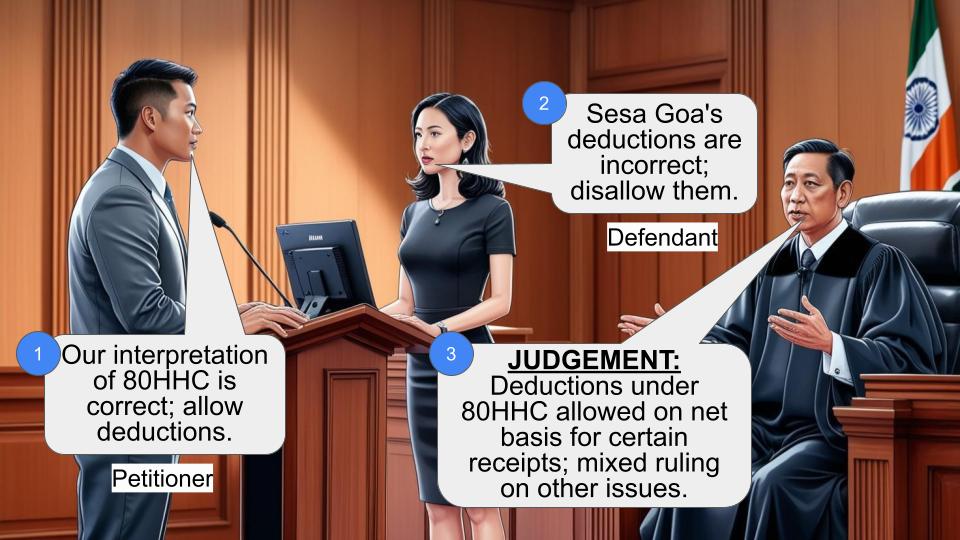
This case involves a dispute between the Commissioner of Income Tax and Hindustan Pipe Udyog Ltd. The main issue was whether deductions under Sections 80 (of Income Tax Act, 1961)-HH and 80-I of the Income Tax Act should be calculated independently on the gross total income. The court ruled in favor of the assessee (Hindustan Pipe Udyog Ltd), allowing deductions under both sections to be calculated on the gross total income independently.
Case Name**: COMMISSIONER OF INCOME TAX VS HINDUSTAN PIPE UDYOG LTD.
**Key Takeaways**:
1. Sections 80-HH and 80-I of the Income Tax Act are independent of each other.
2. Deductions under both sections can be claimed on the gross total income.
3. The court's decision aligns with previous judgments from various High Courts and the Supreme Court.
4. The ruling provides clarity on tax deductions for industrial units.
**Issue**:
The central legal question was whether deductions under Sections 80 (of Income Tax Act, 1961)-HH and 80-I of the Income Tax Act should be calculated independently on the gross total income, or if the deduction under Section 80-I (of Income Tax Act, 1961) should be calculated on the income reduced by the amount allowed under Section 80-HH (of Income Tax Act, 1961).
**Facts**:
Hindustan Pipe Udyog Ltd is engaged in manufacturing steel pipes, synthetic filament yarn, and polyester clips. The company claimed deductions under both Sections 80-HH and 80-I of the Income Tax Act. The Income Tax Department disputed this, arguing that the deduction under Section 80-I (of Income Tax Act, 1961) should be calculated on the income reduced by the amount allowed under Section 80-HH (of Income Tax Act, 1961).
**Arguments**:
- The Revenue (Income Tax Department) argued that the deduction under Section 80-I (of Income Tax Act, 1961) should be calculated on the income reduced by the amount allowed under Section 80-HH (of Income Tax Act, 1961).
- The assessee (Hindustan Pipe Udyog Ltd) contended that both sections are independent and deductions should be allowed on the gross total income under both sections.
**Key Legal Precedents**:
1. J.P. Tobacco Products P. Ltd v CIT (1998) 229 ITR 123: The Madhya Pradesh High Court held that Sections 80-HH and 80-I are independent, and deductions could be claimed under both sections on the gross total income.
2. Commissioner of Income Tax v Lucky Laboratories Ltd (2006) 284 ITR 435 (All): The Allahabad High Court's decision was in conformity with views of other High Courts.
3. Joint Commissioner of Income-Tax v Mandideep Engg. and Pkg. Ind. P. Ltd (2007) 292 ITR 1 (SC): The Supreme Court affirmed the view that both sections are independent.
**Judgment**:
The court ruled in favor of the assessee, Hindustan Pipe Udyog Ltd. It held that:
1. The benefit of Section 80-I (of Income Tax Act, 1961) has to be granted on the gross total income and not on the income reduced by the amount allowed under Section 80-HH (of Income Tax Act, 1961).
2. Both Sections 80-HH and 80-I are independent of each other.
3. The court's decision aligns with previous judgments from various High Courts and the Supreme Court.
4. The Income Tax Department's appeal was dismissed.
**FAQs**:
1. Q: What are Sections 80-HH and 80-I of the Income Tax Act?
A: These sections provide tax deductions for industrial undertakings in backward areas (80-HH) and for newly established industrial undertakings (80-I).
2. Q: Why is this judgment significant?
A: It clarifies that companies can claim deductions under both sections independently on their gross total income, potentially leading to higher tax benefits.
3. Q: Does this judgment apply to all companies?
A: While it sets a precedent, it's best to consult with a tax professional for specific cases, as individual circumstances may vary.
4. Q: Why did the court side with the assessee?
A: The court followed established precedents from various High Courts and the Supreme Court, which had consistently ruled in favor of independent deductions.
5. Q: Can the Income Tax Department appeal this decision further?
A: Given that the Supreme Court has already affirmed this interpretation in previous cases, further appeals seem unlikely to succeed.

1. We have heard Sri Dhananjai Awasthi for the appellant-department. Shri Bhoopesh Jain and Sri R.S. Agarwal appears for the respondent-assessee.
2. This appeal was admitted on the following questions of law:-
"(1) Whether on the facts and in the circumstances of the case, the Tribunal was justified in holding that for purposes of computing relief u/s 80 (of Income Tax Act, 1961) I, relief granted u/s 80 (of Income Tax Act, 1961) HH cannot be deducted from the gross total income?
(2) Whether on facts and in the circumstances of the case, the ld. ITAT was legally justified in directing the A.O to recompute the allowable deduction in view of the decision of the Hon'ble High Court of M.P. in the case of J.P. Tobacco Products (P) Ltd Vs. C.I.T. reported in ITR 140 CTR 329 whereas provisions of sub-section (9) of Section 80 (of Income Tax Act, 1961) HH provide that where the assessee is entitled for deduction both u/s 80 (of Income Tax Act, 1961) HH and 80 I/80 J, the effect first is to be given to Section 80 (of Income Tax Act, 1961) HH of I.T. Act?
(3) Whether on the facts and in the circumstances of the case, the Ld. ITAT was legally justified in holding that the change in method of charging depreciation from straight line to WDV method is approved under the Company Act and there is no specific prohibition u/s 115 (of Income Tax Act, 1961) J of I.T. Act whereas the assessee has arbitrarily short computed its tax liability under Section 115 (of Income Tax Act, 1961) J and depreciation charged to books was considerably swelled by adopting methods not permissible under relevant provisions of I.T. Act, 1961?"
3. The facts, giving rise to this appeal, as given in the assessment order,are as follows:-
"The assessee is engaged in manufacture of Steel Pipes Synthetic Filament Yarn and Polyster Clips. During the year under consideration total sales have been shown at Rs.109.1 crores as against Rs.39.67 crores of last year giving g.p. rates of Steel Unit and PPFY Unit at 10.56 % and 20.12 % respectively whereas last year's rates were 14.06 % and 13.64 %. The consolidated g.p. rate comes to 15.34 % as against 13.91 % of last year. Though there is fall in g.p rate in Steel Unit by 0.5 % the consolidated g.p. rate has increased by 1.43 % owing mainly to a substantial increase in the g.p rate of PPFY Unit.
During the year under consideration the assessee has also set up a new W.D.S. unit for manufacturing of Polyster Clips. Gross profit from this new unit has been shown at Rs.12.20 lacs giving g.p. rate at 3.94 %."
4. On the question of allowing deduction under Section 80-I (of Income Tax Act, 1961) and 80-HH, the Income Tax Appellate Tribunal held in para 3 as follows:-
"3. The next ground is in regard to deduction u/s 80-I (of Income Tax Act, 1961) and 80-HH. The assessee raised the ground that the CIT (A) was wrong in law in building what relief u/s 80-I (of Income Tax Act, 1961) is to be allowed only with reference to the remaining eligible profit after relief u/s 80-HH (of Income Tax Act, 1961) has already been allowed. In this regard,both the parties are agreed that the issue is now squarely covered by decision of the Hon'ble High Court of Madhya Pradesh in the case of J.P. Tobacco Products P Ltd Vs. C.I.T (1997) 140 CTR 329. In that case, it was held that the provision of law is clear that in so far as benefit of section 80 (of Income Tax Act, 1961) I is concerned, it has to be granted on the gross total income and not on the income reduced by the amount allowed u/s 80 (of Income Tax Act, 1961) HH. It was, therefore, held that for purposes of computing relief u/s 80 (of Income Tax Act, 1961) I, relief granted u/s 80 (of Income Tax Act, 1961) HH cannot be deducted from the gross total income. Respectfully, following the above decision, we direct the A.O. to recompute the allowable deduction on the above basis."
5. We find that the question Nos. (1) and (2) are covered by decision of this Court in Commissioner of Income Tax Vs. Lucky Laboratories Ltd [(2006) 284 ITR 435 (All). It was rightly pointed out by the learned counsel for the assessee that the view taken by this Court in Lucky Laboratories Ltd (Supra) was in conformity with the views taken by the Bombay High Court,Rajasthan High Court, Gujarat High Court, Madhya Pradesh High Court and Punjab & Haryana High Court, which were affirmed by the Supreme Court in Joint Commissioner of Income-Tax Vs. Mandideep Engg. and Pkg. Ind. P. Ltd [(2007) 292 ITR 1 (S.C.). In the short but conclusive judgment,the Supreme Court has held as follows:-
"The point involved in the present case is whether sections 80 HH and 80-I of the Income-tax Act, 1961, are independent of each other and therefore a new industrial unit can claim deductions under both the sections on the gross total income independently or that deduction under section 80-I (of Income Tax Act, 1961) can be taken on the reduced balance after taking into account the benefit taken under section 80 (of Income Tax Act, 1961) HH.
The Madhya Pradesh High Court in J.P. Tobacco Products P. Ltd v. CIT reported in [1998] 229 ITR 123 took the view that both the sections are independent and, therefore, the deductions could be claimed both under sections 80 (of Income Tax Act, 1961)-HH and 80-I on the gross total income. Against this judgment a special leave petition was filed in this court which was dismissed on the ground of delay on July 21, 2000 (see [2000] 245 ITR (St.) 71). The decision in J.P. Tobacco Products P. Ltd [1998] 229 ITR 123 (MP) was followed by the same High Court in the case of CIT v. Alpine Solvex P. Ltd in I.T.A. No. 92 of 1999 decided on May 2, 2000. Special leave petition against this decision was dismissed by this court on January 12, 2001 (see [2001] 247 ITR (St.)
36). This view has been followed repeatedly by different High Courts in anumber of cases against which no special leave petitions were filed meaning thereby that the Department has accepted the view taken in these judgments.See CIT v. Nima Specific Family Trust reported in [2001] 248 ITR 29 (Bom); CIT v. Chokshi Contacts P. Ltd [2001] 251 ITR 587 (Raj.); CIT Vs. Amod Stamping [2005] 274 ITR 176 (Guj.); CIT Vs. Mittal Appliances P Ltd [2004] 270 ITR 65 (MP); CIT Vs. Rochiram and Sons [2004] 271 ITR 444 (Raj.); CIT Vs. Prakash Chandra Basant Kumar [2005] 276 ITR 664 (MP); CIT v S.B. Oil Industries P Ltd [2005] 274 ITR 495 (P&H); CIT v. SKG Engineering P Ltd [2005] 119 DLT 673 and CIT v Lucky Laboratories Ltd [2006] 200 CTR 305 (All).
Since the special leave petitions filed against the judgment of the Madhya Pradesh High Court have been dismissed and the Department has not filed the special leave petitions against the judgments of different High Courts following the view taken by the Madhya Pradesh High Court, we do not find any merit in this appeal. The Department having accepted the view taken in those judgments cannot be permitted to take a contrary view in the present case involving the same point. Accordingly, the civil appeal is dismissed. No costs."
6. On the third question, regarding change in method of charging depreciation from straight line to written down value method, the question,as rightly pointed out by the learned counsel for the respondent-assessee,is also covered by the decision of the Supreme Court in Apollo Tyres Vs. CIT [255 ITR 273]. In Malayalam Manorama Vs. CIT [300 ITR 251 (SC)],the Supreme Court following the ratio of the judgment in Apollo Tyres (Supra) held as follows:-
"In Apollo Tyres (supra), this Court examined the object of introducing section 115J (of Income Tax Act, 1961) in the 1961 Act. The Court relied on the budget speech of the then Hon'ble Finance Minister of India made in the Parliament while introducing the said section. The relevant portion of the speech is reproduced as under:
"It is only fair and proper that the prosperous should pay at least some tax. The phenomenon of so-called zero-tax highly profitable companies deserves attention. In 1983, a new Section 80-VVA (of Income Tax Act, 1961) was inserted in the Act so that all profitable companies pay some tax. This does not seem to have helped and is being withdrawn. I now propose to introduce a provision whereby every company will have to pay a minimum corporate tax on the profits declared by it in its own accounts. Under this new provision, a company will pay tax on at least 30% of its book profit. In other words, a domestic widely held company will pay tax of at least 15% of its book profit. This measure will yield a revenue gain of approximately Rs.75 crores."
The Court held that the purpose of introducing this section was that the Income Tax Authorities were unable to bring certain companies within the net of income tax because these companies were adjusting their accounts in such a manner as to attract no tax or very little tax. It is with a view to bring such of these companies within the tax net that section 115J (of Income Tax Act, 1961) was introduced in the 1961 Act with a deeming provision which makes the company liable to pay tax on at least 30% of its book profits as shown in its own account. For the said purpose, section 115J (of Income Tax Act, 1961) makes the income reflected in the companies books of accounts as the deemed income for the purpose of assessing the tax. If we examine the said provision in the above background, we notice that the use of the words in accordance with the provisions of Parts II and III of Schedule VI to the Companies Act was made for the limited purpose of empowering the assessing authority to rely upon the authentic statement of accounts of the company. While so looking into the accounts of the company,an Assessing Officer under the Income Tax Act has to accept the authenticity of the accounts with reference to the provisions of the Companies Act which obligates the company to maintain its account in a manner provided by the Companies Act and the same to be scrutinized and certified by statutory auditors and will have to be approved by the company in its general meeting and thereafter to be filed before the Registrar of Companies who has a statutory obligation also to examine and satisfy that the accounts of the company are maintained in accordance with the requirements of the Companies Act. In spite of all these procedures contemplated under the provisions of the Companies Act, the Court observed that it is difficult to accept the argument of the Revenue that it is still open to the Assessing Officer to rescrutinize this account and satisfy himself that these accounts have been maintained in accordance with the provisions of the Companies Act. The Court categorically held that:
"... the Assessing Officer while computing the income under Section 115-J (of Income Tax Act, 1961) has only the power of examining whether the books of account are certified by the authorities under the Companies Act as having been properly maintained in accordance with the Companies Act. The Assessing Officer thereafter has the limited power of making increases and reductions as provided for in the Explanation to the said section. To put it differently, the Assessing Officer does not have the jurisdiction to go behind the net profit shown in the profit and loss account except to the extent provided in the Explanation to Section 115-J (of Income Tax Act, 1961)"
Mr. Vellapally has also drawn our attention to the division bench judgment of the Bombay High Court in Kinetic Motors v. Deputy Commissioner of Income Tax (2003) 262 ITR 33 and submitted that in this case the Bombay High Court relied on the said judgment of Apollo Tyres and held the issue in favour of the assessee. In this case, the Division Bench of the Bombay High Court observed as under:
"The short question that arises for consideration in this tax appeal is whether it is open to the Assessing Officer to make adjustment to the book profits beyond what is authorised by the definition given in Explanation to Section 115J (of Income Tax Act, 1961) of the Income- tax Act, if the accounts are prepared and certified to be in accordance with Parts II and III of Schedule VI to the Companies Act, 1956. In the case of Apollo Tyres Ltd. [2002] 255 JTR 273, the apex court held that while computing the income under Section 115J (of Income Tax Act, 1961), the Assessing Officer has only power to examine whether the books of account were certified by the authorities under the Companies Act as having been properly maintained in accordance with the Companies Act. It is further held that the Assessing Officer thereafter has limited powers of making increases and reductions as provided for in the Explanation to the said section. The apex court further held that the Assessing Officer does not have the jurisdiction to go beyond the net profits shown in the profit and loss account, except to the extent provided in the Explanation to Section 115J (of Income Tax Act, 1961). In the instant case, the accounts maintained by the assessee are certified by the auditors. Under the circumstances, the book adjustment made by the Assessing Officer being contrary to the decision of the apex court, question No. 1 is answered in the negative and in favour of the assessee."
In view of our answer to question No. 1, question No. 2 becomes academic. It is not in dispute that under the Companies Act, 1956, both straight line method and written down value method are recognised. Therefore, once the amount of depreciation actually debited to the profit and loss account is certified by the auditors, then, as per the decision of the apex court in the case of Apollo Tyres Ltd. [2002] 255 ITR 273, question No. 2 has to be answered in the negative and in favour of the assessee."
7. In view of the aforesaid judgments, we find that the questions of law are covered by the judgment of the Supreme Court. All the three questions are thus decided against the revenue and in favour of respondent-assessee.
8. The department will proceed accordingly.
Order Date :- 28.8.2012
×
Similar Ripples
Questions
Court Upholds Dual Tax Deductions for Industrial Units Under Sections 80 (of Income Tax Act, 1961)-HH and 80-I
Write your CommentSimilar Posts


Generic
- Reportdata/5514.pdf
