


Court Upholds Rental Income as "Income from House Property", Not Business Income


Full News

Court Upholds Rental Income as "Income from House Property", Not Business Income
Court Upholds Rental Income as "Income from House Property", Not Business Income
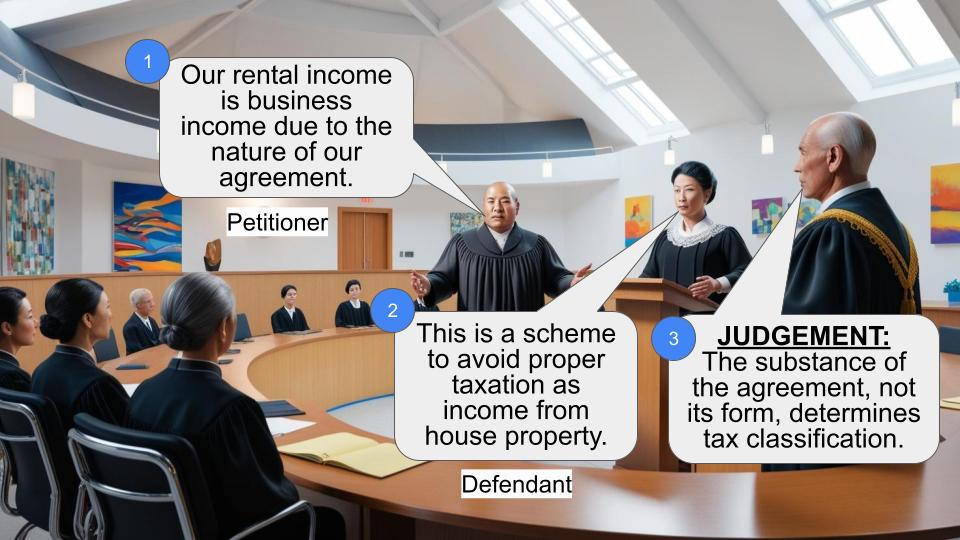
This case involves Keyaram Hotels (P) Ltd. (the assessee) challenging the Income Tax Department's classification of their rental income. The assessee argued that the income from leasing out their property should be considered "Business Income". However, the court upheld the lower authorities' decision to classify it as "Income from House Property" and also confirmed the fair market value determination for capital gains calculation.
Get the full picture - access the original judgement of the court order here
Case Name:
Keyaram Hotels (P) Ltd Vs Assistant Commissioner of Income Tax (High Court of Madras)
T.C.No.1425 of 2007
Date: 29th January 2008
Key Takeaways:
1. Rental income from leasing out property is typically classified as "Income from House Property" unless there's significant business activity involved.
2. The object clause in a company's memorandum of association doesn't automatically determine the nature of its income.
3. Fair market value determinations by lower tax authorities, when based on thorough investigation and evidence, are generally upheld by higher courts.
Issue:
Should the rental income earned by Keyaram Hotels (P) Ltd. from leasing out its property be classified as "Business Income" or "Income from House Property"?
Facts:
1. Keyaram Hotels (P) Ltd. owns a property at No. 2, Harrington Road, Chetpet, Chennai.
2. The company leased out 25,393 sq. ft. of this property to M/s. Shoppers Stop Limited.
3. For the assessment year 2001-2002, the company filed a return showing an income of Rs. 9,92,06,410/-.
4. The Assistant Commissioner of Income Tax computed the total income at Rs. 12,80,59,730/-, including income from house property, long-term capital gains, and income from other sources.
5. The assessee appealed this assessment, arguing that the lease income should be considered "Business Income".
Arguments:
Assessee's Arguments:
1. As per the company's memorandum of association, its main object was to carry on business related to hotels, restaurants, etc.
2. The property was being exploited commercially, so the income should be considered business income.
3. The fair market value for capital gains calculation as of 1.4.1981 should be Rs. 4 lakhs per ground.
Tax Department's Arguments:
1. The rental income was supported by a lease agreement specifying monthly rent.
2. The conditions for income from property under Section 22 (of Income Tax Act, 1961) were met.
3. There was no commercial or business activity carried out by the assessee to earn this income.
Key Legal Precedents:
1. CIT vs. Chennai Properties & Investments Ltd. (2004) 266 ITR 685 (Mad)
2. Sultan Bros. (P) Ltd. vs. CIT (1964) 51 ITR 353 (SC)
3. Universal Plast Limited vs. CIT 237 ITR 454 (SC)
4. East India Housing and Land Development Trust Limited vs. C.I.T. (1961) 42 ITR 49 (SC)
Judgement:
1. The court dismissed the appeal, upholding the classification of the income as "Income from House Property".
2. The court agreed with the lower authorities that there was no significant business activity involved in earning this income.
3. The fair market value determination of Rs. 3,40,000/- per ground as of 1.4.1981 for capital gains calculation was also upheld.
FAQs:
1. Q: Why wasn't the income considered business income despite the company's memorandum of association?
A: The court held that the object clause in a company's memorandum doesn't automatically determine the nature of its income. The actual activity (simple leasing) was considered more important.
2. Q: What factors did the court consider in classifying the income?
A: The court looked at the lack of commercial activity beyond simple leasing, the terms of the lease agreement, and previous legal precedents.
3. Q: Why did the court uphold the fair market value determination?
A: The Commissioner (Appeals) had personally visited the property, considered its location and potential, and based the valuation on evidence provided by the assessee. The court found this thorough approach satisfactory.
4. Q: What impact might this case have on other companies leasing out properties?
A: This case reinforces that simply leasing out a property, even if it's a company's main activity, doesn't automatically make the income "Business Income". Companies need to demonstrate significant commercial activity beyond basic leasing to claim business income treatment.
5. Q: Can the assessee appeal this decision further?
A: The court found no substantial question of law in this case, making further appeal difficult. However, the assessee could potentially approach the Supreme Court if they believe there's a significant legal issue at stake.

The appeal is filed by formulating the following questions of law:
"1. Whether the Appellate Tribunal is correct in law in holding that the income derived by the Appellant from leasing of the 'commercial property' is not business income and has to be assessed as income from property?
2. Whether on the facts and in the circumstances of the case, the Tribunal, having found that the transaction is a business activity was justified in concluding that the income has to be assessed as "income from property"?
3. Whether the Tribunal is correct in law in sustaining the stand of the Respondent on the assessment of lease income under head 'property' even though it was not a case letting 'simpliciter' and on the contrary letting with amenities and services, warranting computation under the head 'business' granting deduction of expenses incurred?
4. Whether the Tribunal is correct in law in sustaining the stand of the Respondent on the assessment of lease income under head 'property' even though the facts and circumstances warrant assessment under head 'other sources' alternatively upon taking into consideration the expenses incurred in relation thereto?
5. Whether the Tribunal is correct in law in sustaining the fair market value as on 1-4-1981 at RS.3,43,485/- per ground in the computation of long term capital gains determined by the Lower Authorities as against RS.4 Lakhs on the facts and in the circumstances of the case?
2. For the assessment year 2001-2002, the appellant company has filed its return of income on 30.10.2001 showing an income of Rs.9,92,06,410/-. In the scrutiny assessment, the Assistant Commissioner of Income-tax, Company Circle II(4), Chennai had computed income from house property at Rs.38,46,982/-, long term capital gains at Rs.12,03,90,674/- and income from other sources at Rs.38,22,070/-. The total income computed in the said order of assessment was Rs.12,80,59,730/-. According to the assessee company, the lease income derived from M/s.Shoppers Stop Limited by leasing out the property of the assessee should be assessed under the head of "Business Income". The assessing officer computed the said lease income under the head of income from house property after verifying the lease deeds entered into by the assessees with the lessees. As regards the computation of long term capital gains, the assessing officer had re-worked the taxable capital gains at Rs.12,03,90,674/- as against the admitted amount of Rs.9,88,63,664/- by adopting the fair market value of the land as on 1.4.1981.
3. Aggrieved by that order, the assessee carried the matter on appeal to the Commissioner of Income-tax (Appeals), Chennai, who in respect of the the first issue confirmed the order of the assessing officer but in respect of the second issue granted partial relief. The second appeal filed before the Tribunal also has not yielded any result in favour of the appellant/assessee. Hence, the present appeal.
4. We heard the argument of the learned counsel for the appellant, who assailed the order of the Tribunal contending inter alia that as per the memorandum of association, the main object of the assessee was to carry on business of hotel, restaurant, roadhouse, motel, cafe, tavem, beer house, refreshment, etc., as such the property has been exploited commercially and the income earned from the exploitation of commercial property has to be regarded as business income. In respect of the valuation of the capital gain, the learned counsel appearing for the assessee has reiterated what was stated before the authorities to the effect that the fair market value to be adopted as on 1.4.1981 should be Rs.4 lakhs per ground.
5. From the materials on record, it is clear that the assessee company is the owner of the property at No.2, Harrington Road, Chetpet, Chennai. The assessee had let out the premises in an extent of 25393 sq.ft., upon entering into an agreement and received the income.
6. Before the authorities under the Act as well as the Tribunal, the assessee has not placed any materials to support its case that the property from which income has been derived was used as business property and the exploitation of the property was the nature of the business of the assessee company.
7. The assessing officer has recorded a factual finding to the effect that the rental income from M/S.Shopper's shop Limited was supported by supplementary agreement of lease executed on 25.7.2000 which was operative from 15.7.2000. The lease agreement executed on 25.7.2000 clearly specified that the rent payable for the premises let out to Shoppers Stop was Rs.3,58,020/- and Rs.2,79,059 per month for ground and first floors respectively. The conditions for chargeability of property income as provided under the provisions of Section 22 of the Income Tax Act, 1961 were all available in this case i.e., the assessee was the owner of the property and has not been used by him for the purpose of his business. Thus the income was chargeable as income from property and not as business income.
8. On appeal, the Commissioner after hearing the argument and perusal of the material on record, has recorded a finding that the income was generated out of exploitation of the property by letting out the same to M/s.Shoppers Stop. There was no commercial activity or business activity carried out by the appellant to earn such income. Some additional facilities extended to the tenant might be useful to the tenant to exploit the property commercially. This finding of fact has been confirmed by the Tribunal. The Tribunal followed the decision of this Court in CIT VS. Chennai Properties AND INVESTMENT LIMITED reported in 266 ITR 685.
9. The well established and recognised principle of law is that no precise test can be laid down to ascertain whether income (referred to by what ever nomenclature, lease amount, rent or licence fee) received by an assessee from leasing or letting out the assets would fall under the head of "Profits and gains of business or profession". It is a mixed question of law and fact and has to be determined from the point of view of a businessman in that business on the facts and in the circumstances of each case including true interpretation of the agreement under which the assets are let out. (See UNIVERSAL PLAST LIMITED VS. CIT 237 ITR 454 (SC).
10. In this case, the assessee earned income out of exploitation of the property by letting it out to M/s.Shoppers Stop. There is neither commercial activity nor business activity carried out by the assessee to earn such income. The object clause contained in the memorandum of Association of the assessee company would not alter the nature of activity of the assessee company. The income earned cannot be under the head of "business income". The agreement did not even suggest that the letting out of the property by the assessee is in the nature of business activity.
11. A constitution Bench of the Supreme Court in the case of SULTAN BROTHERS PRIVATE LIMITED VS. C.I.T. (1964) 51 ITR 353 while approving the decision rendered by three Judges Bench in the case of EAST INDIA HOUSING AND LAND DEVELOOPMENT TRUST LIMITED VS. C.I.T. (1961) 42 ITR 49 (SC) has held that though the object of the assessee company no doubt was to acquire land and building and turn the same into account by construction, reconstruction and leasing and selling the same assuming to be a business activity would not by itself turn the lease into business deal. After taking note of the aforesaid judgment of the Supreme Court, the Division Bench of this Court reported in Chenai Properties case 266 ITR 685 in which one of us (K.Raviraja Pandian,J.) was a party, has also held to the same effect.
12. On the facts of the case, it is clear that the assessee company was only exploiting the property as owner by leasing out the same and realised income by way of rent. Such rental income is liable to be assessed as income from house property.
13. In respect of the capital gain, the assessee has entered into an agreement with the builder M/s.Heeral Constructions Private Limited and as per the developer's agreement dated 6.1.2000, 39 percent of land area has been transferred for construction of 78295 sq.ft., of built up area. Out of 78295 sq.ft., of built up area, the assessee has sold 52902 sq.ft., along with undivided shares to M/s.SSI Technologies Limited and the balance 25393 sq.ft. has been retained by the assessee. The assessing officer after taking note of the sale consideration, purchase cost, cost of investments, development cost and selling expenses, has determined the long term capital gain. Before the first appellate authority, the assessee filed documents in document No.1966/1982. The first appellate authority took the pain of visiting the properties in order to consider the aspect of location and its potentiality. The Commissioner (Appeals) after considering that the property taken up for comparison by the assessing officer had certain disadvantages, found that the property under consideration was almost at the cross road of Chetpet over bridge and was in the prime commercial locality. The commercial potentiality of the property has also been taken note of by the Commissioner (Appeals) and having given due regard to all the factors, the fair market value of the property of the appellant was fixed at Rs.3,40,000/- per ground. Thus, the value of the property has been determined on the basis of the evidence adduced i.e., the documents produced by the assessee pertaining to the year 1982 and this amount has been fixed after taking stock of the factual situation of the locality by a personal visit. Hence, we are of the considered view that the fair market price fixed by the Commissioner, which has been affirmed by the appellate authority requires no re-consideration in this appeal, which is factual in nature.
14. For the above said reasons, we find no question of law, much less a substantial question of law so as to entertain this appeal. The appeal is dismissed.
×
Similar Ripples
Questions
Court Upholds Rental Income as "Income from House Property", Not Business Income
Write your CommentSimilar Posts


Generic
- Reportdata/4939.pdf
