


Court Upholds Repair Expenses as Revenue, Not Capital Expenditure



Full News
Court Upholds Repair Expenses as Revenue, Not Capital Expenditure
Court Upholds Repair Expenses as Revenue, Not Capital Expenditure
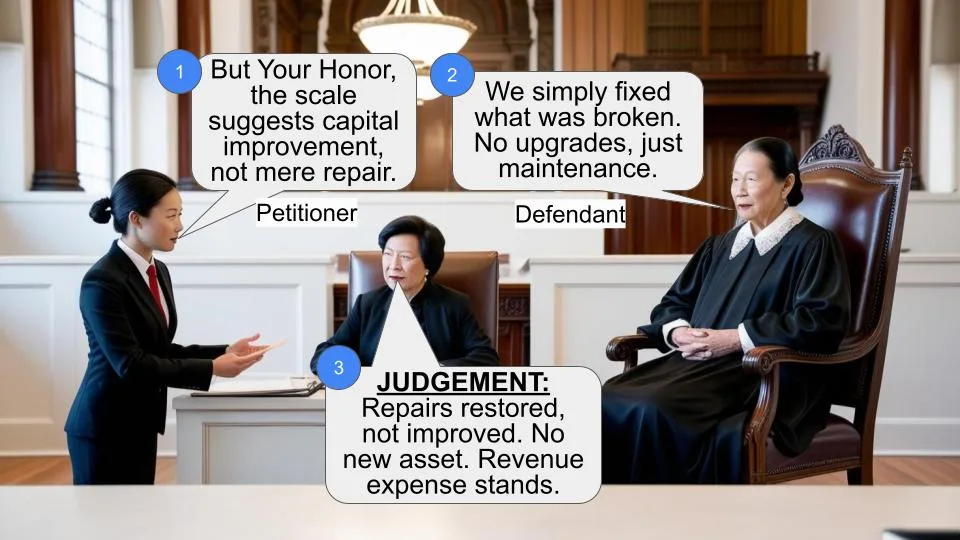
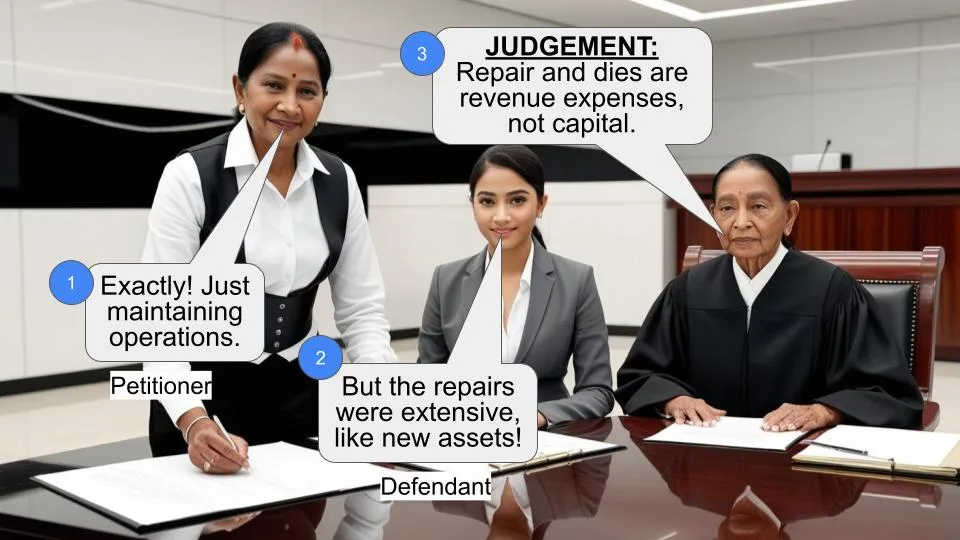
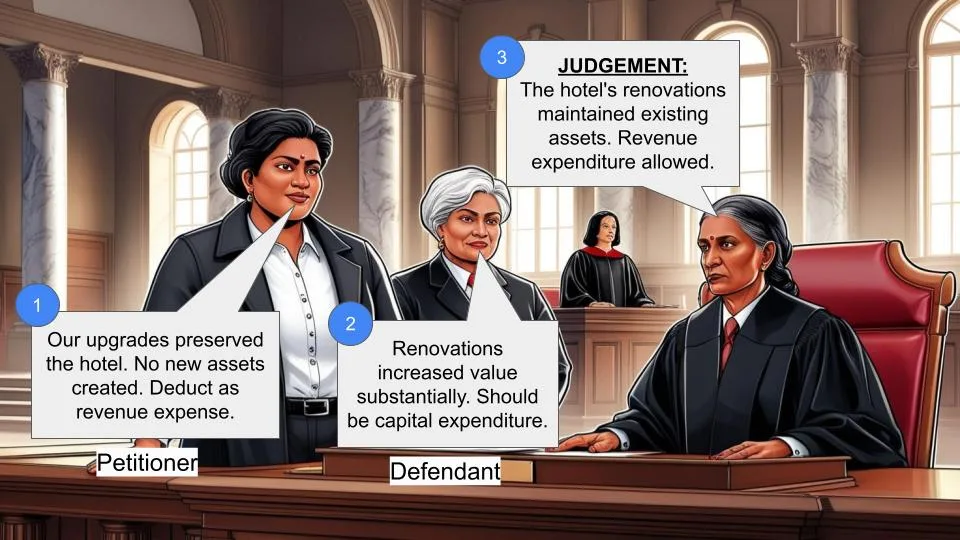
This case involves the Commissioner of Income Tax (the Revenue) appealing against TS TECH SUN INDIA LTD (the assessee) regarding the classification of repair and maintenance expenses. The Revenue claimed these expenses were capital in nature, while the assessee argued they were revenue expenses. The court ultimately sided with the assessee, dismissing the Revenue's appeal.
Case Name**: Commissioner of Income Tax VS TS TECH SUN INDIA LTD
**Key Takeaways**:
1. Expenditure on repairs and maintenance cannot be disallowed as capital expenditure when no new asset or enduring advantage is obtained.
2. Unimpeached findings of fact by lower authorities do not give rise to substantial questions of law in higher courts.
3. Restoration of existing assets to their original condition is generally considered revenue expenditure.
**Issue**:
Can expenditure incurred on repairs and maintenance be disallowed as capital expenditure when no new asset or enduring advantage was obtained by the assessee?
**Facts**:
1. TS TECH SUN INDIA LTD, a public limited company, manufactures automobile parts.
2. For the assessment year 2006-07, the company claimed repairs and maintenance expenditure of Rs. 58.57 lakhs.
3. The expenses were incurred on three dates:
- 28.02.2006: Rs. 48.05 lakhs
- 16.03.2006: Rs. 5.94 lakhs
- 16.03.2006: Rs. 4.58 lakhs
4. The factory building was constructed in 1997, and the floor and roof had deteriorated over 10 years of use.
5. The company repaired the damaged floor, leaking roof, and replaced old steel glazing structures.
**Arguments**:
Assessee's arguments:
1. The expenditure merely restored the factory building to its original condition.
2. No new asset or enduring advantage was created.
3. The repairs were necessary for safety and proper functioning of the factory.
Revenue's arguments:
1. The expenditure brought into existence new floor and roof, resulting in a capital advantage.
2. The entire expenditure should be treated as capital in nature.
**Key Legal Precedents**:
The judgment doesn't explicitly mention any specific legal precedents. However, it refers to the "well settled position that unimpeached findings of facts do not give rise to any substantial question of law."
**Judgement**:
1. The court dismissed the Revenue's appeal.
2. It upheld the Tribunal's finding that no new asset or enduring advantage was obtained by the assessee.
3. The court noted that no extra capacity or space was created in the factory by repairing the roof and floor.
4. The findings of fact by lower authorities were not challenged or shown to be perverse, and thus didn't give rise to any substantial question of law.
**FAQs**:
1. Q: What distinguishes revenue expenditure from capital expenditure?
A: Generally, revenue expenditure is for day-to-day operations or maintenance, while capital expenditure creates new assets or provides long-term benefits.
2. Q: Why did the court side with the assessee in this case?
A: The court agreed with the lower authorities' findings that the repairs merely restored existing assets to their original condition and didn't create any new assets or advantages.
3. Q: What impact does this judgment have on similar cases?
A: It reinforces the principle that expenditure on repairs and maintenance, which doesn't create new assets or enduring advantages, should typically be treated as revenue expenditure.
4. Q: Can the Revenue appeal this decision further?
A: The judgment doesn't mention further appeal options, but generally, decisions of High Courts can be appealed to the Supreme Court if there's a substantial question of law.
5. Q: How important were the factual findings of the lower authorities in this case?
A: They were crucial. The High Court emphasized that unimpeached findings of fact by lower authorities don't give rise to substantial questions of law, which was a key reason for dismissing the appeal.

1. This appeal by the Revenue is directed against the order of the Tribunal dated 28.10.2011 by which the Tribunal confirmed the order of the CIT(Appeals) deleting the disallowance of Rs.52,71,300/- made by the Assessing Officer on the ground that the repair and maintenance expenses claimed to the above extent were capital in nature.
2. The assessee is a public limited company engaged in the manufacture, assembly and selling of automobile parts. In respect of the assessment year 2006-07 the assessee claimed repairs and maintenance expenditure to the extent of Rs.58.57 lakhs. The expenses were incurred on the repairs and maintenance of a building and they were incurred on three different dates as follows :
“Date Amounts (Rs. In lakh)
28.02.2006 48.05
16.03.2006 05.94
16.03.2006 04.58
Total 58.57”
In the course of the assessment proceedings, the explanation of the assessee regarding the justification for the above expenditure was sought by the Assessing Officer. The assessee submitted a detailed written explanation vide letters dated 30.11.2009 and 7.12.2009 which are reproduced in the assessment order. The gist of the explanation was that the factory building was constructed in the year 1997, that the floor was badly damaged due to installation and continuous working and movement of heavy machines, that the asbestos roof of the factory had gone into disrepair and was badly damaged over a period of 10 years resulting in leakage of rain water, that the roof was in a precarious condition and posed safety hazard and therefore, the assessee had to incur expenses of Rs.48.05 lakhs on the building. It was submitted that the expenditure merely restored the factory building to its original shape and condition and that there was no addition thereto resulting in any capital advantage. As regards the expenses of Rs.5.94 lakhs incurred on 16.3.2006, it was submitted that it represented expenditure on replacement of the old steel glazing structure fixed along with the asbestos shields to ensure proper lighting of the factory, that the old glass sheet was replaced along with metal beading, that proper lighting of the factory was an essential requirement, that in order to enable the aforesaid repair the existing machinery and equipment including the pipe fittings had to be removed and be reinstalled after the work was done and the expenditure of Rs.4.58 lakhs was incurred only on such dismantling and re-fixing of the equipment which did not result in any material or enduring benefit nor did the expenditure bring into existence any asset. It was also represented that neither the floor of the factory nor the roof had been replaced in the last 10 years. In sum and substance the claim was that the expenditure merely restored the building to the original shape and condition.
3. The Assessing Officer did not accept the claim. According to him the expenditure brought into existence new floor and roof, which resulted in a capital advantage or enduring benefit. He therefore, treated the entire expenditure of Rs.58.57 lakhs as capital in nature. He allowed 10% depreciation amounting to Rs.5,85,700/- and the balance of Rs.52,71,300/- was disallowed.
4. On appeal the CIT(Appeals) examined the matter in great detail and eventually held that the expenditure was in the nature of repairs incurred in order to preserve and maintain the existing asset namely, the factory building and therefore was allowable as revenue expenditure.
5. Aggrieved, the revenue filed an appeal before the Tribunal. The Tribunal after examining the facts in detail noted that no new asset or extra space was created by incurring the expenditure. It noted that the purpose of the roof is to protect the plant and machinery, the workers and the products from weather conditions and replacement of or the repairs to the roof or adding a glass sheet to ensure proper lighting will not in any way increase the capacity of the factory, even admitting that the asbestos roof was replaced by shield glass sheets. The Tribunal further found that the floor of the factory was redone due to constant damage for the past 10 years. The roof and the floor were integral parts of the factory and they were merely restored to their original condition and strengthened by incurring the expenditure. The Tribunal recorded a finding that no extra space or extra capacity was obtained by incurring the expenditure. In this view of the matter it affirmed the decision of the CIT(Appeals) and dismissed the appeal filed by the revenue.
6. The narration of the facts and the findings recorded by the income tax authorities and the Tribunal as above would clearly show that it has been factually found by the Tribunal that no new asset or enduring advantage was obtained by the assessee by incurring the expenditure. No extra capacity or space was created in the factory by repairing the roof and the floor. These are findings of fact recorded on the basis of the material on record and those findings have not been challenged or shown to be perverse or based on no material. Having regard to the well settled position that unimpeached findings of facts do not give rise to any substantial question of law, we find no merit in the appeal filed by the revenue which is dismissed with no order as to costs.
R.V.EASWAR, J.
S. RAVINDRA BHAT, J.
JULY 03, 2012
×
Similar Ripples
Questions
Court Upholds Repair Expenses as Revenue, Not Capital Expenditure
Write your CommentSimilar Posts
Generic
- Reportdata/5727.pdf
