


Court Upholds Tax Deductions Despite Technical Form Omission



Full News
Court Upholds Tax Deductions Despite Technical Form Omission
Court Upholds Tax Deductions Despite Technical Form Omission
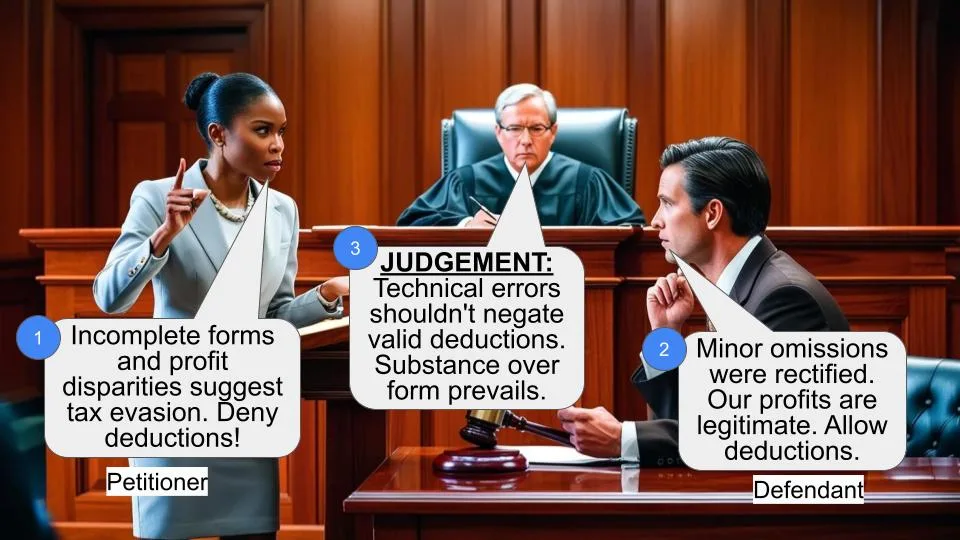
This case involves the Commissioner of Income Tax (Revenue) appealing against Borkar Packaging Private Limited (Assessee) regarding the allowance of tax deductions under Sections 80IB (of Income Tax Act, 1961) and 80IC (of Income Tax Act, 1961). The court ultimately ruled in favor of the Assessee, upholding the decisions of the Commissioner (Appeals) and the Income Tax Appellate Tribunal (ITAT) to allow the deductions.
Get the full picture - access the original judgement of the court order here
Case Name:
Commissioner of Income Tax vs. Borkar Packaging Private Limited (High Court of Bombay)
Tax Appeals No.62 of 2014 & 13 of 2015
Date: 29th September 2020
Key Takeaways:
1. Mere technical omissions in tax forms do not necessarily merit disallowance of deductions.
2. Authorities should provide opportunities to rectify minor errors in tax forms.
3. Multiple factors, not just electricity consumption, should be considered when assessing production and profit disparities between different units of a company.
4. Concurrent findings by lower appellate authorities carry significant weight in higher courts.
Issue:
Should tax deductions under Sections 80IB (of Income Tax Act, 1961) and 80IC (of Income Tax Act, 1961) be disallowed due to incomplete information in Form 10CCB and alleged disparity in electricity consumption versus sales figures?
Facts:
1. Borkar Packaging Private Limited claimed deductions under Sections 80IB (of Income Tax Act, 1961) and 80IC (of Income Tax Act, 1961) for the Assessment Year 2006-07.
2. The Assessing Officer (AO) denied deductions under Section 80IB (of Income Tax Act, 1961) because Form 10CCB lacked details about the number of workers in each unit.
3. The AO also denied deductions under Section 80IC (of Income Tax Act, 1961) for the Nalagarh Unit, citing disparity between electricity consumption and sales compared to other units.
4. The Commissioner (Appeals) and ITAT allowed the deductions, overturning the AO's decision.
5. The Revenue appealed to the High Court against these decisions.
Arguments:
Revenue's Arguments:
1. The Assessee failed to properly fill Form 10CCB, omitting crucial information.
2. There was a significant disparity between electricity consumption and sales in the Nalagarh Unit compared to other units, suggesting inflated profits.
Assessee's Arguments:
1. The omission in Form 10CCB was a minor, rectifiable error.
2. The Assessee provided evidence of employing more than 10 workers in each unit before the assessment.
3. The disparity in electricity consumption and sales was due to various factors, including newer machinery, different technologies, and varying product requirements.
Key Legal Precedents:
1. Hindustan Steel Limited vs. State of Orissa (83 ITR 26 SC): The Supreme Court held that mere furnishing of deduction form 10CCB could, at most, be a default of technical and venial nature, not meriting disallowance of deduction.
Judgement:
The High Court ruled in favor of the Assessee, upholding the decisions of the Commissioner (Appeals) and ITAT. Key points of the judgment include:
1. The omission in Form 10CCB was not fatal to the claim for deduction under Section 80IB (of Income Tax Act, 1961). The AO should have provided an opportunity to rectify the error.
2. The Assessee provided evidence of employing more than 10 workers in each unit, fulfilling the conditions for claiming deduction under Section 80IB (of Income Tax Act, 1961).
3. Regarding Section 80IC (of Income Tax Act, 1961), the court agreed with the lower authorities that multiple factors contribute to increased profits, and focusing solely on electricity consumption was not sufficient to deny the deduction.
4. The court found no perversity in the appreciation of evidence by the Commissioner (Appeals) and ITAT, and their concurrent findings were upheld.
FAQs:
1. Q: What was the main reason for the AO denying deductions under Section 80IB (of Income Tax Act, 1961)?
A: The AO denied deductions because the Assessee failed to provide details of the number of workmen in each unit in Form 10CCB.
2. Q: Why did the court consider the omission in Form 10CCB as not fatal to the deduction claim?
A: The court viewed it as a minor, rectifiable error and cited the Supreme Court's decision in Hindustan Steel Limited vs. State of Orissa, which held that such omissions are of a technical and venial nature.
3. Q: What factors did the Assessee cite to explain the disparity in electricity consumption and sales between units?
A: The Assessee cited factors such as the age of machinery, different technologies, varying product requirements, and the tax-exempt status of the Nalagarh Unit.
4. Q: How did the court view the concurrent findings of the Commissioner (Appeals) and ITAT?
A: The court gave significant weight to these concurrent findings, stating that there was no perversity in their appreciation of evidence.
5. Q: What is the key lesson for taxpayers from this judgment?
A: While it's important to fill forms correctly, minor omissions may not necessarily lead to disallowance of deductions if the substantive conditions for claiming the deduction are met.

Heard Ms. Linhares, the learned Standing Counsel for the Revenue and Mr. S.R. Rivonkar, the learned Senior Advocate for the Assessee.
2. In so far as Tax Appeal 13/2015 is concerned, the Appeal Memo makes reference to Assessment Year 2006-07. In fact, Tax Appeal No.62/2014 pertains to the Assessment Year 2006-07. Even the Memo of Appeal in Tax Appeal No.13/2015 is identical to the Memo of Appeal in Tax Appeal No.62/2014.
3. Ms. Linhares, however, pointed out that there may be a mistake in stating the correct assessment year in the Memo of Appeal in Tax Appeal No.13/2015. She submits that the relevant assessment year, in so far as the said appeal, would be 2007-08. She, therefore, orally applied for leave to amend the Memo of Appeal.
4. We were inclined to grant the leave to amend the Memo of Appeal and we even indicated as such. However, later on Mr. S. R. Rivankar, the learned Senior Advocate appearing for the Respondent pointed out that vide Judgment and Order dated 13th January, 2015, this Court disposed of Tax Appeal No.64/2014 which pertained to the Assessment Year 2007-08.
5. Upon the aforesaid being pointed out, Ms. Linhares did not press for leave to amend the Memo of Appeal in Tax Appeal No.13/2015. It appears that by mistake two appeals have been filed in respect of Assessment Year 2006-07. Since, we propose to consider Tax Appeal No.62/2014, which was instituted prior in point of time, it is not necessary to consider Tax Appeal No. 13/2015. Tax Appeal No.13/2015 is, accordingly, disposed of as infructuous or, in any case, on the ground that the same was filed inadvertently and, therefore, requires no consideration.
6. We now proceed to consider Tax Appeal No.62/2014 which pertains to the Assessment Year 2006-07.
7. Tax Appeal No.62/2014 was admitted by order dated 1st October, 2014 on the following substantial questions of law :
(A) Whether on the facts and in the circumstances of the case, the Income Tax Appellate Tribunal, is right in allowing deduction under Section 80IB (of Income Tax Act, 1961) and under Section 80IC (of Income Tax Act, 1961) ignoring the fact that the assessee has not furnished properly filled Form No.10CCB report. The statute requires such obligation and it is seen from the 10CCB report that such obligation has not been properly complied with.
(B) Whether on the facts and in the circumstances of the case, the Income Tax Appellate Tribunal, is right in allowing deduction under Section 80IC (of Income Tax Act, 1961) amounting to Rs.2,95,50,892/- ignoring the fact that the Assessing Officer has disallowed deduction under Section 80IC (of Income Tax Act, 1961), for Nalagarh Unit on basis of alleged disparity in ratio between consumption of electricity and sales in different assessment years in appellant different Unit ?
(C) Whether on the facts and in the circumstances of the case, the Income Tax Appellate Tribunal, is right in admitting the new evidences such as details of expenditures incurred by the assessee along with the copy of accounts and necessary evidences in the shape of the bills, vouchers and other documents which were not produced earlier before the AO without giving any opportunity to the AO ?
8. Tax Appeal No.13/2015 was admitted by order dated 9th April, 2015 on the same substantial questions of law.
9. Accordingly, the learned Counsel for the parties agree that both these Appeals can be disposed of by a common Judgment and Order.
10. In this case, the Assessing Officer, in respect of both the assessment years, declined the Assessee deduction under Section 80IB (of Income Tax Act, 1961), mainly on the ground that the Assessee had not properly filled in Form 10CCB. This form, inter alia, relates to the details of number of workers working in various units of the Assessee.
11. The AO disallowed the Assessee deduction under Section 80IC (of Income Tax Act, 1961) by reasoning that there was a serious disparity in the rate of consumption of electricity and the sales as between Nalagarh Unit of the Assessee and the other Units of the Assessee at Daman and Goa.
12. The Assessee appealed to the Commissioner of Income Tax (Appeals) and such appeals were allowed and deductions under Section 80IB (of Income Tax Act, 1961) and Section 80IC (of Income Tax Act, 1961) were directed to be granted to the Assessee.
13. The Revenue then appealed to the Income Tax Appellate Tribunal (ITAT) and by the impugned orders, the ITAT dismissed the appeals. Hence, these Appeals which came to be admitted on the aforesaid substantial questions of law.
14. At the outset, we note that nothing was pointed out to us to suggest that the ITAT in these matters admitted any new evidences. In the absence of the ITAT admitting any new evidences, the substantial question of law 'C', as framed, really will not even arise.
15. In so far as the substantial question of law 'A' is concerned, the only reason why the AO denied the Assessee deduction under Section 80IB (of Income Tax Act, 1961) was, because, the Assessee in Form No.10CCB failed to provide the details of number of workmen working in each of the Units of the Assessee. Now, although it is true that there was this omission on the part of the Assessee whilst filling in the Form 10CCB, it is not as if this omission was not rectifiable. In fact, the AO should have granted the Assessee an opportunity for rectifying this omission.
16. Ultimately, the Assessee even prior to the assessment, produced material before the AO, which evidences that each of the Units of the Assessee employed more than 10 workers. This means that there was material before the AO to conclude that the Assessee fulfilled the conditions required for claiming deduction under Section 80IB (of Income Tax Act, 1961). In these circumstances, both, the Commissioner (Appeals), as well as the ITAT, were quite justified in directing grant of deduction under Section 80IB (of Income Tax Act, 1961) to the Assessee.
17. In the case of Hindustan Steel Limited vs. State of Orissa the Hon'ble Supreme Court has held that mere furnishing of deduction form 10CCB could, at the most, be a default of technical and venial nature. Such omission cannot be held to be so fatal as to merit the penalty of disallowance of deduction under consideration. The view taken by the Commissioner (Appeals) and the ITAT is in consonance with the law laid down by the Hon'ble Apex Court in Hindustan Steel Limited (supra). Accordingly, the substantial question of law 'A' is required to be decided against the Revenue and in favour of the Assessee.
18. In so far as substantial question 'B' is concerned, the AO has compared the consumption of electricity in various Units of the Assessee and on such basis, concluded that the profits in respect of the newly established Unit at Nalagarh appeared to be unreasonably high. The AO has held that the profits are not matching with the consumption of the electricity at the said Unit. On this basis, the AO denied the Assessee deduction under Section 80IC (of Income Tax Act, 1961).
19. The record indicates that the Assessee, in this case, had offered detailed explanation as to why the production and consequently profits at the Nalagarh Unit is higher than the production and profits at the Units in Goa and Daman. The explanation is summarized in paragraph 6.2 of the AO's order, which reads as follows :
“6.2 The reasons for such peak performance in one unit selectivey were brought to the notice of the assessee's representative. The assessee in its letter dated 09-11-2011 has submitted that the comparison of the sales of Nalagarh Unit with the sales of the other units with regard to electricity expenses is for the following reasons:
a) The machineries at Goa Units are 20 years old whereas the machineries at Daman are 10 years old, and machineries at Nalagarh Unit are less than 1 year old.
b)) The Goa Unit is manufacturing only two colour printing, whereas the Daman Unit is manufacturing six colour printing and Nalagarh Unit is manufacturing in multiple colours.
c) All the machineries are of different technologies.
d) The machineries at Nalagarh are fully automatic and technically advanced with much higher output i.e. more than 10 times higher than machineries at Goa and Daman.
e) The requirements of the customers of Nalagarh Unit is entirely different from the units of Goa & Daman.
f) The sale value and contribution of Nalagarh Unit is much higher due to quality of printing as compared to other units.
g) The products manufactured at Goa & Daman are excisable products whereas Himachal Pradesh Unit is operating under Excise Exemption for 10 years. Hence, no sales can be diverted from Goa & Daman to Nalagarh.
h) Distance of Nalagarh Unit is 2300 km. from Goa and 1750 km from Daman.
i) The customers of Nalagarh Unit are located in Himachal Pradesh due tax advantages.
j) The electricity power rates at Goa and Daman are different the power rates at Himachal Pradesh. ”
20. The AO rejected the aforesaid explanation by observing that the consumption of electricity is increased only by 1497%, but the sales have increased by 7102%.
21. Now, both the Commissioner (Appeals) as well as the ITAT, have quite correctly held that the alleged mismatch between the production and the profits at the various Units as determined by consumption of electricity at such units, cannot be the sole ground for concluding that there has been some unreasonable inflation of profits. The two authorities have held that several factors can contribute to the increased profits and upon consideration of such several factors which were not only pleaded, but made good by the Assessee to conclude that there was no good ground to deny the Assessee deduction under Section 80IC (of Income Tax Act, 1961).
According to us, the two authorities, having recorded the concurrent findings on this issue, the substantial question 'B' does not deserve to be answered in favour of the Revenue.
22. There is no perversity pointed out in the appreciation of the material on record by the Commissioner (Appeals) and the ITAT. In fact, these two authorities have applied the correct principles and the correct tests for determining whether there is indeed any inflation in the production figures or in the consequent profits. These two authorities have held that it is not proper to focus on the singular aspect of the alleged disparity in the electricity consumption and the production figures.
23. The reasoning of the ITAT on this issue is to be found in paragraph 11.3 of the impugned order and the same reads as follows :
“11.3 We have heard the rival contention of both the parties, looking to the facts of the circumstances of the case, we find that the Assessing Officer has verified the electricity consumed and sales in different unit situated at different far way places. The Assessing Officer has verified the disparity of electricity consumption of Nalagarh Unit and income of sales of Nalagrah Unit in comparison to other units were higher. The main contention of the AO that in comparison to electricity consumed the sales of Nalagarh Unit has shown very high sales. We find that the assessee has explained before us that the machineries at Goa Units are 20 years old whereas the various machineries at Daman are 10 years old, and machineries at Nalagarh Unit are less than 1 year old. All the machineries are of different technologies. The Goa Unit is manufacturing only two colour printing, whereas the Daman Unit is manufacturing six colour printing and Nalagarh Unit is manufacturing in multiple colours. The machineries at Nalagarh are fully automatic and technically advanced with much higher output i.e. more than 10 times higher than machineries at Goa and Daman which are capable of achieving this production more efficiently with less than consumption of electricity. The requirements of customers at Goa Unit are different from those of Daman Unit. The quality of printing, sale value and contribution of Nalagarh Unit is much higher as compared to other units. The products manufactured at Goa & Daman are excisable products whereas Nalagarh Unit is excise exempt for 10 years. Moreover the electricity power rate at Goa, Daman are different from the power rates at Himachal Pradesh. We find that the Commissioner of Income Tax was of the view that the AO should bring out the reason of more sales at Nalagarh Unit. We find that AO has not carried out any excise. We find that in the instant case, the AC has not rejected the books of account. We find that there are many reasons for higher electricity consumption, therefore, on this simple disparity the AO cannot disallow the deduction U/s 80IC (of Income Tax Act, 1961). We find that the CIT(A) has dealt this issue in detail. Therefore, our interference is not required”
24. Again, we find that the view taken by both, the Commissioner (Appeals) as well as the ITAT, is a reasonable view. The findings arrived at by both the authorities are substantially turned out from the material on record. Accordingly, it cannot be said that there is any perversity involved either in recording of the findings, or in the approach adopted by the Commissioner (Appeals) and the ITAT. It will not be possible to answer the substantial question 'B' in favour of the Revenue and against the Assessee.
25. Since Ms. Linhares was unable to point out any documents which were said to have been admitted by the ITAT as new evidences, the substantial question 'C' does not arise and the same is not required to be answered. The subtantial questions of law at 'A' and 'B', in the facts and circumstances of the present case, are answered against the Revenue and in favour of the Assessee.
26. The Appeals are, accordingly, disposed of in the aforesaid terms.
27. There shall, however, be no order as to costs.
Dama Seshadri Naidu, J. M.S. Sonak, J.
×
Questions
Court Upholds Tax Deductions Despite Technical Form Omission
Write your CommentSimilar Posts
Generic
- Reportdata/6176.pdf
