Court upholds tax tribunal’s decision: Company classified as service provider, …



Full News
Court upholds tax tribunal’s decision: Company classified as service provider, not distributor
Court upholds tax tribunal’s decision: Company classified as service provider, not distributor
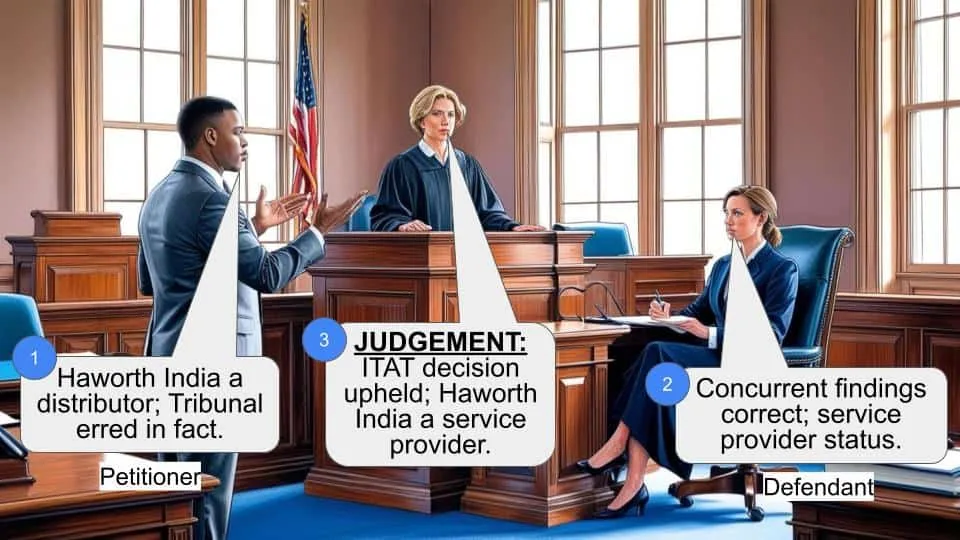
This case involves the Commissioner of Income Tax-I (the appellant) challenging a decision made by the Income Tax Appellate Tribunal regarding Haworth (India) § Ltd. (the respondent-assessee). The main dispute was whether Haworth India should be classified as a distributor or a service provider for tax purposes. The court ultimately dismissed the appeal, upholding the Tribunal’s decision that Haworth India was a service provider entitled to commission.
Get the full picture - access the original judgement of the court order here
Case Name:
Commissioner of Income Tax-I Vs Haworth (India) Pvt. Ltd. (High Court of Bombay)
Income Tax Appeal No.2435 of 2013
Date: 12th July 2016
Key Takeaways:
- The court emphasized the importance of concurrent findings by lower authorities in tax cases.
- The distinction between a distributor and a service provider can significantly impact tax assessments.
- The court showed reluctance to interfere with factual findings unless they are proven to be perverse.
Issue:
Was the Income Tax Appellate Tribunal justified in holding that the assessee (Haworth India) was a service provider entitled to commission, rather than a distributor of its Associated Enterprises?
Facts:
- Haworth (India) Pvt. Ltd. is part of the Haworth Group, a leading manufacturer of modular furniture.
- The case concerns the Assessment Year 2004-05.
- Haworth India had agreements with its Associated Enterprises in Singapore and Thailand.
- The Transfer Pricing Officer initially classified Haworth India as a distributor, leading to an enhancement of the Arm’s Length Price.
- The Commissioner of Income Tax (Appeals) and the Income Tax Appellate Tribunal both concluded that Haworth India was a service provider (commission agent), not a distributor.
Arguments:
Revenue’s Argument:
- Haworth India should be classified as a distributor based on the agreements and activities performed.
- The Tribunal erred in characterizing the company as a service provider entitled only to commission.
Respondent-Assessee’s Argument:
- Haworth India acted as a commission agent, providing services for the sale of furniture by its Associated Enterprises to customers in India.
- The agreements and activities performed support the classification as a service provider.
Key Legal Precedents:
The judgment doesn’t explicitly mention any specific legal precedents. However, it emphasizes the importance of concurrent findings by lower authorities in tax cases and the high bar for overturning such findings.
Judgement:
- The High Court dismissed the appeal, upholding the Tribunal’s decision.
- The court found no reason to interfere with the concurrent findings of the CIT(A) and the Tribunal.
- The court stated that the view taken by the Tribunal was a possible view based on the facts and not shown to be perverse.
- The court concluded that Haworth India was indeed a service provider entitled to commission, not a distributor.
FAQs:
Q1: What was the main point of contention in this case?
A1: The main issue was whether Haworth India should be classified as a distributor or a service provider (commission agent) for tax purposes.
Q2: Why did the court dismiss the appeal?
A2: The court found no evidence that the concurrent findings of the CIT(A) and the Tribunal were perverse. They considered the Tribunal’s view as a possible interpretation of the facts.
Q3: What impact does the classification as a service provider have on the company’s taxes?
A3: As a service provider, Haworth India is entitled to commission rather than being treated as a distributor. This classification likely results in a lower tax liability compared to being treated as a distributor.
Q4: What evidence did the lower authorities consider in making their decision?
A4: They examined the agreements between Haworth India and its Associated Enterprises, as well as the activities performed by Haworth India in relation to the sale of furniture in India.
Q5: Does this judgment set a precedent for similar cases?
A5: While it doesn’t establish a new legal principle, it reinforces the importance of factual findings by lower tax authorities and the high threshold for overturning such findings in higher courts.

1. This Appeal under Section 260 (of Income Tax Act, 1961)A of the Income Tax Act, 1961 (the Act) challenges the order dated 27th December, 2013 passed by the Income Tax Appellate Tribunal (the Tribunal). The impugned order is in respect of Assessment Year 200405.
2. Mr. Tejveer Singh, the learned counsel appearing in support of the appeal urges only the following questions of law for our consideration :
“Whether on the facts and in the circumstances of the case and in law, the Tribunal was justified in holding that the assessee was a serviceprovider and was thus entitled to commission whereas the agreement between the assessee and the Associated Enterprises clearly indicated that the assessee was a distributor of the Associated Enterprises?”
3. The RespondentAssessee is a part of the Haworth Group of Companies which is a leading manufacturer of modular furniture. The short controversy which arises in this appeal is whether the agreements entered into by the RespondentAssessee with its Associated Enterprises in Singapore and Thailand and the functions performed by the Respondent- Assessee would classify the RespondentAssessee as a distributor or as a commission agent. The Transfer Pricing Officer while arriving at the transfer price adjustment held that the activities performed by the RespondentAssessee is that of a distributor and not that of a service- provider i.e. Commission Agent. This led to enhancement of the Arm's Length Price.
4. In appeal, the CIT(A) on analysis of the agreements as well as on analysis of the activities performed by the RespondentAssessee came to the conclusion that the RespondentAssessee was a commission agent and not a distributor. This is so as it was a serviceprovider entitled to commission alone for the services rendered in respect of the goods sold by its Associated Enterprises in Singapore to Thailand to their customers in India. Thus deleted the addition made by the Assessing Officer consequent to the order of the Transfer Pricing Officer.
5. On appeal by the Revenue, the Tribunal on independent examination of the agreements as well as on examining the services/activities performed by the RespondentAssessee in respect of the modular furniture sold by its Associated Enterprises in Thailand and Singapore to consumers in India upheld the order of the CIT(A). In the result it held that the RespondentAssessee cannot be characterized as a distributor but is a Common Agent.
6. The grievance of the Revenue before us is that the Respondent- Assessee is in fact a distributor and therefore, the Tribunal was not correct in holding that the services performed by the RespondentAssessee were that of a serviceprovider and only entitled to commission. However, nothing has been shown to us which would evidence that the findings of fact reached by the two authorities concurrently is perverse. Both the authorities have on examination of the agreements as well of the activity performed by the RespondentAssessee with regard to the sale of furniture by its Associated Enterprises in India concluded that it is a service-provider entitled to commission. Therefore, the view taken by the Tribunal is a possible view on facts and in the absence of the same being shown to be perverse, we see no reason to interfere.
7. The appeal is dismissed. No order as to costs.
(A. K. MENON, J.) (M. S. SANKLECHA, J.)
×