Tax Tribunal’s Decision on SEBI Fees and Preliminary Expenses Upheld by High Co…



Full News
Tax Tribunal’s Decision on SEBI Fees and Preliminary Expenses Upheld by High Court
Tax Tribunal’s Decision on SEBI Fees and Preliminary Expenses Upheld by High Court
The Income Tax Department (the Revenue) wasn’t happy with a decision made by the Income Tax Appellate Tribunal (ITAT) in favor of J.M. Financial Securities § Ltd. The Revenue appealed to the High Court, challenging the ITAT’s order on two main issues: SEBI registration fees and preliminary expenses. Spoiler alert: The High Court dismissed the Revenue’s appeal, agreeing with the ITAT’s decision.
Get the full picture - access the original judgement of the court order here
Case Name:
Commissioner of Income Tax vs J.M. Financial Securities Pvt. Ltd. (High Court of Bombay)
Income Tax Appeal No. 235 of 2014
Date: 27th July 2016
Key Takeaways:
- The High Court upheld the ITAT’s decision to allow the deduction of SEBI registration fees and interest.
- The court confirmed that deductions under Section 35D (of Income Tax Act, 1961) start from the year of business commencement, not incorporation.
- The case highlights the importance of proper documentation and the weight given to factual findings by lower tribunals.
Issue:
The main questions were:
- Was the ITAT justified in allowing the deduction of Rs.1,86,87,069 for SEBI Registration Fees and interest?
- Was the ITAT correct in allowing a claim of Rs.1,04,999 under Section 35D (of Income Tax Act, 1961) for preliminary expenses?
Facts:
- J.M. Financial Securities § Ltd. took over the business of another company and needed to apply for fresh registration with SEBI.
- There was a dispute about the fees payable to SEBI.
- In the assessment year 2004-05, the company decided to accept SEBI’s fee claim.
- The Assessing Officer initially disallowed the company’s claim for the SEBI fees and interest.
- The company was incorporated on 19.06.1998 and had been writing off preliminary expenses.
Arguments:
The Revenue (tax department) argued:
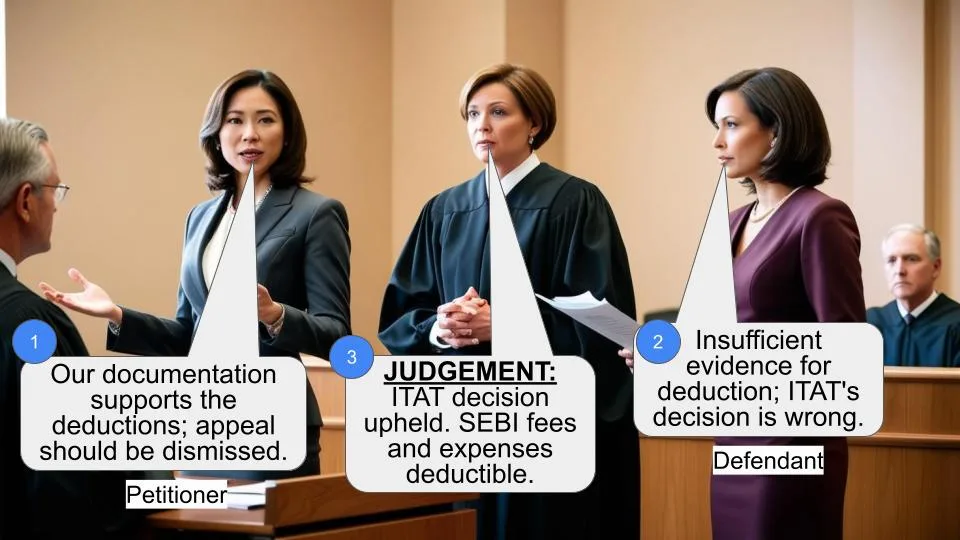
- There wasn’t enough evidence to show the SEBI fee liability crystallized during the assessment year.
- They questioned whether the amount was actually paid to SEBI in that year.
- They disputed the allowance of preliminary expenses under Section 35D (of Income Tax Act, 1961), arguing it should have ended earlier.
The company (J.M. Financial Securities) contended:
- The SEBI fee liability became certain when they decided to accept SEBI’s claim.
- They provided a copy of a cheque as evidence of payment.
- The Section 35D (of Income Tax Act, 1961) deduction should start from the year of business commencement, not incorporation.
Key Legal Precedents:
Interestingly, this case doesn’t mention any specific legal precedents. It focuses more on interpreting Section 35D (of Income Tax Act, 1961) and assessing the factual evidence presented.
Judgement:
The High Court sided with J.M. Financial Securities. Here’s why:
- On the SEBI fees issue:
- The court agreed that the liability crystallized when the company stopped contesting SEBI’s claim.
- They found the ITAT’s acceptance of the cheque copy as evidence of payment reasonable.
2. On the Section 35D (of Income Tax Act, 1961) issue:
- The court clarified that the 5-year period for deduction starts from the year of business commencement, not incorporation.
The High Court dismissed the Revenue’s appeal, finding no substantial questions of law in either issue.
FAQs:
Q: Why did the court accept the cheque copy as evidence of payment?
A: The court considered it a reasonable piece of evidence, especially since the company follows the Mercantile System of Accounting where actual payment isn’t strictly necessary for claiming an expense.
Q: What’s the significance of the Section 35D (of Income Tax Act, 1961) clarification?
A: It confirms that companies can claim preliminary expense deductions for five years from when they start business operations, not from when they’re incorporated. This could be beneficial for companies that take time to start operations after incorporation.
Q: Does this case set a precedent for future tax disputes?
A: While it doesn’t establish new legal principles, it reinforces the importance of factual evidence in tax disputes and the interpretation of Section 35D (of Income Tax Act, 1961).
Q: What lesson can companies learn from this case?
A: It’s crucial to maintain proper documentation of expenses and to understand the correct interpretation of tax laws, especially regarding the timing of deductions.

1. This Appeal under Section 260 (of Income Tax Act, 1961)A of the Income Tax Act, 1961 (the Act) challenges the order dated 19th April, 2013 passed by the Income Tax Appellate Tribunal (the Tribunal). The impugned order is in respect of Assessment Year 200405.
2. The Revenue has urged following questions of law for our consideration :
(i) Whether on the facts and in the circumstances of the case and in law, the Tribunal was justified in deleting the disallowance of Rs.1,86,87,069/ made by the Assessing Officer in respect of SEBI Registration Fees and interest thereon only on the evidence of a copy of a cheque drawn in the name of SEBI dated 31.12.2003 even though there is nothing on record to show that the said liability crystallized during the year under appeal and further there was nothing on record to show that the said amount was actually paid by the Assessee Company to SEBI in the year under appeal ?
(ii) Whether on the facts and in the circumstances of the case and in law, the Tribunal was justified in allowing the claim of the Assessee Company u/s 35D (of Income Tax Act, 1961) of Rs.1,04,999/ as deferred revenue expenses written off by the Assessee Company even though the year under appeal being A.Y. 2004-05 was the sixth year since the incorporation of the company on 19.06.1998 and the Assessee Company had debited its P&L A/c. for F.Y. 1998-1999 a part of the said preliminary expenses in the year of incorporation ?
3. Regarding question (i) :
(a) During the assessment proceedings, the Assessing Officer disallowed respondent assessee's claim for expenditure aggregating to Rs.1.86 crores. This expenditure was on account of payment to SEBI of Registration Fees and interest paid thereon on account of late payment. The explanation of the respondent assessee was that there was a dispute between SEBI and respondent assessee with regard to the fees payable for registration in respect of its taking over the business of M/s. J.M. Financial & Investment Consultancy Services Ltd. However, in the subject assessment year, the respondent assessee decided to accept the contention of the SEBI on the question of fees payable for registration with SEBI along with interest as contended by the SEBI. This was warranted in view of the communication dated 19th November, 2003 from SEBI to National Stock Exchange returning its application for trading in Future and Options.
(b) Being aggrieved, the respondent assessee raised the issue in appeal to CIT(A). By order dated 31st March, 2011 the CIT(A) dismissed the respondent assessee's appeal.
(c) On further appeal, the impugned order of the Tribunal holds that the only reason for not accepting the claim of the respondent assessee as given by the lower Authorities was that the respondent was not able to produce supporting documents to evidence that the payment in fact had been made to SEBI. Before the Tribunal as recorded in the impugned order, there was no dispute that the respondent assessee had taken over the business of one M/s. J.M. Financial Investment Consultant Services Pvt. Ltd. and a final registration had to be applied for with SEBI. The respondent assessee had earlier contested the claim of SEBI in respect of the fees payable. However, during the previous year relevant to the subject assessment year, the respondent assessee decided to accept the claim of SEBI and pay accordingly. The evidence of payment provided was a copy of the cheque issued in favour of SEBI drawn on HDFC Bank as noticed by the Tribunal. On the aforesaid facts, the impugned order allowed the respondent assessee's appeal.
(d) We note that there is no dispute with regard to the requirement of the respondent assessee to apply for fresh registration with SEBI. It is also evident from the letter dated 19th November, 2003 addressed by SEBI to the National Stock Exchange that its Registration in future and option segment is not granted for nonpayment of fees. Once the respondent assessee stopped contesting the claim of SEBI, the liability has crystallized during the year and had to be allowed as an expenditure. So far as payment during the year is concerned, the examination thereof may strictly be not necessary in view of the above findings as the respondent assessee is following Mercantile System of Accounting. Nevertheless, the view taken by the Tribunal is a factual finding. The evidence was in the form of copy of a cheque in favour of SEBI drawn on HDFC Bank. Thus, the view taken by the Tribunal on the basis of the facts before it is a reasonable and possible view.
Accordingly, question (i) as framed does not give rise to any substantialbquestion of law. Thus, not entertained.
4. Regarding question (ii) :
(a) The grievance of the Revenue before us is that impugned order of the Tribunal held that the claim under Section 35D (of Income Tax Act, 1961) is allowable for five consecutive years starting from the year of commencement of the business. According to the Revenue the deduction under Section 35D (of Income Tax Act, 1961) is allowable for a period of five consecutive years from the date of the incorporation of the company.
(b) On perusal of Section 35D (of Income Tax Act, 1961) as in force during the subject assessment years, it is evident that the deduction is allowed for a period of 5 years beginning with the previous year in which the business was commenced.
(c) In view of the above self evident position, the question as framed does not give rise to any substantial question of law. Thus, not entertained.
5. The appeal is dismissed. No order as to costs.
(A.K. MENON, J.) (M.S. SANKLECHA, J.)
×