


Court Upholds Taxation on Actual Rent Received, Not Sublease Amount



Full News
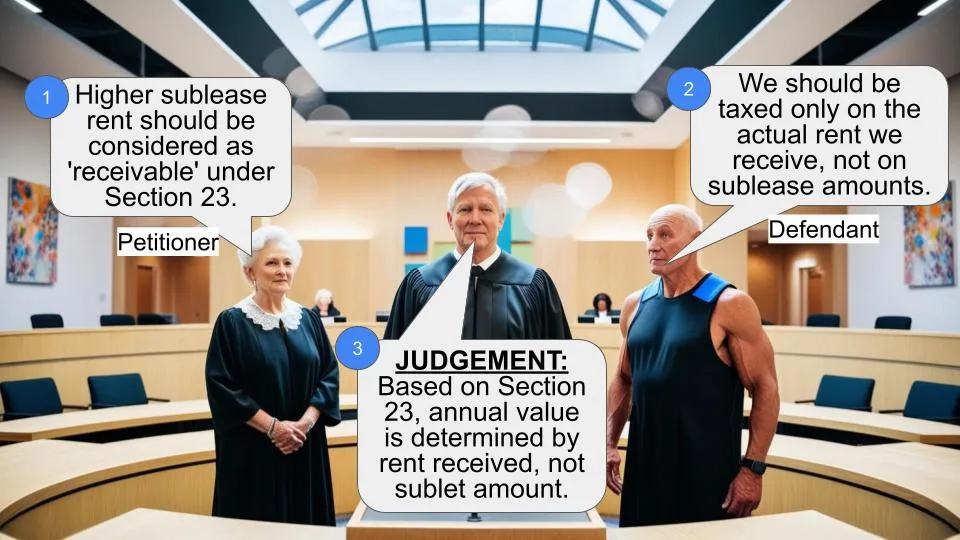
Court Upholds Taxation on Actual Rent Received, Not Sublease Amount
Court Upholds Taxation on Actual Rent Received, Not Sublease Amount
This case involves a dispute between the Commissioner of Income Tax and Akshay Textiles Trading & Agencies (P) Ltd. regarding the determination of annual value for taxation purposes. The court ruled in favor of the assessee, stating that the annual value should be based on the rent received by the property owner, not the higher amount received by tenants who sublet the property.
Get the full picture - access the original judgement of the court order here
Case Name:
COMMISSIONER OF INCOME TAX VS AKSHAY TEXTILES TRADING & AGENCIES (P) LTD
(High Court Of Bombay)
Date:17 Oct 2007
Key Takeaways:
1. Annual value for tax purposes is determined by rent received/receivable by the property owner, not sublease amounts.
2. The court rejected the Revenue's argument that "receivable" rent should include sublease amounts.
3. The judgment reinforces the interpretation of Section 23 (of Income Tax Act, 1961).
4. Sham or colourable transactions must be raised as issues in lower courts to be considered in higher appeals.
Issue:
Should the annual value of a property for tax purposes be determined based on the rent received by the property owner or the higher amount received by tenants who sublet the property?
Facts:
1. The assessee (Akshay Textiles) let out three properties to intermediary companies.
2. These intermediary companies sublet the properties to Reliance Industries Ltd. (RIL) for higher rents.
3. The Income Tax Department argued that the annual value should be based on the higher rent paid by RIL.
4. The assessee contended that the annual value should be based on the rent they actually received from their tenants.
5. The case went through various stages of appeal before reaching the High Court.
Arguments:
Revenue's Arguments:
1. The intermediary tenants were alter egos of RIL, and the arrangements were sham transactions.
2. The term "receivable" in Section 23 (of Income Tax Act, 1961) should include the higher rent received by subtenants.
Assessee's Arguments:
1. The annual value should be determined based on the actual rent received or receivable by the property owner.
2. The issue of sham transactions was not raised in earlier appeals and cannot be considered now.
3. The term "receivable" in Section 23 (of Income Tax Act, 1961) refers to the contracted rent, not potential sublease amounts.
Key Legal Precedents:
1. McDowell and Co. Ltd. vs. Commercial Tax Officer (154 ITR 148)
2. Union of India and Anr. vs. Azadi Bachao Andolan & Anr (263 ITR 706)
3. Apollo Tyres Ltd. vs. Commissioner of Income-tax (2002) 255 ITR 273
The court clarified that there is no departure from the principles laid down in McDowell & Co. Ltd. as understood by the Supreme Court in Azadi Bachao Andolan.
Judgement:
The court ruled in favor of the assessee, holding that:
1. The annual value for tax purposes should be based on the rent received or receivable by the property owner from their tenants.
2. The higher rent received by tenants from subletting is not relevant for determining the owner's tax liability.
3. The issue of sham transactions was not raised in earlier appeals and cannot be considered at this stage.
4. The term "receivable" in Section 23 (of Income Tax Act, 1961) refers to the contracted rent, not potential sublease amounts.
FAQs:
1. Q: What is the significance of this judgment for property owners?
A: Property owners will be taxed on the actual rent they receive, not on higher amounts their tenants might get from subletting.
2. Q: Does this judgment apply to all rental properties?
A: Yes, it applies to properties covered under Section 23 (of Income Tax Act, 1961).
3. Q: Can the tax department still challenge arrangements they believe are shams?
A: Yes, but they must raise this issue in the initial stages of assessment and appeal.
4. Q: What does "annual value" mean in this context?
A: It's the amount on which property owners are taxed, typically the actual rent received or the fair rental value, whichever is higher.
5. Q: How does this judgment interpret the term "receivable" in Section 23 (of Income Tax Act, 1961)?
A: "Receivable" refers to the contracted rent amount, even if not fully received in a given year, but doesn't include sublease amounts.

"A. Whether on the facts and in the circumstances of of the case and in law, the rent paid by ultimate user will be treated as Annual Letting Value of the property as against rent received by the assessee?
"B. Whether on the facts and in the circumstances of of the case and in law, the Hon’ble ITAT was justified in holding that the annual letting value has to be determined with reference to the annual rent received by the assessee and not what has been received by its tenants from the ultimate users?
"C. Whether on the facts and in the circumstances of of the case and in law, the Hon’ble ITAT was correct in upholding the order of the CIT(A) in holding that the capital gains of Rs.19,74,489/- are not to be taken into account while computing the profits liable to be taxed u/s.115JA (of Income Tax Act, 1961) and that the decision of the Hon’ble Bombay High Court in Veekaylal’s case (249 ITR 597) was not applicable?"
2.In so far as question "C", our attention is invited to the judgment of the Supreme Court in Apollo Tyres Ltd. vs. Commissioner of Income-tax (2002) 255 ITR 273. The question framed therein which is similar to the Question "C" has been answered in favour of the assessee and against the Revenue. In the light of that the question of law as framed would not arise.
3.We may now consider questions "A" and "B", as they are inter-related. The case of the Revenue is that the assessee let out three properties to M/s. Elite Mercantile Pvt. Ltd., Saumya Finance & Leasing Pvt. Ltd. and Bloom Trading Pvt. Ltd.Those tenants further sub-let the same property to M/s.Reliance Industries Ltd.,for a higher consideration. Based on this it is submitted, that the intermediate tenant was in fact the alter ego of Reliance Industries Ltd. If the Corporate veil is lifted, it is nothing but another face of Reliance. It is, therefore, submitted that for the purpose of Section 23 (of Income Tax Act, 1961) the annual value of the property should not be one entered into by the assessee with its tenants, but the amount received by the tenant from Reliance Industries Ltd. Even otherwise it is submitted that the annual value of the property would be the rent/compensation, which Reliance Industries Ltd., paid to the tenant of the Respondent herein who is the owner of the property as that would be the real annual letting value. We have been taken through various documents as also judgments.
4.Learned Counsel for the Revenue has also invited our attention to the judgment of the ITAT in I.T.A. No.3285/Mum/99 for the assessment year 1994-95 between Jt. CIT, Special Range 18, Mumbai vs. M/s.Kedareshwar Investment & Trading Co., Ltd., Mumbai. It is pointed out that the Tribunal has mainly relied on this Judgment while dismissing the Appeal preferred by the Revenue. The Tribunal did not address itself to the issue that the Agreement was sham and bogus and in these circumstances the orders of the Commissioner (Appeals) and ITAT ought to be set aside. In the alternative it is submitted that if the Court comes to the conclusion that the order of the A.O. suffers from non-consideration of material, that the order of the A.O. also be set aside be reconsidered by the A.O.
5.On the other hand on behalf of the Respondent assessee, their learned Counsel draws our attention to the language of Section 23(1)(a) (of Income Tax Act, 1961)and (b). Section 23(1)(a) (of Income Tax Act, 1961) and (b) read as under:-
"23. (1) For the purposes of section 22 (of Income Tax Act, 1961), the annual
value of any property shall be deemed to be --
(a) the sum for which the property might reasonably be expected to let from year to year; or
(b)where the property or any part of the property is let and the actual rent received or receivable by the owner in respect thereof is in excess of the sum referred to in clause (a), the amount so received or receivable." It is submitted that in the hands of the owner the annual value can only be determined in terms of clauses (a) and/or (b). The properties are situated in a place where the provisions of the Rent Control Act was applicable. The rent paid by the assessee and its tenant in fact was more than the standard rent. In these circumstances it is submitted that the annual value would be in terms of the Agreement.
Dealing with the contention urged on behalf of the Revenue that the contract between its tenant and Reliance is sham. It is submitted that the finding of the A.O. was reversed in Appeal by the Commissioner (Appeals). The Revenue did not challenge the same before the Tribunal. Once that was not an issue before the Tribunal it is now not open to the Revenue to raise the questions that the contract was a sham. Questions "A" and "B" do not arise from the order.
6.We have given our anxious consideration to the matter. Considerable time was spent as to whether there has been a departure from the ratio decadenti in McDowell and Co. Ltd. vs. Commercial Tax Officer, 154 ITR 148 in the case of Union of India and Anr. vs. Azadi Bachao Andolan & Anr 263 ITR 706. We may address ourselves to that issue. The judgment in McDowell & Co., (Supra) was of a Constitution Bench. The majority judgment in so far as the issue of colourable exercise and tax planning observed as under:-
"Tax planning may be legitimate provided it is within the framework of the law. Colourable devices cannot be part of tax planning and it is wrong to encourage or entertain the belief that it is Honourable to avoid the payment of tax by dubious methods. It is the obligation of every citizen to pay the taxes honestly without resorting to subterfuges....
On this aspect, one of us, Chinnappa Reddy J., has proposed a separate and detailed opinion with which we agree." Chinnappa Reddy J., while answering the issue of colourable devices referred to various authorities and then observed that time has come for us to depart from the Westminster principle as emphatically as the British Courts have done. After so saying the ratio on the issue of colourable devices has been explained as under:-
"In our view, the proper way to construe a taxing statute, while considering a device to avoid tax, is not to ask whether the provisions should be construed literally or liberally, nor whether the transaction is not unreal and not prohibited by the statute, but whether the transaction is a device to avoid tax, and whether the transaction is such that the judicial process may accord its approval to it." (emphasis supplied).
In our opinion this would be the ratio of that judgment. In Azadi Bachao Andolan (supra) the issue arose out of Taxation Treaty between India and Mauritius. A learned Bench considered some observations made by Chinnappa Reddy specially on the applicability of principles set out in Westminster, but after having so said, the Court addressed itself as to what was the ratio in McDowell (supra) and was pleased to observe as under:-
"The Court nowhere said that every action or inaction on the part of the tax payer which results in reduction of tax liability to which he may be subjected in future, is to be viewed with suspicion and be treated as a device for avoidance of tax irrespective of legitimacy or genuiness of the act; and inference which unfortunately, in our opinion, the Tribunal apparently appears to have drawn from the enunciation made in McDowell’s case (1958) 154 ITR 148 (SC). The ratio of any decision has to be understood in the context it has been made. The facts and circumstances which lead to McDowell’s decision leave us in no doubt that the principle enunciated in the above case has not affected the freedom of the citizen to act in a manner according to his requirements, his wishes in the manner of doing any trade, activity or planning his affairs with circumspection, within the framework of law, unless the same fall in the category of colourable device which may properly be called a device or a dubious method or a subterfuge clothed with apparent dignity." (emphasis supplied).
The Supreme Court has thus explained as to how it is understood the law laid down in McDowell (supra). There is, therefore, no departure from the law laid down in McDowell & Co. Ltd., in Azadi Bachao Andolan. In our opinion, therefore, the ratio of McDowell (Supra) as understood by the Supreme Court in Azadi Bachao Andolan, is the law, considering that that is how the Supreme Court understood the ratio decedandi of the Judgment in McDowell & Co. Ltd. In our opinion, therefore, it is not possible to contend that there is departure on the principles laid down in McDowell & Co. Ltd.
7.That bring us to the facts of the case. It is no doubt true that the Assessing Officer had recorded a finding in para.5.4 that the share holding of the Assessee Company as well as the intermediary company is held by another set of group companies and the shareholders of these group companies are once again another set of group companies of RIL. It is further observed that there is a cross holding of shares of each other by large number of group companies of RIL. All these companies had activities in dealing in shares of RIL or holding the shares of RIL as investment. Under these circumstances it was held that it is not possible to hold that the transaction between the assessee company and its tenants is an independent business transaction. Similarly it was held that it was not possible to accept that the transaction between the tenant companies and RIL is an independent transaction between two independent companies. Under these circumstances it held that the rent paid by RIL to the tenant should be considered as annual value.
8.The Assessee aggrieved preferred an Appeal before the Commissioner (Appeals). The ground of recomputation of annual letting value was in issue. The Commissioner (Appeals) noted that in the case of the appellant for the assessment year 1997-98 the addition made on account of enhanced annual letting value is deleted. That decision was followed. In other words the finding of fact of the tenant company being the alter ego of Reliance was not accepted. The finding recorded by the Assessing Officer was thus set aside by the Commissioner (Appeals).
An Appeal was preferred before ITAT. In the grounds of Appeal no contention was taken that the Agreement between Reliance as intermediary tenant is a sham and/or that it was a colourable device which may properly be called a device or a dubious method or a subterfuge clothed with apparent dignity.
6.From the order of the Tribunal also it does not appear that the issue of colourable exercise and/or sham contract was argued or raised. The Tribunal dismissed the Appeal preferred by the Revenue. Once the issue of sham and bogus contract had not been raised before the Tribunal the finding of fact recorded by the Commissioner (Appeal) stood confirmed. From the judgment of the Tribunal the issue which is sought to be now contended or canvassed of sham contract or a colourable device on the ground that the intermediary is a an alter ego of RIL was not in issue. It is not the case of the Revenue that the intermediary was another face of the Assessee and consequently the Agreement entered into with the tenant by the Assessee was a colourable device. In these circumstances considering Section 23 (of Income Tax Act, 1961), what is assessable to tax is the income received from the tenant falling either under sub-section (a) or (b) of Section 23(1) (of Income Tax Act, 1961). The compensation received by the tenant would be taxable in the hands of the tenant. Appeal would lie on substantial question of law from the order of the Tribunal in respect of the matters which were taken up before it and/or on a pure question of law based on undisputed material on record. That is not the case over here.
9.We may also note that Section 23 (of Income Tax Act, 1961) before its amendment by Finance Act, 2001 with effect from 1st April, 2001 read as under:-
"23(1) For the purposes of Section 22 (of Income Tax Act, 1961), the annual value of any property shall be deemed to be:
(a) the sum for which the property might reasonably be expected to let from year to year;
(b) where the property is let and the annual rent received or receivable by the owner in respect thereof is in excess of the sum referred to in clause (a), the amount so received or receivable."
This was necessitated on account of the Supreme Court interpreting Section 23(1) (of Income Tax Act, 1961) as it then stood and to bring within its ambit those cases where higher rent had been received than the annual letting value. In other words were the annual rent receivable was more than the annual letting value.
.On behalf of the Revenue considering the expression ’receivable’ in Section 23(1)(b) (of Income Tax Act, 1961), learned Counsel seeks to contend that what has to be considered is the rent which is receivable as rent from the premises. It is, therefore, submitted that the rent which the tenant was receiving from Reliance would be the rent receivable. On the other hand on behalf of the assessee learned Counsel explains that the expression "receivable" is in the context of the rent reserved in terms of the agreement. As an illustration, it is submitted that if the rent received per annum is Rs.12,000/- even though Rs.6,000/- is paid for the purpose of tax incidence what has to be considered is Rs.12,000/- as that is the rent receivable.
We have given our anxious consideration to the rival contentions. Section 23(1)(a) (of Income Tax Act, 1961) uses the expression " the sum for which the property might reasonably be expected to be let from year to year. This has to be considered in the context of the applicable rent laws. The Courts have construed the rent receivable in such circumstances to be either the standard rent or the rateable value as fixed by the local authority. Though the rateable value may also on occasions has to consider the standard rent in cases where the rent law may be applicable. Before the amendment brought about to Section 23 (of Income Tax Act, 1961) by the Finance Act 2001 with effect from 1st April, 2002 even if an assessee had received higher rent then the standard rent the additional amount would not be the subject of tax. To over come this omission the Section was substituted to cover also those cases where rent received was higher than the standard rent or rent based on municipal rateable value. If the argument of the assessee is to be considered then expression "reasonable" would have to be given different meaning. In our opinion it is not possible to give a meaning wider amplitude than what is contained in Section 23(1)(a) (of Income Tax Act, 1961). The Legislature has substituted the provision and brought in Section 23(1)(b) (of Income Tax Act, 1961) to cover the part of the annual value which otherwise would not fall with the tax ambit before its amendment. In that context the expression "receivable" would mean that though the annual value is fixed in terms of the Agreement even though it is not received in the relevant year, yet the same would be assessable to tax in terms of the illustration given on behalf of the assessee. The contention, therefore, as urged on behalf of the Revenue on the construction or expression "receivable" will have to be rejected.
10.The issue whether the contract between Reliance and the intermediary tenant is a sham cannot be gone into as the question would not arise in the absence of it being in issue raised before the Tribunal. That question as framed does not therefore arise. Further as noted earlier it is not the contention of Revenue that the contract between the assessee and the tenant is sham. The annual value would and be the value in terms of that contract. Therefore, the annual value is the annual value received or receivable by the owner from the tenant irrespective whether tenant on such letting has received higher rent from RIL.
11. Considering the above, in our opinion the question of law at "A" as framed would not arise. Question B has to be answered in the affirmative and against the Revenue. Consequently Appeal stands dismissed.
(J.P. DEVADHAR, J.) (F.I. REBELLO, J)
×
Questions
Court Upholds Taxation on Actual Rent Received, Not Sublease Amount
Write your CommentSimilar Posts
Generic
- Reportdata/5262.pdf
