


Court Upholds Timely Issuance of Notice Under Section 158BD (of Income Tax Act,…


Full News

Court Upholds Timely Issuance of Notice Under Section 158BD (of Income Tax Act, 1961)
Court Upholds Timely Issuance of Notice Under Section 158BD (of Income Tax Act, 1961)
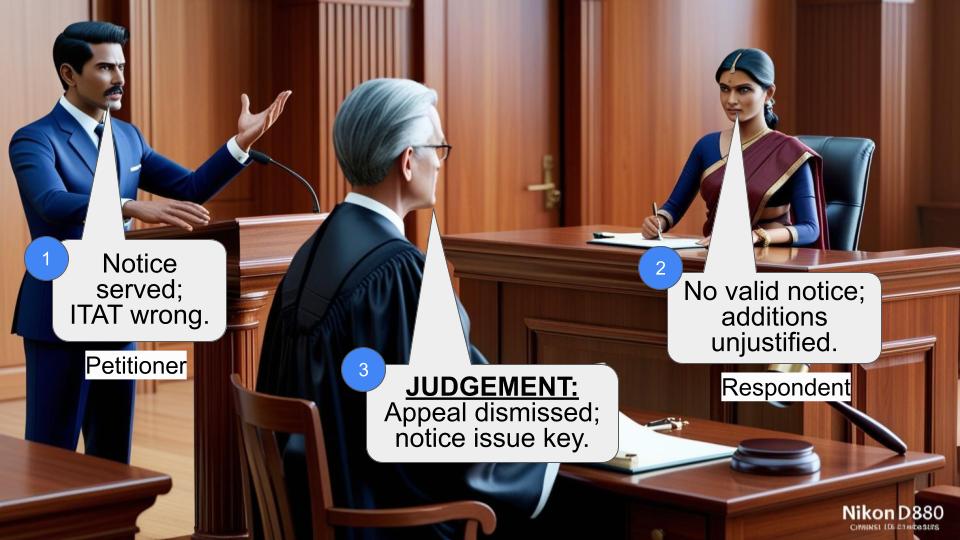
The case involves the issuance of a notice under Section 158BD (of Income Tax Act, 1961) to V.K. Narang HUF. The main issue was whether there was an inordinate delay in issuing the notice. The High Court ruled that the notice was issued within a reasonable time frame and remitted the case back to the ITAT to decide on the merits of the additions made by the Assessing Officer.
Get the full picture - access the original judgement of the court order here.
Case Name:
Commissioner of Income Tax vs. V.K. Narang HUF (High Court of Delhi)
ITA 1064/2009
Key Takeaways
- The High Court found no delay in issuing the notice under Section 158BD (of Income Tax Act, 1961).
- The satisfaction note was recorded within five months of completing the assessment of the searched person.
- The case was remitted to the ITAT to decide on the merits of the additions made by the Assessing Officer.
- The decision aligns with the Supreme Court's guidelines on the timing of issuing notices under Section 158BD (of Income Tax Act, 1961).
Issue
Was there an inordinate delay in issuing the notice under Section 158BD (of Income Tax Act, 1961) to V.K. Narang HUF?
Facts
- Search operations were conducted on 17.12.1999 at the premises of Sh. V.K. Narang.
- Based on the materials obtained, a notice under Section 158BD (of Income Tax Act, 1961) was issued.
- The block assessment for Sh. V.K. Narang was completed on 31.12.2001.
- A satisfaction note was recorded on 30.05.2002.
- Notice was issued to V.K. Narang HUF on 03.06.2002.
Arguments
- Revenue's Argument:
The satisfaction note and subsequent notice were issued within a reasonable time frame, adhering to legal requirements.
- Assessee's Argument:
There was an inordinate delay in issuing the notice, making it unsustainable.
Key Legal Precedents
- CIT vs. Radhey Shyam Bansal:
The court had previously accepted the assessee's contention regarding the unsustainability of delayed notices under Section 158BD (of Income Tax Act, 1961).
- CIT vs. Calcutta Knitwears, Ludhina:
The Supreme Court outlined three possible points in time when a notice under Section 158BD (of Income Tax Act, 1961) can be issued.
- CIT vs. Manish Maheshwari:
The satisfaction note must meet legal requirements.
Judgement
The High Court ruled that there was no delay in issuing the notice under Section 158BD (of Income Tax Act, 1961). The satisfaction note was recorded within five months of completing the assessment of the searched person, which was deemed proximate to the assessment proceedings. The case was remitted to the ITAT to decide on the merits of the additions made by the Assessing Officer.
FAQs
Q1: What was the main issue in this case?
A1: The main issue was whether there was an inordinate delay in issuing the notice under Section 158BD (of Income Tax Act, 1961) to V.K. Narang HUF.
Q2: What did the court decide regarding the delay?
A2: The court decided that there was no delay in issuing the notice, as it was issued within five months of completing the assessment of the searched person.
Q3: What happens next in this case?
A3: The case was remitted to the ITAT to decide on the merits of the additions made by the Assessing Officer.
Q4: What are the key legal precedents cited in this case?
A4: The key legal precedents include CIT vs. Radhey Shyam Bansal, CIT vs. Calcutta Knitwears, Ludhina, and CIT vs. Manish Maheshwari.
Q5: What is Section 158BD (of Income Tax Act, 1961)?
A5: Section 158BD (of Income Tax Act, 1961) deals with the procedure for assessing undisclosed income found during search operations on a third party.

1. The present appeal is directed against the order of ITAT dated
11.12.2008. The question of law raised is whether in the circumstances the ITAT was correct in its view that there was inordinate delay in issuing the notice under Section 158BD (of Income Tax Act, 1961) to the assessee i.e V.K.Narang HUF.
2. At the outset it needs to be noted that this appeal too is a part of the case heard and decided by a common judgment reported as CITvs. Radhey Shyam Bansal 2011 337 ITR 217 (DLI). On that occasion the Court had accepted assessee’s contention that in the circumstances of the case, the notice under Section 158BD (of Income Tax Act, 1961) was unsustainable. The matter was carried in appeal to the Supreme Court which by the judgment reported as CIT vs. Calcutta Knitwears, Ludhina 362 ITR 673 (SC), inter alia, recorded as follows:
“44. In the result, we hold that for the purpose of
Section 158BD (of Income Tax Act, 1961) a satisfaction note is sine qua
non and must be prepared by the assessing officer
before he transmits the records to the other assessing
officer who has jurisdiction over such other person.
The satisfaction note could be prepared at either of the
following stages: (a) at the time of or along with the
initiation of proceedings against the searched person
under Section 158BC (of Income Tax Act, 1961); (b) along with the
assessment proceedings under Section 158BC (of Income Tax Act, 1961) of the
Act; and (c) immediately after the assessment
proceedings are completed under Section 158BC (of Income Tax Act, 1961) of the
Act of the searched person
45. We are informed by Shri Santosh Krishan, who is
appearing in seven of the appeals that the assessing
officer had not recorded the satisfaction note as
required under Section 158BD (of Income Tax Act, 1961), therefore, the
Tribunal and the High Court were justified in setting
aside the orders of assessment and the orders passed
by the first appellate authority. We do not intend to
examine the aforesaid contention canvassed by the
learned counsel since we are remanding the matters to
the High Court for consideration of the individual
cases herein in light of the observations made by us on
the scope and possible interpretation of Section 158BD (of Income Tax Act, 1961)
of the Act.”
3. In these circumstances, this Court has to decide the issue. The
relevant facts are that the search operations were conducted on 17.12.1999 in the premises of Sh.V.K.Narang. Based upon the materials obtained, he was issued notice under Section 158BD (of Income Tax Act, 1961). Subsequently, after considering the assessment returns for the period 01.04.1989 to 17.12.1999 filed by him, the block assessment was completed on 31.12.2001. In the present assessee’s case a satisfaction note was recorded on 30.05.2002. The DCIT recorded undisclosed income in the case of present assessee, and further that the search proceedings of Sh.V.K.Narang reveal that present assessee had also invested in various properties which were undisclosed.
4. Having regard to the decision in CIT vs. Manish Maheshwari (2007)
289 ITR 341 (SC) this Court is of the opinion that the satisfaction note in the present case meets with the requirements of law. So far as the question of delay is concerned, the Court is of the opinion that in the facts and circumstances of the present case, it cannot be held that there was any delay in recording the satisfaction note. The assessment of the searched person was completed on 31.12.2001. The satisfaction note was recorded on 30.05.2002 i.e. just about five months after the date of completion of searched person. Notice was issued on 03.06.2002, immediately after the satisfaction note was recorded to the present assessee.
5. Having regard to the declaration of law made by the Supreme Court
which specified three possible points in time when notice under Section
158BD can be issued to third party/assessee, on the basis of material found on the premises of the searched person, the period of five months spent by the AO of the searched person in finalizing the satisfaction note, can be said to have been proximate to the assessment proceedings. We also recollect the decision of this Court in Commissioner of Income Tax vs. Raghubir Singh Garg ITA No. 1420/2010 decided on 27.08.2014. In that case, the search took place on 29.08.2002 and the satisfaction note was recorded on 16.01.2003 i.e. within a period of 4 1⁄2 months. The Court was of the opinion that the satisfaction note could be upheld. Following the said decision it is held that there was no delay in issuance of notice under Section 158BD (of Income Tax Act, 1961) in the facts of the case. So far as the merits of the appeal are concerned, Court notices that the ITAT had not dealt with the merits of the assessee’s contentions with regard to the various additions made, and grounds urged in that regard. This is especially reflected from a reading of the judgment which has solely proceeded on the question of delay in the issuance of notice
under Section 158BD (of Income Tax Act, 1961). In these circumstances, the matter is remitted to the ITAT to decide the contentions on merits, on the facts of the case, as to the correctness or otherwise of the addition made by the AO of the present assessee. Considering that the satisfaction note and notice were issued in 2003, the ITAT shall consider and decide this appeal expeditiously. The rights and contentions of the parties shall not be prejudiced. The ITA stands disposed of being partly allowed.
S. RAVINDRA BHAT
(JUDGE)
R.K.GAUBA
(JUDGE)
JANUARY 08, 2015
×
Questions
Court Upholds Timely Issuance of Notice Under Section 158BD (of Income Tax Act, 1961)
Write your CommentSimilar Posts

Generic
- Reportdata/4155.pdf
