


Revenue's delay in issuing notices under Section 158BD (of Income Tax Act, 1961…



Full News

Revenue's delay in issuing notices under Section 158BD (of Income Tax Act, 1961) leads to dismissal of appeals.
Revenue's delay in issuing notices under Section 158BD (of Income Tax Act, 1961) leads to dismissal of appeal…
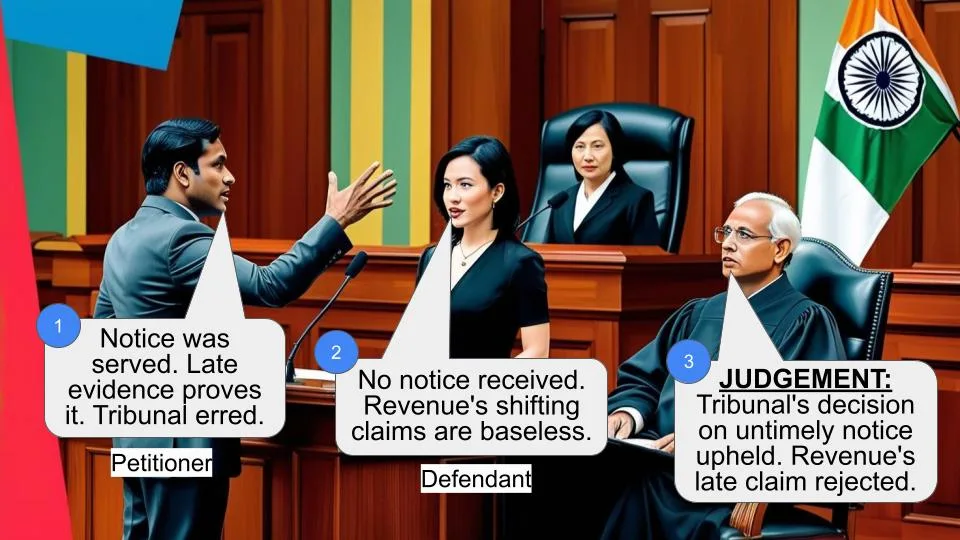
The case involves the Commissioner of Income Tax (CIT) versus Bharat Bhushan Jain and other respondents. The central issue was whether the notices issued to third parties under Section 158BD (of Income Tax Act, 1961) were valid, given that they were issued long after the completion of the assessment of the searched person. The court held that the notices were not issued in conformity with the requirements of Section 158BD (of Income Tax Act, 1961) due to undue delays ranging from 10 months to over a year.

Get the full picture - access the original judgement of the court order here.
Case Name:
Commissioner of Income Tax vs. Bharat Bhushan Jain. (High Court of Delhi)
ITA 648/2009
Key Takeaways
- The court emphasized the need for the Revenue to be vigilant and issue notices to third parties under Section 158BD (of Income Tax Act, 1961) immediately after the completion of the assessment of the searched person.
- Delays ranging from 10 months to over a year in recording the satisfaction note and issuing notices were deemed not contemporaneous with the assessment proceedings.
- The court dismissed the appeals of the Revenue, holding that the notices were not issued in conformity with the requirements of Section 158BD (of Income Tax Act, 1961).
Issue
Did the Revenue issue notices to third parties under Section 158BD (of Income Tax Act, 1961) in a timely manner, in accordance with the requirements of the Income Tax Act
Facts
- The search proceedings were conducted on 03.08.2000.
- The assessment proceedings were completed on 29.08.2002.
- Notices to third parties under Section 158BD (of Income Tax Act, 1961) were issued much later, with delays ranging from 10 months to over a year.
- The satisfaction notes were recorded well after the completion of the assessment of the searched person, which was not in line with the requirements of Section 158BD (of Income Tax Act, 1961).
Arguments
- Revenue's Argument:
The Revenue argued that the notices were valid and issued in accordance with the law.
- Respondents' Argument:
The respondents contended that the notices were issued with undue delay and did not meet the requirements of Section 158BD (of Income Tax Act, 1961).
Key Legal Precedents
- CIT vs. Radhey Shyam Bansal:
This case established that the satisfaction note must be recorded contemporaneously with the assessment proceedings of the searched person.
- CIT vs. Manish Maheshwari:
This case was cited to emphasize the importance of recording a satisfaction note as required under Section 158BD (of Income Tax Act, 1961).
- CIT vs. Calcutta Knitwears, Ludhina:
The Supreme Court in this case held that the satisfaction note is a sine qua non and must be prepared by the assessing officer before transmitting the records to another assessing officer.
Judgement
The court dismissed the appeals of the Revenue, holding that the notices were not issued in conformity with the requirements of Section 158BD (of Income Tax Act, 1961) due to undue delays. The court emphasized that the Revenue must be vigilant and issue notices immediately after the completion of the assessment of the searched person.
FAQs
Q1: What is Section 158BD (of Income Tax Act, 1961)?
A1: Section 158BD (of Income Tax Act, 1961) deals with the procedure for assessing undisclosed income of any person other than the searched person based on evidence found during a search.
Q2: Why were the notices considered invalid?
A2: The notices were considered invalid because they were issued with undue delays, ranging from 10 months to over a year, which was not in line with the requirements of Section 158BD (of Income Tax Act, 1961).
Q3: What did the court emphasize regarding the issuance of notices?
A3: The court emphasized that the Revenue must be vigilant and issue notices to third parties immediately after the completion of the assessment of the searched person.
Q4: What was the outcome of the case?
A4: The court dismissed the appeals of the Revenue, holding that the notices were not issued in conformity with the requirements of Section 158BD (of Income Tax Act, 1961).
1. These appeals are directed against the impugned order of ITAT.
Since they involved common questions of law, a common order is being
made in the present cases.
2. In all these cases, assessee/respondents were third parties, who were
issued notice under Section 158BD (of Income Tax Act, 1961) pursuant to search proceedings in
respect of other persons. In all these cases, the search proceedings were conducted on 03.08.2000. Thereafter notice was issued to them for block assessment for filing of relevant returns for previous years. The assessment proceedings were completed on 29.08.2002. Thereafter, the present assesses-third parties were issued notices under Section 158BD (of Income Tax Act, 1961) . The relevant dates of recording of the satisfaction note by the A.O., issue of notices to the present assesses and completion of assessments are recorded in tabular statement in the following manner:-
ITA No. Date of Search on Manoj Aggarwal group
Date of
assessment of
searched
person under
Section 158 (of Income Tax Act, 1961)
BC
Date of
Satisfaction
Note for other
person
Date of notice
u/S 158BD (of Income Tax Act, 1961)
Date of
completion of
assessment u/s
158BD
648/2009 03.08.2000 29.08.2002 15.07.2003 31.03.2004 31.03.2006
669/2009 03.08.2000 29.08.2002 15.07.2003 31.03.2004 31.03.2006
670/2009 03.08.2000 29.08.2002 15.07.2003 31.03.2004 31.03.2006
771/2009 03.08.2000 29.08.2002 21.07.2003 31.03.2004 31.08.2006
1075/2009 03.08.2000 29.08.2002 15.07.2003 17.08.2004 31.03.2006
1318/2009 03.08.2000 29.08.2002 15.07.2003 31.03.2004 31.03.2006
196/2010 03.08.2000 29.08.2002 13.01.2004 09.02.2004 30.12.2005
198/2010 03.08.2000 29.08.2002 14.01.2004 05.02.2004 17.02.2006
279/2010 03.08.2000 29.08.2002 26.08.2003 27.08.2003 30.08.2005
777/2010 03.08.2000 29.08.2002 13.01.2004 09.02.2004 15.02.2006
1145/2010 03.08.2000 29.08.2002 14.01.2004 06.05.2005 29.05.2007
1313/2010 03.08.2000 29.08.2002 04.06.2003 18.06.2003 27.06.2005
1326/2010 03.08.2000 29.08.2002 04.06.2003 18.06.2003 27.06.2005
3. These appeals were originally disposed of by common judgment of
this Court reported as CIT vs. Radhey Shyam Bansal 2011 337 ITR 217
(DLI). In that judgment it was held that the satisfaction note in all the cases was recorded and notices were issued beyond the period of limitation. It was held, inter alia, that the satisfaction note recorded in these cases did not accord with the requirements of Section 158BD (of Income Tax Act, 1961), applying the decision in CIT vs. Manish Maheshwari (2007) 289 ITR 341 (SC). In this batch of judgments, along with another batch of cases, appeal was preferred before the Supreme Court, which decided in its judgment reported as CIT vs.Calcutta Knitwears, Ludhina 362 ITR 673 (SC), inter alia, that:
“44. In the result, we hold that for the purpose of Section
158BD of the Act a satisfaction note is sine qua non and must
be prepared by the assessing officer before he transmits the
records to the other assessing officer who has jurisdiction over
such other person. The satisfaction note could be prepared at
either of the following stages: (a) at the time of or along with
the initiation of proceedings against the searched person under
Section 158BC (of Income Tax Act, 1961); (b) along with the assessment
proceedings under Section 158BC (of Income Tax Act, 1961); and (c)
immediately after the assessment proceedings are completed
under Section 158BC (of Income Tax Act, 1961) of the searched person
45. We are informed by Shri Santosh Krishan, who is
appearing in seven of the appeals that the assessing officer had
not recorded the satisfaction note as required under Section
158BD of the Act, therefore, the Tribunal and the High Court
were justified in setting aside the orders of assessment and the
orders passed by the first appellate authority. We do not intend
to examine the aforesaid contention canvassed by the learned
counsel since we are remanding the matters to the High Court
for consideration of the individual cases herein in light of the
observations made by us on the scope and possible
interpretation of Section 158BD (of Income Tax Act, 1961).”
4. So far as the determination whether the satisfaction recorded was in
conformity with the Section 158BD (of Income Tax Act, 1961) is concerned, there is no controversy in view of the concurrent findings. Having regard to the order of this Court in CIT vs. Radhey Shyam Bansal (supra) the bone of contention is whether the period when the satisfaction note was recorded, was contemporaneous with the period in which assessment proceedings of the searched person were carried out, as held by the judgment of the Supreme Court in CIT vs.Calcutta Knitwears (supra). In each of the cases it is evident that the satisfaction note was recorded almost or just short of or more than a year after the completion of assessment of the searched person. In ITA No. 279/2010, the satisfaction note was recorded on 26.08.2003 i.e. four days short of a year after completion of assessment of the searched person; in ITA No. 1145/2010 it is recorded on 14.01.2004 i.e. about one year and four months after the searched person’s assessment is completed. In ITA No. 1313/2010 and 1326/2010, satisfaction notes were recorded on 04.06.2003 i.e. about nearly 10 months after the completion of the assessment of the searched person.
5. Additionally, we may note in ITA No.1318/2009 that the main
judgment of this Court in Radhey Shyam Bansal (supra) itself recorded that letter/communication note of 12.07.2003 did not accord with Section
158BD. The findings in the said judgment are as follows:
“17. In view of the above, it is clear that on or before
29th Aug., 2002, the AO of M/s Friends Portfolio (P)
Limited and that of Shri Manoj Aggarwal did not
record any satisfaction. The note dt. 29th Aug., 2002 is,
therefore, not to be taken for recording satisfaction
required under Section 158BC (of Income Tax Act, 1961)/158BD.
23. In view of the aforesaid legal position we can now
examine the letterdated 15th July, 2003 which was
communicated by the Assessing Officer of the searched
assessee to the assessing officer of the respondent. The
question is whether the aforesaid letter can be regarded
as ―satisfaction‖ as required under Section 158BD (of Income Tax Act, 1961), i.e.
satisfaction of the Assessing Officer of Manoj Aggarwal
that there is material that the respondent assessee had
ITA 582/2008 with connected matters undisclosed
income. The first paragraph of the aforesaid letter
states that the diary seized from the possession of
Manoj Aggarwal establishes that the respondent
assessee had acted as a mediator for providing
accommodation book entries by Manoj Aggarwal. The
second sentence in the first paragraph states that the
quantum of transactions as shown in the documents
were enclosed as Annexure-A and the photocopies of
the papers were enclosed as Annexure-B. The second
paragraph states that there was evidence that cash was
received by Manoj Aggarwal from the respondent and
the summary of the amounts received as per the seized
documents was given in Annexure C and the
photocopies of the documents were annexed as
Annexure-D. It is accepted that Annexures A, B, C & D,
referred to in this letter were not filed before the
tribunal and have not been produced before us. It is
conceded by the learned counsel for the revenue that
they are also not available on the file of the Assessing
Officer of the respondent. There is no explanation
forthcoming with regard to the aforesaid annexures. It
is well nigh impossible to know their content. The first
paragraph of the letter dated 15th July, 2003 states that
the respondent-assessee had acted as a mediator i.e.
they had introduced Manoj Aggarwal with other
persons toITA 582/2008 with connected matters whom
accommodation book entries were provided by Manoj
Aggarwal. There is no allegation in the first paragraph
that the respondent assessee was provided with
accommodation book entries or the amounts belong to
the respondent assessee. Book entries were provided to
third parties. It is not stated in this „satisfaction note„
that Manoj Aggarwal or third parties had paid any
amount towards commission for acting as a mediator.
There is no such allegation or statement in the
„satisfaction note„. The second paragraph does create
some doubt but what is relevant and important is the
fact that in the first paragraph, it is accepted by the
Assessing Officer of Manoj Aggarwal that the
respondent assessee was merely acting as a mediator
and nothing more. The second paragraph of the letter
states that there was evidence that cash was received by
Manoj Aggarwal from the respondent assessees. What
was the evidence and material was not brought on
record before the tribunal or even before us. The said
material is not mentioned in the assessment order. It
cannot be „ipse dixit„ without material or evidence to
satisfy the concept of requirement as engrafted under
Section 158BD (of Income Tax Act, 1961). What was the material was neither
highlighted before the tribunal nor before us. Thus, the
appellant-revenue has not discharged the onus that
there was ITA 582/2008 with connected matters valid
satisfaction as required under Section 158 (of Income Tax Act, 1961) BD.
Therefore, the irresistible conclusion is the pre-
requisite of „satisfaction‖ as engrafted under Section
158B for the purpose of initiation of block assessment
proceeding is non-existent or absent.”
6. Having regard to the intent of the Supreme Court in Para 44 of the
Calcutta Knitwears (supra), where it was indicated that the Revenue has to be vigilant in issuing notice to the third party under Section 158 (of Income Tax Act, 1961) BD,immediately after the completion of assessment of the searched person, this Court is of the opinion that a delay ranging between 10 months of 1 1⁄2 years cannot be considered contemporaneous to assessment proceedings. We are of the opinion that notices were not issued in conformity with the requirements of Section 158BD (of Income Tax Act, 1961), and were unduly delayed. The appeals of the Revenue accordingly fail and are dismissed.
S. RAVINDRA BHAT
(JUDGE)
R.K.GAUBA
(JUDGE)
JANUARY 08, 2015
×
Questions
Revenue's delay in issuing notices under Section 158BD (of Income Tax Act, 1961) leads to dismissal of appeals.
Write your CommentSimilar Posts

Generic
- Reportdata/4154.pdf
