


High Court Orders Reconsideration of Penalty Quantum in Kudos Chemie Ltd. Case




Full News
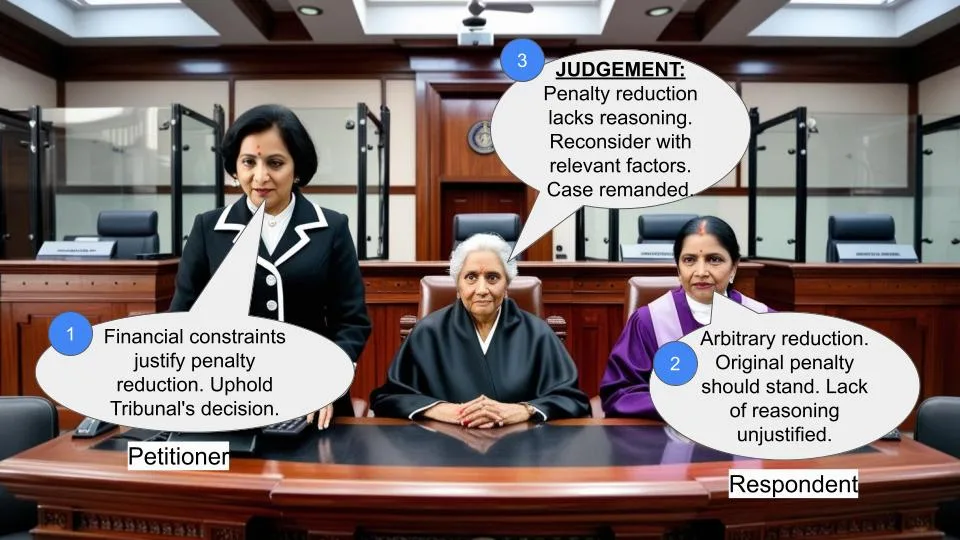
High Court Orders Reconsideration of Penalty Quantum in Kudos Chemie Ltd. Case
High Court Orders Reconsideration of Penalty Quantum in Kudos Chemie Ltd. Case
The High Court reviewed the Income Tax Appellate Tribunal's decision to reduce the penalty imposed on Kudos Chemie Ltd. from Rs.66 lacs to Rs. 10 lacs for each assessment year. The court found that the Tribunal did not provide sufficient reasoning or consider relevant factors in its decision. The case was sent back to the Tribunal for a fresh determination of the penalty amount.
Get the full picture - access the original judgement of the court order here.
Case Name:
Kudos Chemie Ltd. vs. Commissioner of Income Tax (High Court of Punjab and Harayana)
Income Tax Appeal No.134 of 2014
Key Takeaways
- The Tribunal's reduction of the penalty was deemed arbitrary and lacking in sufficient reasoning.
- The High Court emphasized the need for judicial discretion to be exercised with reference to relevant facts and a clear process of reasoning.
- The case was remanded to the Tribunal for a fresh determination of the penalty amount, taking into account relevant factors.
Issue
Can the quantum of penalty be determined without referring to relevant factors and assigning adequate reasons?
Facts
- The Assessing Officer imposed penalties of Rs.65,71,450/- for the assessment year 2009-10 and Rs.66 lacs for the assessment year 2008-09 on Kudos Chemie Ltd. for not depositing taxes before filing the return.
- The assessee cited a lack of funds as the reason for the default.
- The CIT (Appeals) set aside the penalty, but the Tribunal reinstated it, reducing the amount to Rs.10 lacs for each year without providing detailed reasoning.
- Both the assessee and the revenue were dissatisfied with the Tribunal's decision, leading to the current appeal.
Arguments
- Assessee's Argument:
The penalty should be reduced due to financial constraints and the Tribunal's decision should be upheld.
- Revenue's Argument:
The Tribunal's reduction of the penalty was arbitrary and lacked sufficient reasoning, and the original penalty should be reinstated.
Key Legal Precedents
- The Tribunal cited the need for a "liberal interpretation" of Section 140A(3) (of Income Tax Act, 1961) read with Section 221(1) (of Income Tax Act, 1961).
- The High Court emphasized that judicial discretion must be exercised with reference to relevant facts and a clear process of reasoning.
Judgement
The High Court found that the Tribunal's decision to reduce the penalty was arbitrary and lacked sufficient reasoning. The case was remanded to the Tribunal for a fresh determination of the penalty amount, taking into account relevant factors such as the period of default, reasons for default, recurring nature of the default, conduct of the assessee, and any extenuating circumstances.
FAQs
Q1: Why was the Tribunal's decision to reduce the penalty considered arbitrary?
A1: The Tribunal did not provide sufficient reasoning or consider relevant factors in its decision to reduce the penalty.
Q2: What factors should be considered when determining the quantum of penalty?
A2: Factors include the period of default, reasons for default, recurring nature of the default, conduct of the assessee, and any extenuating circumstances.
Q3: What was the outcome of the High Court's decision?
A3: The case was remanded to the Tribunal for a fresh determination of the penalty amount, taking into account relevant factors.
Q4: What sections of the Income Tax Act were relevant in this case?
A4: Sections 140A(3) and 221(1) of the Income Tax Act, 1961 were relevant in this case.

By way of this order, we shall decide ITA Nos. 134, and 135 of 2014 filed by the assessee and ITA Nos. 95 and 119 of 2014 filed by the revenue.
Both the assessee and the revenue are aggrieved by order dated 02.08.2013 passed by the Income Tax Appellate Tribunal, Chandigarh (for short “the Tribunal”).
Counsel for the assessee states that she has instructions to state that the assessee gives up challenge to the assessee's exigibility to penalty but confines her argument to a plea that the quantum of penalty has been rightly determined by the Tribunal and in case it is proposed to remit the matter to the Tribunal on the quantum of penalty, the assessee's argument that penalty can be lower than the Rs.10 lacs, assessed by the Tribunal, may be left open.
Counsel for the revenue submits that though the Tribunal has rightly held that the assessee is liable to pay penalty but while doing so, has arbitrarily and without assigning any reason, reduced the penalty from Rs.66 lacs to Rs.10 lacs in each assessment year. The impugned order is bereft of any reason, much less any factor that persuaded the Tribunal to reduce the penalty to Rs.10 lacs. The order being perverse and arbitrary, may be set aside.
A brief narrative of the facts, would be appropriate. The Assessing Officer issued notices for assessment years 2008-09 and 2009-10, requiring the assessee to show cause why penalty under section 140-A(3) (of Income Tax Act, 1961), read with section 221 (of Income Tax Act, 1961) be not imposed as the assessee did not deposit taxes before filing the return. In response, the assessee pleaded paucity of funds for its inability to deposit tax by the due date. The Assessing Officer imposed a penalty of Rs.65,71,450/- for assessment year 2009-10 and Rs.66 lacs for assessment year 2008-09. Aggrieved by this order, the assessee filed an appeal. The CIT (Appeals) set aside the order in its entirety by holding that paucity of funds prevented the assessee for depositing tax by the due date. Aggrieved by this order, the revenue filed an appeal. The Tribunal accepted the revenue's contention that the assessee was liable to pay penalty but reduced the penalty to Rs.10 lacs for each year. A relevant extract from the order passed by the Tribunal reads as follows:-
“ The issue arising before us is in relation to levy of penalty under section 140A(3) (of Income Tax Act, 1961) with section 221(1) (of Income Tax Act, 1961) for non deposit of the taxes before filing the return of income. The Courts have time and again laid down the proposition that liberal interpretation should be given to the provisions of section 140A(3) (of Income Tax Act, 1961) with section 221(1) (of Income Tax Act, 1961). The list of cases have been referred by the CIT (Appeals). There is no dispute regarding the said issue.
However, the perusal of the financial statements of the assessee company for the financial year 2007-08 and 2008-09 reflect the availability of the funds with the assessee which in-turn have been utilized for expansion purposes. The assessee had also borrowed funds from the banks as is apparent from the perusal of the balance sheet for the two financial years. However, in the totality of the facts and circumstances of the case, we find the assessee to have not discharged its onus vis-a-vis payment of taxes due. We are of the view that the ends of justice would be met by restricting the levy of penalty under section 140A(3) (of Income Tax Act, 1961) read with section 221(1) (of Income Tax Act, 1961) to Rs.10 lacs for each of the year, i.e., assessment year 2008-09 and 2009-10. Thus applying the liberal interpretation, we restrict the levy of penalty in the case to Rs.10 lacs each for the financial year 2007-08 and 2008-09. Accordingly, we direct the Assessing Officer to restrict the penalty levied under section 140A(3) (of Income Tax Act, 1961) read with section 221(1) (of Income Tax Act, 1961) at Rs.10 lacs each. The grounds of appeal, thus, raised by the revenue are partly allowed.”
The assessee has, as recorded in the opening paragraph of the judgment, given up a challenge to exigibility to penalty and, therefore, the questions, as agreed by counsel for the parties, that require an answer are (a) whether quantum of penalty can be determined without referring to relevant factors and assigning adequate reasons? (b) whether quantum of penalty determined is not perverse and arbitrary? and (c) factors to be considered while determining quantum of penalty, under section 221 (of Income Tax Act, 1961) ( hereinafter referred to as “the Act”). The questions are being answered together. A perusal of the aforesaid extract reveals that the Tribunal has restored the assessee's exigibility to penalty, but while doing so, has reduced the quantum of penalty to Rs.10 lacs for each financial year without assigning any reason other than holding that “the ends of justice” and a “liberal interpretation” require that the penalty be reduced.
The words “ends of justice” and “applying a liberal interpretation” are meaningless if they do not refer to relevant facts or factors that underline “the ends of justice” and “ a liberal interpretation”. The mere use of the words “the ends of justice” and “a liberal interpretation” while reducing penalty from Rs.66 lacs to Rs.10 lacs each, particularly when the Tribunal had accepted that the assessee has not discharged onus to explain its default, are insufficient to infer a legal exercise of discretion to determine the quantum of penalty. The impugned order, therefore, does not meet the parameters of a judicial, much less a quasi judicial determination. While exercising the power to determine the quantum of penalty, whether in original or appellate proceedings, the discretion so conferred has to be exercised by reference to relevant facts, followed by a perceptible process of reasoning, leading to a fair and just conclusion. A few factors which, in our considered opinion, may be relevant, though not be exhaustive of the circumstances that may be taken into consideration are:- (a) the period of default;
(b) the reasons for default; (c) the recurring nature of the default;
(d) conduct of the assessee and (e) any extenuating circumstances putforth by the assessee. The Tribunal did not take into consideration any relevant fact or factor but by merely using a few legal phrases, reduced the penalty from 66/60 to 10 lacs each. The discretion conferred to determine the quantum of penalty, is judicial in nature and may if the facts and factors so warrant, be more or less than the Rs.10 lacs determined by the Tribunal or the Rs.66 lacs determined by the Assessing Officer. The Tribunal having determined the quantum of penalty without assigning any tangible reason or by referring to any relevant fact or factor, has arbitrarily reduced penalty to Rs.10 lacs. The Tribunal would, therefore, be required to reconsider the quantum of penalty liable to be paid by the assessee. The questions of law are answered in favour of the revenue accordingly.
The appeals are, therefore, partly allowed, the assessee's exigibility to penalty is affirmed but the quantum of penalty determined by the Tribunal is set aside and the appeals are restored to the Tribunal for adjudication afresh and in accordance with law so as to determine the quantum of penalty to be imposed upon the appellants.
Parties are directed to appear before the Income Tax Appellate Tribunal, Chandigarh, on 18.2.2015.
( RAJIVE BHALLA )
JUDGE
( B.S.WALIA )
16.1.2015 JUDGE
×
Similar Ripples
Questions
High Court Orders Reconsideration of Penalty Quantum in Kudos Chemie Ltd. Case
Write your CommentSimilar Posts

Generic
- Reportdata/4116.pdf
