High Court Upholds Tribunal's Decision on Overhead Expenses in Transfer Pricing…


Full News

High Court Upholds Tribunal's Decision on Overhead Expenses in Transfer Pricing Case
High Court Upholds Tribunal's Decision on Overhead Expenses in Transfer Pricing Case
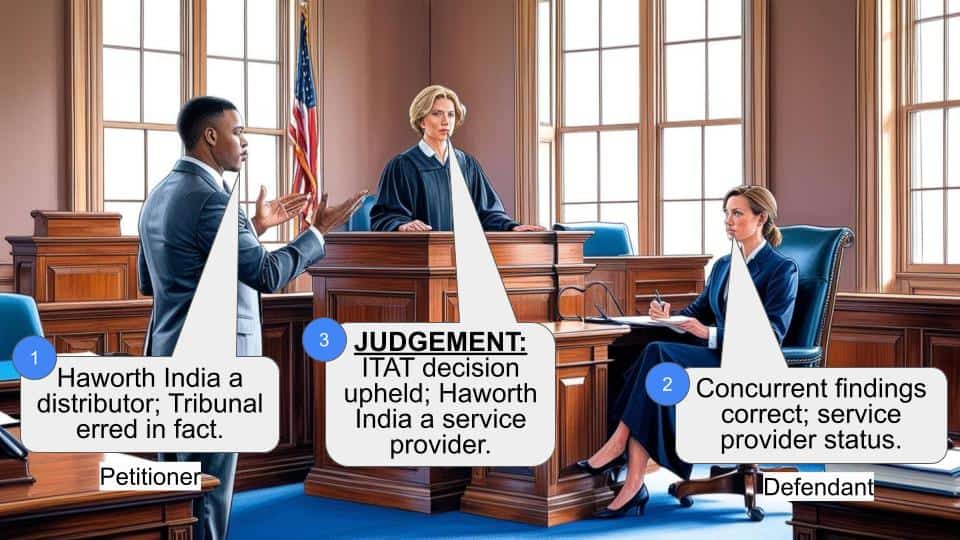
This case involves an appeal by the Principal Commissioner of Income Tax against International Metro Civil Contractors. The dispute centered around the allocation of overhead expenses in a transfer pricing case. The High Court largely upheld the Income Tax Appellate Tribunal's decision, which was in favor of the assessee (International Metro Civil Contractors).
Get the full picture - access the original judgement of the court order here.
Case Name
Principal Commissioner of Income Tax Vs International Metro Civil Contractors (High Court of Bombay)
Income Tax Appeal No. 559 of 2015
Key Takeaways:
1. The High Court upheld the Tribunal's decision on allowing overhead expenses allocation.
2. The court emphasized the importance of benchmarking in transfer pricing cases.
3. The judgment highlights the significance of maintaining proper documentation and evidence in tax matters.
Issue:
The main issue was whether the Income Tax Appellate Tribunal was justified in allowing the assessee's claim for overhead expenses allocation at 8.5% of turnover in a transfer pricing case.
Facts:
1. The case relates to Assessment Year 2008-09.
2. The assessee had an agreement with 5 Joint Venture (JV) partners.
3. This agreement allowed JV partners to allocate head office overhead expenses to the assessee up to 8.5% of the assessee's turnover.
4. The Transfer Pricing Officer (TPO) disallowed this allocation, resulting in an addition of Rs. 19.45 lakhs to the assessee's income.
5. The Commissioner of Income Tax (Appeals) allowed the assessee's appeal against this disallowance.
6. The Revenue then appealed to the Income Tax Appellate Tribunal, which upheld the CIT(A)'s decision.
Arguments:
The Revenue's main arguments were:
1. The Tribunal was not justified in allowing the assessee's claim following AS-7 of the ICAI, as it wasn't notified under Section 145 (of Income Tax Act, 1961).
2. The Tribunal shouldn't have deleted the overhead expenses at 8.5% of turnover without considering that the TPO found the assessee couldn't produce evidence for services rendered.
3. The Tribunal shouldn't have given relief for A.Y. 2006-07 based on findings from earlier years.
The assessee argued that:
1. The allocation was based on a valid agreement with JV partners.
2. They had provided auditor's certificates and detailed workings to support the overhead expenses.
3. The TPO hadn't benchmarked the expenses to prove they were excessive.
Key Legal Precedents:
The judgment doesn't mention specific legal precedents, but it refers to Section 260A (of Income Tax Act, 1961), under which the appeal was filed.
Judgement:
1. The High Court admitted the appeal only on the first question of law (regarding AS-7 of ICAI).
2. On the issue of overhead expenses, the court found no reason to interfere with the Tribunal's decision, stating it was essentially a finding of fact.
3. The court noted that the Revenue hadn't shown that the Tribunal's findings were perverse in any manner.
4. The third question was deemed academic and not entertained.
FAQs:
Q1: What was the main issue in this case?
A1: The main issue was whether the allocation of overhead expenses at 8.5% of turnover was justified in a transfer pricing case.
Q2: Why did the High Court uphold the Tribunal's decision?
A2: The court found that the Tribunal's decision was based on factual findings, and the Revenue couldn't prove these findings were perverse.
Q3: What's the significance of this judgment for transfer pricing case
A3: It highlights the importance of proper documentation and benchmarking in transfer pricing disputes.
Q4: What sections of the Income Tax Act were relevant in this case?
A4: The appeal was filed under Section 260A (of Income Tax Act, 1961). Section 145 (of Income Tax Act, 1961) was also mentioned in relation to accounting standards.
Q5: Did the court make any new legal interpretations in this case?
A5: The judgment doesn't appear to make any new legal interpretations. It primarily upholds the factual findings of the lower authorities.

1. This Appeal under Section 260 (of Income Tax Act, 1961)A of the Income Tax Act, 1961 (the Act) challenges the common order dated 26th September, 2014 passed by the Income Tax Appellate Tribunal (the Tribunal) for Assessment Years 200405 to 200809. This appeal from the common impugned order relates to Assessment Year 200809.
2. Mr. Walve, the learned Counsel appearing for the Revenue urges the following reframed questions of law :
(i) Whether on the facts and in the circumstances of the case and in law, the Tribunal was justified in allowing the claim of the assessee following the AS7 of the ICAI and by not appreciating the fact that the same is not notified the provisions of Sec.145 (of Income Tax Act, 1961)?
(ii) Whether on the facts and in the circumstances of the case and in law, the Tribunal was justified in deleting overhead expenses @8.5% of the turnover is at Arm's Length Price without considering the fact that TPO has specifically given finding that the assessee could not produce evidence for service rendered as overhead expenses by the Joint Venture partners ?
(iii) Whether on the facts and in the circumstances of the case and in law, the Tribunal was justified in giving relief for A.Y. 200607 relying on findings of A.Y. 200203 to 200506 not considering the fact that not taking inquiry in earlier years by Assessing Officer will not preclude Assessing Officer to investigate the matter in following years?
3. Regarding Question No.(ii) :
(a) During the course of the Transfer Pricing proceedings, the Transfer Pricing Officer (TPO) noted that there was an agreement between the assessee and the 5 Joint Ventures (JV partners). This agreement inter alia permitted the JV partners to allocate its head office overhead expenses to the assessee to the extent of 8.5% of the turnover of the assessee. The TPO disallowed the same on the ground that other expenses incurred by the JV partners have been debited in the books of the assessee on being separately computed. Therefore, there was no need to allocate overhead office expenses of JV partners on an adhoc basis to the assessee to the extent of 8.5% of the assessee's turnover. The assessment order was completed on the basis of the transfer pricing adjustment made in TPO's order by disallowing the above expenditure resulting in addition of Rs.19.45 lakhs.
(b) In appeal, the Commissioner of Income Tax (Appeals) [CIT(A)] allowed the appeal of the assessee. This by holding that the TPO had not brought anything on record to indicate that debiting of overhead expenses were excessive on the basis of comparables i.e. no benchmarking of the expenses. Reliance was also placed upon the Agreement between the JV partners and the assessee. Further, it held that details of overhead expenses were supported by the Auditor's Certificate of the JV partners and along with the detailed working. Thus, the assessment order to the above extent was set aside.
(c) Being aggrieved, the Revenue filed an appeal to the Tribunal. The impugned order of the Tribunal examined the agreement entertained into between the JV partners and the assessee. It found that the agreement provides for overhead office expenses of the respective JV partners being allocated to the assessee to the extent of 8.5% of its turnover. Further, the impugned order of the Tribunal also records the fact that the TPO has not benched mark the overhead office expenses debited to determine that it was in excess of comparable transactions. The impugned order on facts independently came to the same conclusion as the CIT(A) that the TPO was not correct in stating that the respondent had not furnished the details in support of his claim for allocation of overhead office expenses to the extent of 8.5%. This was found to be incorrect as the respondent assessee has furnished the Certificate of Auditors of the JV partners indicating its overhead charges. The impugned order further records the fact that for the earlier Assessment Years 20042006 and 200506 on identical facts, the TPO did not challenge the claim of overhead expenses of the respondent's JV being debited with a cap of 8.5% of the turnover of the assessee.
(d) We note that the issue urged by the Revenue is essentially one of finding of facts on which both the CIT(A) and the Tribunal have upheld the assessee's stand. The Revenue has not shown that the finding of fact are perverse in any manner.
(e) In the above view, no substantial question of law arises for our consideration. Thus, not entertained.
4. Regarding Question no. (iii) :
(a) In view of our answer to question no.(ii), this question has become academic. The impugned order of the Tribunal upholds the order of CIT(A) that on facts for the subject assessment year, there was no justification for enhancement the ALP by disallowing allocation of overhead office expenses of the JV partners to respondent assessee with a cap of 8.5% of the turnover of the respondent assessee. The reliance upon the earlier assessment orders was only in support of the fact that in identical factual situation, the TPO did not vary the ALP in respect of the allocation of overhead office expenses to the expenditure of the respective JV partners allocated to the assessee with a cap of 8.5% of its turnover.
(b) In the above view, question no.(iii) being academic, does not give rise to any substantial question of law. Thus, not entertained.
5. Appeal admitted on substantial question of law at Sr. No.(i) above.
6. Registry is directed to communicate a copy of this order to the Tribunal. This would enable the Tribunal to keep the papers and proceedings relating to the present appeal available, to be produced when sought for by the Court.
7. To be head along with Income Tax Appeal Nos. 901/2015, 903/2015, 596/2015 and 597/2015.
(SANDEEP K. SHINDE, J.) (M.S. SANKLECHA, J.)
×