


No Penalty for Honest Mistake in Tax Filing, Says Court


Full News

No Penalty for Honest Mistake in Tax Filing, Says Court
No Penalty for Honest Mistake in Tax Filing, Says Court
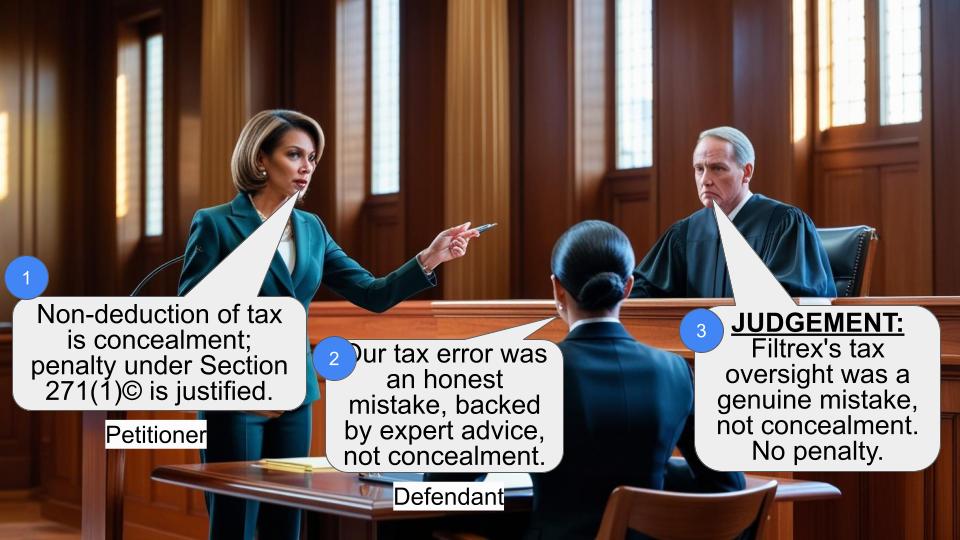
The case involves the Commissioner of Income Tax and Hiralal Doshi, where the main issue was whether a penalty under Section 271(1) (of Income Tax Act, 1961)© of the Income Tax Act, 1961, should be imposed for allegedly concealing income. The court decided in favor of Hiralal Doshi, ruling that no penalty was warranted as there was no concealment or inaccurate particulars filed.
Get the full picture - access the original judgement of the court order here
Case Name
Commissioner of Income Tax vs. Hiralal Doshi (High Court of Bombay)
Income Tax Appeal No. 2331 of 2013
Date: 9th February 2016
Key Takeaways
- The court upheld that if an assessee has not concealed income or filed inaccurate particulars, no penalty under Section 271(1) (of Income Tax Act, 1961)© can be imposed.
- The decision emphasizes the importance of intent and transparency in tax filings.
- The ruling supports the view that mere changes in the classification of income do not automatically lead to penalties.
Issue
Was the imposition of a penalty under Section 271(1) (of Income Tax Act, 1961)© justified when the assessee had disclosed all particulars of income but claimed an exemption?
Facts
Hiralal Doshi initially filed a return declaring a total income, including a long-term capital gain of Rs. 1.62 Crores, which was claimed as exempt under Section 10(38) (of Income Tax Act, 1961). During a survey, additional income was declared, and a revised return was filed. The Assessing Officer imposed a penalty for allegedly concealing income, which was later contested by Doshi.
Arguments
- For the Revenue: The penalty was justified as the assessee initially claimed an exemption which was later withdrawn.
- For Hiralal Doshi: All income particulars were disclosed, and the exemption was claimed in good faith. The change in classification was to avoid litigation and buy peace.
Key Legal Precedents
- Commissioner of Income Tax v/s Reliance Petroleum Products Private Limited: The court referenced this case to support the view that mere change in the head of income does not attract a penalty.
- Commissioner of Income Tax v/s M/s. Bennett Coleman and Co. Ltd: This case was cited to argue that complete disclosure of income, even if reclassified, does not justify a penalty.
Judgement
The court ruled in favor of Hiralal Doshi, stating that the penalty was not justified as there was no concealment of income or filing of inaccurate particulars. The court found the view of the Commissioner of Income Tax (Appeals) and the Tribunal reasonable and dismissed the Revenue’s appeal.
FAQs
Q: Why was the penalty initially imposed?
A: The penalty was imposed because the Assessing Officer believed there was concealment of income when the exemption was claimed and later withdrawn.
Q: What does this decision mean for taxpayers?
A: It underscores the importance of transparency in tax filings and suggests that honest mistakes or reclassifications, when fully disclosed, should not lead to penalties.
Q: How does this case affect future tax assessments?
A: It sets a precedent that penalties should not be imposed for mere reclassification of income if all particulars are disclosed and there is no intent to conceal.

1. This Appeal has been filed by the Revenue under Section 260A (of Income Tax Act, 1961)( the “Act”) assailing the order dated 1st May, 2013 passed by the Income Tax Appellate Tribunal (Tribunal). The impugned order dated 1st May, 2013 deleted the penalty imposed under Section 271(1)(c) (of Income Tax Act, 1961) relating to Assessment Year 2006-2007.
2. The Revenue has urged the following question of law for our consideration:-
“Whether on the facts and circumstances of the case and in law, the ITAT is justified in deleting the penalty u/s.271(1)(c) (of Income Tax Act, 1961) of the I. T. Act,1961 on the income which was offered for taxation during survey and return of income was revised after detection by department”
3. The Respondent-assessee had originally filed a return of income on 31st October, 2006 declaring a total income of Rs.9.69/- lakhs. In its return of income, as filed an amount of Rs.1.62 Crores was credited to its capital account being Long Term Capital Gain on sale of shares. However, no income on account of the above was offered for taxation. Thereafter, on 5th October, 2007, during a course of survey, the Respondent-assessee declared additional income of Rs. 5 Crores which included an amount of Rs.1.62 Crores for Assessment Year 2006-07 which had not been returned as income being long term capital gains in view of exemption claimed under Section 10(38) (of Income Tax Act, 1961).
4. On 29th October, 2007 the Respondent-assessee filed a revised return of income for the Assessment Year 2006-07, wherein an amount of Rs.1.62 Crores was returned as part of income totally aggregating to Rs.1.72 Crores. On 25th November, 2008, the Assessing Officer completed the assessment proceedings under Section 143(3) (of Income Tax Act, 1961) determining a total income at Rs.1.74 Crores. The Assessment order also initiated penalty proceeding under Section 271(1)(c) (of Income Tax Act, 1961), for claiming incorrect exemption.
5. By an order dated 27th May, 2009 the Assessing Officer imposed a penalty of Rs.55.79 lakhs under Section 271(1)(c) (of Income Tax Act, 1961) for having concealed particulars of income and furnishing inaccurate particulars thereof. This on the ground that the amount of Rs.1.62 Crores had originally been claimed as Long Term Capital Gain being exempt in its regular return of income. However, the same was withdrawn and offered to tax as business only consequent to the survey on 5th October, 2007.
6. Being aggrieved by the order imposing penalty, the Respondent-assessee preferred an appeal to the Commissioner of Income Tax(Appeals) (CIT[A]). By an order dated 27th May, 2010 the CIT(A) deleted the penalty on the ground that the amount of Rs.1.62 Crores had been declared as capital gains in the original return of income. Besides inter-alia noting in the order that “It is also pertinent to note that all details relating the transactions have been duly disclosed in the return of income.” Further the order of the CIT(A) observes that during the course of proceeding before him sufficient evidence in the form of brokers note, copy of balance-sheet, copy of Demat account, evidence of payment for shares etc has been produced in support of the transaction for him to prima facie conclude that the amount of Rs.1.62 Crores appears to be attributable to Long Term Capital Gain.
7. On further appeal by the Revenue, the Tribunal by the impugned order dated 1st May, 2013 upheld the findings of the CIT(A) holding the same to be reasonable. In particular, the impugned order records the fact that the Respondent-assessee had disclosed its income of Rs.1.62 Crores but had claimed the same to be a capital gain which is exempt. The impugned order further holds that as the particulars of income had been disclosed in the return of income, the levy of penalty under Section 271(1)(c) (of Income Tax Act, 1961) was not justified. In support it places reliance upon the decision of the Apex Court in Commissioner of Income Tax v/s Reliance Petroleum Products Private Limited reported in 322 ITR 158. Further it holds that mere change in head of income by the Assessing Officer from that claimed, would not attract penalty. In support, reliance was placed upon the decision of this Court in Commissioner of Income Tax v/s M/s. Bennett Coleman and Co.Ltd (Income Tax Appeal(L)No.2117 of 2012 rendered on 26th February, 2013. The impugned order also records the fact that the amount claimed as long term capital gain under Section 10(38) (of Income Tax Act, 1961) while filing its regular return of income on 31st October, 2006 was offered as part of business income during survey of proceeding only by to buy peace. In the circumstances, the impugned order upheld the deletion of penalty of the CIT(A).
8. Mr. Malhotra, learned counsel appearing in support of the Appeal submits as under:-
(a) The Commissioner of Income Tax(Appeals) has referred to brokers note, copy of balance sheet, copy of Demat Account, bank statement etc to reach a conclusion that prima facie the income appears to be on account of Long Term Capital Gain. This is totally unjustified as no remand report was called for from the Assessing Officer and the Revenue was given no opportunity to contest the same;
(b) The justification by the Assessee of having made the disclosure of Rs.1.62 Crores as business income when originally claimed as capital gain was for the purposes of buying peace is not available as held by the Apex Court in Mak Data P. Ltd v/s Commissioner of Income Tax-II(Civil Appeal No.9772 of 2013 rendered on 30th October, 2013; and
(c) That a change of head of income during the assessment proceeding would warrant penalty upon a defaulting assessee if the same has an impact on the tax payable. Thus the decision of this Court in Bennett Column Ltd(supra) will not apply. In the above view, it is submitted that the appeal be admitted.
9. Mr. Malhotra's contention that the order of the CIT(A) was in breach of principles of natural justice in as much as no remand report was called for by the CIT(A) in respect of the fresh evidence led by the Respondent-assessee before him is not even mentioned in the memo of appeal. We find that there is nothing on record to indicate that no remand report were called for by the CIT(A). However,when confronted, Mr Malhotra submits that evidence of no remand report having been called for is the absence of it being mentioned in the order of the CIT(A). Thus, he wants us to infer that no remand report was called for. However, it is also to be noted that before the Tribunal, the Revenue did not raise this issue. This could equally lead to the inference that either the remand report was called for or at the very least, in any event, the Revenue did not have any grievance on the remand report not being called for before the Tribunal. This submission on behalf of the Revenue requires determination of facts which have to be determined by the Tribunal. It is not open at this stage in an appeal under Section 260A (of Income Tax Act, 1961) to go into facts which were not disputed at any prior stage.
10. The reliance by the Revenue upon the decision of the Apex Court in Mak Data P. Ltd(supra) to contend that the justification of having deleted and accepted the amount of Rs.1.62 Crores as business income, to buy peace is not available. We find that the facts in that case are completely distinguishable and the observations made therein would not be universally applicable.
In that case, a sum of Rs.40.74 lakhs had never been disclosed to the Revenue. During the course of survey, the assessee therein had surrendered that amount with a covering letter that this surrender has been made to avoid litigation and buy peace with the Revenue. In the aforesaid circumstances, the Apex Court held that the words like “to avoid litigation and buy peace” is not sufficient explanation of an assessee's conduct. It held that the assessee had to offer an explanation for the concealment of income and/or furnishing of inaccurate particulars of income by leading cogent and reliable evidence. The Apex Court further records that in the facts of the case before it the surrender of income was not voluntary but was made only on the account of detection by the Assessing Officer during the course of survey. Further, the Apex Court also records the fact that the survey was conducted more than 10 months before the assessee filed its return of income. However, the assessee therein had not declared this income in its return of income filed subsequent to the survey which again indicated the fact that he had no intention to declare its true income. In any event, the facts in the present case as found by the CIT(A) and the Tribunal is that the Respondent- assessee had disclosed an amount of Rs.1.62 Crores in the original return by crediting the same to its capital account being Long Term Capital Gain on the sale of share. Thus, the Appellant was under bonafide belief that the income from long term capital gain was exempt from tax. Thus, the decision of the Apex Court would not apply to the facts arising in the present case .
11. The contention on behalf of the Revenue that in case there is a tax impact by virtue of change of head during the assessment proceedings then penalty is imposable and the decision of this Court in M/s. Bennett Coleman(supra) would not apply. In such a case, Mr. Malhotra, for the Revenue emphasized the fact that in M/s Bennett Coleman(supra) the Court was dealing with the change of head of income but not with regard to a claim for full exemption from payment of tax as in this case. We are unable to accept the aforesaid submission. According to us, the distinction sought to made on behalf of the Revenue is not acceptable as the ratio of the decision in M/s Bennett Coleman(supra) is where complete disclosure of income had been made in the return of income and head of the income undergoes a change at the hands of the Assessing Officer would not by itself justify the imposition of penalty under Section 271(1)(c) (of Income Tax Act, 1961).
12. We find that the Commissioner of Income Tax(A) during the penalty proceedings had again examined the issue whether the claim of capital gain made in the regular return of income to the extent of Rs.1.62 Crores with the particulars in support of the same. On examination, the CIT(A) reaches a prima facie conclusion that the income could be regarded as long term capital gain. Once the aforesaid conclusion has been reached coupled with two further facts viz. the authorities have rendered a finding of fact that the Respondent-assessee had not concealed its income nor filed inaccurate particulars attributable to capital gains in its regular return of income, the view taken to delete the penalty is a possible view.
13 In the present fact, the view taken by the CIT(A) as well as the Tribunal is a reasonable and possible view. Nothing has been shown to us to hold that the findings of the CIT(A) and Tribunal was perverse and/or arbitrary warranting any interference by this Court. It may be pointed out that even in the Memo of Appeal, it is not urged by the Revenue that the finding of the CIT(A) and Tribunal are in any manner perverse.
14. In the above view, we see no reason to entertain the question as proposed, as it does not give rise to any substantial question of law. Accordingly, the Appeal is dismissed. No order as to costs.
( B. P. COLABAWALLA, J.) (M. S. SANKLECHA, J.)
×
Similar Ripples
Questions
No Penalty for Honest Mistake in Tax Filing, Says Court
Write your CommentSimilar Posts

Generic
- Reportdata/3109.pdf
