


Petition dismissed due to delay and participation in proceedings.





Full News

Petition dismissed due to delay and participation in proceedings.
Petition dismissed due to delay and participation in proceedings.
The case involves Akshata Mercantile (P) Ltd. challenging the transfer of its income tax assessment from Mumbai to Raipur. The High Court dismissed the petition due to the delay in filing and the company's participation in the proceedings at Raipur, indicating acceptance of the transfer.
Get the full picture - access the original judgement of the court order here.
Case Name:
Akshata Mercantile (P) Ltd. vs Deputy Commissioner of Income Tax (High Court of Bombay)
Writ Petition No.2203 of 2016
Key Takeaways
- The court emphasized the importance of timely filing petitions when seeking extraordinary writ jurisdiction.
- Participation in proceedings at Raipur indicated acceptance of the transfer order.
- The court dismissed the petition due to delay and acquiescence.
Issue
Did the petitioner, Akshata Mercantile (P) Ltd., waive its right to challenge the transfer of its income tax assessment from Mumbai to Raipur by participating in the proceedings at Raipur and delaying the filing of the petition?
Facts
- A search and seizure action was conducted on Akshata Mercantile and its group on October 10, 2012.
- On December 9, 2013, the Commissioner of Income Tax, Mumbai, transferred the assessment proceedings to Raipur.
- The petitioner responded to notices from the Deputy Commissioner of Income Tax, Raipur, and filed returns of income.
- The petitioner challenged the transfer order in the High Court of Chhattisgarh on February 27, 2015, which was later withdrawn.
- The current petition was filed in the High Court on September 22, 2016.
Arguments
Petitioner
- The delay in filing the petition was due to pending rectification applications and representations.
- The petitioner did not waive its objections to the jurisdiction issue.
- The petitioner sought a prospective transfer from Raipur to Mumbai.
Respondent
- The petitioner delayed challenging the transfer order and participated in the proceedings at Raipur.
- The delay and participation indicated acceptance of the transfer order.
Key Legal Precedents
- Chennai Metropolitan Water Supply And Sewerage Board Vs. T.T. Murali Babu:
The court emphasized the importance of timely filing petitions and the consequences of delay and laches.
Judgement
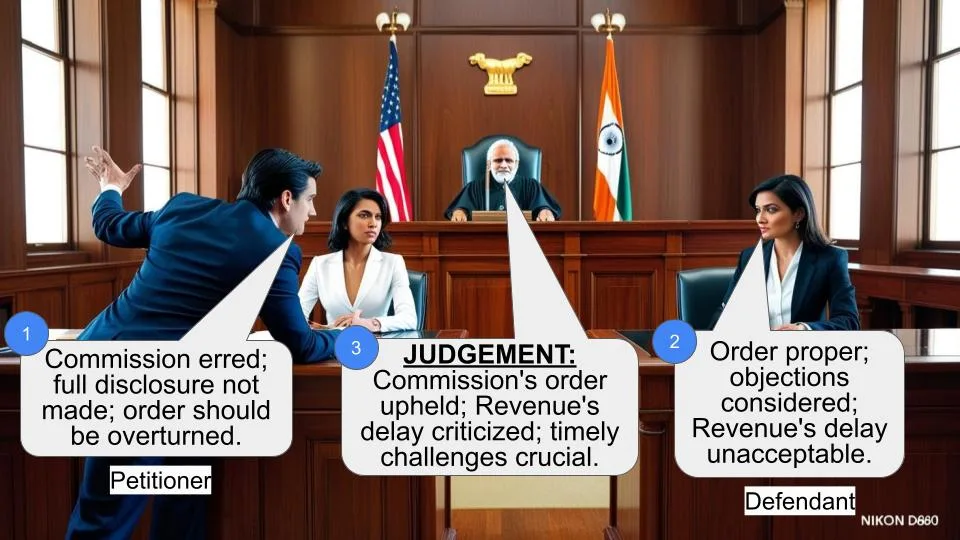
The court dismissed the petition due to the delay in filing and the petitioner's participation in the proceedings at Raipur, indicating acceptance of the transfer order. The court emphasized that extraordinary writ jurisdiction requires timely action and that the petitioner had waived its right to challenge the transfer by participating in the proceedings.
FAQs
Q1. Why was the petition dismissed?
A1. The petition was dismissed due to the delay in filing and the petitioner's participation in the proceedings at Raipur, indicating acceptance of the transfer order.
Q2. What was the main issue in the case?
A2. The main issue was whether the petitioner waived its right to challenge the transfer of its income tax assessment from Mumbai to Raipur by participating in the proceedings at Raipur and delaying the filing of the petition.
Q3. What legal precedent did the court rely on?
A3. The court relied on the precedent set in Chennai Metropolitan Water Supply And Sewerage Board Vs. T.T. Murali Babu, which emphasized the importance of timely filing petitions and the consequences of delay and laches.
Q4. What does this decision mean for the parties involved?
A4. The decision means that the petitioner, Akshata Mercantile (P) Ltd., must accept the transfer of its income tax assessment to Raipur and cannot challenge it further due to the delay and participation in the proceedings.

1. This petition under Article 226 of the Constitution of India challenges :
(i) Order dated 9 December 2013 passed by the Commissioner of Income Tax, Mumbai under Section 127 (of Income Tax Act, 1961) of the Incometax Act, 1961 (“the Act), transferring the Petitioner's assessment proceedings from Mumbai to Raipur. This as a part of centralizing all assessment proceedings belonging to the Petitioner and its group; and
(ii) Order dated 23 January 2014 passed by the Central Board of Direct Taxes (CBDT) rejecting the Petitioner's request to centralize all assessment proceedings of the Petitioner and its group companies at Mumbai.
2. Briefly, the relevant facts leading to this petition are as under :
(i) On 10 October 2012, a search and seizure action under Section 132 (of Income Tax Act, 1961) was carried out by the Office of the Commissioner of Income Tax at Bhopal on the Petitioner and its group. The search was carried out at various places including Raipur.
(ii) Thereafter on 28 August 2013, a show cause notice was issued to the Petitioner. This notice invited objections to the proposed transfer under Section 127(2) (of Income Tax Act, 1961) of Petitioner's income tax assessment proceedings (case) from Mumbai to Raipur (in the charge of Commissioner of Income Tax at Bhopal), for proper coordinated investigation.
(iii) The Petitioner objected to the proposed transfer by its letter dated 5 September 2013. However, the Commissioner of Income Tax, Mumbai did not accept the Petitioner's objections. Therefore, by order dated 9th December, 2013 under Section 127(2) (of Income Tax Act, 1961), the Petitioner's case with its group companies cases were transferred from Mumbai to Deputy Commissioner of Income Tax, Raipur for the purposes of coordinated investigation. This as the flagship company of the group was being assessed at Raipur.
(iv) Consequent to the above, on 31 December 2013, the Deputy Commissioner of Income Tax, Raipur issued notices under Section 153A (of Income Tax Act, 1961). By the above notices under Section 153A (of Income Tax Act, 1961), the Petitioner was called upon to file its return of income for the Assessment Years 2007-08 to 2012-13.
(v) Thereafter on 14th August, 2014 notice was also issued to the Petitioner under Section 142(1) (of Income Tax Act, 1961) read with Section 153A (of Income Tax Act, 1961)/143(2) of the Act for the six Assessment Years 200708 to 201213. The Petitioner states that it partly responded to the above notice. Thereafter the Petitioner also filed its return of income for the six Assessment Years on 25 August 2014 and 28 August 2014.
(vi) The Petitioner was also imposed penalty by the Assessing Officer at Raipur for delay in complying with the notice under Section 153 (of Income Tax Act, 1961)A of the Act. Mr. Shridharan, learned Sr. Counsel for the Petitioner states that the Petitioner has filed an appeal from the order, imposing penalty before the Commissioner of Income Tax (Appeals) [CIT(A)]. On instructions, he states that the order imposing penalty, has now been set aside in appeal.
(vii) In the meantime, the Petitioner made representations dated 13th May, 2013 and 9th December, 2013 to Central Board of Direct Taxes (CBDT). By its representations, the Petitioner sought centralization of the Petitioner's case along with its group companies to Mumbai. By order dated 23rd January, 2014, the CBDT rejected the representations, seeking centralization of cases at Mumbai.
(viii)The impugned order dated 9 December 2013 of the Commissioner of Income Tax, Mumbai and the consequent proceedings taken by the Assessing Officer at Raipur were challenged by this Petitioner, by filing a writ petition before the High Court of Chhattisgarh at Raipur. The Petition before the High Court of Chhattisgrah was filed 27th February, 2015.
(ix) On 3 March 2015, the High Court of Chhattisgarh issued notices to the Respondent Revenue for admission as well as for grant of interim relief to the Petitioner in the Petition filed before it on 27th February, 2015. In the meantime, the order dated 9 December, 2013 was stayed by an adinterim order.
(x) Thereafter, on 14 September, 2016,the High Court of Chhattisgarh dismissed the Petition filed on 27th February, 2015 as withdrawn. However, liberty was granted to the Petitioner to file a fresh Petition.
(xi) Thereafter, the Petitioner has filed the present Petition in this Court on 22 September,2016. This Petition challenges the impugned orders dated 9 December, 2013 and 23 January, 2014.
3. At the very outset, Mr. N.C. Mohanty, learned Counsel appearing for the Revenue raised a preliminary objection to the Petition being entertained in view of the delay/laches coupled with the conduct of the Petitioner in having accepted the impugned order dated 9 December, 2013. In particular, he referred to the aforesaid sequence of events, particularly bearing in mind that the impugned orders dated 9 December 2013 and 23 January 2014 have only been challenged after almost over year in the High Court of Chhattisgarh on 3 March 2015. In the meantime, the Assessing Officer at Raipur had exercised jurisdiction consequent to the transfer of the Petitioner's case and the cases of its group companies by issuing notices under Section 153A (of Income Tax Act, 1961) as far back as 31 December, 2013. The Petitioner had also responded to the notices by filing return of income and also responded to the notice issued under Section 142(1) (of Income Tax Act, 1961) read with Section 153A (of Income Tax Act, 1961)/143(2) of the Act.
4. Therefore, before considering the merits of the Petitioner's challenge, in view of the above, we called upon the Petitioner to respond to the preliminary objections.
5. In response, Mr. Sridharan, learned Senior Counsel appearing for the petitioner submits that the delay had been adequately explained by the Petitioner in its petition filed on 27th February, 2015 before the High Court of Chhattisgarh while challenging the impugned orders. The further period, i.e. from 3 March, 2015 (when adinterim stay was granted) till withdrawal on 14 September 2015, stands explained because of the stay. Further, it is submitted that the Petitioner had not waived its objections to the jurisdiction issue raised in this Petition. This is for the reason that even though it had responded to the notice issued by the Assessing Officer at Raipur, it did not wait till an order was passed by the Assessing Officer to file this Petition. Further, the Petitioner merely seeks a prospective transfer from Raipur to Mumbai. Therefore, all the proceedings taken at Raipur till date will not be in vain and proceedings can be continued from that stage at Mumbai. No prejudice is caused to the Revenue by this as the Officer who issued notices at Raipur has changed and new incumbents would be in the same position as Officers in Mumbai while deciding the case. It is submitted that laches / delay on the part of the Petitioner in moving this Petition is immaterial in the absence any prejudice being shown by the Revenue in view of the delay in filing this Petition.
6. The Petitioner has moved this Court seeking an extraordinary writ of certiorari quashing the impugned orders dated 9 December 2013 and 23 January 2014. It is a settled position of law that a person who seeks to exercise an extraordinary jurisdiction of the Writ Court should move the Writ Court expeditiously. The Apex Court in case of Chennai Metropolitan Water Supply And Sewerage Board Vs. T.T. Murali Babu1, in paragraphs 16 and 17 observed as under :
“16. Thus, the doctrine of delay and laches should not be lightly brushed aside. A writ court is required to weigh the explanation offered and the acceptability of the same. The court should bear in mind that it is exercising an extraordinary and equitable jurisdiction. As a constitutional court it has a duty to protect the rights of the citizens but simultaneously it is to keep itself alive to the primary principle that when an aggrieved person, without adequate reason, approaches the court at his own leisure or pleasure, the court would be under legal obligation to scrutinise whether the lis at a belated stage should be entertained or not. Be it noted, delay comes in the way of equity. In certain circumstances delay and laches may not be fatal but in most circumstances inordinate delay would only invite disaster for the litigant who knocks at the doors of the court. Delay reflects inactivity and inaction on the part of a litigant – a litigant who has forgotton the basic norms, namely,
“procrastination is the greatest thief of time” and second, law does not permit one to sleep and rise like a phoenix. Delay does bring in hazard and causes injury to the list.
17. A court is not expected to give indulgence to such indolent personswho compete with “Kumbhakarna” or for that matter “Rip Van Winkle”. In our considered opinion, such delay does not deserve any indulgence and on the said ground alone the writ court should have thrown the petition overboard at the very threshold.”
7. In the present facts, the delay, the Petitioner submits, has been explained in the Petition, filed before the Chhattisgrah High Court on 27 February, 2015. The Chhatisgrah High Court granted an adinterim stay on 3 March, 2015 and it continued till the Petition was withdrawn on 14 September, 2016. Thus, it is argued, the delay stands explained. We find that in the present facts, the impugned orders are dated 9 December, 2013 and 23 January, 2014. The Assessing Officer at Raipur issued notices under Section 153 (of Income Tax Act, 1961)A of the Act on 31st December, 2013. The Petitioner responded to the same by filing its returns of income. Moreover, the Petitioner also responded to the queries raised in notice dated 14 August, 2014 under Section 142(1) (of Income Tax Act, 1961) read with Section 153 (of Income Tax Act, 1961)A and 143(2) of the Act. Inspite of all this happening in the year 201314, the Petitioner moved the High Court of Chhattisgarh only on 27 February 2015. Although, adinterim stay was granted on 3 March, 2015, the Petition was not admitted by the High Court of Chhattisgrah. In fact, it was awaiting admission till 14 September 2016, when the Petition was withdrawn with liberty to file a fresh petition.
Thus, it cannot be said that the High Court of Chhatisgarh was satisfied with the reasons for delay stated by the Petitioner in its petition filed before the High Court of Chhatisgarh as it had no occasion to examine it. We have perused the copy of the petition filed by the Petitioner before the High Court of Chhatisgarh (as annexed to the Petition) wherein the only reason offered is that rectification application to the order dated 9 December 2013 was pending and representations made to the Commissioner of Income Tax were awaiting disposal. Mere filing of a rectification application and representation to the order dated 9 December 2013, which has since become effective, and when the Officer concerned is functus officio, will not by itself be an explanation sufficient to explain the delay. This delay has to be explained by the Petitioner moving the Court for exercise of Court's extraordinary writ jurisdiction under Article 226 of the Constitution of India. It is a prerogative writ and not a writ of course. In such cases, it is for the Petitioner to explain the delay. It is the Petitioner who seeks the extraordinary remedy. It is not for the Respondents to explain the prejudice caused to them in view of the delay, without the Petitioner first sufficiently explaining the reason for the delay. We may at this stage, also point out that on perusal of a copy of the Writ Petition filed before the Chhatisgrah High Court (as annexed to the Petition), no prayer to set aside the order dated 23 January 2014 of the CBDT appears to have been made by the Petitioner. The Petitioner had filed the petition in the High Court of Chhatisgarh, when the Assessing Officer has under Section 153 (of Income Tax Act, 1961)A of the Act already exercised jurisdiction vested in him by order dated 9 December 2013.
8. From events as set out above, we observe that the delay on the part of the Petitioner is accompanied with waiver of its right to challenge the impugned orders dated 9 December 2013 and 23 January 2014 as they have acquiesced in them as is evident from its conduct. It must be borne in mind that the order under Section 127(2) (of Income Tax Act, 1961) dated 9 December 2013 was a reasoned order, preceded by a show cause notice. Therefore, if the Petitioner were aggrieved by the order dated 9 December, 2013, it ought to have challenged the same immediately before the Assessing Officer at Raipur exercised his jurisdiction consequent to the transfer. In fact, in this case, the Petitioner not only failed to challenge the impugned orders dated 9 December 2013 and 23 January 2014 immediately after they were passed but in fact, let the Assessing Officer at Raipur act upon the transfer by responding to the notices issued by the Assessing Officer at Raipur. This is evident from filing of return of income consequent to the notice dated 31 December 2013 under Section 153 (of Income Tax Act, 1961)A of the Act, filing a reply on merits to notice dated 14 August 2014 under Section 142(1) (of Income Tax Act, 1961) read with Section 153 (of Income Tax Act, 1961)A and 143(2) of the Act and also particularly in penalty proceedings by challenging the same under the Act before the CIT(A).
Therefore, the contention of the Petitioner that it had not participated in the assessment proceedings, consequent to the impugned order order of transfer under Section 127(2) (of Income Tax Act, 1961), cannot be accepted. Participation in proceedings does not mean awaiting an order consequent to participation in the proceedings. Participation is on the part of the Assessee and it is at a stage prior to the passing of the order by the authority concerned.
9. It is also to be noted that it is an admitted position between the parties that time to pass an Assessment Order under Section 153A (of Income Tax Act, 1961) would have normally expired on 31 March 2015. However, in view of the adinterim stay granted by the High Court of Chhattisgarh pending admission, the period between 3 March 2015 to 14 September 2016 would stand excluded. This would now leave the Assessing Officer period of only 60 days to complete the assessment in terms of Section 153B (of Income Tax Act, 1961) from 14 September 2016.
10. In the above circumstances, this is not a case where we should exercise our extraordinary jurisdiction to entertain the petition filed by the Petitioner, who has, by participation in the proceedings before the Assessing Officer at Raipur consequent to transfer, acquesed/ accepted the impugned orders dated 9 December 2013 and 23 January 2014.
11. Petition dismissed. No order as to costs.
(S.C. GUPTE, J.) (M.S. SANKLECHA, J.)
×
Similar Ripples
Questions
Petition dismissed due to delay and participation in proceedings.
Write your CommentSimilar Posts


Generic
- Reportdata/11313-HC-Bombay.pdf
