


Software Expenses Are Revenue, Not Capital Expenditure


Full News
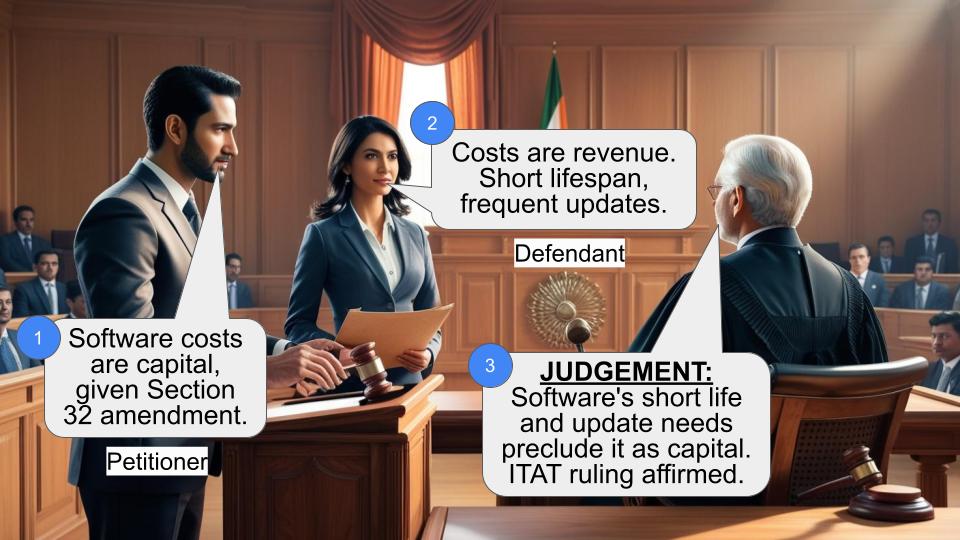
Software Expenses Are Revenue, Not Capital Expenditure
Software Expenses Are Revenue, Not Capital Expenditure
This case involves the Commissioner of Income Tax (CIT) appealing against G.E. Power Services India Ltd. regarding the classification of expenses incurred on computer software. The Income Tax Appellate Tribunal (ITAT) had ruled in favor of the assessee (G.E. Power Services), considering these expenses as revenue expenditure. The High Court dismissed the appeal, agreeing with the ITAT's decision.
Get the full picture - access the original judgement of the court order here
Case Name:
Commissioner of Income Tax vs G.E. Power Services India Ltd. (High Court of Delhi)
ITA No. 1582/2006
Date: 10th October 2007
Key Takeaways
1. Expenses on computer software are considered revenue expenditure, not capital expenditure.
2. Software is not considered an asset of enduring nature due to its short lifespan and need for frequent updates.
3. The amendment to Section 32 (of Income Tax Act, 1961), regarding depreciation on intangible assets, is not retrospective.
4. This ruling reinforces the tax treatment of software expenses for businesses.
Issue
Was the Income Tax Appellate Tribunal correct in allowing a sum of Rs. 4,50,591 for software expenses against the book profit computed under Section 115JA (of Income Tax Act, 1961), treating it as revenue expenditure?
Facts
1. The case pertains to the assessment year 1998-99.
2. G.E. Power Services India Ltd. incurred expenses on software used in its computers.
3. The ITAT had ruled in favor of the assessee, considering these expenses as revenue expenditure.
4. The Commissioner of Income Tax appealed this decision in the High Court.
Arguments
Revenue's Argument:
The Revenue (CIT) argued that the software expenses should be treated as capital expenditure, possibly based on the amendment to Section 32 (of Income Tax Act, 1961), which includes intangible assets for depreciation.
Assessee's Argument:
While not explicitly stated, the assessee (G.E. Power Services) likely argued that software expenses are revenue in nature due to their short-term utility and need for frequent updates.
Key Legal Precedents
1. CIT vs. Woodward Governor India (P) Ltd. (2007) 210 CTR (Del) 354 : (2007) 162 Taxman 60 (Del) - This case was cited as a precedent for dismissing questions (a), (b), and (c) raised by the Revenue .
Judgement
1. The High Court dismissed the appeal, agreeing with the ITAT's decision.
2. The court concluded that expenses incurred on software used in computers are revenue expenditure .
3. The court reasoned that software becomes obsolete quickly and requires frequent updates, therefore not qualifying as an asset of enduring nature .
4. The court noted that the amendment to Section 32 (of Income Tax Act, 1961) is not retrospective and doesn't apply to this case .
FAQs
Q1: Why did the court consider software expenses as revenue expenditure?
A: The court reasoned that software becomes obsolete quickly and requires frequent updates, making it not an asset of enduring nature .
Q2: What is the significance of this judgment for businesses?
A: This judgment allows businesses to claim software expenses as revenue expenditure, potentially reducing their taxable income in the year of purchase rather than depreciating it over time.
Q3: Does this ruling apply to all software purchases?
A: While the judgment doesn't specify, it seems to apply to software used in the regular course of business. However, for specific cases, it's best to consult with a tax professional.
Q4: What about the amendment to Section 32 (of Income Tax Act, 1961)?
A: The court noted that the amendment, which includes intangible assets like software for depreciation, is not retrospective. Therefore, it didn't apply to this case from the 1998-99 assessment year .
Q5: Can this judgment be applied to current tax scenarios?
A: While this judgment provides insight into how courts view software expenses, tax laws may have changed since this ruling. It's always best to consult current tax laws and seek professional advice for specific situations.

1. In this appeal relevant for the asst. yr. 1998-99, the Income-tax Appellate Tribunal (‘Tribunal’), Delhi Bench ‘B’, New Delhi, in ITA No. 1097/Del/2002 dismissed the case set up by the Revenue.
2. The Revenue has raised four questions of law.
3. Insofar as questions (a), (b) and (c) are concerned, the admitted position is that in view of the decision of this Court in CIT vs. Woodward Governor India (P) Ltd. (2007) 210 CTR (Del) 354 : (2007) 162 Taxman 60 (Del) , no substantial question of law arises.
4. Insofar as question (d) is concerned, the question as raised by the Revenue is as under :
"Whether Income-tax Appellate Tribunal (‘Tribunal’) was correct in allowing a sum of Rs. 4,50,591 being software expenses against the book profit computed under s. 115JA of the Act treating the same as revenue expenditure."
5. The Tribunal has come to the conclusion, and we think rightly, that the expenses incurred by the assessee on software used in its computers, are a revenue expenditure. It is well known that the software used in computers gets obsolete in a short span of time and in any case needs to be updated from time to time. It, therefore, cannot be said to be an asset of enduring nature.
6. Learned counsel for the Revenue has brought to our notice s. 38 of the IT Act, 1961 as amended which suggests that know-how, patent, copy rights, trademarks, licences, franchises or any other business or commercial rights of similar nature, being intangible assets acquired on or after the 1st day of April, 1998 and therefore are entitled to depreciation.
7. The amendment to s. 32 is not retrospective and we do not see how it assists learned counsel for the Revenue.
8. In our opinion, no substantial question of law arises.
Dismissed.
MADAN B. LOKUR, J
S. MURALIDHAR, J
OCTOBER 10, 2007
×
Similar Ripples
Questions
Software Expenses Are Revenue, Not Capital Expenditure
Write your CommentSimilar Posts


Generic
- Reportdata/5280.pdf
