


Software firm wins tax deduction battle over foreign currency expenses






Full News

Software firm wins tax deduction battle over foreign currency expenses
Software firm wins tax deduction battle over foreign currency expenses
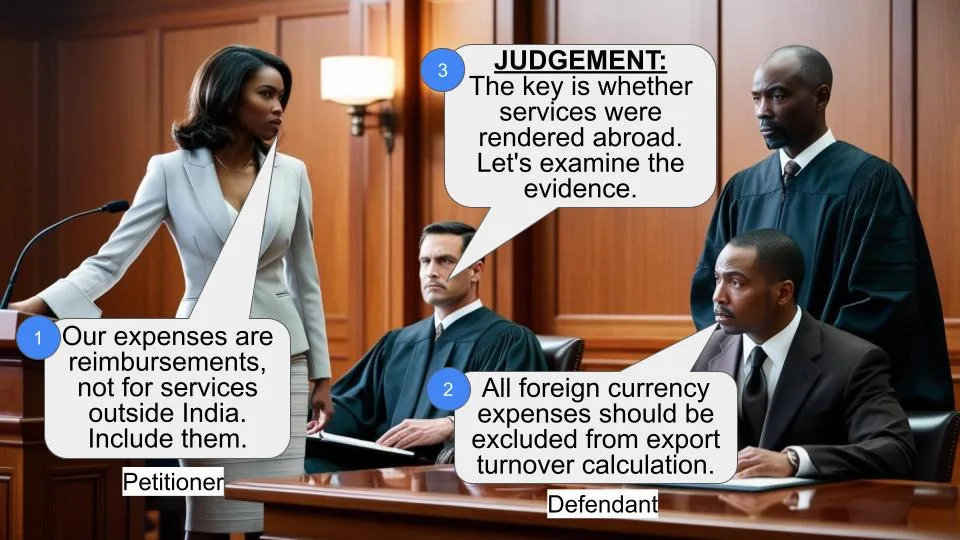
This case involves M/S. Mindtree Ltd. (formerly Mindtree Consulting Pvt. Ltd.) challenging the Income Tax Department's decision to exclude certain expenses from their export turnover when calculating tax deductions under Sections 10B (of Income Tax Act, 1961) and 10AA (of Income Tax Act, 1961). The High Court ruled in favor of Mindtree, allowing the inclusion of these expenses in the export turnover calculation.
Get the full picture - access the original judgement of the court order here
Case Name:
M/s. Mindtree Ltd.(formerly Mindtree Consulting Pvt. Ltd.) Vs Assistant Commissioner of Income Tax (High Court of Karnataka)
ITA No.89 of 2013
Date: 25th August 2020
Key Takeaways:
1. Expenses incurred in foreign currency for software development should not be excluded from export turnover for tax deduction purposes.
2. Telecommunication charges related to software delivery outside India should be included in export turnover.
3. The court's decision aligns with previous rulings on similar issues, strengthening the interpretation of Sections 10B and 10AA (of Income Tax Act, 1961).
Issue:
Should expenses incurred in foreign currency and telecommunication charges be excluded from the export turnover when calculating tax deductions under Sections 10B (of Income Tax Act, 1961) and 10AA (of Income Tax Act, 1961) for a software development company?
Facts:
1. Mindtree Ltd. is a company engaged in software development.
2. For the Assessment Year 2008-09, Mindtree declared a total income of Rs.17,71,91,200/-.
3. The Assessing Officer recomputed the deductions claimed under Sections 10B (of Income Tax Act, 1961) and 10AA (of Income Tax Act, 1961).
4. The dispute centered around the exclusion of Rs.198,17,58,814/- incurred in foreign currency and Rs.3,70,62,460/- in telecommunication charges from the export turnover.
5. The case went through various stages of appeal before reaching the High Court.
Arguments:
Mindtree's arguments:
1. The expenses incurred in foreign currency for software development should not be excluded from export turnover as per Explanation 2(iii) to Section 10B (of Income Tax Act, 1961).
2. Telecommunication charges attributable to software delivery outside India should not be excluded from export turnover.
3. Previous orders for the company's Assessment Year 2009-10 supported their position.
Revenue's arguments:
1. The nature of contracts entered into by Mindtree needed further examination.
2. The case should be remitted to the Commissioner of Income Tax (Appeals) for factual adjudication.
Key Legal Precedents:
1. COMMISSIONER OF INCOME-TAX, BANGALORE VS. MPHASIS LTD., (2016) 74 TAXMANN.COM 274 (KARNATAKA) - upheld by Supreme Court on 13.11.2019 in SLP(C)No.766/2015
2. COMMISSIONER OF INCOME TAX AND ANR. VS. M/S TATA ELXSI LTD AND ANR., I.T.A.NO.386, 387 & 388/2015 decided on 15.02.2016
3. COMMISSIONER OF INCOME-TAX, BANGALORE VS. RELQ SOFTWARE (P) LTD., (2015) 53 TAXMANN.COM 78 (KARNATAKA)
Judgement:
1. The High Court ruled in favor of Mindtree Ltd.
2. The court held that expenses incurred in foreign currency for software development should not be excluded from export turnover under Section 10B (of Income Tax Act, 1961).
3. Telecommunication charges related to software delivery outside India should not be excluded from export turnover under Section 10AA (of Income Tax Act, 1961).
4. The court quashed the previous order (dated 11.01.2013) to the extent it was prejudicial to Mindtree.
FAQs:
1. Q: What was the main issue in this case?
A: The main issue was whether foreign currency expenses and telecommunication charges should be excluded from export turnover when calculating tax deductions for a software development company.
2. Q: How does this judgment affect software companies in India?
A: This judgment allows software companies to include certain foreign currency expenses and telecommunication charges in their export turnover, potentially increasing their tax deductions under Sections 10B (of Income Tax Act, 1961) and 10AA (of Income Tax Act, 1961).
3. Q: Did the court create new law in this case?
A: No, the court primarily reinforced existing interpretations of the law, citing previous similar judgments that were upheld by the Supreme Court.
4. Q: What sections of the Income Tax Act were central to this case?
A: Sections 10B and 10AA of the Income Tax Act, particularly the explanations related to the definition of "export turnover," were central to this case.
5. Q: Why is this judgment significant?
A: This judgment provides clarity on the interpretation of tax laws for software companies, potentially leading to more favorable tax treatment for their foreign currency expenses and telecommunication charges.

This appeal under Section 260A (of Income Tax Act, 1961) (hereinafter referred to as the Act for short) has been preferred by the assessee. The subject matter of the appeal pertains to the Assessment year 2008-09. The appeal was admitted by a bench of this Court vide order dated 09.04.2013 on the following substantial questions of law:
(i) Whether on the facts and in the circumstances of the case, the Honourable ITAT was right in upholding the action of the Learned Respondent in excluding expenditure of Rs.198,17,58,814/- incurred in foreign currency from export turnover under Section 10B (of Income Tax Act, 1961) and Section 10AA (of Income Tax Act, 1961) when the Appellant is engaged in software development?
(ii) Whether on the facts and in the circumstances of the case, the Honourable ITAT was right in upholding the action of the Learned Respondent in excluding telecommunication charges of Rs.3,70,62,460/- from export turnover under Section 10B (of Income Tax Act, 1961) and Section 10AA (of Income Tax Act, 1961) when the same represented payment made for standard facility?
(iii) Whether on the facts and in the circumstances of the case, the Honourable ITAT was right in upholding the action of the learned respondent in excluding expenditure of Rs.198,17,58,814/- incurred in foreign currency from export turnover under Section 10B (of Income Tax Act, 1961) and Section 10AA (of Income Tax Act, 1961) when the appellant is engaged in software development?
(iv) Whether on the facts and in the circumstances of the case, the Honourable ITAT was right in upholding the orders of lower authorities in excluding telecommunication charges of Rs.83,19,013/- from export turnover under Section 10B (of Income Tax Act, 1961) and Section 10AA (of Income Tax Act, 1961) when the same was not incurred in foreign currency?
(v) Whether on the facts and in the circumstances of the case, the Honourable ITAT was right in upholding the action of the learned respondent in excluding telecommunication charges of Rs.3,70,62,460/- from export turnover under Section 10B (of Income Tax Act, 1961) and Section 10AA (of Income Tax Act, 1961) when the same represented payment made for standard facility?
2. The factual backdrop in which the aforesaid questions arise for consideration in this appeal needs mention. The assessee is a company engaged in software development and filed its return of income for Assessment year 2008-09 by declaring a total income of Rs.17,71,91,200/-. The return was processed under Section 143(1) (of Income Tax Act, 1961) and was selected for scrutiny assessment under Section 143(3) (of Income Tax Act, 1961). Thereupon, a notice under Section 143(2) (of Income Tax Act, 1961) was issued. The Assessing Officer by an order 31.12.2010 inter alia held that deductions as claimed by the assessee under Section 10B (of Income Tax Act, 1961) and Section 10AA (of Income Tax Act, 1961) are required to be recomputed and the return of income after re- computation of the deduction was assessed along with interest and penalty. Being aggrieved, the assessee filed an appeal before the Commissioner of Income Tax (Appeals). The Commissioner of Income Tax (Appeals) by an order dated 03.02.2012 partly allowed the appeal. Being aggrieved, the assessee as well as the revenue filed appeals before the Income Tax Appellate Tribunal (hereinafter referred to as ‘the Tribunal’, for short). The Tribunal vide order dated 11.01.2013 dismissed the appeal preferred by the assessee. In the aforesaid factual background, the assessee has filed this appeal.
3. Learned counsel for the parties at the outset submitted that substantial question of law Nos. III and V in substance arise for consideration in this appeal.
4. It is submitted by learned counsel for the assessee that assessee had incurred expenditure of Rs.198,17,58,814/- in foreign currency from export turnover when the assessee was engaged in software development and therefore, in view of Explanation 2(iii) to Section 10B (of Income Tax Act, 1961), the term ‘export turnover’ does not include any expenses incurred in foreign exchange in providing technical services outside India. However, notwithstanding the fact that having found that assessee is engaged in the development of computer software, which would qualify for deduction under Section 10B (of Income Tax Act, 1961), the Commissioner of Income Tax (Appeals) and the Tribunal have failed to appreciate the aforesaid aspect of the matter. It is further submitted that the expression ‘export turnover’ used in Explanation 2(iii) to Section 10B (of Income Tax Act, 1961) does not include trade, telecommunication charges or insurance attributable to delivery of articles or things or computer software outside India or expenses, if any, incurred in foreign exchange in providing the technical services. It is therefore, submitted that the aforesaid expenses could not have been excluded from the export turnover. In support of aforesaid submissions, reference has been made to order dated 26.12.2011 passed by the Assessing Officer in the case of assessee itself for the Assessment year 2009-10, and the expenditure incurred by the assessee towards telecommunication expenses, foreign currency expenses was excluded from the export turnover. The aforesaid order was upheld by the Income Tax Appellate Tribunal vide order dated 11.05.2016 passed in I.T.A.Nos.1328, 1347/bang/2011 and 1391/bang/2013. Thereafter, an order was passed on 31.01.2017 by which the order of the Tribunal was given effect to. It is further submitted that substantial questions of law involved in this appeal are no longer res integra and have been answered by a division bench of this court in I.T.A.No.42/2008 vide judgment dated 20.10.2014. The aforesaid order was upheld by the Supreme Court vide order dated 22.02.2019. Reliance has been placed on decisions of this court in ‘COMMISSIONER OF INCOME-TAX, BANGALORE VS. MPHASIS LTD.’, (2016) 74 TAXMANN.COM 274 (KARNATAKA) which has been upheld by Supreme Court vide order dated 13.11.2019 passed in SLP(C)No.766/2015. Reference has also been made to decisions of this court in ‘COMMISSIONER OF INCOME TAX AND ANR. VS. M/S TATA ELXSI LTD AND ANR.’, I.T.A.NO.386, 387 & 388/2015 DECIDED ON 15.02.2016 and ‘COMMISSIONER OF INCOME-TAX, BANGALORE VS. RELQ SOFTWARE (P) LTD.’, (2015) 53 TAXMANN.COM 78 (KARNATAKA).
5. On the other hand, learned counsel for the revenue submitted that the finding with regard to nature of contracts entered into by the assessee has not been returned either by Commissioner of Income Tax (Appeals) or by Income Tax Appellate Tribunal and therefore, the matter deserves to be remitted for adjudication of the aforesaid factual aspect to the Commissioner of Income Tax (Appeals). It is also urged that the aforesaid questions of fact cannot be adjudicated by this court in this appeal and the decisions relied upon by the learned counsel for the revenue are distinguishable as in the aforesaid cases, the findings were recorded with reference to the facts of the case.
6. We have considered the submissions made by learned counsel on both the sides and have perused the record. Before proceeding further, it is apposite to take note of the relevant provisions of Section 10B (of Income Tax Act, 1961) and Section 10AA (of Income Tax Act, 1961).
Explanation 2(iii) to Section 10B (of Income Tax Act, 1961) “export turnover” means the consideration in respect of export by the undertaking of articles or things or computer software received in, or brought into India by the assessee in convertible foreign exchange in accordance with Section 10B(3) (of Income Tax Act, 1961), but does not include:-
(a) Freight, telecommunication charges or insurance attributable to the delivery of the articles or things or computer software outside India.or
(b) Expenses, if any, incurred in foreign exchange in providing the technical services outside India.
7. From perusal of aforesaid provision, it is evident that expression ‘export turnover’ does not include any expenses incurred in foreign exchange in providing technical services outside India.
Explanation 1(i) to Section 10AA (of Income Tax Act, 1961) and Explanation 2 to Section 10AA (of Income Tax Act, 1961) read as under:
“export turnover” means the consideration in respect of export by the undertaking, being the Unit of articles or things or services received in, or brought into, India by the assessee but does not include –
a. Freight, telecommunication charges or insurance attributable to the delivery of the articles or things outside India.or
expenses, if any, incurred in foreign exchange in rendering of services (including computer software) outside India
Explanation 2 – For the removal of doubts, it is hereby declared that the profits and gains derived from on site development of computer software (including services for development of software) outside India shall be deemed to be the profits and gains derived from the export of computer software outside India.
8. In the light of aforementioned statutory provisions, the facts of the case in hand may be examined. It is pertinent to note that Commissioner of Income Tax (Appeals) in paragraph 5.2 of the order has taken note of the agreements entered into by the assessee and has reproduced the relevant extracts of the agreement in the tabular form. Thereafter, in paragraph 5.4, the Commissioner of Income Tax (Appeals) has held as follows:
“In the instant case, it is true that the appellant is engaged in development of computer software, which is then exported outside India.”
9. Thus, the Commissioner of Income Tax (Appeals) has recorded a categorical finding that assessee is engaged in the development of computer software, which is exported outside India. The aforesaid finding has not been set aside by the Tribunal. Therefore, in view of Explanation 2(iii) to Section 10B (of Income Tax Act, 1961), the expression ‘export turnover’ does not include any expenses incurred in foreign exchange in providing technical services outside India. The assessee has incurred expenditure of Rs.198,17,58,814/- in foreign currency from export turnover for software development. Similarly, the telecommunication charges attributable to delivery of computer software outside India could not have been excluded from the export turnover in view of Explanation 1(i) to Section 10AA (of Income Tax Act, 1961). It is also noteworthy that Explanation 2 to Section 10AA (of Income Tax Act, 1961) provides that profits and gains derived from; on site development of computer software (including services for development of software) outside India shall be deemed to be the profits and gains derived from the export of computer software outside India.
10. It is pertinent to mention here that in the case of assessee itself, for the Assessment year 2009-10, the expenditure incurred in foreign currency was not reduced from export turnover and total turnover, which is evident from the order dated 31.01.2017 passed by the Assistant Commissioner of Income Tax. A bench of this court in Tata Elxsi Limited supra has also taken a view that technical services rendered by the assessee’s engineers in connection with export of computer software, cannot be excluded in computing the export turnover as it forms part of export turnover. The aforesaid order was upheld by the Supreme Court vide order dated 22.02.2019 passed in SLP (C) No.19150/2015. A division bench of this court in Mphasis Ltd., supra has held that foreign currency expenditure incurred for providing software development services outside India cannot be excluded from export turnover for the purpose of computing deduction under Section 10B (of Income Tax Act, 1961) and the aforesaid decision has been upheld by the Supreme Court vide order dated 13.11.2019 passed in SLP (C) No.766/2015.
In view of preceding analysis, substantial questions of law No.3 and 5 are answered in favour of the assessee and against the revenue. In the result, the impugned order dated 11.01.2013 to the extent it is prejudicial to the assessee is hereby quashed. In the result, the appeal is allowed.
Sd/-
JUDGE
Sd/-
JUDGE
×
Similar Ripples
Questions
Software firm wins tax deduction battle over foreign currency expenses
Write your CommentSimilar Posts

Generic
- Reportdata/6190.pdf
