


Supporting Manufacturer Entitled to Deduction Under Section 80HHC (of Income Ta…






Full News

Supporting Manufacturer Entitled to Deduction Under Section 80HHC (of Income Tax Act, 1961) Despite Export House's Loss
Supporting Manufacturer Entitled to Deduction Under Section 80HHC (of Income Tax Act, 1961) Despite Export Ho…
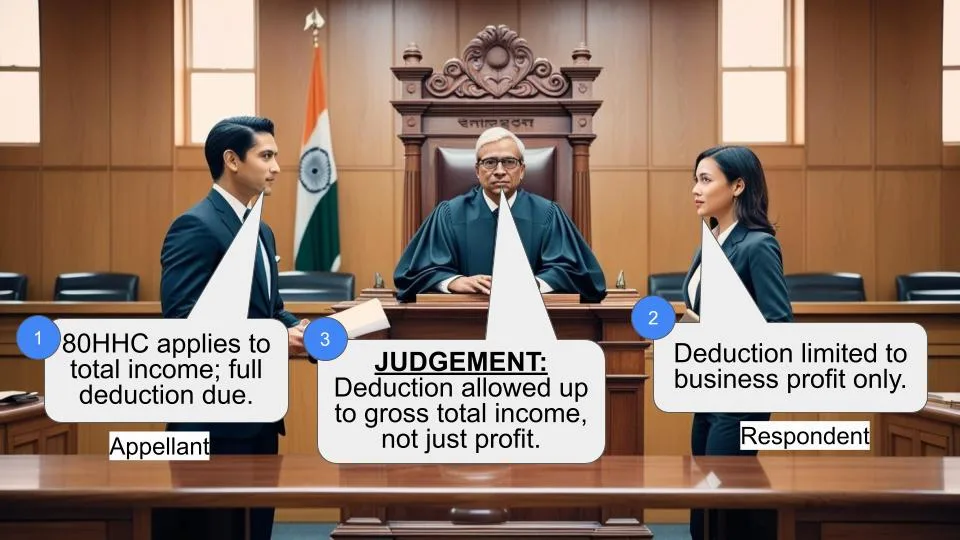
The case involves the Commissioner of Income Tax and Shamanur Kallappa and Sons, where the main issue was whether a supporting manufacturer could claim a deduction under Section 80HHC (of Income Tax Act, 1961), even if the export house did not earn a profit or realize foreign exchange. The court ruled in favor of the supporting manufacturer, allowing the deduction.
Get the full picture - access the original judgement of the court order here.
Case Name:
Commissioner of Income Tax and Another vs. Shamanur Kallappa and Sons (High Court of Karnataka)
Income Tax Appeal No.10/2009
Date: 12th January 2015
Key Takeaways
- The supporting manufacturer is entitled to a deduction under Section 80HHC (of Income Tax Act, 1961) if they fulfill the conditions of selling goods to an export house and obtaining a certificate from the export house.
- The export house's profit or realization of foreign exchange is immaterial for the supporting manufacturer's deduction.
- The court upheld the Tribunal's decision, which allowed the deduction based on the supporting manufacturer's compliance with Section 80HHC(1A) (of Income Tax Act, 1961).
Issue
Can a supporting manufacturer claim a deduction under Section 80HHC (of Income Tax Act, 1961), even if the export house does not earn a profit or realize foreign exchange?
Facts
- The assessee, Shamanur Kallappa and Sons, is a partnership firm engaged in trading sugar, pulses, and exporting rice.
- For the assessment year 2003-04, the assessee claimed a deduction under Section 80HHC (of Income Tax Act, 1961).
- The assessee exported rice to Cambodia through the State Trading Corporation of India Ltd. (STC) and obtained a certificate from STC stating that no export benefit was claimed by STC.
- The Assessing Officer disallowed the deduction, citing STC's loss and the lack of foreign exchange realization.
- The Tribunal ruled in favor of the assessee, leading to an appeal by the revenue.
Arguments
- Revenue:
Argued that the deduction should not be allowed as the export house did not earn a profit and no foreign exchange was realized.
- Assessee:
Contended that they fulfilled all conditions under Section 80HHC(1A) (of Income Tax Act, 1961) and were entitled to the deduction.
Key Legal Precedents
- Section 80HHC(1A) (of Income Tax Act, 1961):
Allows a supporting manufacturer to claim a deduction if they sell goods to an export house and obtain a certificate from the export house.
- INCOME TAX OFFICER vs. MANDIRA D. VAKHARIA:
Established that a certificate produced during proceedings, even if not filed with the return, should be considered for granting benefits.
Judgement
The court ruled in favor of the assessee, Shamanur Kallappa and Sons, stating that the supporting manufacturer is entitled to the deduction under Section 80HHC(1A) (of Income Tax Act, 1961) as long as the conditions are met, regardless of the export house's profit or foreign exchange realization. The appeal by the revenue was dismissed.
FAQs
Q1: What is Section 80HHC (of Income Tax Act, 1961)?
A1: Section 80HHC (of Income Tax Act, 1961) provides deductions for profits derived from export business.
Q2: What conditions must be met for a supporting manufacturer to claim a deduction under Section 80HHC (of Income Tax Act, 1961)?
A2: The supporting manufacturer must sell goods to an export house and obtain a certificate from the export house.
Q3: Does the export house need to earn a profit for the supporting manufacturer to claim the deduction?
A3: No, the export house's profit or realization of foreign exchange is immaterial.
Q4: What was the court's decision in this case?
A4: The court ruled in favor of the supporting manufacturer, allowing the deduction under Section 80HHC (of Income Tax Act, 1961).
Q5: What precedent did the court rely on for this decision?
A5: The court relied on the precedent set in INCOME TAX OFFICER vs. MANDIRA D. VAKHARIA, which allowed consideration of certificates produced during proceedings.

1. The assessee is a partnership firm carrying on the business of trading in Sugar, Pulses and export of Rice. For the assessment year 2003-04, the assessee filed return of income declaring total income of Rs.2,20,55,450/- after claiming deduction of Rs.80,95,064/- under Section 80HHC (of Income Tax Act, 1961) (for short hereinafter referred to as ‘the Act’).
2. It is not in dispute that the assessee exported
rice to Pnomphenh, Cambodia through State Trading
Corporation of India Ltd., (for short hereinafter referred
to the ‘STC’), Jalandhar as a supporting manufacturer
and therefore, they claimed deduction under Section 80 (of Income Tax Act, 1961)
HHC of the Act. The assessee produced a letter dated
28.11.2003 from the STC to the effect that STC had not
claimed any export benefit on the said exports and that
the said exports are under protocol exports i.e.
Government of India to Government Aid Programme and
that the export consideration was received in Indian
rupees from the Ministry of External Affairs. A
certificate of disclaimer from STC in the prescribed
Form 10CCAB and the bill of lading was also filed before
the Assessing Officer.
3. The Assessing Officer disallowed the said claim
on the ground that the STC had declared loss. In other
words, they had not earned any profit out of such
exports. Secondly on the ground that deduction under
Section 80HHC (of Income Tax Act, 1961) is permissible only when the
realization is in foreign exchange. Aggrieved by the said
order, the assessee preferred an appeal to the
Commissioner of Income Tax (Appeals), who confirmed
the order of the Assessing Authority against which the
assessee preferred an appeal to the Tribunal.
4. The Tribunal on consideration of various
provisions of law as well as Circulars held that under
the scheme, the supporting manufacturer gets an
independent right to claim deduction once he gets a
declaration certificate in his favour from the Export
House. What is to be seen is whether the benefit is
claimed by both the Export House and the supporting
manufacturer. If the export house is not claiming the
benefit and the issue of certificate of disclaimer is in
respect of export turn over, then the supporting
manufacturer is entitled to the benefit. After referring to
the circulars issued by the Central Board of Taxes
dealing with the protocol exports, it was held that the
supporting manufacturer has realized the consideration
in Indian currency. Whether the Government of India
has realized some foreign currency is not the criteria.
In view of the specific provision as contained in Section
80 HHC(1A) of the Act, the supporting manufacturer is
entitled to the said benefit. Aggrieved by the said order,
the revenue is in appeal.
5. The learned Counsel appearing for the revenue
assailing the impugned order contended that when the
export house has not earned any profit, the question of
passing on the said benefit to the supporting
manufacturer does not arise. Secondly, the
Government of India gifted the rice to Cambodia and it
is not a sale and no foreign exchange is realized and
therefore, he submits Section 80HHC (of Income Tax Act, 1961) has no
application to the facts of this case.
6. Per contra, learned Counsel for the assessee
submitted that the present case falls under Section
80HHC(1A) of the Act and all the conditions prescribed
therein are fulfilled as held by the Tribunal and
therefore, no case for interference is made out in the
impugned order.
7. The appeal was admitted to consider the
following substantial question of law:
“Whether the Tribunal was right in holding
that the respondent-assessee was entitled
to the benefit of the provisions of Section
80HHC(1A) of the Income Tax Act, 1961
even without actually exporting any food
grains to a foreign country?”
8. Section 80HHC (of Income Tax Act, 1961) provides for
deduction in respect of profits return from export
business. In the instant case, the role of the assessee is
that of the supporting manufacturer and therefore, it is
Section 80HHC(1A) (of Income Tax Act, 1961) that is attracted which
reads as under:
“Section 80HHC(1A) (of Income Tax Act, 1961): Where the
assessee, being a supporting
manufacturer, has during the previous
year, sold goods or merchandise to any
Export House or Trading House in respect
of which the Export House or Trading
House has issued a certificate under the
proviso to sub- section (1), there shall, in
accordance with and subject to the
provisions of this section, be allowed in
computing the total income of the
assessee, a deduction to the extent of
profits, referred to in sub-section (1B)
derived by the assessee from the sale of
goods or merchandise to the Export
House or Trading House in respect of
which the certificate has been issued by
the Export House or Trading House.”
9. To attract the said provision, the supporting
manufacturer who sells the goods or merchandise to the
export house or trading house, the export house and
trading house has to issue a certificate under the
proviso to Sub-section (1) of Section 80HHC (of Income Tax Act, 1961).
If these two conditions are fulfilled, then the supporting
manufacturer is entitled to the deduction as
contemplated under Section 80HHC (of Income Tax Act, 1961) to an
extent as mentioned in Section 80HHH(1B) (of Income Tax Act, 1961).
It is immaterial whether in the process, export house or
trading house sells the goods to any foreign country or
earns profit or realizes any foreign exchange. In order
to attract Section 80HHC(1A) (of Income Tax Act, 1961), after purchase
of goods or merchandise from the supporting
manufacturer, the said goods has to be exported out of
India. Once such export is established, a certificate
under the proviso to Sub-section (1) is issued by the
export house or trading house and when they are not
claiming benefit under Section 80HHC (of Income Tax Act, 1961), the assessee
would be entitled to the benefit of deduction as
prescribed under Section 80HHC(1A) (of Income Tax Act, 1961). Even
the circulars relied on do support the case of the
assessee.
10. In that view of the matter, we do not see any
merit in this appeal. The substantial question of law is
answered in favour of the assessee and against the
revenue.
11. Yet another substantial question of law which
arises for consideration in this appeal is as under:
“Whether on the facts and in the
circumstances of the case, the Tribunal
was right in law and on facts in coming to
the conclusion that the assessee has
apparently complied with the statutory
requirements provided in Section
80HHC(1A) for claiming the deduction,
even though the requisite certificate duly
signed by an accountant as defined in the
Explanation below sub-section (2) of
Section 288 (of Income Tax Act, 1961),
has not been filed along with the R/I?”
12. This Court had an occasion to consider this
question in the case of INCOME TAX OFFICER –vs-
MANDIRA D. VAKHARIA [2001 (250) ITR 432
(Karnataka)] where it has been held that even though
the requisite certificate duly signed by an accountant as
defined in Sub-section (2) of Section 88 (of Income Tax Act, 1961) is not
produced along with return. If it is produced even in the
course of proceedings, it has to be taken note of and
given the benefit. Therefore, the Tribunal was justified
in granting the relief to the assessee relying upon the
certificate produced in the course of the proceedings.
Therefore, we do not see any merit in this contention
also and the substantial question of law is answered in
favour of the assessee and against the revenue.
No merit. The appeal is dismissed.
Sd/-
Judge
Sd/-
Judge
×
Similar Ripples
Questions
Supporting Manufacturer Entitled to Deduction Under Section 80HHC (of Income Tax Act, 1961) Despite Export House's Loss
Write your CommentSimilar Posts

Generic
- Reportdata/4142.pdf
