


Composite Contracts and Tax Deductions: Court Clarifies Section 194C (of Income…





Full News
Composite Contracts and Tax Deductions: Court Clarifies Section 194C (of Income Tax Act, 1961)
Composite Contracts and Tax Deductions: Court Clarifies Section 194C (of Income Tax Act, 1961)
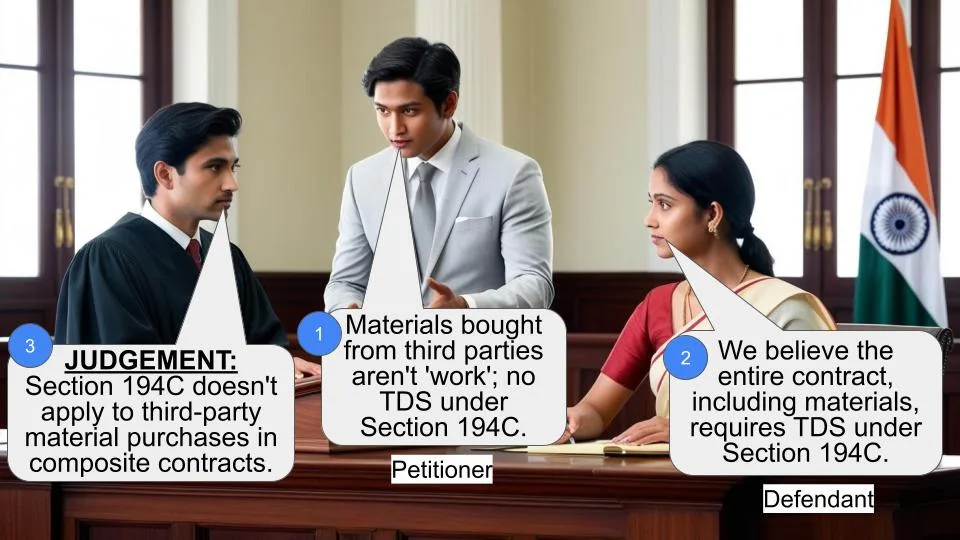
This case involves the Gulbarga Electricity Supply Company Limited (GESCOM) and the Income Tax Department. The main issue was whether payments made under composite contracts for turnkey projects should be subject to tax deduction at source under Section 194C (of Income Tax Act, 1961). The court ruled that when materials are purchased from a third party, it does not fall under the definition of 'work' as per Section 194C (of Income Tax Act, 1961), thus no tax deduction is required.
Get the full picture - access the original judgement of the court order here
Case Name:
Commissioner of Income Tax vs. Executive Engineer (High Court of Karnataka)
Income Tax Appeal No. 92, 93, 94, 95, 96 & 97 of 2014
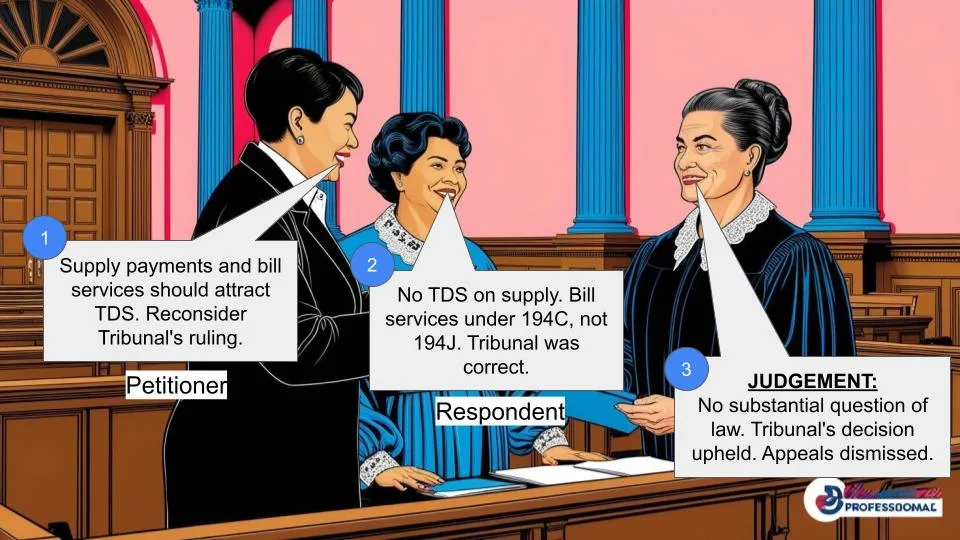
Date: 18th August 2015
Key Takeaways:
- Composite Contracts: The court clarified that composite contracts, which include separate contracts for supply of materials, do not require tax deduction under Section 194C (of Income Tax Act, 1961) if materials are purchased from a third party.
- Section 194C (of Income Tax Act, 1961): This section is intended for tax deductions on payments for works contracts, not for supply contracts.
- Legal Precedent: The decision aligns with previous rulings, reinforcing the interpretation of Section 194C (of Income Tax Act, 1961) post-amendment.
Issue
Does Section 194C (of Income Tax Act, 1961) require tax deduction at source for payments made under composite contracts when materials are purchased from a third party?
Facts
- GESCOM was involved in turnkey projects that included composite contracts.
- The contracts had separate components for the supply of materials and execution of work.
- The Income Tax Department demanded tax deductions on payments for these contracts under Section 194C (of Income Tax Act, 1961).
Arguments
- GESCOM's Argument: Payments for materials purchased from third parties should not be subject to tax deduction under Section 194C (of Income Tax Act, 1961), as these are not 'works' contracts.
- Income Tax Department's Argument: Argued for tax deduction on the entire contract value, including materials, under Section 194C (of Income Tax Act, 1961).
Key Legal Precedents
- The court referred to the case of Commissioner of Income-tax vs. Karnataka Power Transmission Corporation Limited, which had similar issues and was decided in favor of not requiring tax deductions for material supply under Section 194C (of Income Tax Act, 1961).
Judgement
The court ruled in favor of GESCOM, stating that Section 194C (of Income Tax Act, 1961) does not apply to the supply of materials purchased from third parties. The court emphasized that the section is meant for works contracts, and the supply of materials is distinct from this definition.
FAQs
Q1: What is a composite contract?
A1: A composite contract includes multiple components, such as supply of materials and execution of work, often bundled together for a single project.
Q2: Why doesn't Section 194C (of Income Tax Act, 1961) apply to these contracts?
A2: Section 194C (of Income Tax Act, 1961) is specifically for works contracts. When materials are purchased from a third party, it is considered a supply contract, not a works contract.
Q3: What was the significance of the court's decision?
A3: The decision clarifies the application of Section 194C (of Income Tax Act, 1961), ensuring that tax deductions are not wrongly applied to supply contracts within composite agreements.

1. These appeals by the revenue are against the judgment and order dated September 30, 2013, passed by the Income-Tax Appellate Tribunal, C Bench,
Bengaluru, affirming the order dated July 29, 2011, passed by the Commissioner of Income-tax (Appeals), Navanagar, Hubli.
2. We are informed that in all these six appeals, similar questions of law and facts are involved. Therefore, by consent of the parties, we take up all
these appeals for analogous hearing.
3. Gulbarga Electricity Supply Company Limited, the assessee in short, challenged demands of the jurisdictional Deputy Commissioner of Income-tax.
Appeals were filed before the Commissioner of Income- tax (Appeals) and by order dated July 29, 2011, the appeals were partly allowed. The revenue took the matter before the Income-tax Appellate Tribunal, but the attempt of the revenue was abortive.
4. The first issue involved in these appeals is if
on the payment made against the supply of materials
included in composite contracts for executing Turn Key
Projects, provisions under Section 194C (of Income Tax Act, 1961) of the Income-
Tax Act, 1961 (for short, ‘the Act’) would attract or not.
5. The other issue is if payments made by the
assessee to Bellary Computers and IT Solutions,
Bellary, towards Bill Management Services are fees for
professional and technical services and, therefore,
comes within the purview of Section 194J (of Income Tax Act, 1961) or
payments made towards carrying out work come within
the ambit of Section 194C (of Income Tax Act, 1961).
6. The Tribunal, in its detailed discussion, held
that the issue regarding non-deduction/short deduction
of tax deducted at source on payments made on supply
part of contracts awarded for execution of Turn Key
Projects, has, already, been settled by the Jurisdictional
High Court in the case of Commissioner of Income-tax
and others vs. Karnataka Power Transmission
Corporation Limited, the respondent in ITA 337 of
2011. The issue was decided by a Division Bench of
this court on March 15, 2012. It is recorded that the
decision of the coordinate Bench is also binding on this
Bench.
7. We are, also, of the opinion that the clauses
of the contract particularly, clause 3.5 of the contract
agreement, make it clear that three separate contracts
have been entered into, but all the separate contracts
were integral parts of a composite contract on single
sale responsible basis. The invoices raised on the basis
of the said composite contract separately mentioning
the value of the material supplied, no deduction is
permissible under Section 194C (of Income Tax Act, 1961). Section
194C of the Act cannot be pressed into service to deduct
tax at source. The whole object of introduction of that
Section is to deduct tax in respect of payments made for
works contract. No division is, therefore, permissible in
respect of a contract for supply of materials for carrying
out the work. It is in a case of distinct contracts. The
contract for supply of material being a separate and
distinct contract, no division is permissible under
Section 194C (of Income Tax Act, 1961). Section 194C (of Income Tax Act, 1961) has suffered an
amendment also with effect from October 1, 2009 and
the provision has been made very clear without any
ambiguity.
8. Thus, we can conclude safely that if a person
executing the work, purchases the materials from a
person other than the customer, the same would not fall
within the definition of ‘work’ under Section 194C (of Income Tax Act, 1961) of the
Act.
9. Now, we shall deal with the second issue. If
the provisions of Section 194J (of Income Tax Act, 1961) or Section 194C (of Income Tax Act, 1961) would
apply in respect of payments made by an assessee
towards Bill Management Services. The services
rendered by the agencies engaged by the assessees at
Hospet, Bellary and Raichur are not professional
services, and, therefore, Section 194J (of Income Tax Act, 1961) is not attracted.
The demand towards the alleged short deduction of tax
deducted at source and interest, therefore, was
improper. The contract was rightly held to be a service
contract by the Tribunal and we, also, feel that it was a
contract, which should be covered under Section 194C (of Income Tax Act, 1961)
of the Act.
10. We do not find that these appeals involve
any substantial question of law, which requires
consideration by this court. Therefore, all these appeals
are dismissed.
11. The parties are however directed to bear
their respective costs.
Sd/-
ACTING CHIEF JUSTICE
Sd/-
JUDGE
×
Similar Ripples
Questions
Composite Contracts and Tax Deductions: Court Clarifies Section 194C (of Income Tax Act, 1961)
Write your CommentSimilar Posts

Generic
- Reportdata/3521.pdf
