


Tax Appeal Partially Allowed: Academic Question Remains Undecided





Full News
Tax Appeal Partially Allowed: Academic Question Remains Undecided
Tax Appeal Partially Allowed: Academic Question Remains Undecided
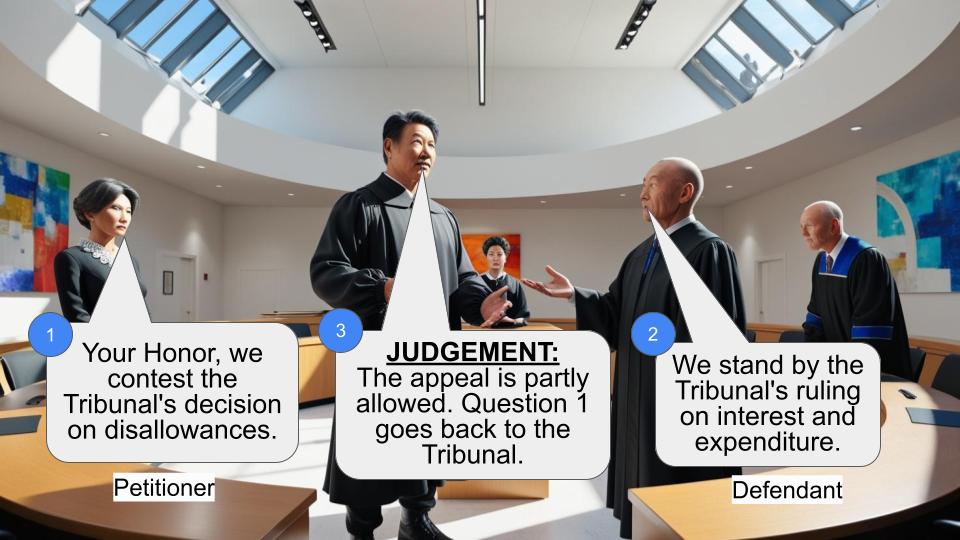
This case involves an appeal filed by the Commissioner of Income Tax against Hindustan Zinc Ltd. The appeal challenged a judgment by the Income Tax Tribunal, Jodhpur Bench. The High Court partially allowed the appeal, remitting one question back to the Tribunal for fresh consideration, while deciding on others based on previous judgments and academic nature of the issue.
Get the full picture - access the original judgement of the court order here
Case Name:
Commissioner of Income Tax vs. Hindustan Zinc Ltd. (High Court of Rajasthan)
Income Tax Appeal No. 30 of 2003
Date: 22nd November 2007
Key Takeaways
1. The court remitted one question back to the Tribunal for fresh consideration.
2. A previous judgment was applied to decide one of the questions against the revenue department.
3. The court deemed one question as academic and chose not to decide on it.
4. The court clarified that the Tribunal's finding on a particular expenditure should not be treated as a precedent.
Issue
The main issues were:
1. Whether the Tribunal was justified in deleting certain disallowances made under section 40A(9) (of Income Tax Act, 1961)?
2. Whether the Tribunal was correct in allowing a claim of interest as revenue expenditure on funds borrowed for a new plant?
3. Whether the Tribunal was right in treating certain expenditure on technology alteration as revenue expenditure?
Facts
- The case originated from a judgment of the Income Tax Tribunal, Jodhpur Bench, dated 06.11.2001.
- The appeal was admitted on 16.09.2003 with three substantial questions of law.
- The case involved disputes over various financial matters, including disallowances, interest claims, and expenditure classification.
- Previous judgments related to the same assessee (Hindustan Zinc Ltd.) but for different assessment years were relevant to this case.
Arguments
The specific arguments of each party are not explicitly stated in the provided text. However, the questions of law suggest that:
1. The Revenue department argued against the Tribunal's decision to delete certain disallowances.
2. They contested the Tribunal's allowance of interest as revenue expenditure.
3. They disagreed with the Tribunal's classification of technology alteration expenditure as revenue expenditure.
Key Legal Precedents
1. A judgment dated 14.12.2004, reported in (2005) 194 CTR page 121, involving the same assessee but for different assessment years. This judgment led to the remission of the first question back to the Tribunal.
2. A judgment dated 17.07.2003, reported in (2004) 269 ITR page 369, also involving the same assessee but for different assessment years. This judgment was used to decide the second question against the revenue department.
Judgement
1. On the first question, the court remitted the matter back to the Tribunal for fresh consideration, following the guidelines set in the judgment dated 14.12.2004.
2. The second question was answered against the revenue department, based on the previous judgment dated 17.07.2003.
3. For the third question, the court deemed it academic and chose not to decide on it. The court noted that whether the expenditure was treated as capital or revenue, the assessee would receive tax benefits, either through depreciation over eight years or as a one-time deduction.
The appeal was partly allowed, with the first question remitted back to the Tribunal for reconsideration.
FAQs
Q1: What does it mean when the court says a question is "academic"?
A1: When a court refers to a question as "academic," it means that deciding on that question would not have any practical impact on the case's outcome. In this case, the court found that whether the expenditure was classified as capital or revenue, the tax implications for the assessee would be similar.
Q2: Why did the court remit the first question back to the Tribunal?
A2: The court remitted the first question back to the Tribunal because a previous judgment involving the same assessee had set guidelines for deciding such matters. The court wanted the Tribunal to reconsider the question in light of those guidelines.
Q3: What is the significance of the court's clarification about the Tribunal's finding not being treated as a precedent?
A3: By stating that the Tribunal's finding should not be treated as a precedent, the court is ensuring that this particular decision doesn't automatically apply to future cases with similar circumstances. This allows for each case to be judged on its own merits in the future.
Q4: How did previous judgments influence this case?
A4: Previous judgments played a crucial role in this case. They were used to decide how to handle the first two questions of law, demonstrating the importance of legal precedents in the Indian judicial system.

This appeal has been filed against the judgement of learned Income Tax Tribunal, Jodhpur Bench dated 06.11.2001, the appeal was admitted vide order dated 16.09.2003 by framing following three substantial questions of law:-
(1) “Whether on the facts and in the circumstances of the case the Tribunal was justified in deleting the disallowance of Rs.1,77,16,044/- made u/s 40A(9) (of Income Tax Act, 1961) on account of payment made to various funds, contributions of clubs, grant to school and hospital etc.?”
(2) “Whether on the facts and in the circumstances of the case the tribunal was justified in allowing the claim of interest amounting to Rs. 18,56,32,417/- as revenue expenditure on funds borrowed specifically for the new plant known as Chandaria Unit?”
(3) “Whether on the fact and in the circumstances of the case the ITAT was justified in holding the expenditure of Rs. 1,58,77,000/- incurred on technology alternation prior of new unit as revenue expenditure and even if it is held to be so the same was not allowable being it an abortive expenditure because of the fact that the amount was paid as a damag to the contractor as the technology was not found suitable and the contact stood cancelled before the production was stablished?”
We have heard learned counsel for the parties on all the three questions and have perused the impugned judgement of the learned Tribunal.
So far as the question No. 1 is concerned, the matter had earlier come before this Court in the case of present assessee, of course relating to different assessment years, and that matter was decided by this Court vide judgement dated 14.12.2004, reported in (2005) 194 CTR page 121, and by that judgement, the orders of the Tribunal were set aside, and the matter was remitted back to the Tribunal for deciding the claim afresh.
In our view, in view of the aforesaid judgement of this Court, the matter is required to be remitted back to the Tribunal for deciding this question No. 1 afresh on lines given in the aforesaid judgement dated 14.12.2004.
So far as question No. 2 is concerned, this question stands already decided against revenue by another judgement of this Court on 17.07.2003 in the case of present assessee itself, rendered with respect to the controversy involved in different assessment years. This judgement is reported in (2004) 269 ITR page 369. For the reason given in the aforesaid judgement, in our view, this question is also required to be answered against the revenue, and is accordingly, answered.
So far as question No. 3 is concerned, the learned Tribunal itself has observed that in view of the orders of the Subordinate Authorities, the amount was treated as capital expenditure, and the assessee was allowed for depreciation on this amount @ of 12.5% over a period of eight years. If the the contention of assessee is accepted, to treat as revenue expenditure, even in that event, the assessee would have been entitled to deduction in one assessment year, relevant to the previous year, in which the expenditure was incurred, while if even if it is, treated to be capital expenditure, in that event also, the assessee has received the benefit of tax, by being allowed depreciation over a period of eight years. It has also been found by the learned Tribunal that rate of tax on the company is uniform.
Obviously, therefore, even if, the tax benefit allowed to the assessee in 1 year, or over a period of eight years, it hardly results into financial loss to either the assessee or the revenue.
We are of the view that thus this question remains only academic, and need not be decided in this appeal. It is however clarified that since we are not deciding the question on merits, the finding given by the learned Tribunal about the particular expenditure being that of a capital expenditure, need not be treated as precedent.
The appeal is, accordingly partly allowed, in view of the answer given to question No. 1, and the matter is remitted back to learned Tribunal as above.
( MUNISHWAR NATH BHANDARI ),J. ( N P GUPTA ),J.
×
Similar Ripples
Questions
Tax Appeal Partially Allowed: Academic Question Remains Undecided
Write your CommentSimilar Posts


Generic
- Reportdata/5157.pdf
