Tax Dispute Over Capital Gains Year: Court Upholds Reassessment







Full News

Tax Dispute Over Capital Gains Year: Court Upholds Reassessment
Tax Dispute Over Capital Gains Year: Court Upholds Reassessment
The case involves M/S. Dass Media Private Limited and the Income Tax Department. The dispute centers on the correct assessment year for capital gains tax from a joint development agreement. The court upheld the reassessment for the year 2014-15, despite the petitioner’s argument that the gains were already taxed in 2016-17.
Get the full picture - access the original judgement of the court order here
Case Name:
M/s. Dass Media Private Limited Vs. Income Tax Officer and Anr. (High Court of Madras)
W.P. Nos.34963 of 2019 and 4063 of 2020 and WMP.Nos. 4800, 4803 of 2020 & 35746, 35748 & 35751 of 2019
Date: 15th December 2020
Key Takeaways:
- The court confirmed the reassessment of capital gains for the year 2014-15.
- The decision emphasizes the importance of determining the correct year for tax liability.
- Protective assessments are valid when there is uncertainty about the correct year or entity for tax assessment.
Issue
Was the reassessment of capital gains for the year 2014-15 justified, despite the gains being taxed in 2016-17?
Facts
- M/S. Dass Media Private Limited entered a joint development agreement with M/s. Bashyaam Construction Pvt. Ltd. in 2013.
- The petitioner initially reported capital gains in the assessment year 2016-17.
- The Income Tax Department issued a notice to reassess the gains for 2014-15, arguing that the capital gains should have been taxed in that year.
- The petitioner challenged this reassessment, claiming the gains were already taxed in 2016-17.
Arguments
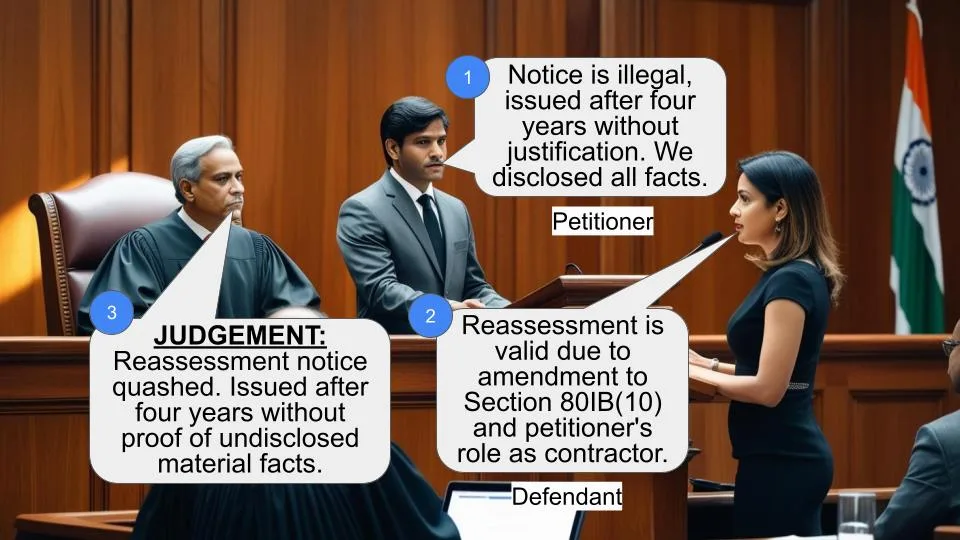
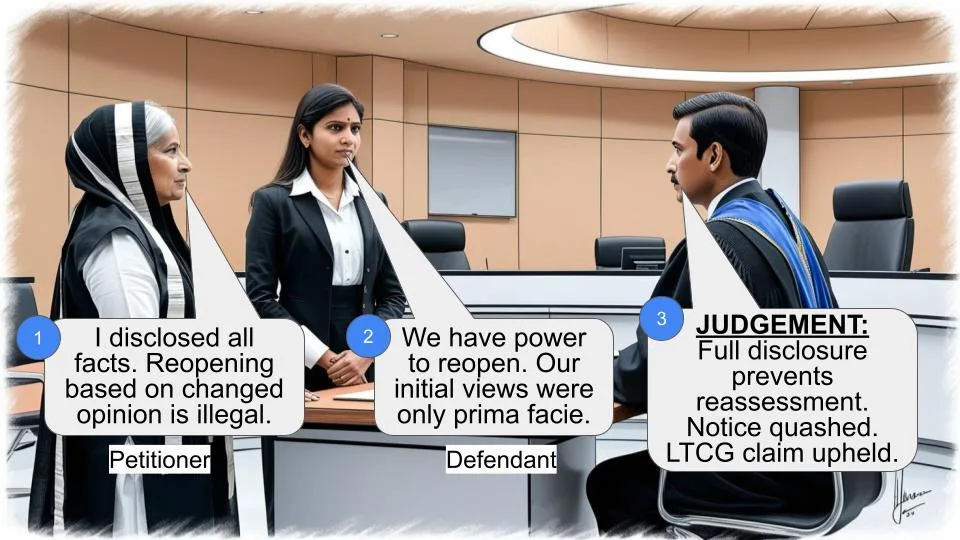
- Petitioner: Argued that the capital gains were correctly reported and taxed in 2016-17, and reassessment for 2014-15 was unnecessary and incorrect.
- Respondent (Income Tax Department): Claimed that the capital gains should have been assessed in 2014-15, as the approval for the development was obtained in that financial year.
Key Legal Precedents
- Section 147 (of Income Tax Act, 1961): Allows for reassessment if income has escaped assessment.
- Banyan and Berry Vs. Commissioner of Income Tax (222 ITR 831): Supports the use of protective assessments when there is doubt about the correct entity or year for tax assessment.
- Smt. Hemlata Agrawal Vs. CIT (64 ITR 428): Discusses the validity of protective assessments in the context of reassessment.
Judgement
The court upheld the reassessment for the year 2014-15, stating that the Income Tax Department was justified in its protective assessment to determine the correct year for taxing the capital gains. The court dismissed the petitioner’s argument that the reassessment was a change of opinion, emphasizing that no initial opinion was formed due to the lack of scrutiny in the original assessment.
FAQs
Q1: Why was the reassessment necessary?
A1: The reassessment was necessary to determine the correct year for taxing the capital gains, as the initial assessment did not undergo scrutiny.
Q2: What is a protective assessment?
A2: A protective assessment is used when there is uncertainty about the correct entity or year for tax assessment, allowing the tax authorities to safeguard revenue interests.
Q3: Does this mean the petitioner will be taxed twice?
A3: No, the protective assessment is meant to ascertain the correct year for taxation, not to impose double taxation.
Q4: What happens next for the petitioner?
A4: The reassessment will proceed on its merits, and the petitioner’s appeal will be heard by the Commissioner of Income Tax (Appeals).

1. The petitioner is a company and had entered into an agreement for joint development in the capacity of a land owner with one M/s. Bashyaam Construction Pvt. Ltd. (BCPL) as developer. The petitioner filed a return of income (ROI) for assessment year (AY) 2014-15 on 04.03.2015 admitting a total loss. The return was not taken up for scrutiny. In its return of income for AY 2016-17, the petitioner had returned long term capital gain (LTCG) in regard to the project of joint development. The return of income was selected for scrutiny by issuance of notice under Section 143(2) (of Income Tax Act, 1961) and vide questionnaire under Section 142(1) (of Income Tax Act, 1961) various details/particulars were sought from the petitioner including copy of annual report, financials (profit and loss accounts and balance sheet with complete schedules) and a computation of Long Term Capital gains (LTCG) along with an explanation in regard to the purported mismatch between the income credited in the profit and loss account and sales turnover/receipts.
2. The petitioner responded vide letter dated 28.07.2018 enclosing the details sought including the computation of LTCG. A notice under Section 133(6) (of Income Tax Act, 1961) was also issued to BCPL seeking the details of cost of construction and basis of valuation of the same. On the basis of the reply furnished by BCPL, a notice was issued on 20.12.2018 to the petitioner calling upon it to show cause why the sale consideration for the purpose of capital gains not be 70% of the total sale receipts, on the understanding that the ratio of sharing on profits between petitioner and BCPL was 70-30%. In response, while accepting the quantum of turnover per se, the petitioner submitted that the correct proportion was 69-31% and not 70-30%. The assessment was, however, completed along with the lines proposed for the SCN and is stated to be challenged by the petitioner and pending in appeal.
3. While this is so, a notice under Section 148 (of Income Tax Act, 1961) came to be issued on 21.03.2019 seeking to reopen the income tax assessment of the petitioner for AY 2014-15.The petitioner requested the reasons for re-assessment vide letter dated 23.09.2019 parallely filing a return of income on 03.04.2019 in response to the notice under Section 148 (of Income Tax Act, 1961). The reasons were furnished and read as follows:
GOVERNMENT OF INDIA MINISTRY OF FINANCE INCOME TAX DEPARTMENT DC/ACIT (OSD) CORP RG 1 CHENNAI
The Reasons for reopening the assessment proceedings u/s 147 (of Income Tax Act, 1961) in the case of M/s Dass Media P. Ltd AY 2014-15 are as follows:
“ 1. The assessee company had entered into a joint Development Agreement with M/s. Bashyaam Constructions Pvt. Ltd., Chennai for promotion of its property at old No.26, new No.57, Poes Garden, Chennai-600 086 as a high rise luxurious apartments numbering 8 units. The Joint Development Agreement was entered into on 11.09.2013 with the Developer wherein the land owner M/s. Dass Media pvt Ltd transferred the rights and conveyed the same to the extent of 30% to the Deeloper including UDS and the super built-up area. As the Developer was handed over the above share, thee assessee stood to have capital gain with the execution of the above transaction. The assessee company received R.2 (of Income Tax Rules, 1962).5 Crores on 11.09.2013 and Rs.81 Lakhs on 06.03.2014.
2. The total number of flats as per JDA was 8 flats out of which assessee’s share was 6 flats. From the information regarding the break up of cost centre expenses receivedin resonse to 133(6) notie dated 14.12.2018 sent to M/s Bashyam Constructions Pvt. Ltd., it is seen that the total cost of construction is Rs.24,51,07,602.38
The Capital gains is computed as under:
70% of Cost of Construction: 70% of Rs.24,51,07,602.38 = R.17,15,75,322
Add: Monetary Compensation pertaining to developer’s share) = Rs.3,30,00,000 (+)
Less: Cost of Acquisition (Indexed)
Proportionate land value: Rs.16,24,940 30% of the above : Rs.4,87,482/.-
Purchase in FY 1985-86-Capital gain index is 133
Cost indexed for FY 13-14 index is 939 Rs.34,41,696 (-)
Long Term Capital Gain Rs.20,11,33,626
3. It was also learnt during the survey that the CMDA approval for the building was obtained in FY 2013-14 itself. Thus it is clear that the incidence of capital gain arose in AY 2014-15 itself. The assessee has offered capital gains in AY. 2016-17 which was subsequently assessed vide order u/s 143(3) (of Income Tax Act, 1961) dated 29.12.2018. The assessee has preferred an appeal before the CIT(A) against the above order u/s 143(3) (of Income Tax Act, 1961) dated 29.12.2018. It is noticed that the assessee company has not offered any capital gain in AY 2014-15 which is the correct year of incidence of capital gain. Therefore, the assessment has to be reopened for AY. 2014-15 and assessed protectively to safeguard the interest of revenue.”
4 . The petitioner wrote to the respondent on 15.06.2019 objecting to the proposed re-assessment and pointing out that the very income proposed to be brought to tax in AY 2014-15, had suffered tax in AY 2016-17. The assumption of jurisdiction by the Assessing Officer was challenged on the ground that there existed no valid reasons for the proposed re-assessment and no material on the basis of which the Officer has arrived at the prima facie conclusion that income had escaped assessment.
5. The proposed re-assessment was also challenged on merits by the petitioner stating that profits were realized from the project only in the financial year relevant to AY 2016-17, the Officer proceeded on the basis that the approval of the Chennai Metropolitan Development Authority had been received in FY, relevant to AY 2014-15 and as such the capital gain ought to have been brought to tax in AY 2014-15 itself. Moreover, one of the reasons for re-opening was to safeguard/protect the interests of the revenue and this was also, according to the petitioner, legally incorrect.
6. The objections came to be rejected by order dated 05.12.2019, challenged in Writ Petition No.34963 of 2019. Though an interim stay was granted by this Court on 17.12.2019, it appears that the order came to the notice of the respondent only on 23.12.2019, by which time, the order of assessment had been passed. This order came to be challenged by the petitioner in W.P.No.2390 of 2020. The Officer has, at paragraph 8 of counter dated 23.01.2020 in W.P. No.34963 of 2019 expressed regret for proceeding to pass the order of assessment despite interim order dated 17.12.2019. He assigns the blame to a gap in intra-department communication by which order dated 17.12.2019 came to his attention only on 23.12.2019 by which time the impugned order of assessment had been passed, on 20.12.2019. The explanation offered is accepted. Both matters have thus been taken up together.
7. Revenue points out that as the original processing of the ROI was only by way of intimation and no scrutiny assessment under Section 143(3) (of Income Tax Act, 1961) had been made, the assumption of jurisdiction under Section 147 (of Income Tax Act, 1961) is unassailable. It was only when the return of income for AY 2016-17 was taken up that the Officer gleaned that the appropriate year for taxing the capital gain would be 2014-15 and not 2016-17.
8. The question of change of opinion or review of the earlier order would not arise insofar as no opinion was formed and no order passed at the first instance. It is for this reason that the reopening has been done protectively, to ascertain the correct year in which the incidence of taxing the capital gain arose. According to the revenue, the very fact that the reopening was protective would establish that the Officer had no intention whatsoever to engage in double taxation of the same income in both AY 2013-14 and 2016-17, but only wanted to ascertain the appropriate year for taxation of the capital gain.
9. The issue that arises turns on whether the assumption of jurisdiction in terms of Section 147 (of Income Tax Act, 1961) for AY 2012-13 is proper, particularly, seeing as the Officer only proposes a re-assessment, on protective basis. Admittedly, there has been no scrutiny assessment for AY 2012-13 and only an intimation has been passed. The issue based on which the re-assessment has been initiated is whether the capital gains offered to tax in AY 2016-17 should have been offered in the earlier year i.e. AY 2012-13.
10. Ordinarily the limitation provided for the initiation of re-assessment is four years from the end of the relevant financial year, extended to six years upon satisfaction of the conditions elaborated in the proviso to Section 147 (of Income Tax Act, 1961), conditional upon an order under Section 143(3) (of Income Tax Act, 1961) having been passed at the original instance. Since only an intimation under Section 143(1) (of Income Tax Act, 1961) has been passed in this case, limitation of six years is, available. (See The Assistant Commissioner of Income Tax (ACIT) Vs. Rajesh Jhaveri Stock Brokers Pvt. Ltd. (291 ITR 500).
11. Coming to whether a re-assessment may be initiated on protective basis, I see no legal infirmity in the same. Though the assumption of jurisdiction to re-open an assessment must be based on the satisfaction of the officer that income has escaped assessment, such reasoning is not expected to be ironclad even at that preliminary stage. It will suffice that the Officer has a legitimate and reasonable basis to come to such a conclusion. In the present case, the return of income for AY 2012-13 was not scrutinized and only the return of income of the petitioner for AY 2016-17 was taken up for scrutiny.
The question of whether the capital gain is assessable in AY 2012-13 or 2016-17 is thus, a matter to be decided by the Authorities after due verification of relevant documents and in accordance with the law. Thus, while the merits of the matter relating to the year in which the instance of capital gain would fall is left entirely open for decision by the Officer, the assumption of jurisdiction is upheld.
12. The concept of a protective assessment is not new to income tax proceedings and in Banyan and Berry Vs. Commissioner of Income Tax (222 ITR 831), a Division Bench of the Gujarat High Court states that where there is a doubt or ambiguity about the real entity in whose hands particular income is to be assessed, the Assessing Authority is justified to take recourse to a protective assessment in the hands of one entity and a regular assessment in the hands of the other. At the end of the day, it is only one assessment that would survive, after the authorities, with the cooperation of both the assessees, ascertain which the proper entity is to be assessed. So too in ascertaining the proper year of assessment.
13. In Smt. Hemlata Agrawal Vs. CIT (64 ITR 428), a Division Bench of the Allahabad High Court considered the scope of protective assessment in the context of re-assessment. The issue concerned the nature and source of investment in immovable property. The amount in question was brought to tax in the hands of both the husband and wife, the former substantively and the latter protectively. Both the assessees therein challenged the orders of assessment till the Income Tax Appellate Tribunal. In the wifes’ case an additional point taken was that the re-assessment was only by way of change of opinion and was thus unsustainable. This argument was rejected by the Tribunal stating that a protective assessment did not amount to a change of opinion but merely indicated caution on the part of the income tax officer in deciding the question of law. In further appeal, the Court was of the view that the proper approach of the Tribunal would have been to hear both the appeals together and then determine whose hands the income was assessable. The tax case filed by Mrs.Agrawal was allowed.
14. In this case the issue that arises is whether the capital gain is taxable in one year or the other and thus, it is only if the material pertaining to both years were available before the officer that a proper decision in this regard could be arrived at.
15. The petitioner argues that the order of assessment for AY 2016-17 has been challenged in appeal only on the aspect of computation of the capital gain and thus as far as the year of taxability is concerned, the order has attained finality. This argument is misconceived since the very doubt entertained by the Officer turns on the question of whether the year of taxability adopted by the petitioner is correct or not. The finality attained by filing of the first appeal by the petitioner is subject to statutory processes such as 263 and 147 of the Act, if otherwise valid. This argument is thus rejected.
16. The impugned order is confirmed and this writ petition dismissed. The re-assessment shall be taken up on merits and decided as expeditiously as possible and at any rate within a period of eight weeks from today. Let the appeal filed by the petitioner also be taken up for hearing and disposed by the Commissioner of Income Tax (Appeals) parallelly. Connected miscellaneous petitions are closed. No costs.
DR. ANITA SUMANTH, J.
×