Full News
Tax Exemption Upheld for Non-Profit Fertilizer Association
Tax Exemption Upheld for Non-Profit Fertilizer Association
This case involves the Commissioner of Income Tax (Exemptions) appealing against orders of the Income Tax Appellate Tribunal (ITAT) that ruled in favor of the Fertilizers Association of India. The ITAT had held that the amounts received and utilized by the association were for business and trade purposes, allowing them to maintain their tax-exempt status. The High Court dismissed the appeal, agreeing with the ITAT's decision.
Get the full picture - access the original judgement of the court order here
Case Name:
Commissioner of Income Tax (Exemptions) Vs Fertilizers Association of India (High Court of Delhi)
ITA 964/2017
Date: 13th November 2017
Key Takeaways:
1. Non-profit organizations can maintain tax-exempt status even if they charge fees for certain activities, as long as these are incidental to their main charitable purpose.
2. The 2009 amendment to the Income Tax Act did not fundamentally alter the "dominant object" test for determining an organization's charitable status.
3. The court emphasized the importance of considering an organization's overall objectives rather than focusing solely on specific income-generating activities.
Issue:
Does the Fertilizers Association of India's receipt of funds from registration charges for seminars/workshops disqualify it from tax-exempt status under Section 2(15) (of Income Tax Act, 1961)?
Facts:
- The Fertilizers Association of India is a non-profit, non-trading company representing various stakeholders in the fertilizer industry.
- The case concerns assessment years 2010-11 and 2011-12.
- The Association received money from registration charges for seminars and workshops.
- The Assessing Officer (AO) initially denied tax exemption based on the 2009 amendment to Section 2(15) (of Income Tax Act, 1961).
- The Commissioner of Income Tax (Appeals) upheld the AO's decision.
- The Income Tax Appellate Tribunal (ITAT) overturned these decisions, ruling in favor of the Association.
Arguments:
Revenue's Argument:
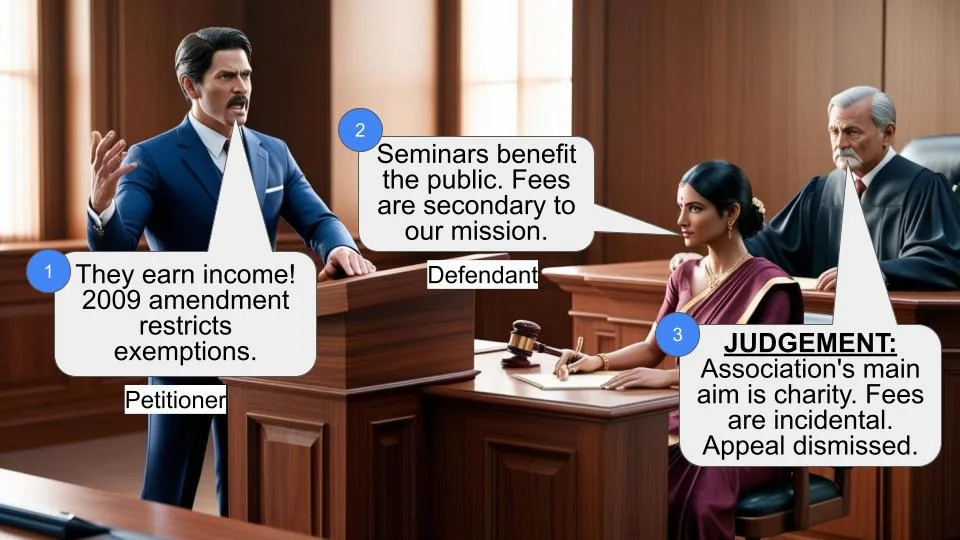
- The 2009 amendment to Section 2(15) (of Income Tax Act, 1961) disqualifies the Association from tax exemption as it engages in activities that generate income.
Association's Argument:
- The dominant object of the Association remains charitable.
- Charging fees for seminars and workshops is incidental to the main activity and doesn't negate its charitable status.
- The Association's activities benefit the public at large.
Key Legal Precedents:
1. Commissioner of Sales Tax v. Sai Publication Fund (2002) 258 ITR 70 (SC)
2. Addl. Commissioner of Income Tax v. Surat Art Silk Cloth Manufacturers Association (1980) 121 ITR 1 (SC)
3. India Trade Promotion Organization v. Director General of Income Tax (Exemptions) & Others 371 ITR 333
4. CIT v. Andhra Chamber of Commerce 55 ITR 722
Judgement:
The High Court dismissed the appeal, agreeing with the ITAT's decision. Key points of the judgment include:
- Mere charging of fees for services like training and seminars doesn't automatically lead to denial of tax exemption.
- The dominant object of the Association remains charitable, with fee-charging activities being incidental.
- The 2009 amendment didn't alter the "dominant object" test for determining charitable status.
- The ITAT correctly applied the ratios from relevant precedents.
FAQs:
1. Q: Does this judgment apply to all non-profit organizations?
A: While it sets a precedent, each case would be judged on its specific facts and circumstances.
2. Q: Can non-profits charge for their services and still maintain tax-exempt status?
A: Yes, as long as these charges are incidental to their main charitable purpose and don't become their dominant activity.
3. Q: What is the "dominant object" test?
A: It's a principle used to determine an organization's primary purpose, considering its overall activities rather than focusing on isolated income-generating events.
4. Q: How did the 2009 amendment to Section 2(15) (of Income Tax Act, 1961) affect non-profits?
A: While it added scrutiny to income-generating activities, this judgment clarifies that it didn't fundamentally change how an organization's charitable status is determined.
5. Q: What should non-profits take away from this judgment?
A: They should ensure their income-generating activities remain incidental to their main charitable purpose and continue to benefit the public at large.

1. Revenue is in appeal – in these two proceedings against two orders of the Income Tax Appellate Tribunal (ITAT) concerning the assessee for A.Y. 2010-11 and 2011-12 by which the amounts received by the assessee and utilized, were held to be for the purposes of business and trade.
2. The assessee Association is a non-profit and non-trading company representing the interests of fertilizer manufacturers, distributors, importers, equipment manufacturers, research institutes and suppliers of inputs, registered under Section 25 of the Companies Act, 1956. In scrutiny assessment for A.Y. 2010-11, the AO was of the opinion that the exemption under Section 2(15) (of Income Tax Act, 1961) by virtue of the amendment of 2009 i.e. that the assessee was engaged in the advancement of general public utility, disentitled it to claim exemption in tax from payment of tax. One of the main grounds which influenced the AO to hold as it did, were the sums of money received by the assessee on account of registration charges, etc., for seminars/workshops held to inform its members.
3. The AO’s order was affirmed by the CIT(A); the assessee therefore approached the ITAT. By the impugned order, the ITAT upheld the assessee’s contention after noticing the amendments to the Income Tax Act, 1961 made in 2009. The ITAT also took note of several decisions such as Commissioner of Sales Tax v. Sai Publication Fund (2002) 258 ITR 70 (SC), Addl. Commissioner of Income Tax v. Surat Art Silk Cloth Manufacturers Association (1980) 121 ITR 1 (SC) and more importantly the recent decision of this Court in India Trade Promotion Organization v. Director General of Income Tax (Exemptions) & Others 371 ITR 333.
4. The Tribunal held as follows:-
“7.7 We also agree with the submissions made by the Ld. Counsel of the assessee that mere charging of fee from members or non-members for rendering services like training, conducting seminars would not ipso facto lead to denial of exemption. The dominant object of the assessee remains charitable and the aforesaid activities are only incidental to the main activity of the assessee. Also, the activities of the assessee are benefiting the public at large at submitted by the Ld. Counsel for the assessee. Furthermore, it is not the case of the department that any change in objects had taken place in the relevant year so as to take the assessee outside the ambit of section 2(15) (of Income Tax Act, 1961). The effect of the amendment has been discussed elaborately by the Hon’ble Delhi High Court in ITPO Case (supra) as well as the judgment of Apex Court in Andhra Pradesh Chamber of Commerce (supra) and the test of dominant object has not been altered even after the said amendment. We therefore hold that the denial of exemption under section 11 (of Income Tax Act, 1961) and 12 in the case of the assessee is not in accordance with law and accordingly the additions made by the AO and confirmed by the CIT(A) are deleted.”
5. Having regard to the entirety of circumstances, especially that the ITAT took note of the relevant decisions such as Surat Art Silk Cloth Manufacturers Association (supra), CIT v. Andhra Chamber of Commerce 55 ITR 722 and India Trade Promotion Organization (supra), the ratio of which were correctly applied, this Court is of the opinion that no substantial question of law arises.
6. The other questions urged arise from the application of income which was held not to be exempt under Section 11 (of Income Tax Act, 1961). Consequently, those too do not arise for consideration in the present appeals.
7. The appeals are therefore dismissed.
S. RAVINDRA BHAT, J
SANJEEV SACHDEVA, J
NOVEMBER 13, 2017
×