


Tax Exemption Upheld: ISKCON Bangalore's Assessment Order Stands


Full News
Tax Exemption Upheld: ISKCON Bangalore's Assessment Order Stands
Tax Exemption Upheld: ISKCON Bangalore's Assessment Order Stands
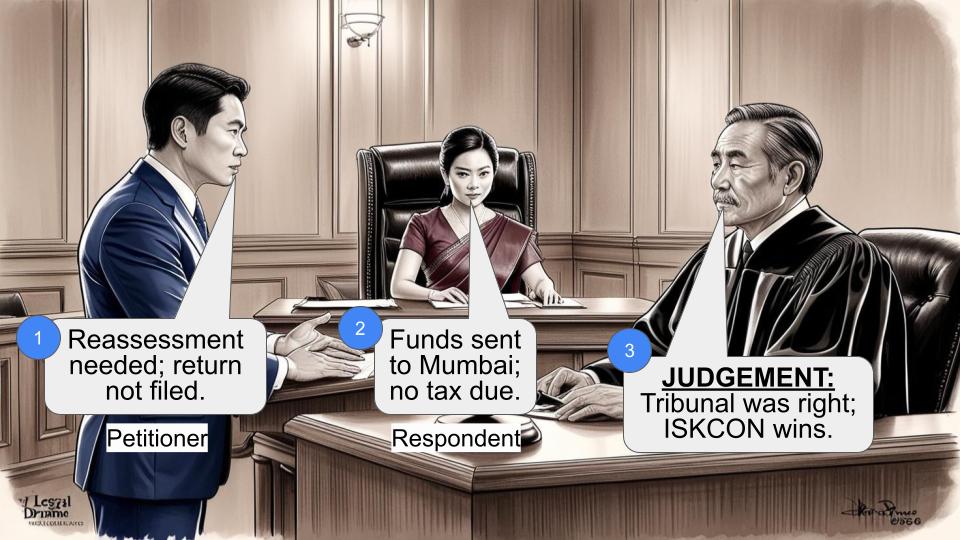
This case is about the Income Tax Department trying to reassess ISKCON Bangalore's income for the 1997-98 assessment year. The tax folks thought something was fishy, but the court ended up siding with ISKCON. Let's break it down, shall we?
Get the full picture - access the original judgement of the court order here
Case Name:
Commissioner of Income Tax and Anr. Vs M/s. International Society for Krishna Consciousness (High Court of Karnataka)
ITA No.36 of 2009
Date: 9th June 2020
Key Takeaways:
1. The court upheld the Income Tax Appellate Tribunal's decision in favor of ISKCON.
2. It reinforced the principle that if an assessing officer's view is one of two possible views, it can't be considered erroneous.
3. The case highlights the importance of proper documentation and communication between different branches of an organization for tax purposes.
Issue:
Was the Income Tax Department justified in initiating proceedings under Section 263 (of Income Tax Act, 1961) to reassess ISKCON Bangalore's income for the 1997-98 assessment year?
Facts:
- ISKCON Bangalore is registered under Section 12A (of Income Tax Act, 1961).
- For the 1997-98 assessment year, they showed an income of Rs.12,60,9195 before exemptions.
- They didn't file a return as required under Section 139(4A) (of Income Tax Act, 1961).
- The Assessing Officer initiated proceedings under Section 147 (of Income Tax Act, 1961).
- ISKCON filed a return on 28.04.2004 in response.
- The Assessing Officer dropped the proceedings on 15.03.2005.
- The Director of Income Tax (Exemptions) then initiated proceedings under Section 263 (of Income Tax Act, 1961), questioning the dropping of the earlier proceedings.
Arguments:
The tax department said:
- ISKCON should have filed a return, and not doing so was grounds for reassessment.
- The Assessing Officer should have investigated whether the income was assessed in Mumbai.
ISKCON argued:
- They were sending their accounts to Mumbai for consolidation.
- The amount in question was part of their corpus fund, which isn't taxable.
- The Section 263 (of Income Tax Act, 1961) proceedings were invalid from the get-go.
Key Legal Precedents:
1. 'MALABAR INDUSTRIES CO. LTD., VS. CIT', 243 ITR 83: This case established that if an Assessing Officer's view is one of two possible views, it can't be considered erroneous.
2. 'COMMISSIONER OF INCOME-TAX, MUMBAI VS. AMITABH BACHAN', (2016) 69 TAXMANN.COM 170 (SC): The tax department cited this, arguing that the scope of proceedings under Section 148 (of Income Tax Act, 1961) and 263 (of Income Tax Act, 1961) are different.
Judgement:
The court sided with ISKCON, dismissing the tax department's appeal. Here's why:
1. The Assessing Officer had conducted a proper inquiry before dropping the proceedings.
2. ISKCON's accounts were being consolidated with ISKCON Mumbai, and this was confirmed by the Mumbai tax office.
3. The Director of Income Tax (Exemptions) didn't find any issues with ISKCON's 1997-98 accounts.
4. The court applied the principle from the Malabar Industries case, saying the Assessing Officer's view was one of two possible views, so it couldn't be considered erroneous.
FAQs:
1. Q: Why didn't ISKCON file a return initially?
A: They were sending their accounts to Mumbai for consolidation with the main ISKCON branch there.
2. Q: What's this corpus fund that was mentioned?
A: It's a fund that's generally not taxable for non-profit organizations. In this case, it was a significant part of ISKCON's balance sheet.
3. Q: Why did the court dismiss the tax department's appeal?
A: The court found that the Assessing Officer had made a reasonable decision based on available information, and this decision couldn't be considered erroneous just because another view was possible.
4. Q: What's the significance of Section 263 (of Income Tax Act, 1961)?
A: It allows higher tax authorities to revise orders they believe are erroneous and prejudicial to the interests of revenue. In this case, the court found its use wasn't justified.
5. Q: Does this mean ISKCON doesn't have to pay taxes?
A: Not necessarily. It just means that for this particular assessment year, the original decision to not reassess their income stands. They still need to comply with tax laws and may be subject to assessment in other years.

1. This appeal under Section 260-A (of Income Tax Act, 1961), 1961 (hereinafter referred to as ‘the Act’, for short) has been filed by the revenue. The subject matter of the appeal pertains to Assessment year 1997-98. The appeal was admitted by a Bench of this Court vide order dated 29.06.2009 on the following substantial questions of law:
a) Whether the Tribunal was correct in holding that the Assessing Officer was justifying in dropping the reopened assessments under an order dated 15.03.2005 without recording any reasons by recording its own reasons for the first time in its order presuming the reasons on which the Assessing Officer would have passed an order?
2. Facts giving rise to filing of this appeal briefly stated are that the assessee is a society registered under Section 12A (of Income Tax Act, 1961). During the course of the proceedings for grant of registration under Section 80G (of Income Tax Act, 1961), the assessee had filed copies of statement of accounts for year ending 31.03.1997. As per the aforesaid accounts, the income before granting exemption under Section 11 (of Income Tax Act, 1961) and 12 (of Income Tax Act, 1961) was Rs.12,60,9195/-. The assessee was therefore required to file the return of income under Section 139(4A) (of Income Tax Act, 1961). The assessee stated to have submitted its account to the ISKON, Mumbai for consolidation of their accounts. The assessee did not file the return as required under Section 139(4A) (of Income Tax Act, 1961). Therefore, the proceeding under Section 147 (of Income Tax Act, 1961) were initiated by the assessing officer. In response to the aforesaid proceeding, the assessee filed return of income on 28.04.2004. Therefore, the proceeding was dropped vide order dated 15.03.2005.
3. The Director of Income Tax (Exemptions) initiated proceeding under Section 263 (of Income Tax Act, 1961) and a notice was issued to the assessee as to why order dated 15.03.2005 be not cancelled and assessing officer be directed to frame a fresh assessment for the Assessment year 1997-98. The Director of Income Tax (Exemptions) by an order dated 30.03.2007 inter alia held that the order dated 15.03.2005, by which proceeding under Section 147 (of Income Tax Act, 1961) were dropped for the Assessment year 1997-98 to be erroneous and prejudicial to the interest of the revenue. The order dated 15.03.2005 was cancelled and matter was remitted to the assessing officer by treating the income shown as opening balance for the Assessment year 1997-98. Being aggrieved, the assessee filed an appeal before the Income Tax Appellate Tribunal. The tribunal by an order dated 05.09.2008 inter alia held that contention of the assessee that they were sending accounts to Mumbai for the purpose of consolidation is correct and the aforesaid fact finds place in the order passed by the Director of Income Tax (Exemptions) under Section 263 (of Income Tax Act, 1961). It was further held that assessee was registered under Section 12A (of Income Tax Act, 1961) and accounts were being submitted along with ISKON, Mumbai. It was further held that Director of Income Tax (Exemptions) has not found anything wrong with the accounts for the financial year 1996-97.
4. It was further held that the assessing officer applied his mind on the basis of the facts and found that no income has escaped assessment for the Assessment year 1997-98. It was further held that the view taken by the assessing officer is one of the possible views and therefore, in view of law laid by the Supreme Court in the case of ‘MALABAR INDUSTRIES CO. LTD., VS. CIT’, 243 ITR 83, it cannot be held that the order of the assessing officer was erroneous and required an action under Section 263 (of Income Tax Act, 1961). The tribunal accordingly quashed the order under Section 263 (of Income Tax Act, 1961) and partly allowed the appeal. In the aforesaid factual background, this appeal has been filed.
5. Learned counsel for the revenue submitted that the assessee was admittedly registered under Section 12A (of Income Tax Act, 1961) and did not file the return. Therefore, the proceeding under Section 148 (of Income Tax Act, 1961) initiated. It is further submitted that scope of proceeding under Section 148 (of Income Tax Act, 1961) and 263 (of Income Tax Act, 1961) is different and the proceeding under Section 263 (of Income Tax Act, 1961) could not have been brought on the ground that the income was already assessed to tax in Mumbai. In support of aforesaid submission on a decision of the Supreme Court in ‘COMMISSIONER OF INCOME-TAX, MUMBAI VS. AMITABH BACHAN’, (2016) 69 TAXMANN.COM 170 (SC). It is also urged that the assessing officer was under a duty to proceed with the assessment and to find out whether amount in question was assessed to tax in Mumbai.
6. On the other hand, learned counsel for the assessee has submitted that the proceedings under Section 263 (of Income Tax Act, 1961) were brought after taking into account factual aspect. A decision of division bench of this Court in W.A.No.595/2007 has also been referred to and our attention has been invited to paragraph 6 of the aforesaid decision and it has been pointed out that the return of income was filed for the first time in the year 2000-01 showing opening corpus fund of Rs.39.59 Crores in the balance sheet. It is also urged that corpus fund is not taxable. In this connection, our attention has been invited to the order passed by the Commissioner of Income Tax (Appeals) as well as Section 11(1)(d) (of Income Tax Act, 1961) where the finding has been recorded that amount in question is part of corpus fund. It is also submitted that proceeding under Section 263 (of Income Tax Act, 1961) were ab initio void and the tribunal has passed a reasoned order, which does not call for any interference.
7. By way of rejoinder reply, learned counsel for the revenue has invited our attention to paragraphs 7 & 8 of the order passed by the division bench in W.A.No.595/2007 and has submitted that assessee is a separate legal entity and was required to file the return.
8. We have considered the submissions made on both the sides and have perused the record. Admittedly in response to the notice under Section 148 (of Income Tax Act, 1961), the assessee filed the return on 28.04.2004. From perusal of the proceeding, it is evident that the assessee was called upon to furnish certain details as well as documents on 28.10.2004 and 06.01.2005, which were supplied by the assessee on 18.02.2005. The Deputy Director, Income Tax (Exemptions) on 23.02.2005 confirmed that the assessee’s consolidation of accounts was done at Mumbai and assessment was completed. After examining the submissions, made by the assessee, the proceeding under Section 147 (of Income Tax Act, 1961) were dropped. The Director of Income Tax (Exemptions) in its order has found that the assessee for the Assessment year 1997-98 had disclosed an opening balance of Rs.15,88,02,860/- as corpus fund. The finding recorded by the Director of Income Tax (Exemptions) that the proceedings were dropped without proper enquiry and appreciation, cannot be sustained as from perusal of the record, it is evident that an enquiry was conducted and confirmation was sought from Deputy Director, Income Tax (Exemptions), Mumbai who confirmed that consolidation was done at Mumbai and assessment was completed and exemption under Section 11 (of Income Tax Act, 1961) was granted. The fact that assessee was sending accounts to Mumbai is recorded in the order under Section 263 (of Income Tax Act, 1961) passed by the Director of Income Tax (Exemptions), Mumbai. The relevant extract has been reproduced by the tribunal in para 4.5 of the order, which is reproduced below for facility of reference:
“Up to the asst. year 2000-01, the assessee have included complete accounts of its Bangalore Branch functioning from Hare Krishna Hill in Rajajinagar, Bangalore in its final audited accounts.”
9. Thus, the accounts were being submitted along with ISKON, Mumbai. The Director of Income Tax (Exemptions) has not found anything wrong in the accounts for the Assessment year 1997-98. It is pertinent to mention here that view taken by the assessing officer is one of the two plausible views and therefore, in view of law laid down by the Supreme Court in the case of MALABAR INDUSTRIAL CO. LTD., supra, the proceeding under Section 263 (of Income Tax Act, 1961) cannot be upheld. The tribunal has therefore, rightly set aside the proceeding under Section 263 (of Income Tax Act, 1961) initiated against the assessee. In view of preceding analysis, the substantial question of law is answered against the revenue. In the result, we do not find any merit in this appeal, the same fails and is hereby dismissed.
Sd/-
JUDGE
Sd/-
JUDGE
×
Similar Ripples
Questions
Tax Exemption Upheld: ISKCON Bangalore's Assessment Order Stands
Write your CommentSimilar Posts


Generic
- Reportdata/6242.pdf
